10 Unexplained Ancient Artifacts Scientists Still Can't Fully Solve
Real, cataloged, unsolved ancient artifacts — a 2,000-year-old geared computer, a color-shifting Roman cup, a disc no one can read — plus a new 2025 study on why the tech might have failed.
A cup that looks green by day and burns red from the inside when you hold a candle behind it. A bronze box packed with gears so precise that nothing like it would appear again for over a thousand years — gears a 2025 engineering study now argues may have jammed within months of use. A clay disc stamped with a message no living person can read.
Most of a museum makes sense. Coins, cooking pots, swords, rings — we know what those are for. And then, in a quiet case off to the side, sits the object that makes curators trail off mid-sentence.
Here's the important part: none of these are hoaxes, and none are "lost super-technology." They're real. Cataloged. Studied for decades by careful people, with new analysis still arriving. What makes them haunting is the gap that stays open after all the science is done. Below are ten of them, each broken into three honest pieces — what we actually know, the question that refuses to die, and the best guesses on the table (and yes, the guesses are labeled as guesses).
> The 60-Second Brief
> - The Antikythera Mechanism dates to roughly 205–60 BCE and was recovered from a shipwreck found in 1901; nothing as mechanically complex resurfaces anywhere for over 1,000 years.
> - A 2025 engineering study (Szigety & Arenas, National University of Mar del Plata, posted to arXiv April 1, 2025) modeled its triangular gear teeth and found manufacturing inaccuracies could have jammed or disengaged the gears within months of regular use.
> - The Phaistos Disc carries 241 stamped symbols across 16 centimeters and has resisted decipherment since its 1908 discovery — no bilingual key exists to check any proposed reading.
> - More than 100 Roman dodecahedra (2nd–4th centuries CE) have been found, all in Rome's northwestern provinces and none in Italy itself; a 33rd English example turned up at Norton Disney in 2023 and toured exhibitions into January 2026.
> - Göbekli Tepe's T-pillars date to roughly 9000 BCE — some over 5 meters tall and up to 10 tons — built before pottery, metal tools, or writing existed.
> - UNESCO designated Costa Rica's Diquís stone spheres a World Heritage Site in 2014 and states their meaning and manufacture "remain largely a mystery."
What We Actually Know
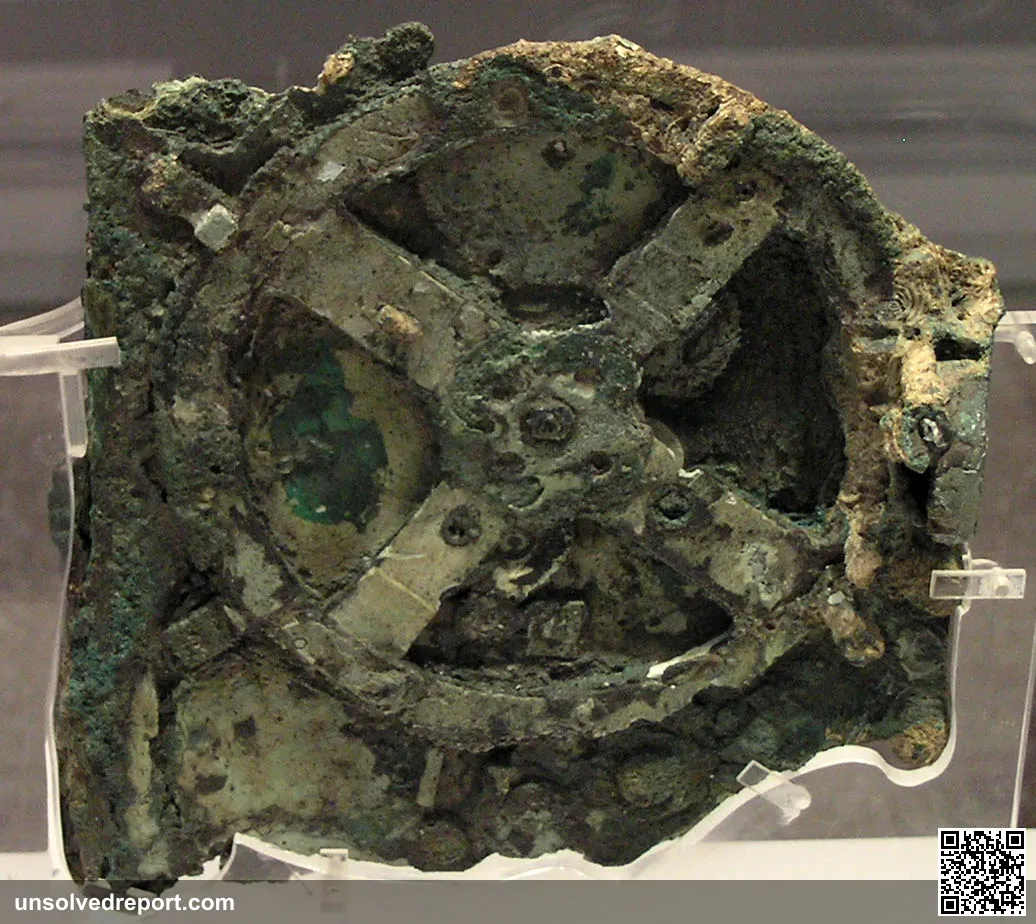
1. The Antikythera Mechanism. In 1901, sponge divers hauling treasure from a Roman-era shipwreck off the Greek island of Antikythera pulled up a lump of corroded bronze. It didn't look like much. It was a computer. Dated to roughly 205–60 BCE, it ran a sophisticated train of bronze gears off a simple hand crank to predict the sky — eclipses, moon phases, the zodiac, even the four-year Olympiad cycle (World History Encyclopedia). You can see it today in the National Archaeological Museum in Athens. And here's the strange part: nothing this mechanically complex shows up again anywhere for well over a thousand years — which is why the Antikythera Mechanism gets an entire field of research to itself.
2. The Phaistos Disc. Picture a fired-clay disc about the size of a saucer — 16 centimeters across — unearthed in 1908 in the Bronze Age palace of Phaistos on Crete. Spiraling across both faces are 241 symbols, and each one was pressed into the wet clay with an individual stamp before firing. That makes it, arguably, the earliest known example of "movable type" printing on Earth (Wikipedia, Phaistos Disc). It's the centerpiece of the Heraklion Archaeological Museum.
3. Roman Dodecahedra. More than 100 of these twelve-sided bronze objects have surfaced: hollow, each face a pentagon punched with a circular hole, a little knob at every corner. They date from the 2nd to 4th centuries CE. Now the odd bit — they only ever turn up in Rome's former northwestern provinces, scattered across Gallo-Roman territory, and never once in the Mediterranean heartland of Rome itself (Smithsonian Magazine).
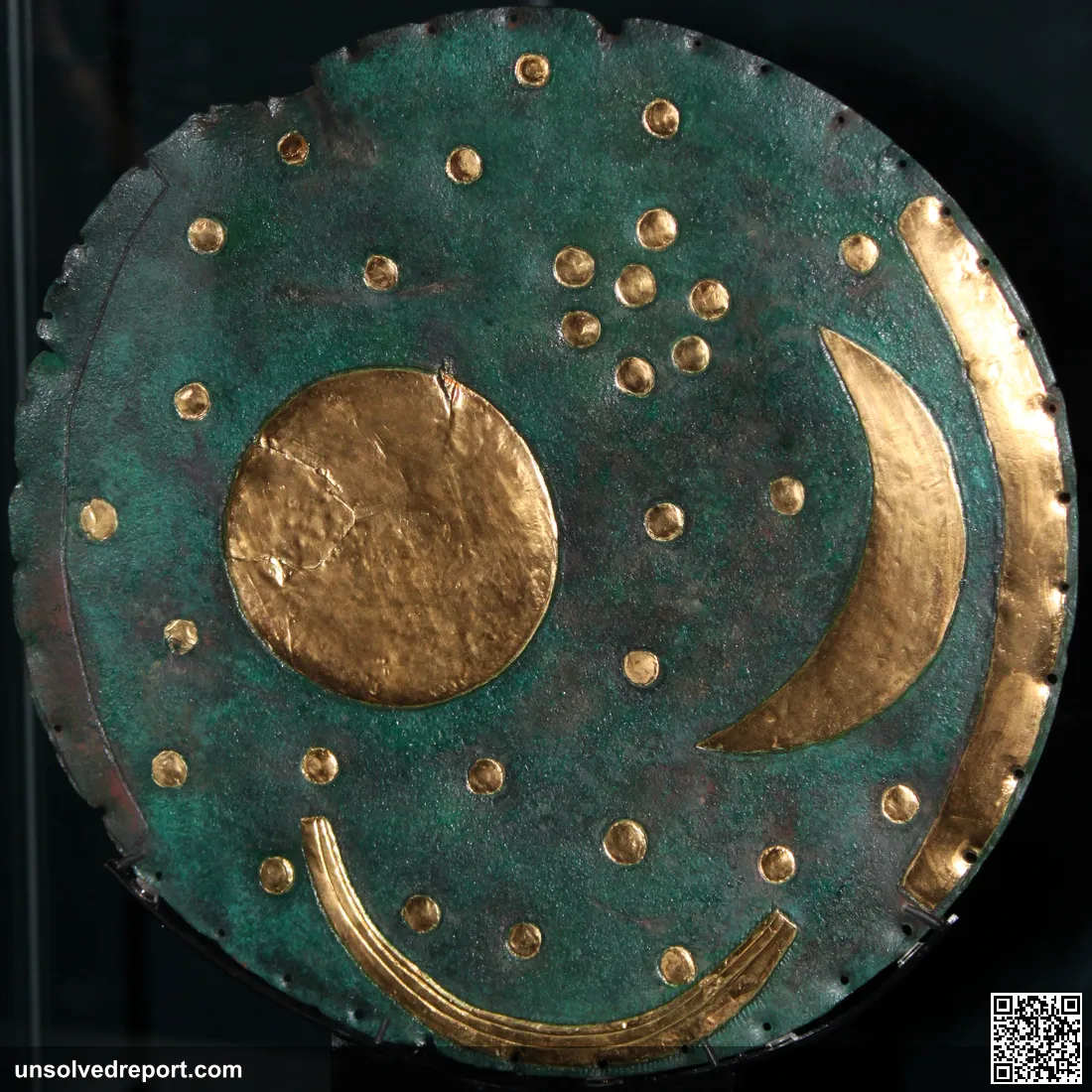
4. The Nebra Sky Disc. Roughly 3,600 years ago, someone buried a bronze disc about 30 centimeters wide in the soil of central Germany. Inlaid in gold across its dark face: the sun or a full moon, a crescent, scattered stars, and a tight little cluster that reads as the Pleiades. UNESCO calls it "the oldest concrete depiction of cosmic phenomena worldwide" and entered it into its Memory of the World register (UNESCO). It lives at the State Museum of Prehistory in Halle.
5. Göbekli Tepe's T-Pillars. Now go back further — way further. Around 9000 BCE, before pottery, before metal tools, before writing, hunter-gatherers in southeastern Turkey quarried, carved, and raised enormous circular enclosures of T-shaped limestone pillars. Some stand over five meters tall and weigh up to ten tons. Carved into their faces: foxes, scorpions, vultures, and strange abstract human forms (Smithsonian Magazine). Göbekli Tepe is arguably the single most disruptive archaeological site of the last century.
6. The Longyou Caves. In 1992, villagers near Longyou, China, decided to pump out some flooded ponds. What emerged underneath stole their breath: 24 vast sandstone caverns, carved entirely by hand, at least 2,000 years old. The chisel marks are eerily uniform across every surface, and the rock removed adds up to something near a million cubic meters. Not one historical record says who dug them, or why (HeritageDaily).
7. The Diquís Stone Spheres. Somewhere between 500 and 1500 CE, people in southern Costa Rica carved more than 300 stone spheres — near-perfect, the largest over two meters across. UNESCO made them a World Heritage Site in 2014, and noted, plainly, that their meaning, their use, and even how they were made "remain largely a mystery" (UNESCO).
8. The Lycurgus Cup. In ordinary daylight it's an opaque green goblet. Light it from behind, though, and it glows a deep translucent red. Made in Rome around the 4th century CE, it's the only complete surviving example of dichroic glass, and the trick is pure nanotechnology by accident: tiny particles of gold and silver suspended right in the glass (British Museum, via search). It sits in the British Museum.
9. The "Baghdad Battery." Dug up near Ctesiphon, Iraq, in 1936: a ceramic jar holding a copper tube and an iron rod, the whole thing sealed shut with bitumen, dated to the Parthian or Sasanian era. In 1938 a museum director named Wilhelm König dropped a startling suggestion — what if it was a battery? Fill a replica with something acidic and, sure enough, it pushes out roughly half a volt to two volts (Wikipedia, Baghdad Battery). Hold that thought — the full evidence for and against gets a proper treatment in the Baghdad Battery deep-dive.
10. The Sabu Disk. Excavated in 1936 from a First Dynasty tomb at Saqqara, this fragile schist object dates to roughly 3000–2800 BCE. It's about 61 centimeters wide, with a central hub and three curving lobes sweeping out from it — something between a stylized wheel and a bowl, and quite unlike anything else from its time (Wikipedia, Sabu disk).
Recency Check: A 2025 Study Asks If Antikythera Even Worked Reliably
This development concerns the Antikythera Mechanism directly, not just the broader theme of ancient technology. In an April 2025 paper, "The Impact of Triangular-Toothed Gears on the Functionality of the Antikythera Mechanism," engineers Esteban Guillermo Szigety and Gustavo Francisco Arenas of Argentina's National University of Mar del Plata modeled how the device's triangular gear teeth behave under real manufacturing tolerances (arXiv, April 1, 2025). Their computational analysis found that triangular tooth shape alone produces negligible error, but the manufacturing inaccuracies visible in CT scans of the surviving gears — irregular tooth spacing, uneven distribution — could have caused jamming or disengagement within a matter of months of turning the crank. The paper's conclusion is deliberately narrow: either the mechanism never actually functioned as a working device, or its real-world manufacturing errors were smaller than earlier estimates by physicist Mike Edmunds assumed. Separately, other 2024–2025 analysis (including a University of Glasgow study reworking the calendar ring's hole count to 354–355, matching a lunar year) has kept refining what the device was meant to track — Venus and Saturn's retrograde motion among the proposed additions — even as the Mar del Plata team questions how well it could ever have tracked anything for long. Together they sharpen, rather than resolve, the original puzzle: a device this ambitious, built by someone who left no name behind.
The Question That Won't Die
Cut away the breathless headlines and one real, shared puzzle is left standing: *for several of these objects, we know the what and roughly the when — but not the why, and not the how on earth did they know to do this.*
Take the Antikythera Mechanism. Its geared astronomy is so far ahead of its moment that serious scholars still argue over a basic question — was it the one-off work of a lone genius, or the last survivor of a whole lost tradition of machines like it? Or look at the Roman dodecahedra. They resist us precisely because they left no trail: no ancient text describes them, no illustration shows them in use, not even a worn-down working surface hints at a job. Curators at the Gallo-Roman Museum in Tongeren simply admit that no proposed function is "satisfying." The Phaistos Disc stays undeciphered in the strict scientific sense — 241 signs, no bilingual key, so even a clever reading can't be checked. And at Göbekli Tepe the deepest question of all just hangs there: what moved pre-farming people to organize hundreds of laborers and haul ten-ton stones into place, six thousand years before anyone wrote a word?
One thing to be clear about. "Unexplained" is not the same as "unexplainable." It means the evidence that survived isn't enough to pin down the answer — too few clues left to force a single conclusion. That honest shortfall is the mystery. It is not a hole you're meant to plug with miracles. (For fifteen more cases in that same category, see ancient mysteries archaeologists still can't explain.)
Theories and Interpretations
Read this section as informed guesswork, full stop. Nothing below is settled fact.
- Antikythera: Ancient writers say Archimedes and Hipparchus built astronomical devices, so they often get floated as the intellectual ancestors of the mechanism. Tempting — but no direct link has ever been proven.
- Roman dodecahedra: People have proposed everything from range-finders to knitting tools to calendars. Right now several researchers lean toward a ritual or divination use, mostly because the objects barely show wear and appear in zero official records. It's a suggestive case — but notice it's built on an argument from silence, which proves nothing on its own.
- Phaistos Disc: Candidates include a prayer to a mother goddess and a calendar. None has cleared the bar for an accepted decipherment, so treat every confident "translation" you see as a guess wearing a costume.
- Göbekli Tepe: The late excavator Klaus Schmidt famously called it humanity's first temple — a sanctuary, not a town. Others read it as a burial ground, or the work of a "death cult." Every one of these is interpretation, not proof.
- Longyou Caves: Quarry, granary, troop hideout, ceremonial hall — each idea has been proposed and then picked apart. The thing that keeps tripping up the simple "it's just a quarry" answer is that uncannily uniform, almost decorative carving.
- Diquís spheres: They may have marked the approaches to chiefs' homes, or lined up in alignments with some astronomical meaning — a possibility hinted at by where the spheres were found, never confirmed.
- Baghdad Battery: Remember that "battery" thought? Here the legend has sprinted far ahead of the evidence. Plenty of archaeologists — Stony Brook's Elizabeth Stone among them — reject the ancient-battery idea outright. The sober frontrunner is much quieter: the jar probably held sacred scrolls or papyrus, just like similar vessels found nearby. The genuine open question is its everyday purpose, not some lost spark of electricity.
- Sabu Disk: Mainstream Egyptology reads it as a ritual or practical bowl-stand; one researcher even pitched it as a brewing tool. The "flywheel" and other exotic readings have nothing behind them.
So what ties these ten together? Not magic. Something humbler and, honestly, more interesting: the past was inventive, deliberate, and a great deal smarter than we tend to give it credit for. And a careful, unflinching "we don't know yet" turns out to be one of the most honest sentences in all of archaeology. The next puzzle is always one museum case away.
The Ten at a Glance: What's Actually Unsolved
These ten aren't unsolved in the same way, and lumping them together hides the real distinction. For a few, the object itself is fully understood and only its purpose is missing (the dodecahedra, the spheres). For others, we can't even read the message (the Phaistos Disc) or the technique genuinely outran its era by a wide margin (Antikythera, the Lycurgus Cup). The table sorts each item by the single question that actually keeps it open, using only the facts established above.
| Artifact | The core unsolved question | Best-supported status | Read more |
|---|---|---|---|
| Antikythera Mechanism | Lone genius, or the last survivor of a lost tradition of geared machines? | Function solved (astronomical predictor); its origin and isolation are what remain open | link |
| Phaistos Disc | What do the 241 stamped signs say? | Undeciphered in the strict sense — no bilingual key exists to check any reading | link |
| Roman Dodecahedra | What were they for? | Open; no ancient text, image, or wear pattern survives — several researchers lean ritual/divination | link |
| Nebra Sky Disc | (Object understood) — a cosmic depiction | Least mysterious here: UNESCO calls it the oldest concrete depiction of cosmic phenomena | link |
| Göbekli Tepe | Why did pre-farming people haul ten-ton pillars into place? | Open; read as first temple, burial ground, or "death cult" — all interpretation | link |
| Longyou Caves | Who dug 24 caverns, and why? | Open; no historical record names builder or purpose; uniform carving resists the "quarry" answer | link |
| Diquís Stone Spheres | Meaning, use, and method of manufacture | Open by UNESCO's own account — "remain largely a mystery" | link |
| Lycurgus Cup | (Technique understood) — gold/silver nanoparticles | Effectively solved: the only complete dichroic-glass survivor; the open point is whether the effect was intentional | link |
| Baghdad Battery | What was the jar's everyday purpose? | Battery claim rejected by archaeologists; frontrunner is a vessel for sacred scrolls | link |
| Sabu Disk | What was this three-lobed schist object used for? | Open; mainstream Egyptology reads it as a ritual/practical bowl-stand — "flywheel" readings unsupported | — |
Read down the "status" column and a pattern emerges: the two that are essentially closed (Antikythera's mechanism, the Lycurgus Cup's chemistry) are the ones where a physical object could be measured and reverse-engineered. The stubbornly open ones (the dodecahedra, the caves, the spheres, the disc) all share the same missing ingredient — context. No text describes them, no image shows them in use, and no worn surface records a job. That absence, not any exotic technology, is what keeps them unsolved.
Frequently Asked Questions
Is the Antikythera Mechanism really the world's oldest computer?
It's the oldest known geared analog computer — a mechanical device using interlocking gears, not electronics, to calculate astronomical positions like eclipses and the four-year Olympiad cycle (World History Encyclopedia). Nothing of comparable mechanical complexity is known to survive from the next thousand-plus years, which is what earns it the "computer" label.
Has anyone actually deciphered the Phaistos Disc?
No. Despite dozens of proposed translations since its 1908 discovery, none has been independently verified, because no second bilingual text exists to check a reading against — the same problem that made Egyptian hieroglyphs unreadable before the Rosetta Stone (Wikipedia, Phaistos Disc). Any confident "translation" you see online is a hypothesis, not an accepted result.
What were Roman dodecahedra actually used for?
Nobody knows for certain. More than 100 have been recovered, all from Rome's former northwestern provinces, with no ancient text or image describing their use and little wear on the objects themselves. Current researchers lean toward a ritual, divination, or measuring function, but the Smithsonian notes no proposed explanation has proven fully satisfying (Smithsonian Magazine).
Was the "Baghdad Battery" really an ancient battery?
Most archaeologists reject that reading. The jar, copper tube, and iron rod found near Ctesiphon in 1936 can produce roughly half a volt to two volts when filled with an acidic liquid, but researchers including Stony Brook's Elizabeth Stone argue the object more likely held sacred scrolls, matching similar sealed jars found nearby (Wikipedia, Baghdad Battery).
Why is Göbekli Tepe considered such a big deal archaeologically?
Because its circular stone enclosures, some pillars over 5 meters tall and up to 10 tons, were built around 9000 BCE — before agriculture, pottery, or metal tools existed in the region. That timeline forced archaeologists to reconsider whether organized monumental construction could precede farming rather than follow it (Smithsonian Magazine).
Did the 2025 gear study prove the Antikythera Mechanism was broken or fake?
No — it's a modeling study, not physical proof about the actual 2,000-year-old object, and its authors frame the result as two possibilities rather than a verdict: either the device's real manufacturing tolerances were tighter than earlier estimates, or a working version would have jammed within months under the tolerances Mike Edmunds previously proposed (arXiv, April 1, 2025). The mechanism's core astronomical function is not in dispute; its long-term reliability is the open question.
The next puzzle is always one museum case away.
Sources and Further Reading
- World History Encyclopedia — Antikythera Mechanism
- Szigety, E.G. & Arenas, G.F., National University of Mar del Plata — The Impact of Triangular-Toothed Gears on the Functionality of the Antikythera Mechanism, arXiv, April 2025
- Smithsonian Magazine — Göbekli Tepe: The World's First Temple? and another Roman dodecahedron found in England
- UNESCO — Nebra Sky Disc and Stone Spheres of the Diquís
- HeritageDaily — The Mystery of the Longyou Caves
- The Metropolitan Museum of Art — A Stone Sphere from Costa Rica
- Wikipedia (overviews, well-cited) — Phaistos Disc, Lycurgus Cup, Baghdad Battery, Sabu disk
Meroe Pyramids: How Kush Out-Built Egypt by 100+ Tombs
Sudan has more pyramids than Egypt — 200+ steep stone spikes hiding a looted queen's gold and a script scholars can read aloud but still can't translate. Why?
Khami Ruins Zimbabwe: The Stone City With a Cross Nobody Can Explain
Great Zimbabwe fell, and 250km west a new stone city rose, traded with three continents, then fell to a warlord — leaving one granite cross nobody has ever explained. Why?

Lake Titicaca Underwater Ruins: The Gold Divers Can't Explain
Lake Titicaca underwater ruins hide real gold, carved shell, and sacrificed llamas divers pulled from the deep. So why is a sacred reef submerged at all?