Cahokia: The American City That Outgrew London, Then Vanished
Cahokia once out-grew London. Then 20,000 people quietly vanished, no war, no fire, no famine. Every leading theory has collapsed. What really happened?
Around the year 1100, the biggest city in what is now the United States wasn't a colonial port or a frontier outpost. It hadn't been founded yet. The great city of that moment stood on the Mississippi floodplain, just across the river from where St. Louis sits today, and at its peak it may have packed in more people than London. Then it drained. Over roughly two centuries the houses came down, the plaza went quiet, and the giant earthen pyramids were handed back to the grass. We call the place Cahokia, but that was never its name. And why everyone left is one of the most stubbornly unsolved questions in North American archaeology, a mystery that rivals the Classic Maya collapse further south.
What We Actually Know
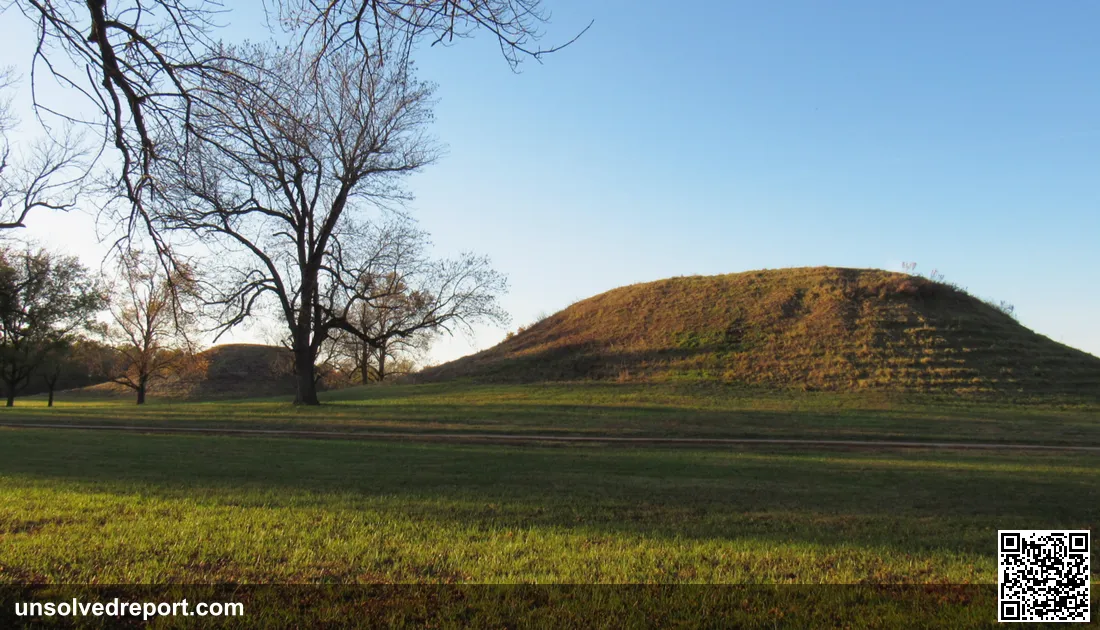
Cahokia was the beating heart of the Mississippian culture. People lived there mainly between roughly 800 and 1400 CE, and the city hit its stride around 1050 to 1200. At its largest it sprawled across nearly 1,600 hectares and held some 120 earthen mounds, according to the UNESCO World Heritage Centre, which added Cahokia Mounds to its World Heritage list in 1982.
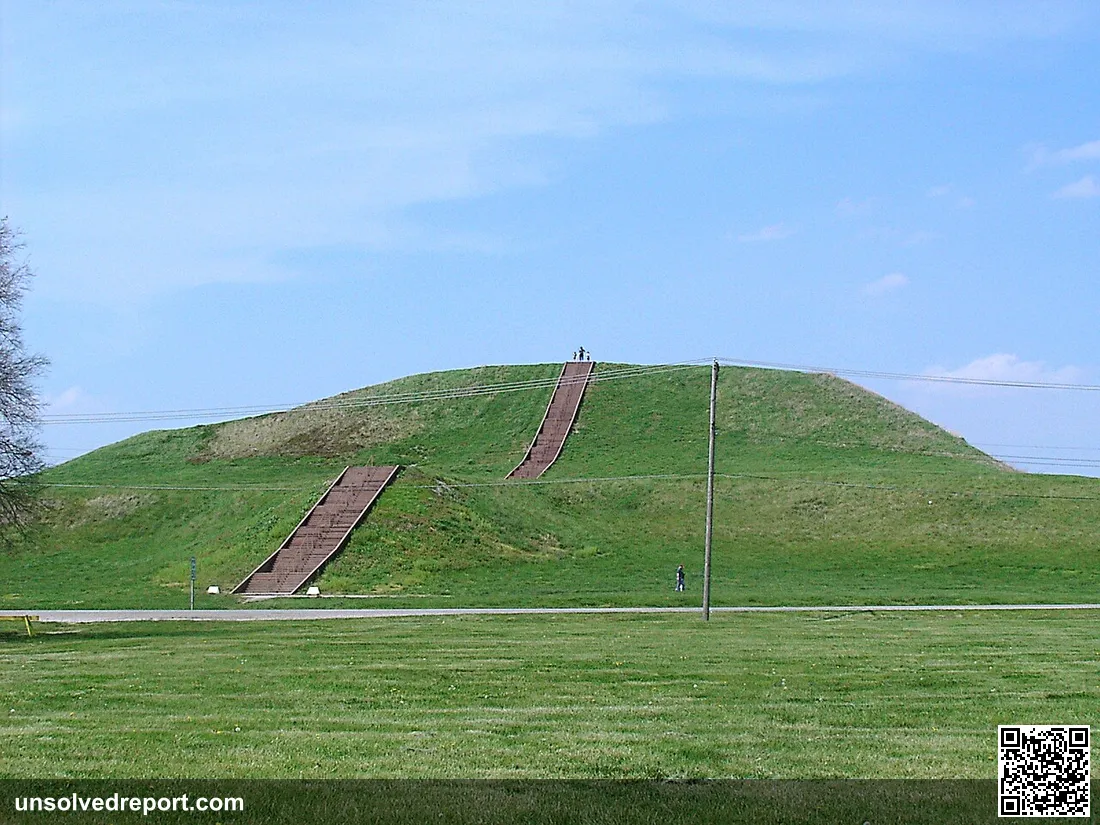
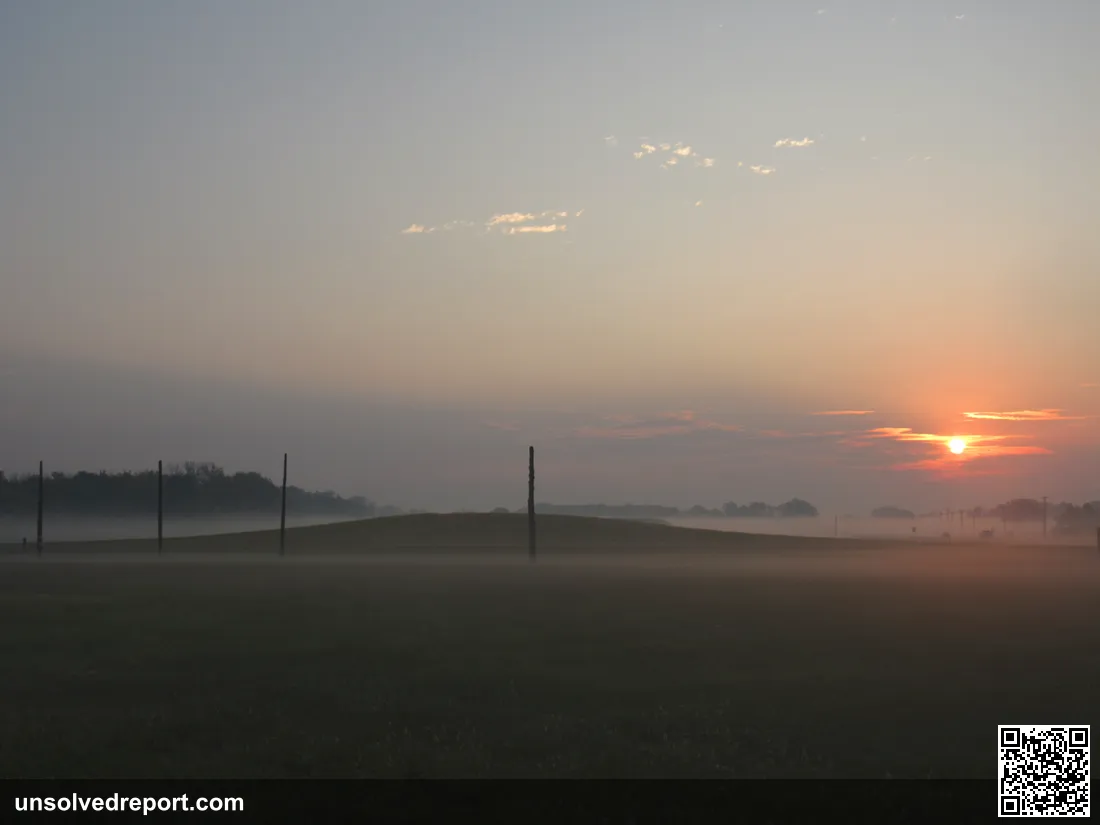
Now look up at the centerpiece. Monks Mound is the largest pre-Columbian earthwork in the Americas and the biggest earthen pyramid anywhere north of Mesoamerica. It climbs about 100 feet (30 meters), runs roughly 955 feet long and 775 feet wide, and covers about 14 acres at its base — a footprint that rivals the Great Pyramid of Giza. Here's the part that stops you cold: it was built by hand, in stages, out of millions of basket-loads of earth, with most of the work done between about 900 and 1200 CE. No wheels, no draft animals. Just people and baskets. The same builders raised a "Woodhenge" too, a ring of red cedar posts they used to track the sun across the seasons, a feat of naked-eye astronomy echoed further east at the Newark Earthworks.
How many lived there? Estimates for the city proper usually land between 10,000 and 20,000, with thousands more scattered through the settlements around it. Smithsonian Magazine puts the peak near 20,000 around 1050 — a city on the scale of London and Paris at the same moment. Sit with this one: by many accounts, no city inside today's United States would clearly beat Cahokia's population again until Philadelphia in the late 1700s.
Even the name is a hand-me-down. As Britannica and Illinois state historians explain, "Cahokia" comes from a subtribe of the Illinois Confederation who lived in the area when French explorers showed up in the late 1600s — centuries after the city had emptied out. The original residents left no writing behind, so the city's real name is simply lost.
And here's a myth worth killing right away: this was never a permanently "lost" land. A 2020 study in American Antiquity by UC Berkeley researcher A.J. White, summarized by Berkeley News, read fecal stanols and pollen locked in lake sediment and found that Native people moved back into the region in the 1500s and stayed through the 1700s. Several modern nations — among them the Osage, Peoria, and others — trace their ancestry to the wider Mississippian world.
The Real Mystery
So here's the knot at the center of it all. We know Cahokia was abandoned. We know roughly when. We do not know why.
And it wasn't a thunderclap. The decline was slow — archaeologist Neal Lopinot calls it "a slow demise," a drawn-out leaving spread across the 1200s and 1300s rather than one bad year, as reported by National Geographic. No invasion, no obvious cataclysm. Just a city steadily letting go — the same quiet, unforced emptying that still puzzles researchers at Mohenjo-daro half a world away.
What keeps the mystery alive is almost funny: every promising explanation keeps failing its own test. With no written records, researchers have to reconstruct people's motives from dirt, pollen, sediment, and the holes left by long-rotted posts — and that physical evidence has a habit of wrecking the tidy stories built on top of it. As Smithsonian flatly puts it, the cause "remains unknown." The honest summary is a city that quietly poured itself out for reasons its own ground still won't fully surrender.
The Theories — and Why They Keep Breaking
Below are the front-running explanations. Several are still being fought over in the literature, so read them as competing ideas, not verdicts.
Theory 1: Drought (some climate data backs it). A 2021 study in Scientific Reports by Pompeani and colleagues, archived on PubMed Central, measured oxygen isotopes in Horseshoe Lake sediments and caught a sharp drop in the precipitation-to-evaporation ratio as the world slid into the Little Ice Age — with severe drought clustered roughly between 1200 and 1450 CE. Picture a farming population of 15,000 to 20,000 mouths when the warm-season rains simply stop coming. The authors argue that's a population in serious trouble. But they're careful: this is a correlation, not proof of cause.
Theory 2: Actually, drought wasn't the killer (the recent twist). Then a 2024 study in The Holocene turned the drought story sideways. Washington University archaeologists Natalie Mueller and Caitlin Rankin, in work described by Washington University, read carbon isotopes in the soil to find out what was actually growing in the ground. If crops had been failing across the board, you'd expect a swing toward drought-tolerant prairie grasses. They found no such swing. Their take: Cahokians had storage, a diverse mix of crops, and the farming know-how to ride out dry stretches, and that "people probably just spread out to be near kin or to find different opportunities." Notice what that does — it deepens the mystery instead of solving it.
Theory 3: They wrecked their own environment (mostly ruled out). For years a 1993 idea held sway: that Cahokians chopped down too much timber, triggering erosion and floods that eventually drowned the city's prospects. It's a tidy morality tale. The trouble is the dirt won't cooperate. Caitlin Rankin's soil work, published in Geoarchaeology and covered by National Geographic, turned up no sediment layers near the mounds that match that kind of flooding. Rankin has also pointed out that the "squeeze everything out of it" framing says more about a Western assumption than about anything in the evidence.
Theory 4: People, politics, and pressure. At some point Cahokians threw up a big defensive palisade around the central precinct — and many archaeologists read that wall as a tell, a sign that warfare or factional infighting had become a real worry, per National Geographic. Maybe it was political fragmentation. Maybe shifting alliances, or a collapse of trust in whoever was running things. Any of it could have nudged families to do the simplest thing of all: pack up and go. That fits neatly with the slow, voluntary exodus the newest research keeps describing.
The truth, more and more scholars suspect, isn't a single villain — it's a braid, much like the tangle of drought, migration, and unrest that historians now blame for the Bronze Age collapse half a world away. Climate stress, political strain, and a thousand ordinary human decisions, all twisting together across generations until the city unwound. For now, the place that out-grew London keeps its strangest secret close. Not how it rose. But why its people, with no disaster forcing their hand, simply got up and walked away — and what finally tips a great city from full to empty.
Cahokia at a Glance
| Fact | Figure | Source |
|---|---|---|
| Main occupation | c. 800–1400 CE | UNESCO |
| Urban apogee | c. 1050–1150 CE | UNESCO |
| Site extent at maximum | ~1,600 hectares | UNESCO |
| Earthen mounds | ~120 | UNESCO |
| Monks Mound height | 30 m (~100 ft), in four terraces | UNESCO |
| Monks Mound base | over 5 hectares | UNESCO |
| Monks Mound construction | hand-built in fourteen stages | UNESCO |
| Peak population | ~15,000–20,000 (1100–1200 CE) | Pompeani et al. 2021 |
| Greater Cahokia abandoned | by c. 1450 CE | Pompeani et al. 2021 |
| Regional Native repopulation | 1500s–1700s | Berkeley News |
| World Heritage listing | 1982 | UNESCO |
A Timeline of the City — and of the Detective Work
The Cahokia debate has two clocks running: what happened on the floodplain, and when researchers found each piece. Reading them together shows why the case keeps reopening.
- c. 800 CE — Mississippian occupation of the Cahokia site begins (UNESCO).
- c. 900–1200 CE — Monks Mound raised by hand from basket-loads of earth, in fourteen construction stages (Britannica; UNESCO).
- c. 1050 CE — Population climbs toward its peak, on the scale of contemporary London and Paris (Smithsonian Magazine).
- 1200s–1300s — The "slow demise": a drawn-out departure rather than a single catastrophe (National Geographic).
- c. 1350–1450 CE — Horseshoe Lake sediments record the most severe drought conditions in the sequence (Pompeani et al., Scientific Reports, 2021).
- by c. 1450 CE — Greater Cahokia is abandoned, with only intermittent, small-scale occupation afterward (Pompeani et al. 2021).
- 1500s — Fecal stanol and pollen evidence shows Native people returning to the region, staying into the 1700s (Berkeley News).
- Late 1600s — French explorers arrive and record the Cahokia subtribe of the Illinois Confederation, whose name sticks to the ruins (Britannica).
- 1982 — Cahokia Mounds inscribed on the UNESCO World Heritage list (UNESCO).
- 1993 — The wood-overuse ("ecocide") hypothesis is proposed by Neal Lopinot and William Woods, dominating explanations for years (per National Geographic).
- 2020 — A.J. White's American Antiquity sediment study dismantles the "lost civilization" framing (Berkeley News).
- 2021 — Pompeani et al. tie Little Ice Age drought to the abandonment window — as correlation, not proven cause (PMC).
- 2024 — Mueller and Rankin's carbon-isotope study in The Holocene finds no prairie-grass takeover, undercutting crop-failure scenarios (Washington University).
Weighing the Theories: What the Evidence Actually Shows
| Theory | Strongest evidence | Where it breaks | What would settle it |
|---|---|---|---|
| Drought / Little Ice Age | Oxygen-isotope record from Horseshoe Lake showing a falling precipitation-to-evaporation ratio, with severe drought overlapping the abandonment window (Pompeani et al. 2021) | Correlation, not demonstrated cause — and the 2024 soil-carbon data show no shift toward drought-tolerant prairie grasses, i.e. no signature of widespread crop failure (WashU) | Direct evidence of harvest failure or food stress in the 1200s–1300s — the very layer the isotope proxies can't supply on their own |
| Voluntary dispersal ("spread out to be near kin") | Fits the slow, generations-long decline with no destruction layer; consistent with evidence of crop diversity and storage (WashU; National Geographic) | It names the manner of leaving, not the reason — motives leave no sediment, and there are no written records to check | Tracing where Cahokian families actually went; without texts, this may stay underdetermined |
| Environmental self-destruction (1993 wood-overuse idea) | Tidy mechanism: deforestation → erosion → flooding | Rankin's Geoarchaeology soil work found no flood-sediment layers near the mounds to match the story (National Geographic) | Largely settled — the predicted physical evidence isn't there |
| Warfare / political fracture | The defensive palisade around the central precinct, read by many archaeologists as a sign of real insecurity (National Geographic) | A wall proves worry, not war — no invasion or cataclysm shows up in the record, and the decline stayed gradual | Evidence of who or what the palisade answered to: conflict traces, or signs of internal factional breakdown |
The pattern across the table is the article's argument in miniature: the eliminative work is going well — ecocide is effectively out, catastrophic crop failure looks unlikely — while the positive case for any single driver keeps failing to close. Each new proxy narrows what didn't happen without yet proving what did.
Sources and Further Reading
- UNESCO World Heritage Centre — Cahokia Mounds State Historic Site
- Encyclopaedia Britannica — Cahokia Mounds
- Smithsonian Magazine — Why Did Cahokia Collapse?
- National Geographic — Why was the ancient city of Cahokia abandoned?
- Washington University in St. Louis — New study adds to mystery of Cahokia exodus (Mueller & Rankin, The Holocene, 2024)
- Pompeani et al., Scientific Reports (2021) — Severe Little Ice Age drought during the Mississippian abandonment of Cahokia (PMC)
- UC Berkeley News — Study debunks myth of Cahokia's "lost civilization" (A.J. White, American Antiquity, 2020)
Mount Nemrut: Stone Gods Guard a Lost King
Mount Nemrut's stone gods guard a king's hidden tomb. Seismic scans and 70 years of digging still haven't found his body. Where is he really buried?
Dhar Tichitt: 4,000 Years Ago, West Africa Built 500 Stone Towns—Then Emptied Them
Hundreds of dry-stone towns rose in Mauritania by 2200 BC, then went silent by 300 BC. New 2026 radiocarbon dates are finally testing why — and where the builders went.
Venus of Willendorf Mystery: The Journey Nobody Can Explain
Venus of Willendorf mystery: a CT scan found her stone traveled 730 km from Italy 30,000 years ago. No one can explain how she crossed the Alps.