Dancing Girl of Mohenjo-daro: Why Her Identity Is Still Unsolved
A four-inch bronze girl outlasted 4,000 years of silence — then made 2026 headlines when a textbook altered her body. Nobody has ever known her name.
She is barely four inches tall. She is missing both feet. She is roughly four thousand years old. And in June 2026, an Indian government textbook tried to give her clothes she never had.
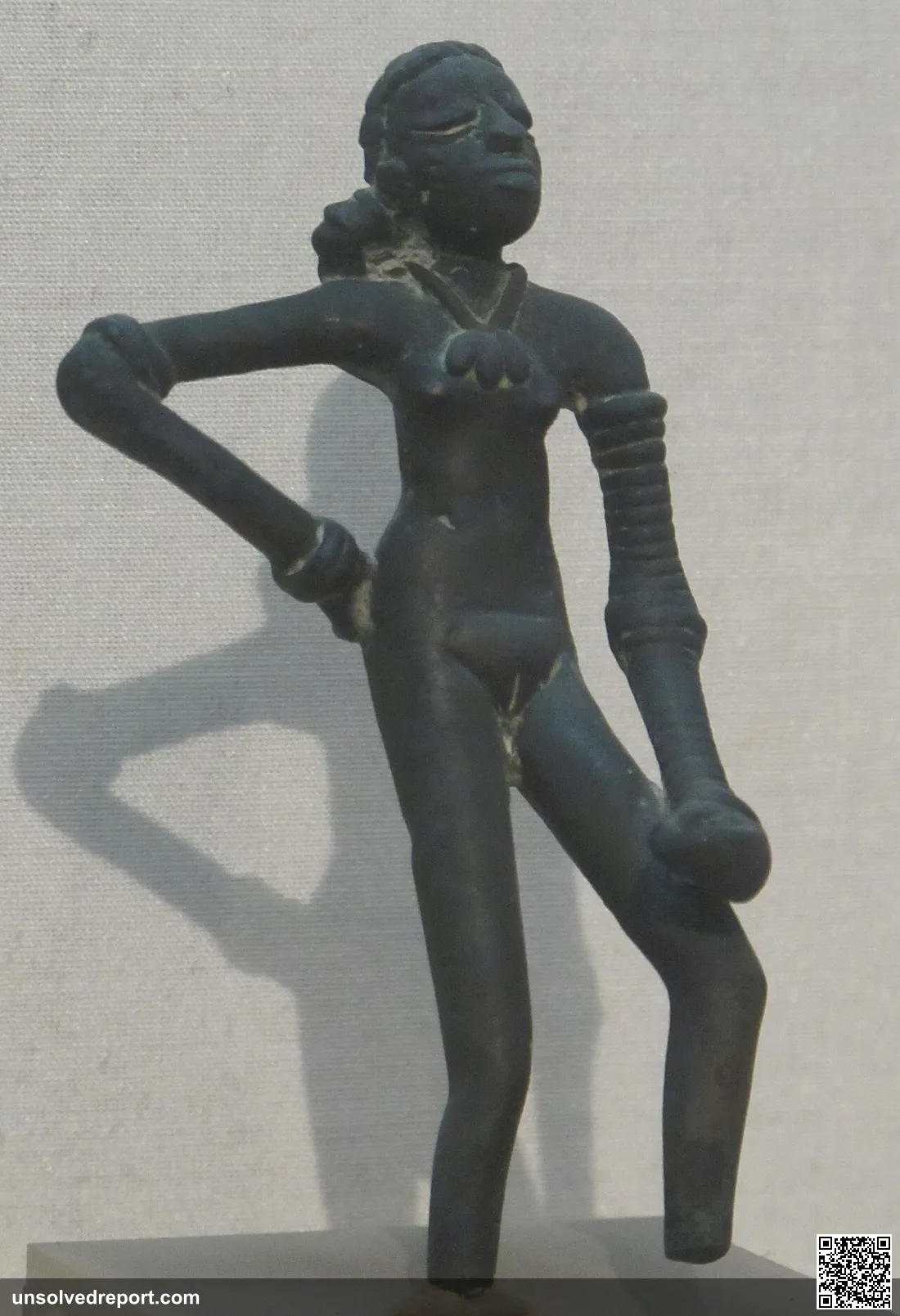
One hand cocked on her hip, chin tilted up, the small bronze figure called the Dancing Girl of Mohenjo-daro carries an attitude so alive that it rattled one of the twentieth century's most celebrated archaeologists. Mortimer Wheeler, the British excavator, couldn't stop staring. He called her "a girl perfectly, for the moment, perfectly confident of herself and the world," then added the line that has followed her ever since: "There's nothing like her, I think, in the world" (Wikipedia, citing Wheeler)).
Here's the strange part. All that confidence, and we have no idea who she was. The Indus Valley Civilization that made her wrote in a script nobody can read, so she can't tell us her name, her job, or why a society that engineered the ancient world's finest plumbing chose to freeze this particular young woman in metal. That silence is exactly what a 2026 textbook edit ran into head-on. So let's do something the legends rarely bother with: separate what the evidence actually supports from the stories that have crusted over her.
> The 60-Second Brief
> - Found 1926 by Ernest Mackay at Mohenjo-daro, Sindh; published by John Marshall.
> - Stands 10.5 cm (4.1 inches) tall, cast in bronze (copper-tin alloy) by lost-wax casting.
> - Dated to roughly 2300–1750 BCE, the mature phase of the Indus Civilization.
> - Wears 24–25 bangles on her left arm and about 4 on her right; both feet are missing.
> - Split from Pakistan's "Priest-King" at the 1947 Partition; now in the National Museum, New Delhi.
> - In June 2026, NCERT's Class 9 Madhurima textbook shaded over her torso; NCERT confirmed it would restore the original image after the Education Ministry sought an explanation.
What we actually know
Start with the dirt. In 1926, diggers pulled her out of the ground at Mohenjo-daro, a major city of the Indus (Harappan) Civilization in what is now Sindh, Pakistan. The man with the trowel was the British archaeologist Ernest Mackay, working under the Archaeological Survey of India (Smarthistory). The survey's Director-General, John Marshall, was the one who published her and pinned on the famous name.
She's tiny — about 10.5 centimeters, roughly 4 inches — and she's bronze, an alloy of copper and tin (Wikipedia)). And here's where it gets impressive. She was made by lost-wax casting: you sculpt a model in wax, pack it in clay, melt the wax out, then pour molten metal into the hollow it leaves behind. That is fussy, exacting work. Pulling it off at Mohenjo-daro is one of the loudest signals we have that Harappan metalworkers truly understood their craft — alloying, temperature, the lot. Indus smiths shifted the tin content of their bronze quite a bit and seem to have grasped how that recipe changed hardness and durability (Smarthistory).
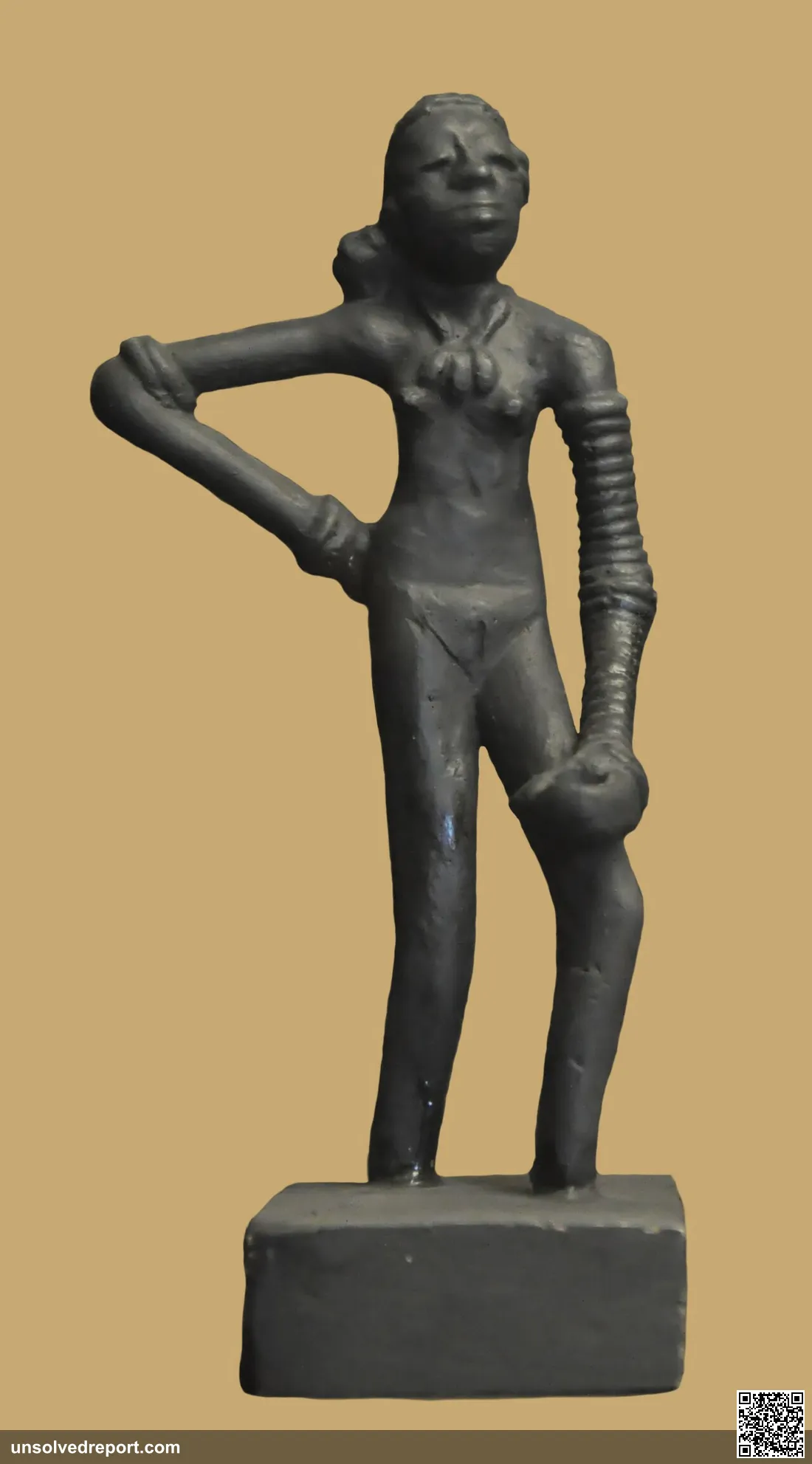
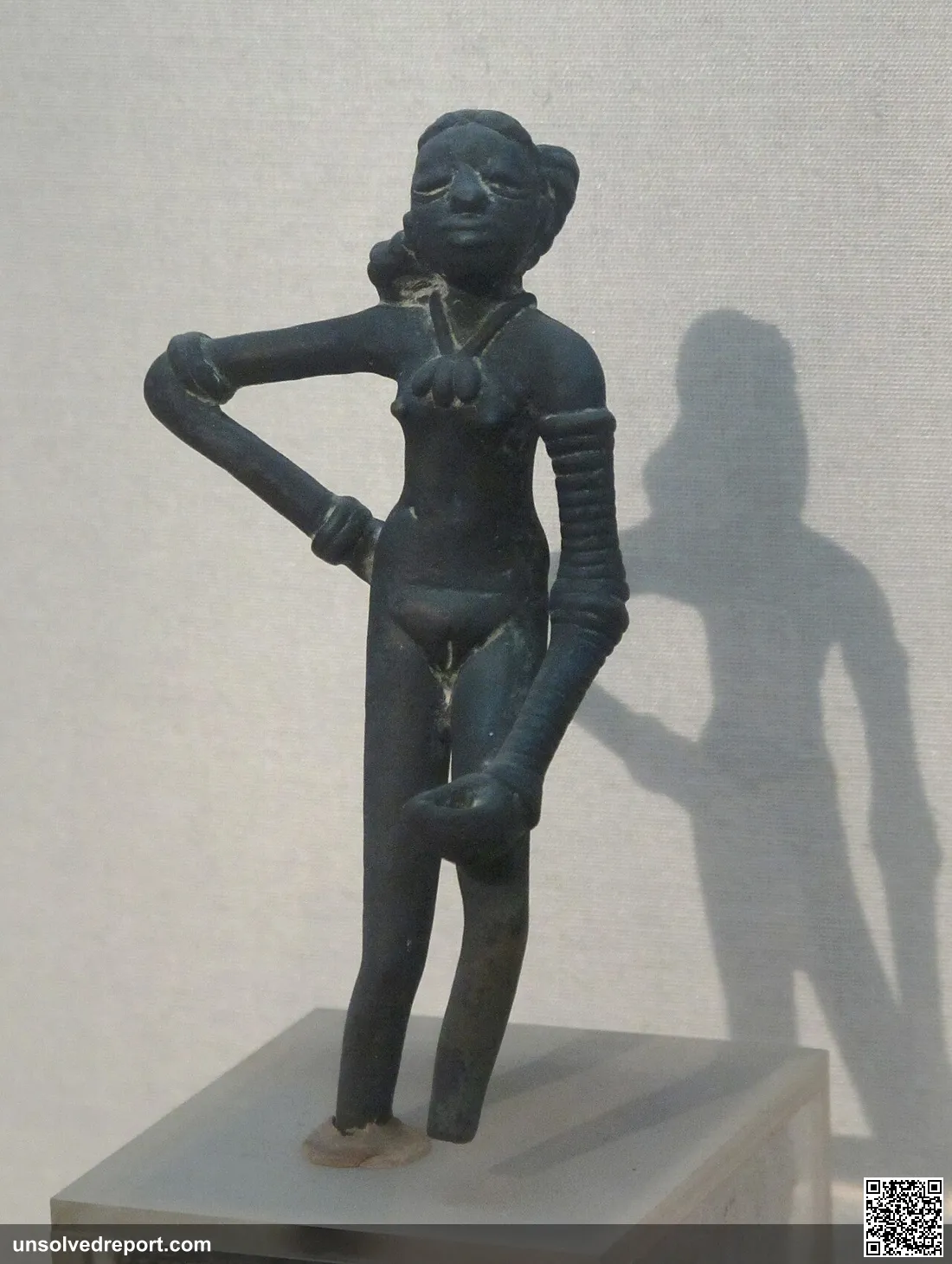
Now picture her stance. A nude young woman, relaxed and off-balance on purpose — weight dropped onto one leg, one arm resting on the hip, the other dangling loose. The jewelry steals the show. Up her left arm climbs a stacked tower of bangles, around two dozen of them (usually counted as 24 or 25), running almost to the shoulder; her right arm wears only about four (Wikipedia)). A short necklace with three fat pendants sits at her chest, and her hair is bundled into a heavy bun slumped against one shoulder. Her feet are gone, so her exact original pose is lost to us.
And she isn't the only one. A second bronze female figurine — rougher, less assured — came out of Mohenjo-daro in the 1930–31 season. It now sits in the National Museum of Pakistan in Karachi (Wikipedia)).
When did she live? Roughly 2300–1750 BCE, squarely inside the mature phase of the Indus Civilization (Smarthistory; Google Arts & Culture). Then history split her world in two. When British India was partitioned in 1947 and the region's antiquities were carved up, the Dancing Girl was assigned to India; today she lives in the National Museum, New Delhi. The famous "Priest-King" sculpture from the same world went to Pakistan (Wikipedia)).
The thing nobody can answer
Everything above is solid ground. Now we walk off the edge of it.
The mystery is hiding inside the very question the nickname pretends to have solved: who was she, and why was she made?
We honestly don't know. The biggest wall in our way is the Indus script. It shows up on thousands of seals and objects — and to this day, nobody can read a word of it. No Harappan name, no title, no caption survives that we can understand (Smarthistory). So we can't say whether she's a real person, a goddess, a generic "type," or a character from a story that vanished without a trace. We don't even know what little bronze figures meant to these people — household keepsakes? ritual objects? toys? offerings? something with no modern label at all, the same kind of blank that still surrounds an even older female figure, the Venus of Willendorf? And the puzzle deepens, because for all their careful city planning, the Indus cities have given up startlingly little large-scale figurative art. That makes this four-inch girl an oddball, not a typical sample.
So the confident pose tells us she meant something to the people who cast her. It just won't tell us what.
The theories — and where they fall apart
Here's the first thing to know: the famous name is itself a theory, and a shaky one. It is interpretation, not fact. John Marshall looked at her pose, reached for the only dancers he personally knew, and described "a young aboriginal nautch girl... her hand on hip in half-impudent posture... as she beats time to the music with her feet" (reported in scholarship summarized by Wikipedia)). "Nautch girls" were professional female dancers of colonial-era India — which means his label tells you a great deal about a 1920s Englishman and almost nothing about a Bronze Age woman. There is no Harappan evidence that she danced at all.
Modern scholars handle the "dancer" tag with tongs. The historian Upinder Singh points out that the figure "may not have been dancing at all, and even if she was, she may not represent a professional dancer." The archaeologist Jonathan Mark Kenoyer goes further, suggesting she "more likely represents a woman carrying an offering" — reading her loose, balanced posture as someone steadying a vessel rather than catching a beat (Wikipedia, citing Kenoyer and Singh)). Notice these are rival readings. Each is plausible. None is proven.
Then there's a second set of guesses, this time about who she actually was. Because her features don't match the idealized faces of some later South Asian art, various writers have proposed she depicts a particular community or "tribal" group within Harappan society. This is old, contested terrain, and it's worth being blunt about it: the claim leans on visual impression, not on any hard evidence about who the Harappans really were. The more careful summaries flag it as speculation to hedge, not a finding (Google Arts & Culture). The honest line — the one the museums themselves take — is that "we can only guess at her exact identity and position in society."
One thing, though, is beyond argument: the skill. To shape a human figure this naturally, this casually, and then cast it in bronze before 1750 BCE took a command of metal and a sharpness of eye that genuinely stunned the people who dug her up. Marshall reportedly found it "difficult to believe that they were prehistoric" (Wikipedia)). Whoever she was, the hands that made her were anything but primitive. They were simply silent. And four thousand years on, that silence is still doing most of the talking — which is exactly the problem with every Bronze Age face that survives without a voice to go with it.
The Dancing Girl at a glance
Four thousand years of speculation rest on a surprisingly short list of hard facts. Here they are, in one place:
| Detail | What the record says |
|---|---|
| Height | 10.5 cm (about 4.1 inches) (Wikipedia)) |
| Material & technique | Bronze (a copper–tin alloy), lost-wax casting (Wikipedia); Smarthistory) |
| Date | c. 2300–1750 BCE, mature Indus phase (Smarthistory; Google Arts & Culture) |
| Found | 1926, by Ernest Mackay, in the HR area of Mohenjo-daro (Smarthistory; Wikipedia)) |
| Named by | John Marshall, Director-General of the Archaeological Survey of India (Smarthistory) |
| Bangles | 24–25 on the left arm, about 4 on the right (Wikipedia)) |
| Condition | Both feet missing; original pose unrecoverable |
| Current home | National Museum, New Delhi — assigned to India at the 1947 partition, while the "Priest-King" went to Pakistan (Wikipedia)) |
| Companion piece | A second, rougher bronze female figurine from Mackay's 1930–31 season (DK-G area), now in the National Museum of Pakistan, Karachi (Wikipedia)) |
Everything else written about her — dancer, offering-bearer, portrait of a real woman — is built on top of that table, not inside it.
What the evidence actually shows
Since the theories above can't all be right, it's worth grading them the way an archaeologist would: what does each one stand on, and what would it take to settle it?
The "dancing girl" reading (Marshall). Evidence: the pose alone — hand on hip, weight shifted, an air of movement. Weakness: it was coined by projecting colonial-era "nautch" dancers backward onto a Bronze Age figure, and with her feet missing, the one body part that could show a dance step is gone (Wikipedia)). No Harappan text or image confirms she danced.
The offering-bearer reading (Kenoyer). Evidence: the same pose, read differently — a balanced stance consistent with steadying a vessel, proposed by a leading Indus specialist (Wikipedia, citing Kenoyer)). Weakness: no vessel survives in her hands, so this too is inference from posture. It corrects Marshall's colonial framing without being independently provable.
The "specific community" reading. Evidence: essentially none beyond visual impression of her features. The more careful treatments flag it outright as speculation (Google Arts & Culture). This is the weakest of the three.
What would actually resolve any of this is the same thing blocking everything else about the Harappans: deciphering the Indus script, which remains unread on the thousands of seals and objects that carry it (Smarthistory). Until a caption, a name, or a parallel scene can be read, every label on her — including the famous one — stays a hypothesis. The bronze itself is the only testimony that doesn't wobble: someone in Mohenjo-daro could sculpt, alloy, and cast at a level Marshall found "difficult to believe... prehistoric" (Wikipedia)).
2026: a textbook tried to dress her
In June 2026, the Dancing Girl resurfaced in the news for a reason that had nothing to do with archaeology. NCERT's newly introduced Class 9 arts textbook, Madhurima, printed her with her torso shaded over — giving a 4,000-year-old nude bronze figure the appearance of clothing she has never worn in any museum display or in the same publisher's own Class 6 Social Science textbook, where she has appeared unaltered for over two decades (LiveLaw).
When asked why, an NCERT Director said there was "no specific reason" and pointed to the textbook's development team. Only after India's Education Ministry sought an explanation did NCERT confirm it would restore the original, unaltered image in future print runs and in the digital edition (LiveLaw). The episode doesn't change anything about who the Dancing Girl was — that question is still unanswered — but it is a reminder that even the one thing everyone agrees on, her physical appearance, only stayed settled because people pushed back.
Separately, and only thematically connected to this specific statue: in January 2025, Tamil Nadu Chief Minister M.K. Stalin announced a $1 million prize, named for epigraphist Iravatham Mahadevan, for anyone who can decipher the Indus script to the satisfaction of archaeological experts — announced at a Chennai conference marking the centenary of the civilization's discovery (Archaeology Magazine). That prize targets the script broadly, not the Dancing Girl herself — but the script is precisely what would let anyone finally read her name, if she ever had one written down.
Frequently Asked Questions
Was the Dancing Girl actually dancing?
Nobody can confirm it. John Marshall, who named her, projected the pose of colonial-era "nautch" dancers onto the figure in the 1920s. Modern scholars including Jonathan Mark Kenoyer and historian Upinder Singh argue the evidence is just as consistent with her carrying an offering, and note her feet — which might have shown a dance step — are missing entirely (Wikipedia)).
How old is the Dancing Girl of Mohenjo-daro?
She dates to roughly 2300–1750 BCE, within the mature phase of the Indus Civilization, based on stratigraphy at the Mohenjo-daro site where she was excavated in 1926 (Smarthistory).
Why can't experts read what the Indus Valley wrote about her?
The Indus script appears on thousands of seals and objects, but it has never been deciphered — no bilingual text or confirmed grammar exists to unlock it. That gap is why her name, status, and purpose remain guesses rather than facts (Smarthistory).
Where is the Dancing Girl statue now?
She is held at the National Museum in New Delhi, India. She was assigned to India when antiquities were divided at the 1947 Partition; the related "Priest-King" sculpture went to Pakistan's National Museum in Karachi (Wikipedia)).
Is she the only bronze figure of her kind found at Mohenjo-daro?
No. A second, cruder bronze female figurine was excavated by Ernest Mackay in the 1930–31 season and is now held in the National Museum of Pakistan, Karachi (Wikipedia)).
What happened with the 2026 textbook controversy?
NCERT's Class 9 Madhurima arts textbook shaded over the figure's torso, and after public criticism and an Education Ministry inquiry, NCERT confirmed the original unaltered image would be restored in future editions (LiveLaw).
A four-inch bronze woman has now survived four thousand years of silence, a hundred years of archaeological argument, and a textbook editor's eraser — and the only thing that's actually changed is that more people know her name is still a guess.
Sources & further reading
- Smarthistory – Dancing Girl from Mohenjo-daro: https://smarthistory.org/dancing-girl-mohenjodaro/
- Wikipedia – Dancing Girl (prehistoric sculpture): https://en.wikipedia.org/wiki/Dancing_Girl_(prehistoric_sculpture)
- Google Arts & Culture – Dancing To Her Own Tune: Discover the Harappan Dancing Girl: https://artsandculture.google.com/story/dancing-to-her-own-tune-discover-the-harappan-dancing-girl/AAVx4Miljw-yQg
- ANU Open Research Repository – Mohenjo-Daro copper statuette of dancing girl record: https://openresearch-repository.anu.edu.au/entities/anuarchivesitem/9bb8cc11-f980-4cc8-aa36-78e72ddc934f/full
- LiveLaw – Dancing Girl's Disappearing Torso: NCERT's Self-Censorship (2026): https://www.livelaw.in/lawschool/articles/dancing-girl-disappearing-torso-ncert-self-censorship-541619
- Archaeology Magazine – $1 million prize offered to decipher 5,300-year-old Indus Valley script (2025): https://archaeologymag.com/2025/01/prize-offered-to-decipher-indus-valley-script/
Great Zimbabwe: The Stone City a Lie Tried to Steal
Great Zimbabwe: an 11-meter stone city no mortar holds up - and the racist lie colonial rulers invented to explain who built it. What the walls prove.
Göbekli Tepe: The Temple That Came 6,000 Years Too Early
Göbekli Tepe: hunter-gatherers raised 7-ton carved pillars 11,500 years ago — before farming, pottery, or the wheel existed. So who taught them to build? The evidence, and the open question.
Why Was Mohenjo-daro Abandoned? No War, No Bodies, No Answer
Why was Mohenjo-daro abandoned? No war. No bodies. No ruler ever found. Just a 4,500-year-old city gone silent — and the real reason is still argued over.