Dyatlov Pass Incident: The Tent Nobody Could Explain, Until 2021
Nine hikers fled barefoot into a fatal night on Dead Mountain. A 2021 model finally explains the Dyatlov Pass incident — but not everything. Here is why.
February 1959. A mountain in the northern Urals that the local Mansi people call Kholat Saykhl — a name sometimes translated as "Dead Mountain." Nine experienced hikers are camped on its slope. Sometime in the night, they slash their own tent open from the inside and run out into a sub-zero darkness barefoot or in socks. Days from now, searchers will find some of them with crushed skulls and broken ribs, injuries no simple fall seems to explain.
For more than sixty years, that scene sat in a strange limbo: too well-documented to wave away, too bizarre to close. Then, in 2021, two snow scientists published a model that pulled off something no investigation ever had. Using nothing but physics, they showed that the most boring explanation on the table could actually work. Here's what that model settled — and what it deliberately refused to touch.
What we actually know
Start with the parts nobody argues about.
The expedition set out in late January 1959, led by 23-year-old Igor Dyatlov. On the night of February 1, the group pitched a tent on an open slope of Kholat Saykhl. None of them came back on schedule. The search didn't begin for weeks.
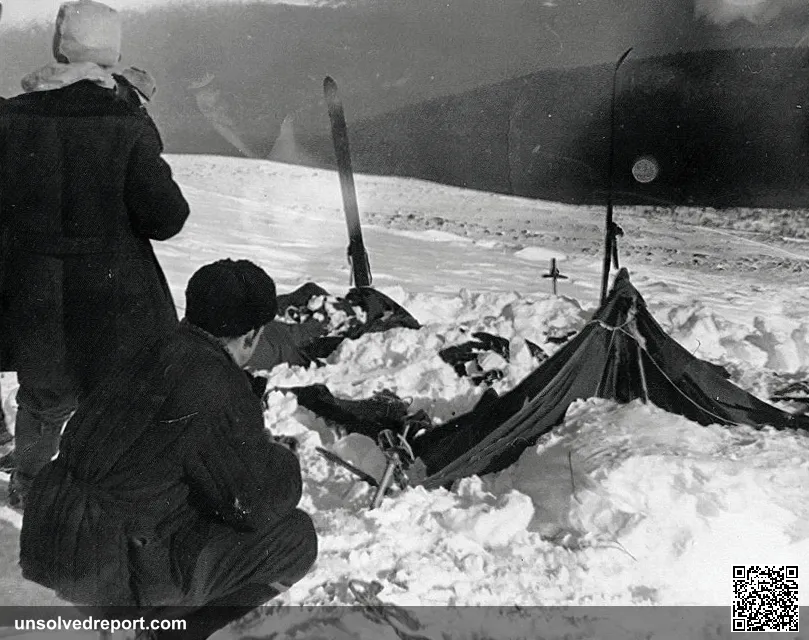
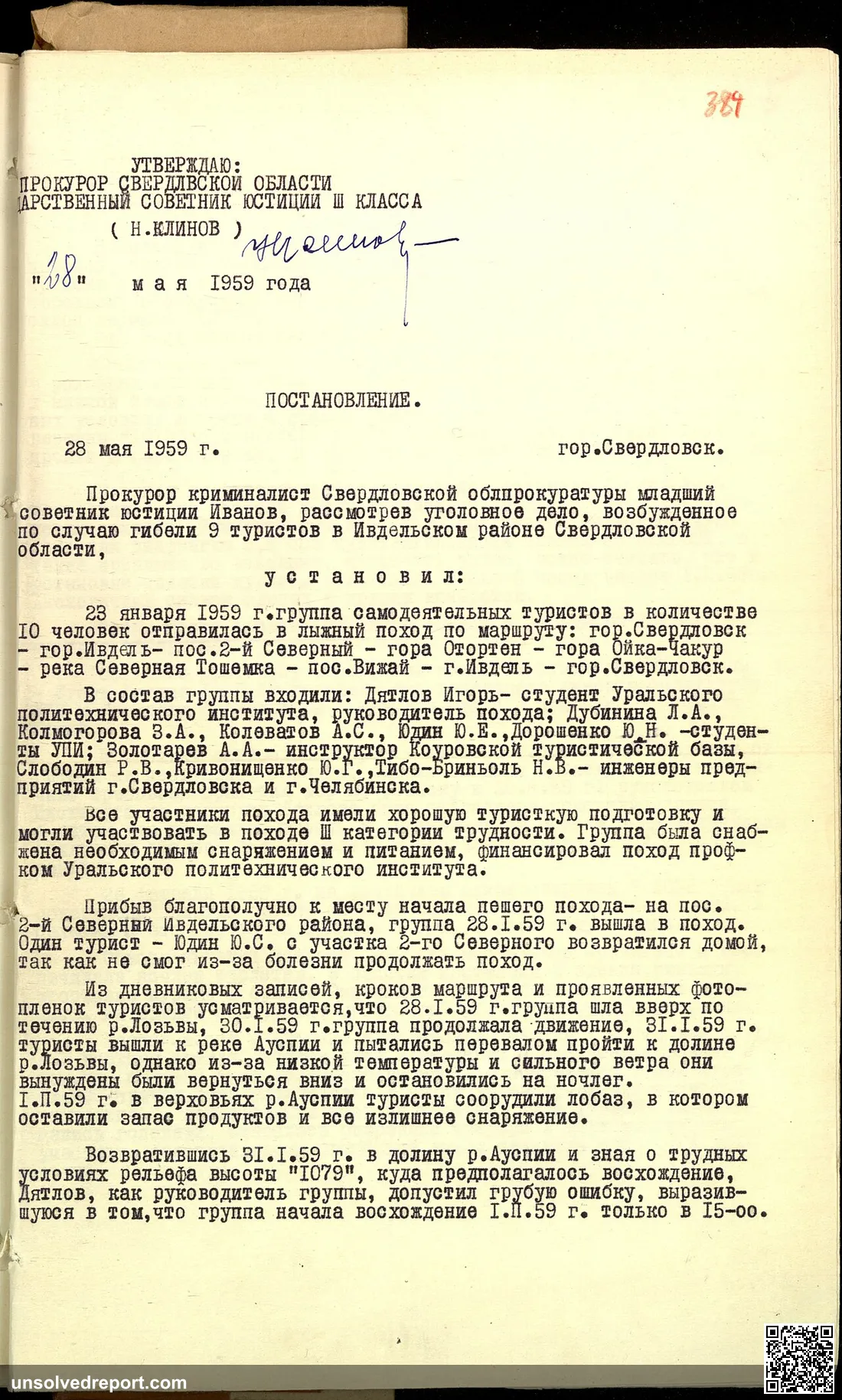
What the searchers found is the spine of this whole mystery. The tent had been cut open from the inside. Tracks ran downslope toward a forest line, and that's where the first bodies turned up. Some of the hikers wore only underclothes and socks against a Ural winter. And then the part that haunts the case: the autopsies recorded severe trauma in several of the victims — fractured skulls, broken ribs, major internal injuries — alongside deaths attributed mostly to hypothermia, according to reporting by National Geographic and Live Science. The original Soviet inquiry blamed "a compelling natural force," then sealed the file.
Decades later, Russia opened it back up. In 2020, the Prosecutor General's Office landed on an avalanche as the likely cause. Deputy chief investigator Andrei Kuryakov said the victims' injuries were "characteristic for the injuries of rock climbers caught in an avalanche," with hypothermia finishing the hikers after they fled, per TASS (July 11, 2020).
Case closed? Not quite. The official finding showed up thin on one crucial thing: mechanism. And skeptics had a sturdy objection ready. A classic avalanche leaves a debris field — and searchers reported none. Worse, the slope was widely described as too gentle to slide at all.
The hole nobody could fill
That objection is the whole game.
If an avalanche hit the tent, where did the evidence go? And how could a slope of roughly 23 to 28 degrees — well below the angle most of us picture when we think "avalanche" — produce something violent enough to crack ribs and skulls, yet leave the campsite looking basically undisturbed weeks later?
For sixty years, that gap is exactly where the wild theories rushed in — the same vacuum that turned a Vermont mountain into a legend for swallowing hikers whole. Fill an empty space with mystery and people will reach for anything: secret weapons, the supernatural, you name it.
So here's the precise problem two researchers set out to solve. Not "did something supernatural happen." Something narrower and far harder: is there a physically plausible, ordinary-snow scenario that fits every documented detail at the same time?
The model, the theories, and the honest blanks
The 2021 slab-avalanche model. Johan Gaume of EPFL and Alexander Puzrin of ETH Zurich published "Mechanisms of slab avalanche release and impact in the Dyatlov Pass incident in 1959" in Communications Earth & Environment on January 28, 2021 (a Nature Portfolio journal). Forget the roaring snow cloud you see in movies. What they proposed was a small, delayed slab avalanche — a slab of packed snow letting go like a trapdoor.
Picture four things stacking up at once. First, the tent sat below a shoulder, on ground locally steeper than it looks from a photo. Second, a buried weak layer of fragile "depth hoar" snow ran parallel to the slope, like a sheet of sugar under the crust. Third, to level a spot for the tent, the hikers had cut into the slope — quietly undermining the snowpack above their heads. Fourth, strong downslope "katabatic" winds kept dumping fresh snow onto that cut all night long.
Now the clock starts ticking. As the journal paper describes it, the wind-driven snow piled up and "sintered," or hardened, over roughly 7.5 to 13.5 hours — silently loading stress into that weak layer until it finally failed, hours after the tent went up. That delay is the answer to the "but there was no trigger" complaint. Nobody pulled a trigger. The slope built up the pressure itself, on a slant shallow enough to fool everyone.
The injuries got their own clever treatment. Could a modest slab really break bones? To find out, the team borrowed animation code first written for Disney's Frozen, then checked it against 1970s General Motors cadaver crash-test data, as National Geographic recounts. The verdict: relatively small, dense blocks of snow striking people who were lying on rigid surfaces — their stiff skis and a hard-packed tent floor underneath them — could deliver chest and skull loads that matched the autopsies. Lie in soft powder and you might walk away. Lie pinned against a ski and the same block of snow becomes a hammer against an anvil. That one insight is what bridges "small avalanche" and "catastrophic trauma."
What the model flatly did not claim. Here's where honesty matters more than a tidy ending. Gaume and Puzrin were unusually upfront that they hadn't closed the case. "We do not claim to have solved the Dyatlov Pass mystery, as no one survived to tell the story," Gaume said. The paper itself states the authors "do not explain nor address other controversial elements... such as traces of radioactivity... the behavior of the hikers after leaving the tent, locations and states of bodies, etc." Read that twice. The model proves a release and a set of injuries are plausible. It does not reconstruct the night.
And several of those untouched details are precisely the ones that keep the legend alive. Faint radiation traces on some clothing get floated as something sinister — though the more mundane reading offered in coverage is contamination from thorium in camping lanterns. That's an interpretation, not a proven fact. The missing soft tissue on a couple of bodies — a tongue, eyes — endlessly milked in lurid retellings, is most plausibly explained by ordinary scavenging and decomposition during the weeks the bodies lay exposed, as National Geographic notes. Again: an interpretation, not a forensic certainty — the same gap between "unexplained" and "sinister" that keeps cases like the Mary Celeste alive a century after the mundane answers were on the table. And "paradoxical undressing," the grim phenomenon in which severely hypothermic people sometimes shed their clothes as they die, may explain why some victims were so lightly dressed. None of this is settled, and it would be dishonest to pretend it is.
Where scientists still push back. A hypothesis is an invitation to argue, and peers took it. Mathematician and avalanche researcher Jim McElwaine cautioned that, for the trauma scenario to hold, "the block of snow would have needed to be incredibly stiff and moving at some speed" — and he questioned how readily those conditions arise. Gaume, for his part, spotted a more human obstacle. An avalanche, he suggested, may simply feel too normal for a case this famous. "People don't want it to be an avalanche," he noted. Still, the wave of attention did something useful: it prompted follow-up expeditions that, according to EPFL, found the terrain around the campsite "clearly avalanche prone."
So what did the 2021 model finally explain? It handed us a coherent, physics-based, peer-reviewed answer to the two hardest questions of all — why nine calm, expert hikers would cut their way out and run, and how a "gentle" slope could deal out deadly trauma.
And what did it leave alone? Everything after the tent. The exact path of the flight. The placement and condition of each body. The radiation traces. The dozens of small human decisions made in the freezing dark. The mystery isn't gone — but it's smaller now, and sharper: an ordinary mountain that behaved in a rare and brutal way, with a few honest blanks we're wiser to leave open than to stuff with legend, not unlike the still-unexplained death toll piled up at Roopkund's Skeleton Lake.
Some mysteries shrink under a good model. The next one — like three lighthouse keepers who vanished off Scotland without a trace — might not give up so easily.
Sources and Further Reading
- Gaume, J. & Puzrin, A. M. "Mechanisms of slab avalanche release and impact in the Dyatlov Pass incident in 1959," Communications Earth & Environment (Nature Portfolio), Jan. 28, 2021. https://www.nature.com/articles/s43247-020-00081-8
- "Has science solved one of history's greatest adventure mysteries?" National Geographic. https://www.nationalgeographic.com/premium/article/has-science-solved-history-greatest-adventure-mystery-dyatlov
- "Russia's 'Dyatlov Pass' conspiracy theory may finally be solved 60 years later," Live Science. https://www.livescience.com/dyatlov-pass-incident-slab-avalanche-hypothesis.html
- "Prosecutors say avalanche killed Dyatlov group in Urals in 1959," TASS, Jul. 11, 2020. https://tass.com/emergencies/1177345
- "Intense press coverage prompts new expeditions to Dyatlov Pass," EPFL / EurekAlert! https://www.eurekalert.org/news-releases/947564

Phobos Grooves: The Claw Marks No One Can Explain
Phobos grooves: ruler-straight scars raking across Mars' dying moon. Four rival theories, zero proof — so what really carved these claw marks?
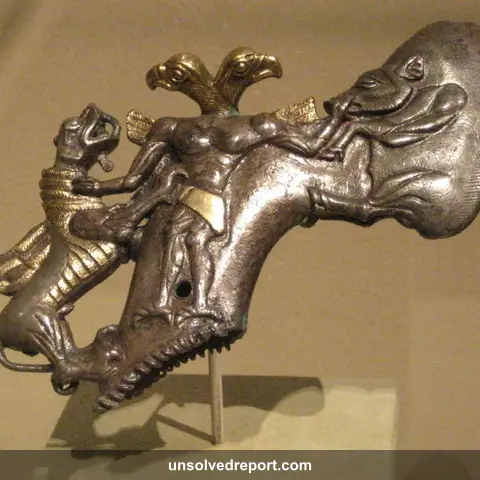
Gonur Depe: The Lost City a Whole Civilization Forgot
One piece of pottery in the Karakum sands exposed a vanished Bronze Age capital with plumbing, gold-packed tombs, and no name anyone remembers. What happened here?
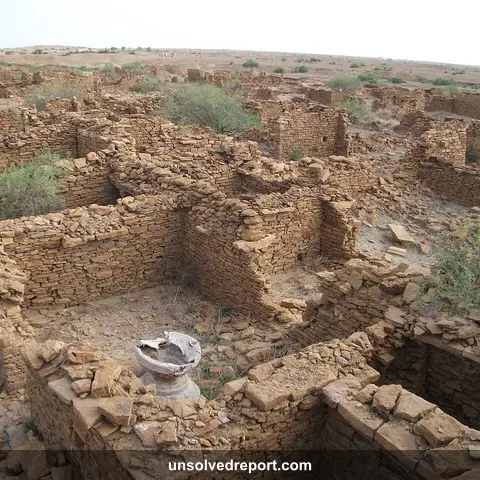
Kuldhara: The Village That Walked Out and Never Came Back
Kuldhara's legend says one cursed night emptied the whole village. The census records tell a slower, stranger story — so which one actually happened?