Roopkund Skeleton Lake: 500 Dead, One Question Nobody Can Answer
Roopkund Skeleton Lake: 500+ frozen bodies at 16,000 feet. DNA proved they died 1,000 years apart, some from the Mediterranean. Nobody knows why.
The ice pulls back in late summer, and the bones come out.
Skulls. Femurs. Ribs. Hundreds of them, scattered across the rocks and lying in the shallows of a tiny frozen pond that sits at roughly 16,500 feet in the Indian Himalayas — a smaller, shallower cousin of the ice-buried secrets at Lake Vostok. The air up here is so thin and so cold that some of the bones still wear scraps of flesh and human hair. Locals call the place Roopkund. Everyone else calls it Skeleton Lake.
For decades, those bones came with a neat little story attached and almost no real evidence. Then geneticists got hold of the dead. In 2019 they read the DNA, and the whole mystery flipped over.
The shock wasn't how these people died.
It was where some of them were born.
How a Forest Ranger Stumbled Onto a Field of Bones
It started with a patrol. In 1942, a forest ranger walking what is now the Nanda Devi area looked into the lake and found it full of human bones (Wikipedia, "Roopkund"). Not a handful. Hundreds. Counts have climbed into the several hundred individuals, in and around the water.
For sixty years, nobody really knew what they were looking at. Then, in 2004, a National Geographic-supported team finally examined and dated some of the skeletons. They found something that sounded like a horror movie: many of the dead had been struck on the head and shoulders by "blunt, round objects about the size of cricket balls." Their theory? A sudden, violent hailstorm had cut these people down in the open, at altitude — the same brutal high-altitude physics later invoked to explain the Dyatlov Pass incident (National Geographic). For years, that was the story everyone told: death by giant ice, hammering out of the sky.
It was a great story. It was also, it turned out, only part of one.
The real reckoning came in 2019, in a Nature Communications study with a title that gives the game away: "Ancient DNA from the skeletons of Roopkund Lake reveals Mediterranean migrants in India." It was led by Éadaoin Harney with a 28-author international team stretched across Harvard University, the Max Planck Institute, and India's CSIR Centre for Cellular and Molecular Biology (Nature Communications, 2019; PMC open-access version). They pulled genome-wide data from 38 skeletons, added radiocarbon dating, threw in dietary isotope analysis — much like the ancient DNA that finally cracked the identity of the Tarim Basin mummies — and blew the single-disaster story apart.
Here's the first twist. The dead were not one people.
They split into three genetically distinct groups. Twenty-three individuals, labeled Roopkund_A, carried ancestry that fits comfortably within today's South Asians. Fourteen others, Roopkund_B, carried ancestry typical of the eastern Mediterranean — clustering closest to present-day people of Crete and mainland Greece. And one lone individual, Roopkund_C, carried Southeast Asian-related ancestry (Nature Communications, 2019).
Now the second twist, and it's a bigger one. They didn't even die together.
Radiocarbon dating put the South Asian group at around 800 CE — and the numbers hinted that even those people weren't dropped here all at once. But the Mediterranean and Southeast Asian individuals? They dated to roughly 1800 CE. Read that again. Two of the main groups lie in the same icy water, separated in death by about a thousand years (Max Planck Institute press release).
The study also quietly closed some doors. Screening the bone DNA turned up no pathogenic bacteria, which knocks out the epidemic idea. The roughly even split of men and women argues against a marching army. And the chemistry of the bones whispered something too: the diet signatures differed between the groups, with the South Asian individuals eating a more varied diet than the Mediterranean group (PMC).
So forget the doomed expedition. These were strangers. People who never met, never knew of each other, never shared a campfire — bound together only by the single patch of frozen ground where their bones came to rest.
The Question Science Can't Answer
Here's where the honesty kicks in. There is one thing nobody can explain.
What were a group of people of eastern Mediterranean ancestry doing at a remote Himalayan lake around the year 1800? And how did they die there?
The Max Planck team didn't dress it up. "It is still not clear what brought these individuals to Roopkund Lake or how they died," they said flatly (Max Planck Institute). The genetics are sharp enough to say their recent ancestors came from somewhere near the eastern Mediterranean. But there is no known trade route, no military campaign, no migration that would casually dump Greeks and Cretans onto a high Hindu pilgrimage trail in Uttarakhand at that exact moment in history.
And it gets stranger. The 2019 study found no genetic sign that these people had recently mixed with locals — meaning Roopkund_B hadn't been quietly living in India for generations. They seem to have arrived more directly, closer to the time they died. Why they came, and who led them up that brutal trail, the record simply does not say.
The South Asian group from around 800 CE is the easy part — there's a plausible reason for them to be there, which we'll get to. The Mediterranean dead are the real riddle. And the careful, grown-up answer is: we still don't know.
Theories, Legends, and the Goddess Who Threw Hail
Everything below is interpretation and local tradition. None of it is settled fact, and we'll say so as we go.
The pilgrimage idea (the strong one — for the older group). The lake sits right on the route of the Nanda Devi Raj Jat, a Hindu pilgrimage to the goddess Nanda Devi held roughly every twelve years. The 2019 authors point out that the ~800 CE date for the South Asian group fits neatly with pilgrims dying along this route over many separate journeys (Nature Communications, 2019). It's a solid scientific inference. It just does nothing to explain the Mediterranean dead who showed up a thousand years later.
The hailstorm theory. Remember those rounded head and shoulder wounds from 2004? They fed the picture of a freak hailstorm catching people in the open at altitude (National Geographic). It's a believable way for at least some of these people to have died. But now that we know the bones span a thousand years and three different groups, no single storm could possibly have killed everyone.
The folk legend (a story, not evidence). And then there's the tale the mountains themselves tell. Local Garhwali tradition speaks of a king — often named Raja Jasdhaval of Kanauj — who set out on the pilgrimage with his pregnant queen and a whole retinue of servants and dancers. They were loud. They celebrated. And their noise is said to have enraged the goddess Nanda Devi, who answered by hurling down hailstones "hard as iron" and burying the whole party at the lake. An old regional folk song still carries the warning to anyone who would defile the sacred mountain (Wikipedia, "Nanda Devi Raj Jat"). Sit with that for a second: a centuries-old oral tradition, passed down by people who couldn't have known the forensic findings, encodes both mass death and lethal hail at this precise spot. Eerie. But legend is not data — and it offers nothing at all for a band of Mediterranean travelers.
So why does Roopkund still grip us? Because science actually answered the question everyone first asked — who are these people? — and in answering it, uncovered a far stranger question that nobody had even thought to ask. A lake at the roof of the world gathered its dead across a thousand years and half a continent. The bones of Greeks and the bones of Himalayan pilgrims lie tangled in the same frozen shallows. And the reason the Greeks are there at all remains a blank the evidence has never managed to fill.
For now.
Sources & further reading
- Harney, É. et al. "Ancient DNA from the skeletons of Roopkund Lake reveals Mediterranean migrants in India." Nature Communications, 2019 — https://www.nature.com/articles/s41467-019-11357-9
- Open-access full text (PMC) — https://pmc.ncbi.nlm.nih.gov/articles/PMC6702210/
- Max Planck Institute press release, "Biomolecular analyses of Roopkund skeletons show Mediterranean migrants in Indian Himalayas" — https://www.shh.mpg.de/1438702/roopkund-lake-nayak
- National Geographic, "DNA study deepens mystery of lake full of skeletons" — https://www.nationalgeographic.com/premium/article/dna-study-deepens-mystery-lake-skeletons-roopkund
- Penn State University, "The Secrets of Skeleton Lake" — https://www.psu.edu/news/research/story/secrets-skeleton-lake
- Wikipedia, "Roopkund" — https://en.wikipedia.org/wiki/Roopkund
- Wikipedia, "Nanda Devi Raj Jat" — https://en.wikipedia.org/wiki/Nanda_Devi_Raj_Jat

Hanging Coffins of Sagada: The 2,000-Year Claim No One Can Prove
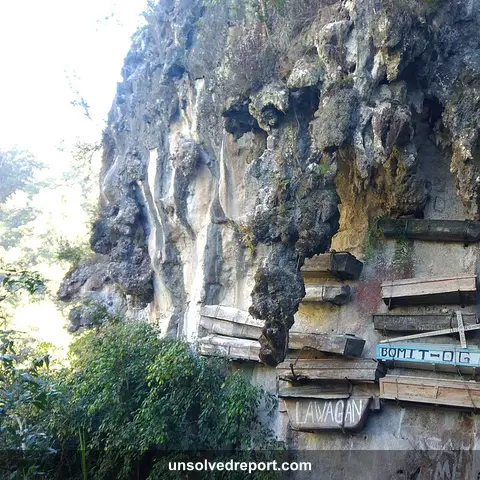
Hanging coffins of Sagada: wooden boxes some victims carved for themselves, nailed to cliffs. Everyone repeats one age for them — so why has no one ever tested it?
Giants of Mont'e Prama: The 3,000-Year Army Someone Smashed
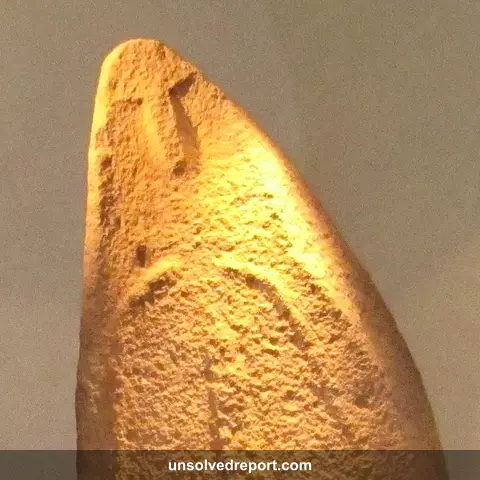
A farmer's plow hit a stone head in Sardinia and uncovered a buried army of giants, all shattered. Nobody agrees who smashed them, or why. Here's what we know.
Bir Hima Petroglyphs: The 7,000-Year Wall Nobody Can Fully Date
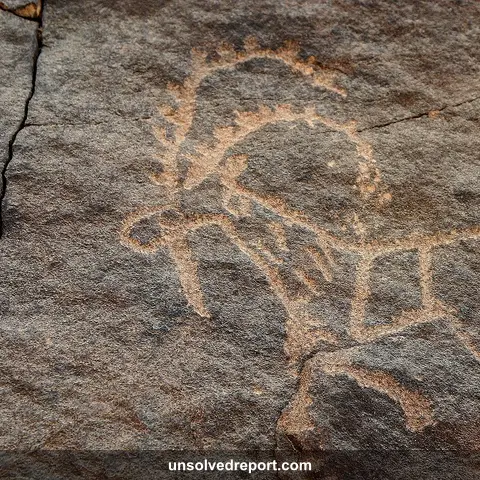
Bir Hima's rock art spans 7,000 years - cattle, camels, a war dated to the month. So why can't experts agree how old the oldest carvings really are?