Eberswalde Hoard: Germany's Gold That Vanished in 1945
Germany's largest Bronze Age gold hoard vanished from a Berlin museum in 1945. It took 59 years to find out where it went — and who still won't give it back.
May 16, 1913. A crew is digging a house foundation at a brass factory in Finow, near Eberswalde northeast of Berlin. About a meter down, a spade hits clay. It's a pot — and inside it sits the largest cache of prehistoric gold ever pulled from German soil.
Thirty-some years later, that gold is gleaming behind glass in a Berlin museum. Then the Second World War ends, the Red Army takes the city, and the entire treasure simply vanishes. For nearly half a century, nobody could say for sure whether it still existed at all.
This is the story of the Eberswalde Hoard — a real archaeological masterpiece, a real vanishing act, and a fight that has never quite been settled.
What we know for certain
Start with the things nobody disputes. The hoard came out of the ground on May 16, 1913, about a meter down, at a brass works in Finow (Oberbarnim), a part of Eberswalde in the German state of Brandenburg (Wikipedia; The Vintage News). A factory supervisor sent word to Carl Schuchhardt, director of the Prehistoric Department of the Royal Museums in Berlin, who made sure the gold was secured and brought into the collection (Ancient Origins).
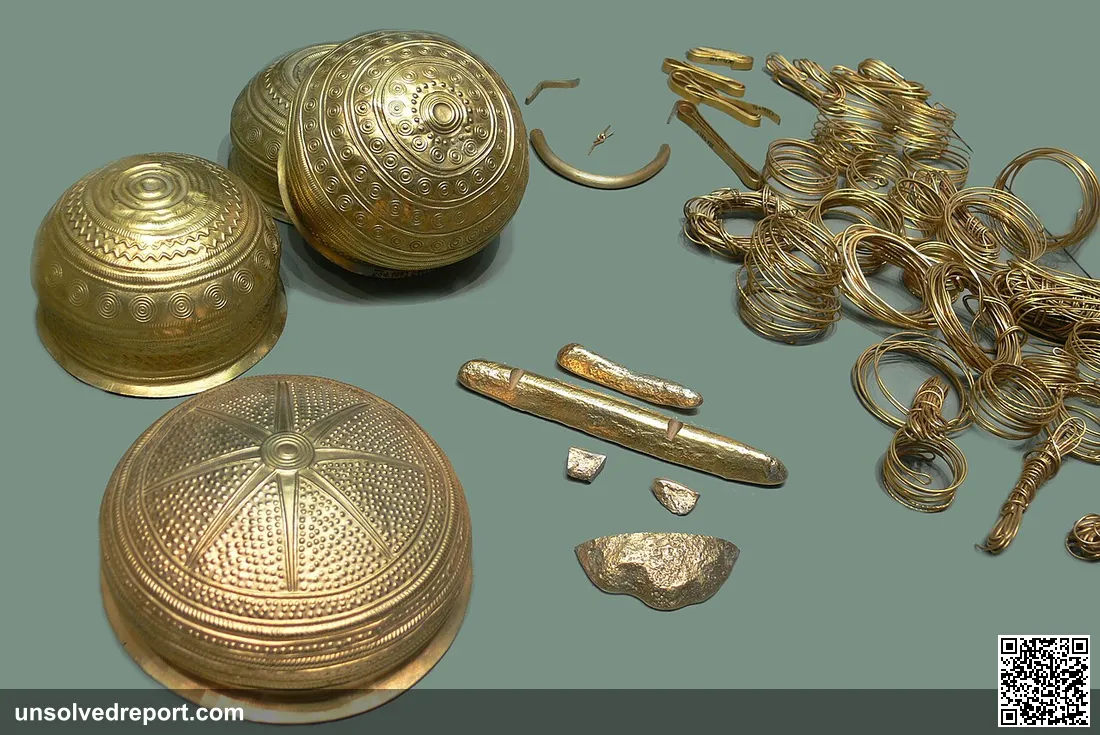
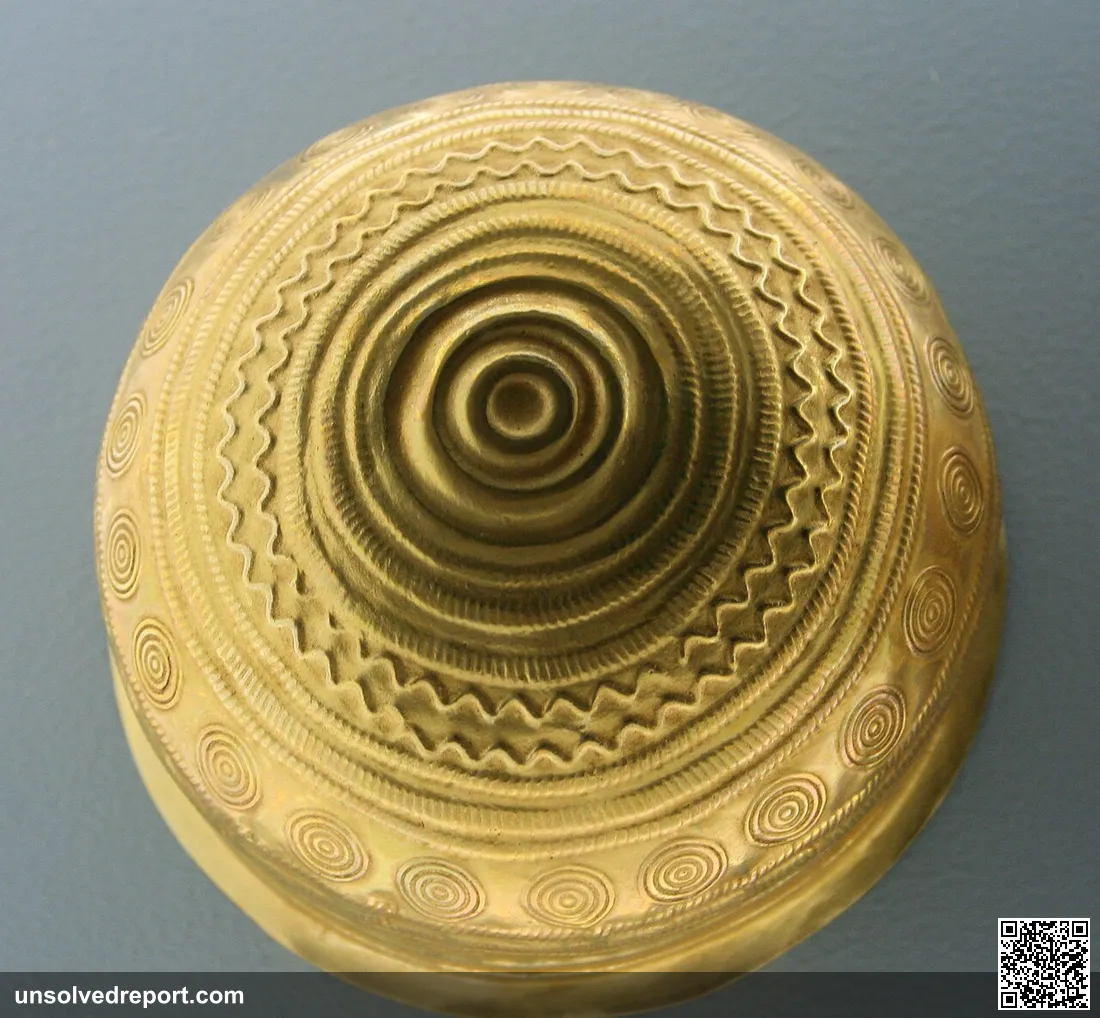
Now picture what was actually inside that pot. Eighty-one gold objects, weighing about 2.59 kilograms together — roughly 83 troy ounces of the stuff. Eight thin-walled, ornamented gold bowls, nested one inside the next. And tucked inside those bowls, 73 more objects: neck rings, bracelets, some 60 wire arm spirals, bundled double spirals, plus a gold ingot and lumps of raw material that look like crucible leftovers (Wikipedia; The Vintage News). The Prussian Cultural Heritage Foundation doesn't reach for fancy words — it calls the find simply "the largest Bronze Age gold treasure ever found in Germany," of "extraordinary importance for Bronze Age research" (Stiftung Preußischer Kulturbesitz). It belongs to the European Bronze Age; the dates most often cited land somewhere around the 11th to 9th centuries BC, though pinning it down exactly is a job for specialists, not for settled popular opinion.
For years, the gold lived in Berlin's Museum für Vor- und Frühgeschichte (Museum for Prehistory and Early History), part of the Berlin State Museums, where it was put on display and studied (Wikipedia).
Then came the war. As Allied bombs fell harder on the city, Berlin's museums hauled their most precious holdings into hardened shelters. By multiple accounts, the prehistoric gold — the Eberswalde Hoard, plus the famous "Priam's Treasure" that Heinrich Schliemann dug up at Troy — went into the massive Zoo flak tower (Flakturm Tiergarten), a reinforced anti-aircraft bunker right beside the Berlin Zoo. That tower guarded other Berlin museum treasures through the war's final, desperate weeks (Liberation Route / Zoo Tower context; Apollo Magazine).
And then the Red Army took Berlin in 1945, and the gold left the city. As widely reported, the museum official Wilhelm Unverzagt handed the prehistoric treasures over to a Soviet arts commission — a move often credited with keeping the collection together instead of letting it be scattered by looters (Priam's Treasure, Wikipedia). Soviet "trophy brigades" were stripping cultural property out of the occupation zone on a staggering scale, crating up art and artifacts to fly and ship east — the same wave of confiscation that swallowed the Amber Room from a palace near Leningrad (Apollo Magazine). The Eberswalde Hoard went with them. And in Germany, and across the West, it was simply gone.
Gone — but where?
For decades the question was brutally simple: did the Eberswalde Hoard even survive — and if it did, where on earth was it? The Soviets weren't saying. Just like with Priam's Treasure — or, further east, the disputed Bactrian gold of Tillya Tepe — officials spent the whole Cold War acting as if they had no idea what had become of the Berlin prehistory gold (Resilience.org).
The fog lifted in pieces. In 1994, the Pushkin State Museum of Fine Arts in Moscow finally admitted out loud that it had Schliemann's Trojan gold (Priam's Treasure, Wikipedia). But the Eberswalde Hoard stayed in shadow longer. Here's the kicker: it took until 2004 for a reporter from the German magazine Der Spiegel to track the Eberswalde gold to a depot inside the Pushkin Museum — proof at last that this exact treasure had survived, and exactly where it was sitting (Wikipedia; Ancient Origins).
So the "vanishing" got its answer. But a real open question is still very much alive — and it's less Hollywood than courtroom. Who actually owns the gold now, and will it ever go back to Germany? In 1998, Russia passed a law declaring that cultural assets moved to the Soviet Union after the war are Russian state property (Apollo Magazine). Germany sees the hoard as wartime-displaced property that belongs home. Here's the strange detail: the clay pot that held the gold is still in Berlin — but the gold itself stays in Moscow (Stiftung Preußischer Kulturbesitz). The object is found. The ending is not.
There's a quieter problem, too. Because the hoard slipped out of expert hands for decades, it got studied far less than treasures that stayed within reach. Some research has had to make do — including a German Research Foundation (DFG) project on the hoard's archaeology and production technology, which has had to lean partly on records, replicas, and limited access rather than steady, hands-on work with the originals (DFG GEPRIS).
Where the facts run out
A few things deserve careful handling, because this is the point where solid fact thins into guesswork.
Why bury the gold in the first place? Genuinely unknown. Scholars read Bronze Age hoards in different ways: as ritual offerings to the gods, as a goldsmith's stashed working stock (people point to that ingot and raw material as a clue), or as wealth hidden away when danger came near — the same guessing game surrounds the Tartessian gold of El Carambolo further south in Spain. For Eberswalde, none of these is proven — careful accounts lay them out as rival possibilities, not as the answer.
What the bowls' decoration "means." The vessels carry chased ornament, and popular writing sometimes reads those concentric circles as sun symbols tied to a Bronze Age solar cult. Treat that as speculation: it fits the known imagery of the period, sure, but it's an interpretation, not documented intent.
Did handing the gold to the Soviet commission "save" it? That's the usual framing — a rescue from looting. It's a reasonable way to explain why the collection stayed whole. But it's still a judgment call about motives and what might have happened otherwise, not an established fact.
Here's what isn't in doubt. A clay pot near Eberswalde gave up Germany's greatest Bronze Age gold. It shone in a Berlin museum. It went silent in 1945. And decades later it surfaced again, behind the doors of a Moscow museum — where it waits still, while two nations argue over the meaning of the word home. The next treasure with a missing chapter may be closer than you think.
Sources & further reading
- Wikipedia, "Eberswalde Hoard" — en.wikipedia.org/wiki/Eberswalde_Hoard
- Ancient Origins, "The Eberswalde Hoard: Golden Treasure Trove of the Bronze Age" — ancient-origins.net
- Stiftung Preußischer Kulturbesitz (Prussian Cultural Heritage Foundation), "Bronze Age – Europe without borders" press release (2013) — preussischer-kulturbesitz.de
- Apollo Magazine, "Haul of shame – the 'trophy art' taken from Germany by the Red Army" — apollo-magazine.com
- Wikipedia, "Priam's Treasure" — en.wikipedia.org/wiki/Priam%27s_Treasure
- Wikipedia, "Zoo Tower" (Flakturm Tiergarten) — en.wikipedia.org/wiki/Zoo_Tower
- DFG GEPRIS, "The Hoard from Eberswalde. Archaeology, production technology, analysis" — gepris.dfg.de
- The Vintage News, "The Treasure of Eberswalde is the largest prehistoric collection of gold objects ever found" — thevintagenews.com
Sroda Treasure: The $100M Crown Nobody Can Name
The Sroda Treasure's $100M crown may not belong to who everyone thinks — and most of the hoard vanished before authorities arrived. What's still missing?
Staffordshire Hoard: 4,000 Pieces of War Gold Nobody Can Explain
Staffordshire Hoard: 4,000 pieces of torn-up Anglo-Saxon war gold — and one question experts still can't answer: who buried it, and why?
Lost Faberge Imperial Eggs: 6 Are Still Missing Right Now
6 of the 50 lost Faberge Imperial eggs are still unaccounted for - and one nearly got melted for scrap gold before anyone realized what it was. Where are the rest?