El Carambolo Treasure: The Gold That Wasn't Supposed to Exist
3 kilos of 2,700-year-old gold, buried under a Seville shooting club — and a lab test that quietly demolished the Atlantis theory. What it actually proves is stranger.
A renovation crew was tidying up a pigeon-shooting club on a low hill west of Seville. It was September 1958. Then a shovel hit something that had no business being under a sportsmen's lodge — a knot of gold so pure it still gleamed after twenty-five centuries in the dirt. Twenty-one objects. Glittering. Intricate. Buried since before Rome was Rome.
They named it the Treasure of El Carambolo, and almost overnight it became a lightning rod for one of archaeology's most intoxicating dreams: that someone had finally found a thread leading back to Atlantis. The truth turned out to be stranger than the legend — and, in a way you may not expect, better. Here's what we actually know, where the real mystery hides, and which parts belong firmly in the "made-up" pile.
What the Shovels Found
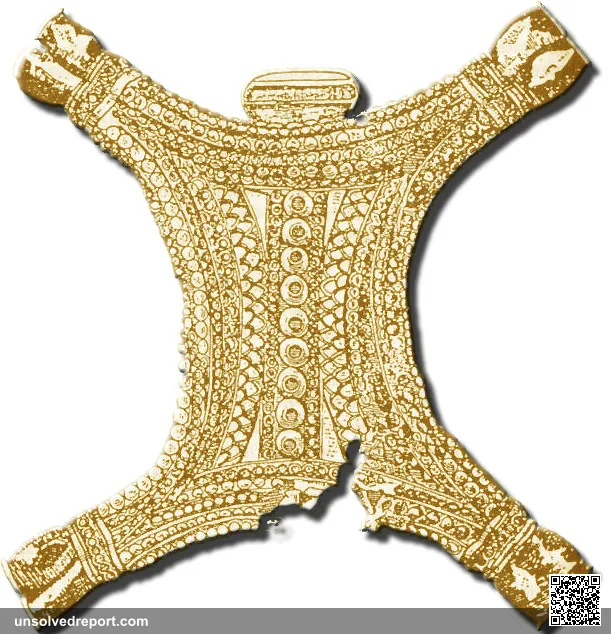
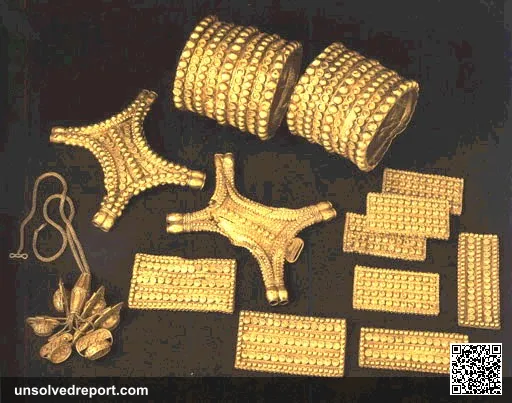
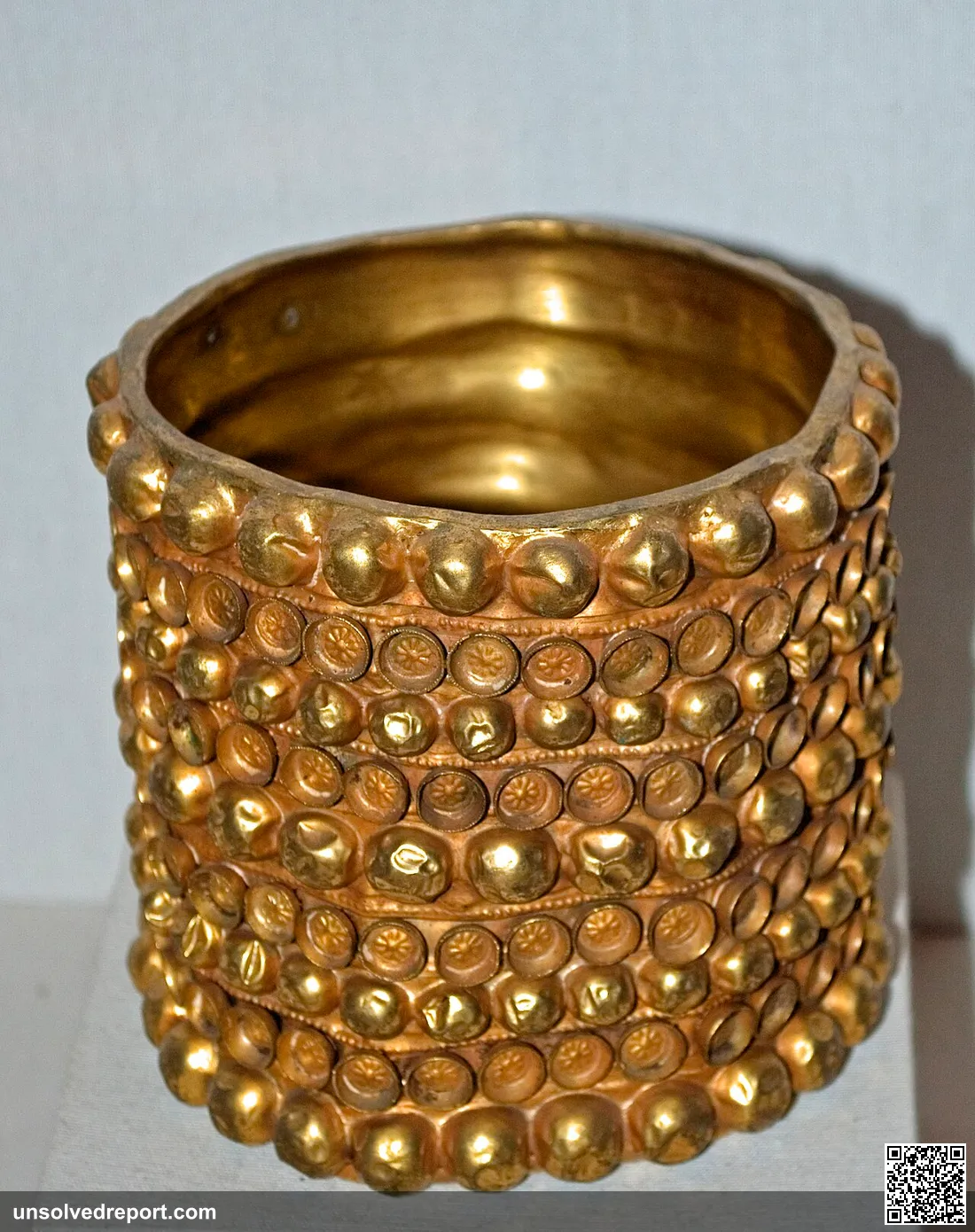
Start with the cold facts, because they're remarkable enough on their own. The gold surfaced on September 30, 1958, at El Carambolo hill in Camas, in the Province of Seville, during building work at a pigeon-shooting society (Wikipedia, "Treasure of El Carambolo"; National Geographic). Twenty-one pieces in all: a necklace strung with pendants, two bracelets, two pectorals shaped like stretched ox-hides, and 16 plaques (Wikipedia). Lift the whole hoard and you're holding roughly three kilograms of high-purity gold — the kind usually called around 24 carat (World History Encyclopedia).
Now look closer, because the craftsmanship is the first crack in the case. These pieces show off the elite tricks of the trade — filigree, soldering, and granulation, the maddening art of fusing tiny gold spheres onto a surface, one bead at a time (ScienceDirect, manufacturing-process study), the same painstaking goldsmithing on display in the Panagyurishte treasure further east. Those were signature moves of eastern Mediterranean, Phoenician-linked metalwork. Which is why scholars keep reading the treasure's style as Phoenician — even though, as you're about to see, its gold tells a completely different story.
Here's where it gets strange. A 2018 analysis in the Journal of Archaeological Science fired lasers at minute fragments — laser-ablation and lead-isotope mass spectrometry, sampling without scarring the objects — and read the gold's chemical fingerprint. The match led straight back home. The signature lined up with sources tied to Valencina de la Concepción, a major prehistoric site near Seville whose monumental tombs reach back to the third millennium B.C. (ScienceDirect, gold-origin study; Eos). The punchline: this gold was local. Not shipped from the eastern Mediterranean. Not floated in from some Atlantic homeland. Mined and worked right there (National Geographic).
The dirt around the gold only thickened the plot. Digging between roughly 1960 and 1962, excavators pulled out a small bronze statuette of the Phoenician goddess Astarte, the same pantheon whose demand for child sacrifice still fuels the Carthage tophet debate — and she carried a five-line Phoenician inscription, catalogued today as KAI 294 and dated to the first half of the eighth century B.C. (Wikipedia). Later seasons turned up what many specialists read as a full Phoenician religious sanctuary on the hill, layered so that an indigenous settlement comes first and Phoenician contact follows (Wikipedia). The treasure itself is usually dated to the eighth century B.C., with the burial of the hoard often pushed to the sixth century B.C. (National Geographic).
And if you want to see it? Since January 2012 the originals have lived on permanent display at the Archaeological Museum of Seville, with replicas standing in at the National Archaeological Museum in Madrid (Wikipedia).
The Question Nobody Can Quite Answer
Forget Atlantis for a second. Even after you do, a genuine puzzle is left standing, and it's a stubborn one: who made the El Carambolo treasure, and for whom?
The evidence pulls two ways at once. The gold is plainly Iberian, dug from the ground near Seville. But the techniques — and the sanctuary, and the Astarte statuette sitting in the middle of it all — are Phoenician. And the one name that should bind the region together, the half-legendary culture of Tartessos, hangs maddeningly in the gap between them.
Tartessos was a rich, metal-soaked society of southwestern Iberia, generally slotted between roughly the ninth and sixth centuries B.C. (National Geographic) — a few centuries before the Visigothic gold crowns of Guarrazar were buried in that same corner of Spain. The trouble? Its borders, its language, its people, even the moment it slipped out of history — Spanish archaeologists are still arguing over all of it (Russpain). So when we ask whether the treasure is "Tartessian" or "Phoenician," we're partly asking a question the field hasn't fully pinned down. The cleanest answer today is that El Carambolo captures a blended world — local Iberian communities and Near Eastern Phoenician settlers swapping metals, gods, and goldsmithing secrets until you can't tell where one ends and the other begins.
Even the famous 2018 study comes with honest small print. Only a handful of pieces were sampled. Archaeologist Ignacio Montero Ruiz, who wasn't part of the work, pointed out it would carry more weight if more of the 21 objects had been tested (Eos). Some pieces might still turn out to come from somewhere else entirely — the necklace, for one, has been linked on style to Cyprus (Wikipedia). So the real mystery isn't a buried map to a sunken city. It's quieter and harder: who were these people, exactly, at a crossroads where the ancient Mediterranean was busy reinventing itself?
The Stories People Tell
The Atlantis connection — legend, not archaeology. This is the tale that made El Carambolo a household name, so let's label it plainly: it's speculation, and most scholars wave it off. The thread runs back to the German archaeologist Adolf Schulten, who went hunting for Tartessos in the early twentieth century and sold the world on the idea that it had sunk beneath the waves and seeded Plato's Atlantis (Russpain; Atlantipedia on Schulten). His 1920s expeditions came up empty, but he and the writers who echoed him welded "Tartessos" and "Atlantis" together in the popular imagination for decades. Archaeologist Alicia Perea gave National Geographic the academic verdict without flinching: tying the treasure to Atlantis is "complete madness… that has nothing to do with archaeology" (National Geographic). Worth knowing as folklore. Not worth believing as fact.
The ritual-offering reading — scholarly, but unproven. Set the gold beside the apparent sanctuary and the Astarte statuette, and several researchers reach a different conclusion: this was sacred, not personal. A votive set, or regalia bound up with worship of Phoenician gods like Baal and Astarte — the same instinct to load precious metal with ritual meaning that drove the golden raft ceremony behind the El Dorado legend an ocean away. The ox-hide shape of those two pectorals is sometimes read in exactly that sacrificial, cult-tinged light. It's a careful, archaeology-rooted argument — but it's still a guess about meaning, not a closed case.
The blended-culture model — the best fit we have. The explanation that swallows the most evidence is also the least dramatic: local gold, Phoenician hands, a shared sanctuary, a Tartessian world drinking in eastern influence. El Carambolo may not be a riddle with a single answer at all. It may be a snapshot — two cultures caught in the act of becoming one.
Whatever it truly was, here's the part the legend can't touch: El Carambolo is real, solid, and standing in a glass case in Seville right now, no lost continent required. You can walk up and look at it. And every so often, the thing that actually happened turns out to shine brighter than the myth we wrapped around it.
Sources & Further Reading
- Treasure of El Carambolo — Wikipedia
- Origin of Ancient Gold Tartessos Treasure Revealed — National Geographic
- Fresh Take on a Gold Treasure's Origins Using Geochemistry — Eos (AGU)
- The gold of the Carambolo Treasure: new data on its origin — Journal of Archaeological Science (ScienceDirect)
- Non-destructive study of manufacturing processes of El Carambolo jewels — ScienceDirect
- Treasure of Carambolo — World History Encyclopedia
- Tartessos and Atlantis: how an archaeological mistake changed history — Russpain
- Adolf Schulten — Atlantipedia
11 Shipwrecks That Swallowed Fortunes Still Missing
Galleons of silver, ships of gold, royal emeralds lost to the sea — here are 11 famous shipwreck treasures, and the fortunes still unaccounted for below.
Batavia Shipwreck Mutiny: The Massacre Nobody Warns You About
Batavia shipwreck mutiny: a coral reef, a power vacuum, and 125 dead before rescue arrived. Two men vanished after — and no one has ever found out why.
El Dorado: The Golden Man Nobody Can Find
El Dorado was never a city — it was a man dipped in gold dust. So why did armies die hunting the wrong myth for 400 years? The real story is stranger.