Panagyurishte Treasure: Solid Gold Mistaken for Whistles
Three brothers digging clay in 1949 Bulgaria pulled nine solid-gold vessels from the ground and reportedly tried to blow into them like whistles. Who buried them, and why did they never come back for the gold?
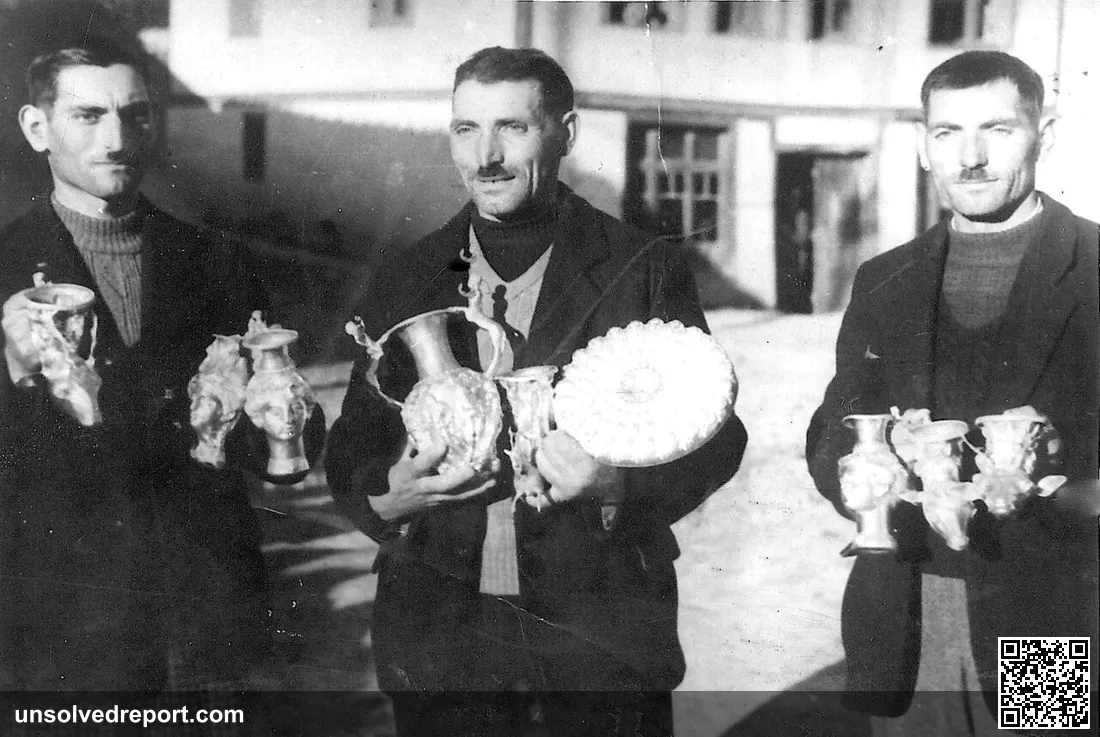
A cold December morning in 1949. Three brothers are digging clay for a brick factory in central Bulgaria when their tools snag on something hard. They scrape away the dirt and pull up a handful of yellow shapes, glinting in the gray light. They turn them over in their muddy hands. They have no idea what they are.
Here's the part that sounds made up but keeps getting told: the shapes looked, to some who saw them, like odd brass instruments. Like whistles. And a few people reportedly raised them to their lips and tried to blow.
What those hands were actually holding was one of the most spectacular hoards of ancient gold ever found. Nine vessels of nearly pure gold, made for a Thracian court more than two thousand years before. This is the Panagyurishte Treasure. And after a century of scholars poring over it, some of its simplest questions still have no answer.
What we actually know
It happened on December 8, 1949, just outside the town of Panagyurishte. Three brothers, Pavel, Petko, and Mihail Deikov, were digging clay at the "Merul" tile factory near the railway station. About two meters down, their tools hit the cache (BTA; Ancient Origins). The clay, by the accounts of the find, broke apart "like a lid" — and there it all was, arranged in a neat cluster, a shallow dish at the bottom and a big amphora standing in the middle (panagyurishte-treasure.com). The brothers gathered the pieces, carried them to the river, washed off the clay, and brought them to the authorities, who sent for specialists (The History Blog) — a stroke of accidental discovery not unlike the boy who tripped over the Pereshchepina Treasure.
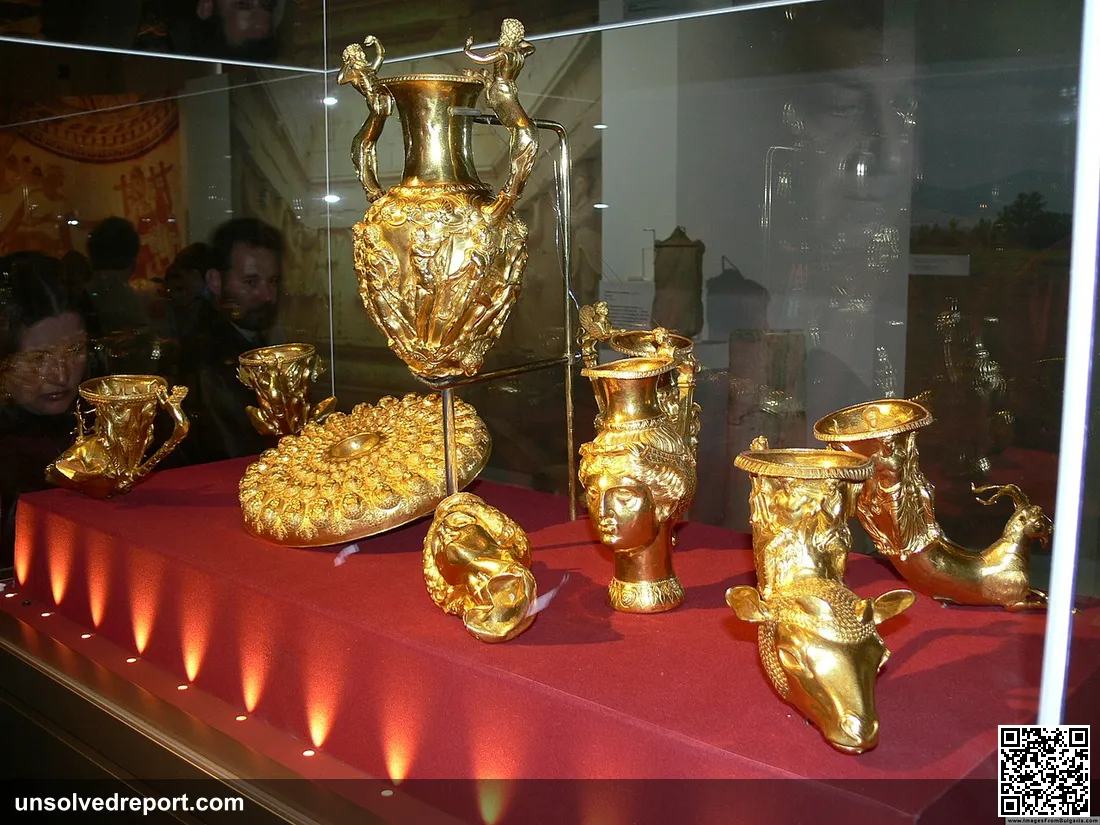
Now picture what those specialists saw. Nine vessels of solid gold, weighing 6.164 kilograms all together (BTA; Wikipedia). And not just gold — staggeringly pure gold, generally cited at roughly 23 to 24 karat. The set is one phiale (a shallow dish for pouring offerings), one large amphora-rhyton, and seven rhyta, the horn- and animal-shaped drinking vessels of the ancient world (Wikipedia). Some of the rhyta are capped with the heads of animals. Others rise into jugs crowned with the heads of women. The phiale is ringed with circles of African heads, acorns, and palmettes (Ancient Origins).
And the artistry will stop you cold. Look closely and the whole sweep of Greek myth comes alive in the metal. One rhyton freezes the Judgment of Paris — the goddesses Hera, Athena, and Aphrodite standing before the Trojan prince. Another shows Heracles wrestling the Ceryneian hind, with Theseus and the Marathonian bull beside them (Google Arts & Culture / Getty) — the same instinct to cast Greek myth in precious metal that turns up in the Mahdia shipwreck's sunken cargo of gods. Scholars put the set at the turn of the fourth to third centuries BC and tie it to the Odrysian kingdom of Thrace — country linked to the Thracian king Seuthes III, who founded a capital nearby (BTA). The phiale even carries inscriptions, recording its weight in the units used by the Greek city of Lampsacus, on the Asian shore of the Hellespont (BTA).
Today the treasure is one of Bulgaria's national emblems. It's registered as a movable cultural asset of the Regional Archaeological Museum in Plovdiv, kept and shown under heavy security at the National Museum of History in Sofia, and now and then it travels back to a special hall in Panagyurishte itself (Archaeology in Bulgaria). In late 2024 and early 2025 the original crossed an ocean, loaned to the Getty Villa in Los Angeles for the exhibition Ancient Thrace and the Classical World (The Sofia Globe).
The question nobody can answer
We know so much. And yet the heart of it stays dark. Who owned this set? Where exactly was it made? And why on earth did it end up buried in a bank of clay?
Follow the clues and they pull in opposite directions. The Lampsacus weight inscriptions whisper of a workshop in Asia Minor — not Thrace at all. But the gold was found deep in Thracian ground. And the decoration is a strange braid: Greek myth twisted together with Thracian and Persian-flavored shapes. So what was it? A diplomatic gift? War loot? A king's personal table service? An offering to the gods?
Then there's the bigger mystery: why hide it? The most common idea among scholars is that someone buried the hoard to keep it safe during dangerous times, when Thrace was being overrun — first by Macedonians, then by Celts, around the early third century BC (Wikipedia; Google Arts & Culture / Getty) — the same wartime instinct that put Britain's Staffordshire Hoard into the ground centuries later. But that's a guess built from circumstances, not a fact carved in stone. No tomb. No building. No inscription buried with the gold to tell us who put it there, or why they never came back to dig it up. And on the amphora-rhyton there's a scene that only deepens the fog: armed men gathered at a doorway, one of them seeming to blow a horn. What does it mean? Scholars argue. A mythical siege? A ritual? Nobody agrees.
Theories and interpretations
The following are interpretations and traditions, not established fact.
The "mistaken for whistles" story (popular tradition). That irresistible detail — the brothers, or the townspeople, taking the vessels for brass instruments and trying to blow into them — shows up all over the accounts of the find (The History Blog; Ancient Origins). It's a wonderful image. It might even be true. But it has the smooth, worn feel of a tale buffed up by years of retelling, so treat it as a beloved anecdote, not documented archaeology. The sober museum versions tend to stress something quieter: how fast the brothers grasped that this mattered, and how quickly they handed it over to be examined.
A royal drinking service for Seuthes III (scholarly hypothesis). Many experts see the set as a king's ceremonial symposion service — possibly tied to Seuthes III or the Odrysian court, used for elite feasting and ritual wine offerings (BTA). It's a reasonable read. But it's circumstantial, because the gold carries no owner's name anywhere.
Made in Lampsacus, or made locally (competing views). Those weight inscriptions have convinced some scholars the pieces were commissioned from Greek goldsmiths in Lampsacus. Others insist Hellenic-trained artisans working closer to Thrace made them (The History Blog). Both ideas are still very much alive — much like the unresolved origin fight still dogging the Seuso Treasure, a Roman silver hoard that also refuses to say where it came from.
Here's what no one can dispute: the objects themselves. Nine pieces of brilliant gold that survived more than two thousand years underground, were briefly taken for something almost worthless — and now stand among the finest works the ancient world ever produced. Somebody buried them in a panic, or a prayer, and walked away forever. The gold is still waiting for us to figure out which.
Sources & further reading
- BTA (Bulgarian News Agency), "December 8, 1949: Panagyurishte Gold Treasure is Discovered": https://www.bta.bg/en/news/1023465-december-8-1949-panagyurishte-gold-treasure-is-discovered
- Wikipedia, "Panagyurishte Treasure": https://en.wikipedia.org/wiki/Panagyurishte_Treasure
- Google Arts & Culture / J. Paul Getty Museum, "Mythology in Gold: The Panagyurishte Treasure of Ancient Thrace": https://artsandculture.google.com/story/mythology-in-gold-the-panagyurishte-treasure-of-ancient-thrace/uAXxyByBrWVl1g
- Ancient Origins, "How The Thracian Panagyurishte Treasure Changed Bulgaria's History": https://www.ancient-origins.net/artifacts-other-artifacts/panagyurishte-treasure-0013368
- The History Blog, "Bulgarian museums fight over Thracian gold": https://www.thehistoryblog.com/archives/7901
- Archaeology in Bulgaria, "Bulgaria's Most Famous Thracian Treasure ... to Return to Home Town": https://archaeologyinbulgaria.com/2016/06/13/bulgarias-most-famous-thracian-treasure-the-panagyurishte-gold-treasure-to-return-to-home-town-after-two-year-lapse/
- The Sofia Globe, "Ancient Thrace and the Classical World ... exhibition at J Paul Getty Museum": https://sofiaglobe.com/2024/10/22/ancient-thrace-and-the-classical-world-treasures-from-bulgaria-romania-and-greece-exhibition-at-j-paul-getty-museum-in-la/
- panagyurishte-treasure.com, "The Story of the Panagyurishte Gold Treasure": https://www.panagyurishte-treasure.com/en/8-december-1949-panagyurishte-en/
12 Lost Treasures the World Has Never Found
A king's jewels eaten by the tide. A room of amber that blinked out of history. Twelve real fortunes that left a paper trail, then simply vanished.
São Bento Shipwreck 1554: The Wreck That Won't Stop Giving Up Gold
The 1554 São Bento shipwreck scattered its treasure off South Africa's coast. Gold, porcelain, and beads still wash ashore — but is the legendary gold bar real?
The San Jose Galleon: The Billion-Dollar Wreck Nobody Can Claim
The San Jose galleon sank in 1708 loaded with gold and emeralds nobody has recovered. Four rivals are now fighting over it — here's fact vs. hype.