The Faint Young Sun Paradox: Earth Should Be Frozen
The Sun was 25% dimmer 4 billion years ago—Earth should've been frozen solid. The rocks say oceans existed anyway. Over 50 years later, no one has a clean answer.
Wind the clock back four billion years and look up. The Sun hanging over the young Earth is the wrong Sun. It's dimmer, paler, throwing only about 70 to 75 percent of the light it pours down today. Now do the math any climate scientist would do, and the verdict is brutal: this planet should be a solid ball of ice, its oceans frozen shut for its first two billion years.
Here's the strange part. The rocks flatly refuse to agree. Ancient sediments are stamped with rivers, oceans, rainfall, and the chemical fingerprints of life already getting comfortable. Liquid water, everywhere, under a Sun too weak to keep it from freezing. How? That contradiction has a name, the faint young sun paradox, and after more than fifty years of clever people throwing everything they have at it, it still hasn't been put to rest.
Two sciences, head-on collision
In 1972, astronomer Carl Sagan and his colleague George Mullen noticed something that should not have been possible, and they had the nerve to say it out loud. Two rock-solid sciences were pointing in opposite directions (Feulner, 2012, Reviews of Geophysics).
Start with the Sun. A star like ours runs on hydrogen fusion in its core, a process astrophysicists can model with remarkable precision even as basic questions like what the Sun is actually made of remain surprisingly contested. As hydrogen burns to helium, the core packs tighter and runs hotter, and the whole star slowly brightens across billions of years. This isn't a fringe idea; it's mainstream, well-tested astrophysics, and it leaves no escape hatch. A younger Sun was a fainter Sun. Reviews of the problem put the solar energy reaching the infant planet at roughly 25 percent below today's (Feulner, 2012, arXiv).
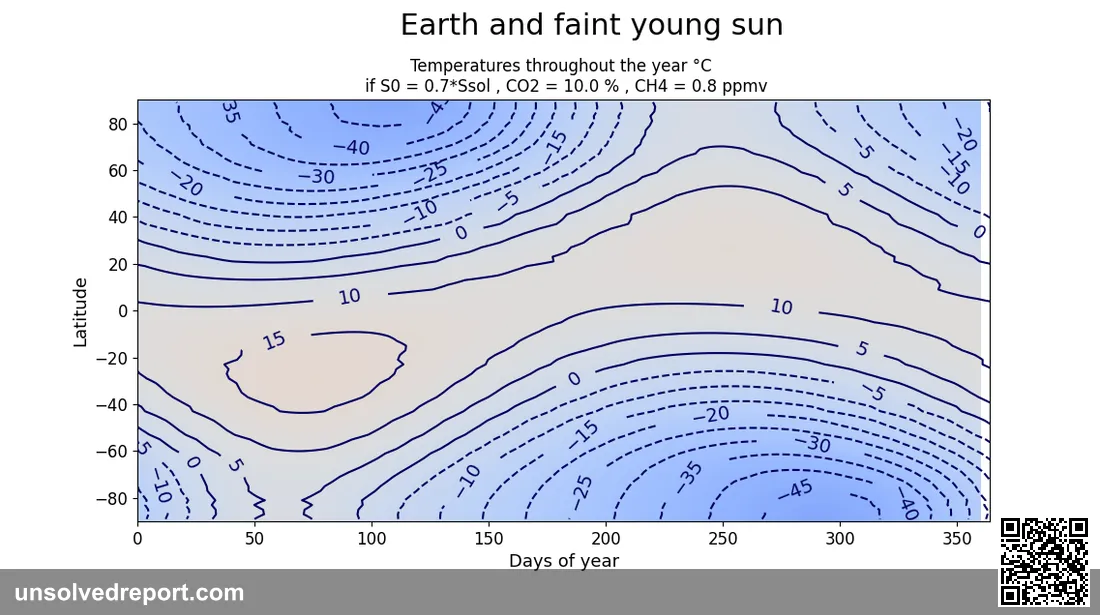
Now run the puzzle. Take the Earth you know, dim its Sun by that much, change nothing else, and the planet's average surface temperature plunges well below freezing. Feulner's review doesn't soften it. The result, he writes, is "a completely frozen world." The oceans skin over with ice, and because bright ice bounces sunlight straight back to space, the freeze tends to lock itself in. Once you're white, you stay cold.
Except the Earth was not white. The geology is emphatic on this point, and it does not care how tidy the physics looks. Tiny zircon crystals from the Jack Hills of Western Australia, some clocking in around 4.4 billion years old, carry oxygen-isotope signatures from magmas that brushed up against liquid water near the surface, pushing the evidence for surface water back to about 4.3 billion years ago (Wilde et al., 2001, Nature). Move forward into the Archean Eon, 3.8 to 2.5 billion years ago, and the case stops being subtle. There are stromatolites and microbial mats from roughly 3.35 to 3.43 billion years ago, and cherts laid down in "shallow-water, tidally affected, marine environments," the kind of words that only make sense if there were open, sunlit oceans (GSA Today, "The Faint Young Sun Problem Revisited"). Not a puddle. Oceans.
So both walls hold. The Sun really was fainter. The water really was there. Something had to be quietly bridging the gap, and figuring out what is where this gets good.
The obvious answer that doesn't quite work
The clean fix is the greenhouse effect. Stuff the early atmosphere with enough heat-trapping gas and the extra warmth covers for the weak Sun. Sagan and Mullen said exactly that, and it's still the front-runner.
The catch is the fine print, and that's where the mystery actually lives. Scientists still can't agree on which gases did the heavy lifting, or in what amounts, and some of the rocks shove back hard against the simplest version of the story.
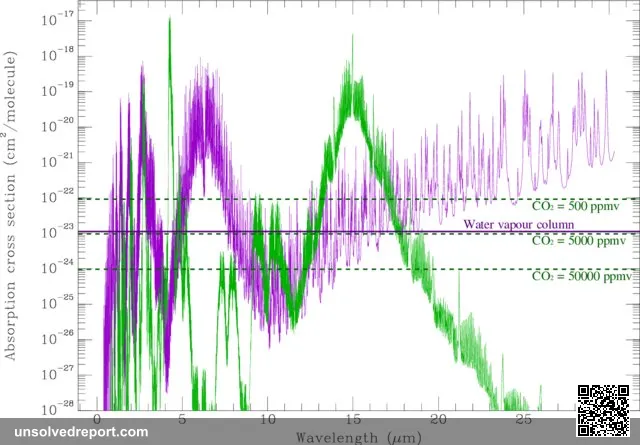
Carbon dioxide is the obvious suspect, and a famous one let the planet down. Ancient soils, called paleosols, keep a chemical ledger of the air that once sat on them, and that ledger says CO2 was running surprisingly low in the late Archean, far below what a CO2-only rescue would need. In a classic study, Rye and colleagues used the missing iron-carbonate mineral siderite in paleosols 2.2 to 2.75 billion years old to cap CO2 at roughly 100 times today's level, an amount most researchers judge too small, on its own, to thaw the planet (Feulner, 2012, arXiv). Read that again, because it's the whole paradox in one sentence: the easy answer appears to be partly ruled out by the dirt itself.
Feulner's authoritative review doesn't pretend otherwise. Every proposed way out, he writes, "present[s] considerable difficulties," and so "the faint young Sun problem cannot be regarded as solved." Half a century after Sagan and Mullen, what kept early Earth from freezing is still an open, honest question, not a closed file. Or, as the GSA Today treatment puts it, "It is not clear which additional factors were dominant or if we are missing something fundamental."
The suspects, ranked
Several serious explanations are still standing, each with its champions. None has won clean, and the real answer may be a blend of more than one.
The methane boost (mainstream, well-supported). Methane traps heat far better than CO2, and on an early Earth almost starved of oxygen, it could have piled up, much of it belched out by methane-making microbes. A 3-D climate study from the University of Colorado Boulder found that CO2 around 15,000 to 20,000 parts per million plus methane up to about 1,000 ppm could deliver "moderate" average Archean temperatures. Lead author Eric Wolf put it plainly: "it's really not that hard in a three-dimensional climate model" to keep the planet temperate, though he added the honest caveat that "we can't say definitively what the atmosphere looked like back then without more geological evidence" (CU Boulder, 2013). There's a sting in the tail, though. Pile on too much methane and it curdles into a sunlight-blocking organic haze that can cool the planet right back down.
A darker, less cloudy world (contested). In 2010, Minik Rosing and colleagues made a bolder claim: maybe you don't need a stronger greenhouse at all. With barely any continents, the young Earth was mostly dark, heat-drinking ocean, and with few microbes around to seed clouds, the sky may have been clearer and less mirror-like. Less reflection means more sunlight soaked up rather than thrown away (Rosing et al., 2010, Nature). It's a real, peer-reviewed idea, and it drew a real, pointed punch back: a follow-up in Nature argued that even the most generous assumptions about albedo and clouds still miss closing the gap by something like a factor of two (Goldblatt & Zahnle, 2011, Nature).
A heavier, brighter young Sun (largely rejected). Suppose the early Sun was more massive. It would have burned hotter and brighter, then slimmed down over time. Elegant. It also seems to be wrong. Measurements of how Sun-like stars spin down suggest the extra mass would have been shed inside the first few hundred million years, before most of that warm Archean record was even written (GSA Today).
The supporting cast (speculative but plausible). Researchers have floated other helpers: a thicker early atmosphere cranking up the pressure and broadening how greenhouse gases absorb heat, a dash of hydrogen sharpening CO2's warming, even stronger tides from a closer Moon adding a little heat of their own. Any of them might have chipped in at the edges. None obviously closes the gap by itself.
And that's exactly why this puzzle refuses to fade. It isn't some exotic curiosity off in the corner of science, any more than the missing lithium from the Big Bang is just a rounding error. It's a stand-off between two of our most trustworthy ways of reading the universe, stellar physics and field geology, and neither will blink. The hunt for whatever bridges them keeps sharpening our portrait of the world where life first found its footing, a question that echoes the same what-are-the-odds unease behind the Fermi paradox, and leaves you wondering what else those oldest rocks are still waiting to tell us.
Sources & further reading
- Feulner, G. (2012). "The faint young Sun problem." Reviews of Geophysics. Wiley | arXiv preprint
- "The Faint Young Sun Problem Revisited." GSA Today, Geological Society of America. geosociety.org
- Wilde, S. A., et al. (2001). "Evidence from detrital zircons for the existence of continental crust and oceans on the Earth 4.4 Gyr ago." Nature. nature.com
- Rosing, M. T., et al. (2010). "No climate paradox under the faint early Sun." Nature. nature.com
- Goldblatt, C., & Zahnle, K. J. (2011). "Faint young Sun paradox remains." Nature. nature.com
- University of Colorado Boulder (2013). "CU study shows how early Earth kept warm enough to support life." colorado.edu
Lake Anjikuni: The Vanished Village That Never Existed
2,000 people vanished from Lake Anjikuni with empty graves and no footprints — or so the story goes. The real trail leads somewhere stranger.

Sigiriya: The Sky Palace a Murderer Built on a Rock
Sigiriya rock fortress: a king who killed his father built a sky palace on a 180m cliff, painted 500 women on its face, then cut his own throat. Why?

Flannan Isles Mystery: Three Vanished, One Coat Left Behind
December 1900: three keepers vanish from Flannan Isles lighthouse. Two coats are missing. The third is still on its hook. What happened to him?