Fermi Paradox Explained: Why the Universe's Silence Is Terrifying
300 million habitable planets, billions of years, and total silence. So where is everybody? The Fermi paradox explained — and why the answer may be worse than you think.
Four physicists are walking to lunch at Los Alamos, summer 1950. The talk wanders the way lunch talk does. Then one of them — Enrico Fermi, a man who helped build the atomic bomb — stops mid-stride and asks a question that has nothing to do with anything: "Where is everybody?"
The others crack up. They know exactly who he means. The universe is almost unimaginably big and old. If even a sliver of its countless stars host life, the galaxy ought to be crowded, loud, busy with neighbors. So why does the sky stare back so empty? That gap — between everything we'd expect and the silence we actually get — is the Fermi paradox. Decades on, nobody has closed it.
What we actually know
The lunch was real. The paradox carries Fermi's name because he asked the question during that 1950 conversation at Los Alamos National Laboratory, alongside physicists Emil Konopinski, Edward Teller, and Herbert York. Fermi died in 1954, so the exact words had to be pieced back together in 1984, when Los Alamos physicist Eric Jones wrote to the three men still living. Teller remembered the question landing "out of the blue" — and yet "everybody around the table seemed to understand at once that he was talking about extraterrestrial life" (Wikipedia, "Fermi paradox"; EBSCO Research Starters).
The numbers are genuinely staggering. Our galaxy holds somewhere between 100 billion and 400 billion stars, NASA says — and we can't even pin the count down tightly, because we're trying to count a forest while standing inside it (NASA Blueshift). Beyond our galaxy lie hundreds of billions more.
Planets are everywhere — and some look promising. NASA's Kepler space telescope handed us a jolt: there are more planets than stars out there. A 2020 study in The Astronomical Journal fused nine years of Kepler data with the European Space Agency's Gaia mission and landed on a number — the Milky Way may carry "at least an estimated 300 million" potentially habitable worlds, with roughly half of all Sun-like stars possibly cradling a rocky planet in the zone where liquid water can pool (NASA, October 2020). A few might sit within 30 light-years of your front porch.
Someone tried to do the math. In 1961, astronomer Frank Drake sat down and wrote what we now call the Drake equation — a chain of factors (how fast stars form, how many have planets, how long a chatty civilization survives) multiplied together to estimate how many detectable civilizations might share the galaxy with us. The SETI Institute's Seth Shostak shrugs off the idea that it spits out a real answer. He calls it "a road map" — a list of everything we still don't know (SETI Institute; Drake equation, Wikipedia).
And still — nothing. Decades of listening, and not one confirmed signal from anyone out there (SETI, Wikipedia). The Breakthrough Listen initiative, launched in 2015 as a $100 million, ten-year sweep of the skies, is the biggest search we've ever mounted. Result so far: silence. Its most exciting lead, a blip called "BLC-1," turned out to be something we made ourselves — likely interference. (Other unexplained radio blips, like fast radio bursts, remain open puzzles of a different kind.)
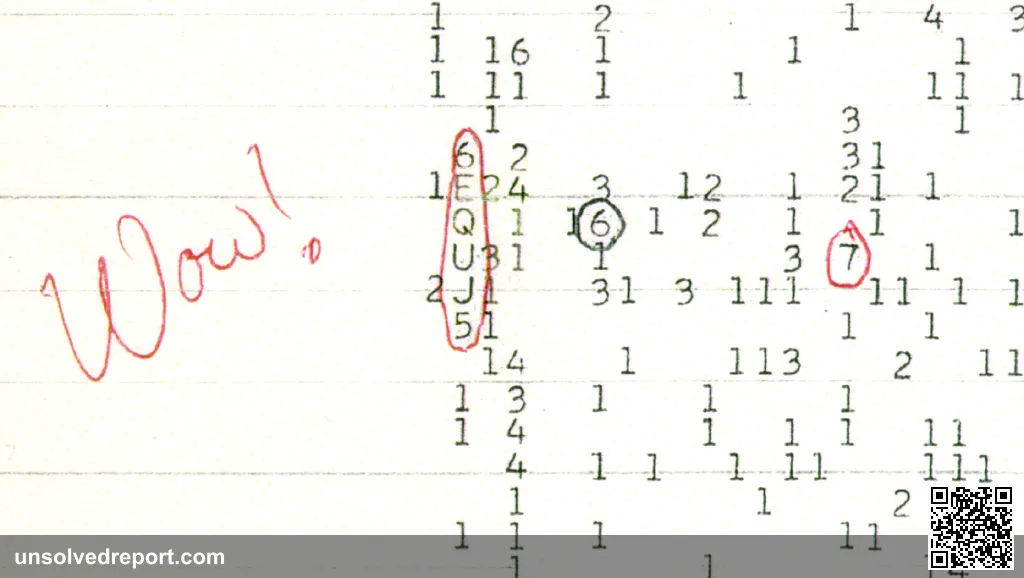
The closest brush came earlier, and it still gives people chills. August 15, 1977. Ohio State University's Big Ear radio telescope picks up a strong, narrow signal and holds it for the full 72 seconds it can see. Astronomer Jerry Ehman, looking over the printout, circles the spike and scrawls one word in the margin: "Wow!" Nobody has ever heard the Wow! signal again, no matter how many times we've pointed sharper instruments at the same patch of sky (The Planetary Society; Wow! signal, Wikipedia).
The question nobody can answer
Here's the paradox stripped to the bone. The galaxy is old — in many places, billions of years older than our Sun. Real estate for life looks plentiful. And even crawling along below the speed of light, a single technological civilization could, in principle, spread clear across the Milky Way in a few tens of millions of years — barely a heartbeat in cosmic terms. By rights, the galaxy should already be settled, or at least buzzing with signals.
Instead, as far as any instrument we own can tell, everything past Earth is quiet — and some corners of the cosmos are quieter still, like the Boötes Void, a supervoid so empty it sharpens the paradox. Not one confirmed trace of another technological civilization — not now, not ever.
That's the real mystery, and it's worth being honest about how little we've checked. We've surveyed a sliver of the sky, across a sliver of the radio dial, for a sliver of time. Not finding something isn't the same as it not being there. The Fermi paradox doesn't prove we're alone — it's a tug-of-war between two perfectly sensible beliefs: that life should be common, and that we've found none of it. One of them is wrong. Nobody knows which.
So where could everybody be?
Everything below is informed guesswork — explanations scientists and philosophers kick around, none of them proven, all of them speculation.
Maybe Earth is a stranger fluke than it looks
The Rare Earth hypothesis flips the problem: maybe simple microbial life is everywhere, but complex, intelligent life is freakishly rare. The pitch is that Earth caught an absurd run of lucky breaks — a big Moon to steady its wobble, a giant planet standing guard, plate tectonics, a long stretch of calm — and that hitting all those numbers at once almost never happens twice (Great Filter, Wikipedia). If that's right, the silence isn't eerie at all. We're just the freak result.
Maybe something kills civilizations before they spread — the Great Filter
In a 1996 essay, economist Robin Hanson floated the Great Filter: somewhere on the long climb from lifeless chemistry to a galaxy-spanning civilization sits at least one step so wildly improbable that almost nothing clears it (Space.com). The chilling part isn't the filter — it's where it sits. If it's already behind us — say, the very spark of life — then we're the ones who beat impossible odds. If it's still ahead, it might mean technological societies tend to wipe themselves out before they ever leave home. Worth saying plainly: this is a thought experiment, not a prediction.
Maybe they're out there, watching, saying nothing
The zoo hypothesis, dreamed up by astronomer John Ball in 1973, pictures advanced civilizations that know full well we're here — and choose to leave us be, observing without ever stepping in, like keepers strolling past an enclosure (ScienceAlert; Universe Today). The catch critics love to point out is the "uniformity of motive" problem: for the zoo to hold, every single civilization would have to agree to the same hands-off rule and never break it. Try imagining that kind of unanimity, forever.
Or maybe we just haven't looked hard enough — or long enough
The least thrilling answer might be the truest one. Interstellar distances are brutal, our search is barely out of diapers, and our methods are narrow. We've only been able to listen for a few decades, and we've meaningfully scanned a vanishingly thin slice of stars and frequencies. On this reading, the paradox doesn't end with a bombshell — it just quietly dissolves once we keep going. The empty sky might simply be the part of the sky we haven't gotten to yet.
Fermi's question is still hanging there, unanswered: Where is everybody? The honest reply, for now, is that we don't know. And when it comes to the cosmos, there may be no more thrilling thing a question can be — which is exactly why the next quiet patch of sky is worth pointing a telescope at.
Sources and Further Reading
- Fermi paradox — Wikipedia
- Fermi paradox — EBSCO Research Starters
- About Half of Sun-Like Stars Could Host Rocky, Potentially Habitable Planets — NASA (2020)
- How Many Stars in the Milky Way? — NASA Blueshift
- Drake equation — Wikipedia
- How Many Habitable Planets Are Out There? — SETI Institute
- Search for extraterrestrial intelligence — Wikipedia
- The Wow! Signal — The Planetary Society
- Great Filter — Wikipedia
- How the 'Great Filter' Could Explain Why We Haven't Found Aliens — Space.com
- The Zoo Hypothesis — ScienceAlert

Ariel School UFO: 62 Kids, One Alien Sighting, No Answers
62 Zimbabwe schoolkids said a UFO landed and black-eyed aliens spoke to them. A Harvard psychiatrist believed every one. So why can't anyone explain it?

Mantell UFO Incident 1948: The Pilot Who Chased It to His Death
A fighter pilot chased a metallic giant across Kentucky skies, then never landed. What really killed Thomas Mantell in 1948? The evidence surprises.
Westall UFO at 60: Why 200+ Witnesses Still Won't Recant
60 years after 200+ Australian students watched a UFO land at Westall High, witnesses are still telling the same story. What's the strongest documented explanation?