Hinterkaifeck: The Killer Who Stayed for Dinner
Six people slaughtered on a Bavarian farm in 1922 — then someone fed the cows, lit the stove, and stayed for days. Who, and why, still has no answer.
The smoke gave it away first. For days after the killing, a thin curl of it rose from the chimney of a lonely Bavarian farm — the stove burning, the cattle fed, meals cooked and eaten. Everything looked alive. Everything was dead. Six people lay murdered inside and out, and somebody was still walking the floorboards, still keeping the fire lit. More than a hundred years later, nobody knows who. The Hinterkaifeck murders are Germany's most famous unsolved crime — in the same league as D.B. Cooper's vanishing act in America — and they have never let go.
What We Know For Sure
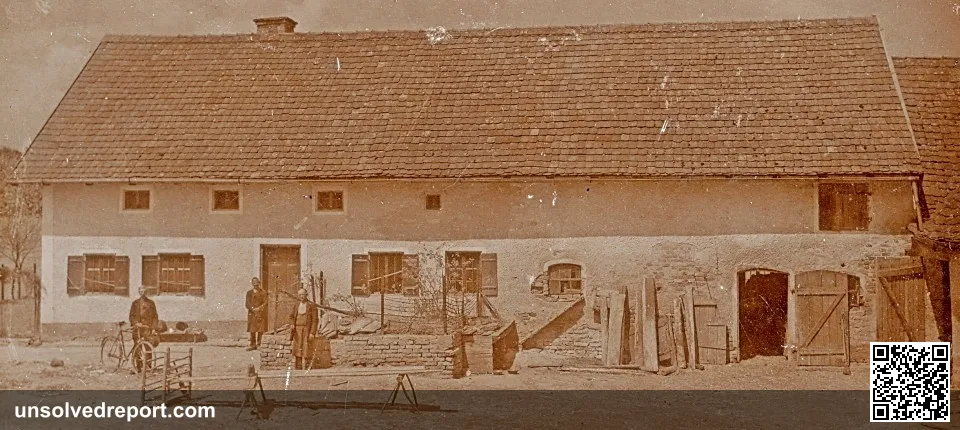
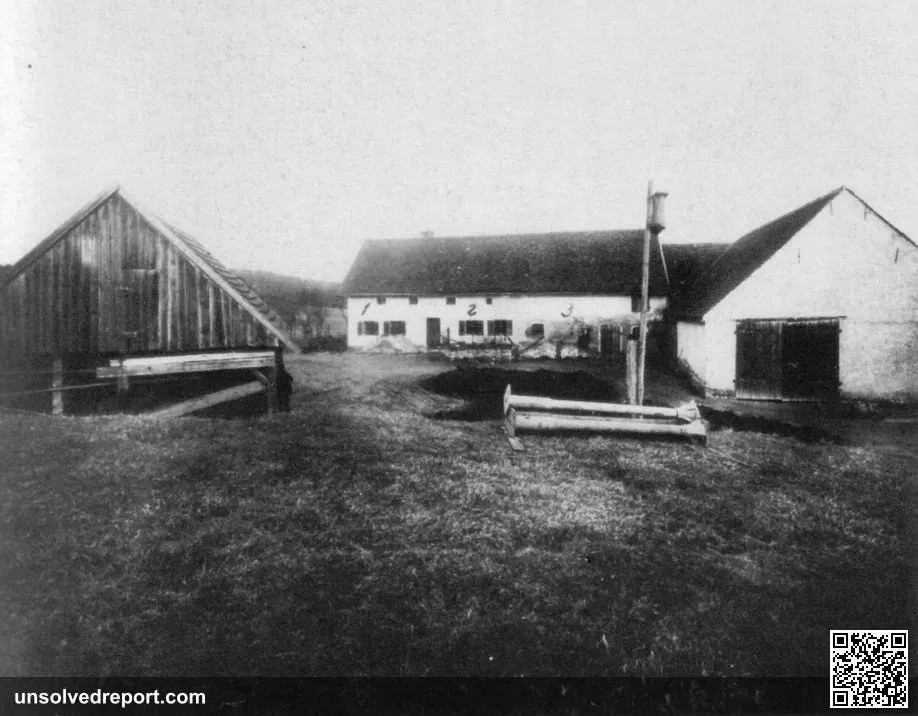
Start with the place. Hinterkaifeck was a tiny farmstead tucked into the Bavarian countryside between Ingolstadt and Schrobenhausen, about 70 kilometers (43 miles) north of Munich, near the little village of Waidhofen (Wikipedia; Mental Floss). Out there, your nearest neighbor was a walk away. On the evening of March 31, 1922, every single person living on that farm was killed.
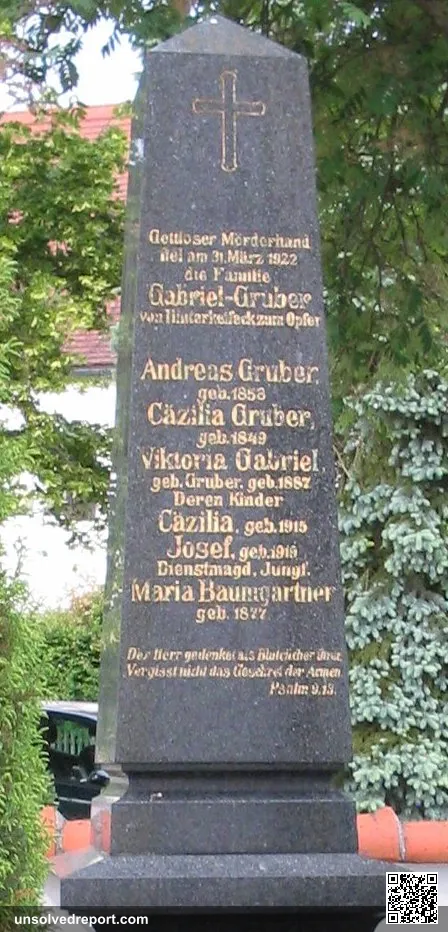
Six of them. The farmer Andreas Gruber, 63, and his wife Cäzilia, 72. Their widowed daughter, Viktoria Gabriel, 35. Viktoria's two small children — Cäzilia, just 7, and Josef, only 2. And the family's new maid, Maria Baumgartner, 44 (Wikipedia) — children and adults alike, gone in a single night much like the Sodder children would vanish without a trace a generation later. Here's the gut-punch detail: Maria had walked in to start the job only hours before she died (All That's Interesting). She unpacked, she settled in, and she never saw the next morning.
Nobody noticed for days. The family stopped showing up around the village. The little girl didn't come to school. Finally, on April 4, 1922, a neighbor named Lorenz Schlittenbauer went to see what was wrong, bringing two other men, Jakob Sigl and Michael Pöll (Wikipedia). What they found is the kind of thing you can't unsee. Four of the victims — Andreas, old Cäzilia, Viktoria, and the 7-year-old — were stacked together in the barn and buried under hay. The maid Maria and toddler Josef lay inside the house (Mental Floss; Historic Mysteries).
The weapon was already on the farm. It was a mattock — a heavy, pickaxe-like tool the locals called a Reuthaue — and it belonged to the Grubers themselves (Wikipedia). Someone later pulled a blood-crusted mattock out of the loft. On April 5, the court physician Dr. Johann Baptist Aumüller did the autopsies and agreed: a mattock was almost certainly what did it (Wikipedia). The wounds were brutal blows to the head. And one detail haunts the file more than any other — the evidence suggested little Cäzilia, the 7-year-old, didn't die quickly. She lived for hours after the attack, lying alone in the straw (Mental Floss). The victims' skulls were removed and shipped to Munich for study. They were reportedly never sent back, and they're believed to have been lost during World War II (Wikipedia; search corroboration).
Now here's the part that turns a horror into a mystery you can't shake. The killer didn't run. Investigators concluded that whoever did this stayed on the farm for days afterward. The animals had been fed. Food in the house had been eaten. The kitchen stove had been used (All That's Interesting; Wikipedia). Remember that smoke? Neighbors had seen it rising from the chimney in the days before anyone found the bodies. Someone was living there, calm as you like, among the dead.
Robbery was the first guess. It collapsed fast — a good pile of cash was sitting right there in the house, untouched (gsnsp summary of case). Over the years the case swallowed roughly 100 interviews and a long line of suspects. The farmhouse was torn down in 1923. Then, in 2007, students at the Fürstenfeldbruck police academy reopened it with modern methods — not unlike how a 2021 physics model finally explained the Dyatlov Pass incident decades after the fact — and said they'd actually landed on a leading suspect. But they refused to publish the name, out of respect for living descendants (Wikipedia; Historic Mysteries). So the answer may exist on paper somewhere. The case has still never been officially solved.
The Real Question Nobody Can Answer
Strip away a century of retellings and the open question is brutally simple: who killed everyone in that house, and why?
Part of why Hinterkaifeck digs under your skin is what supposedly happened in the weeks before the murders. According to accounts repeated in later reporting, Andreas Gruber told neighbors a strange thing — he'd found footprints in the snow leading out of the forest toward his house, but none leading back (All That's Interesting; Mental Floss). Whoever made them, in other words, had walked to the farm and never left. There was more. He reportedly found a Munich newspaper on the property that nobody in the family had bought. He heard footsteps in the attic. A house key went missing. And the previous maid had quit about six months earlier, swearing she heard odd noises and was sure the place was haunted.
Slow down, though. A lot of those chills come from secondhand memories collected after the killings, and a hundred years of folklore has piled onto this case like the hay over those bodies. So lean on what's actually documented — and honestly, it's eerie enough. The animals fed by a killer's hand. The days that killer apparently spent at the scene. The forensic evidence that simply vanished. And the crime scene? Wrecked almost immediately. Schlittenbauer and the others moved the bodies before the authorities showed up, and 1922 forensics weren't much to begin with. The 2007 review reportedly admired how thorough the original detectives were while shaking its head at the missing professional forensics. Any physical clue that might have named the killer was smudged out within hours — and the skulls, the best evidence of all, were eventually lost for good.
So Who Did It? The Theories
What follows are theories. Not one has been proven. The case is still officially open.
The neighbor, Lorenz Schlittenbauer. This is speculation. The man who found the bodies has drawn suspicion for a century. He'd once been romantically involved with Viktoria, and court records show Viktoria had earlier named her own father, Andreas, as the father of her little son Josef during an investigation into the family (Wikipedia). The suspicion leans on reports that Schlittenbauer got into the locked house with surprising ease and handled the bodies, possibly muddying everything. But no one ever found hard proof he was the killer, and he was never charged.
The husband who came back from the dead. Also speculation. Viktoria's husband, Karl Gabriel, was reported killed in France during World War I — but his body was never recovered. That gap fed postwar rumors, none of them backed up, that he'd actually survived and come home to do this. Most researchers find it unlikely given the military records. It stays pure guesswork.
The dark history under the same roof. Here the background is documented; the motive is the guess. Court records confirm that in 1915, Andreas and Viktoria were convicted in connection with an incestuous relationship (Wikipedia). Some argue a household that troubled points to a personal motive rather than a random stranger. Maybe. But a motive isn't a culprit, and no theory built on this one has ever been proven.
The stranger in the attic. Speculation, and the spookiest of the lot. Those footprints that led in but not out, the missing key, the noises overhead — they've fueled the idea that someone had been quietly living in the house for weeks, watching the family from above before he struck. It's the most cinematic theory by miles. It's also the one with the least hard evidence behind it.
A century later, Hinterkaifeck still grips us because it stands exactly on the line between the proven and the unknowable: real people, a real unsolved file, and a fog of detail nobody has ever cleared. The six are buried at Waidhofen, where a memorial still marks the case Bavaria never closed — a nameless-culprit cold case as stubborn as the Somerton Man has been for identity-seekers on the other side of the world. And somewhere out there is one quiet question that has waited a hundred years for an answer — who kept the fire burning?
Sources and Further Reading
- Hinterkaifeck murders — Wikipedia
- The Chilling Story of the Hinterkaifeck Killings — Mental Floss
- The Gruesome True Story of the Unsolved Hinterkaifeck Murders — All That's Interesting
- Germany's Hinterkaifeck Murders Remain Unsolved — Historic Mysteries
Easter Island Moai Walking Mystery: The Legend Science Mocked
Elders swore the moai walked to their platforms. Scientists dismissed it as myth — until 18 people, 3 ropes, and a 4-ton replica proved something startling.

Taos Hum: The Sound Only 2% Can Hear—Machines Found Nothing
Only 2% of people near Taos, New Mexico can hear a strange low drone nobody else can — and government scientists never found where it comes from. Why?

Strangest Historical Events: 12 Real Moments Nobody Can Explain
A town danced itself to death. A crew vanished from a seaworthy ship. Twelve strangest historical events — all documented, all still unsolved. Which one breaks your logic?