Lycurgus Cup Mystery: The Roman Glass That Bleeds Red
A 1,600-year-old Roman cup turns jade green to blood red depending on where the light hits it. Scientists found the nanotech inside — but not who built it, or why.
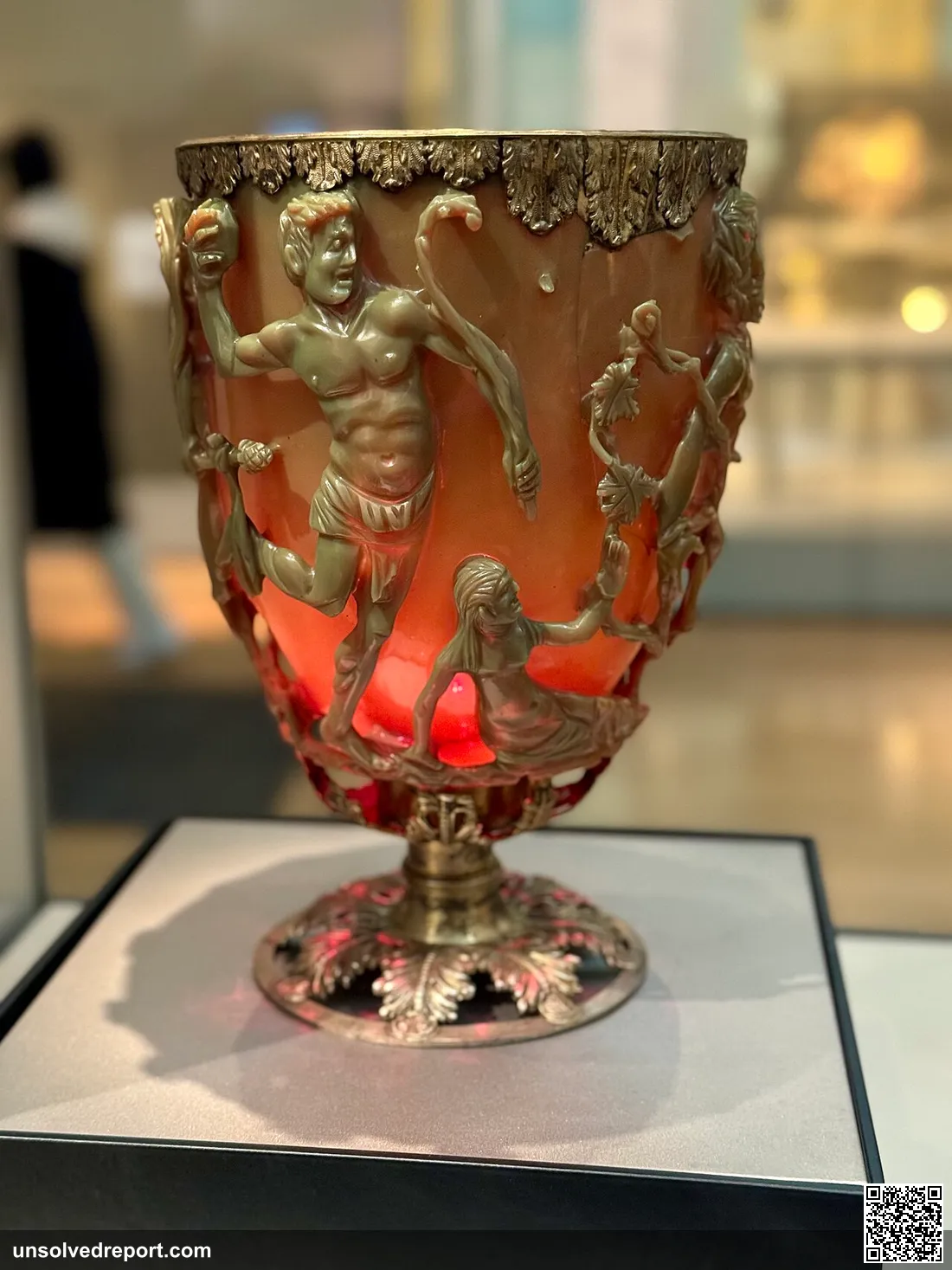
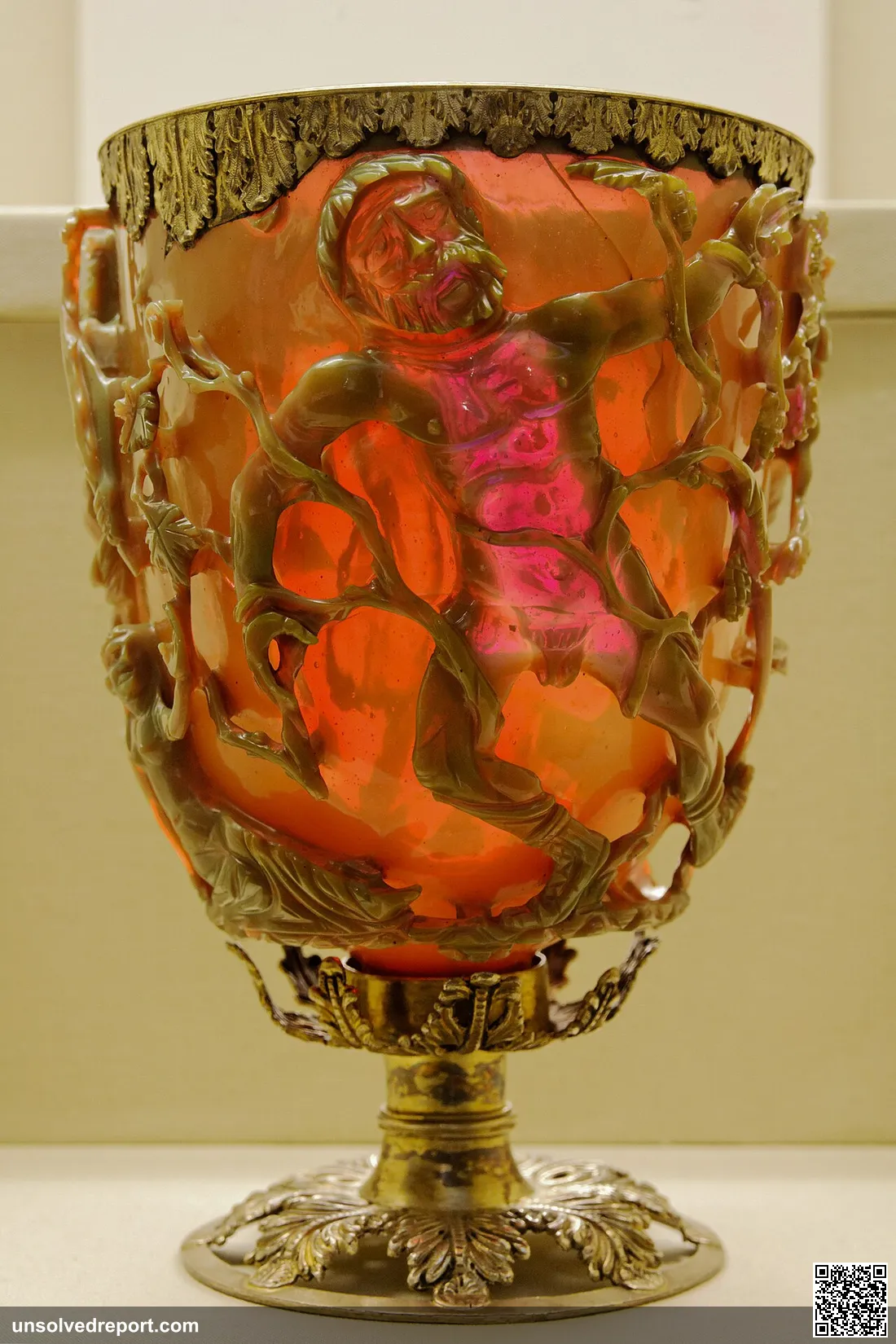
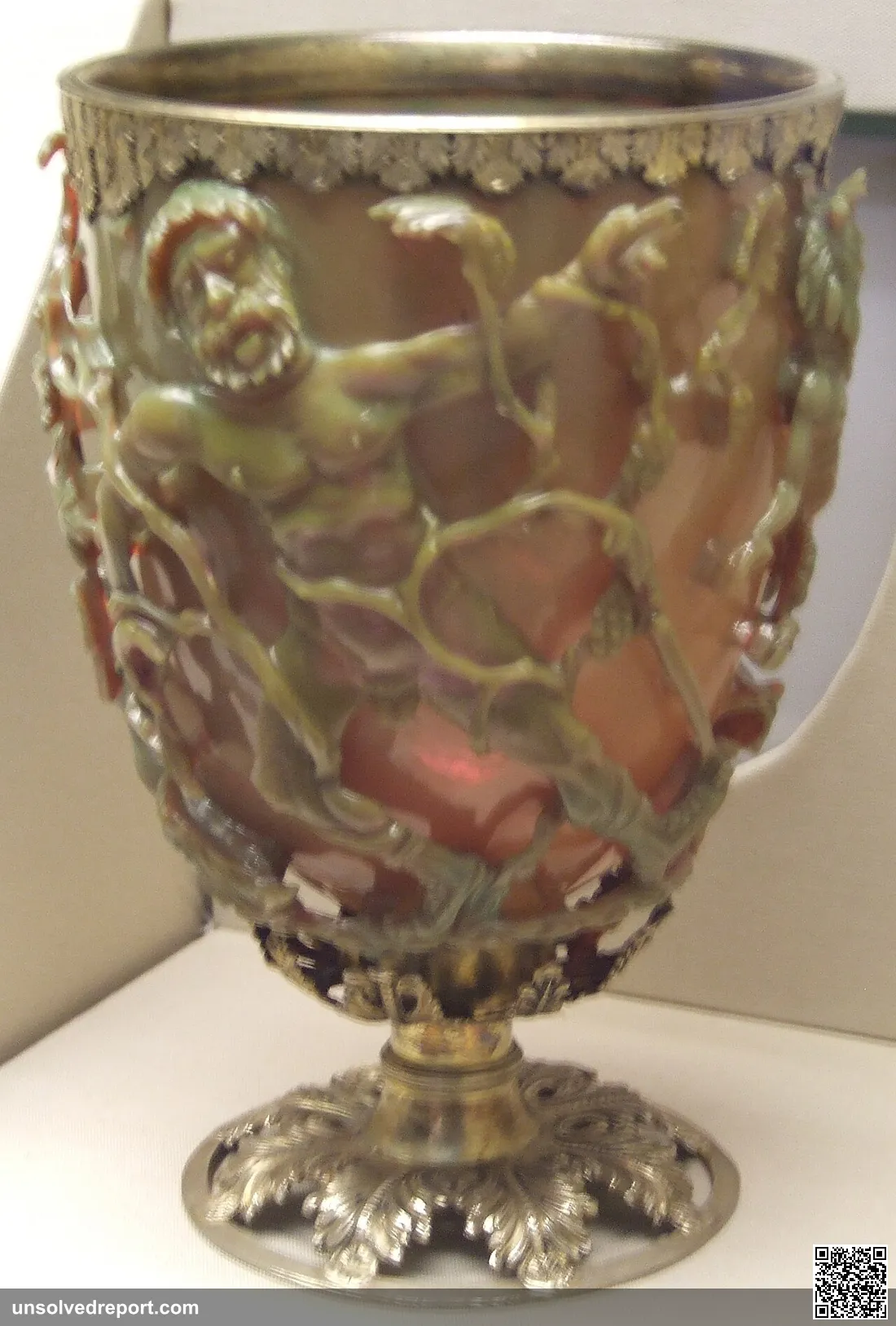
Put a lamp in front of it. The cup sits there cold and jade green, opaque, dead as carved stone. Now carry that same lamp around to the back. The glass catches fire. It floods with a deep, see-through wine-red — like there's blood trapped inside, waiting for the light to find it.
The cup has been pulling this trick for about 1,600 years. And here's what should stop you cold: the people who made it almost certainly had no idea how. We do — mostly. But "mostly" is exactly where the ghost in this story hides.
What we know for certain
Start with the solid ground. The Lycurgus Cup is a Roman drinking vessel from the fourth century A.D., usually pinned to around 290–325 A.D. (British Museum, object 1958,1202.1). It's small — about 15.9 cm tall, 13.2 cm wide, roughly 700 grams. Its gilt-silver rim and foot aren't original; somebody bolted those on much later, around 1800. The British Museum bought it in 1958 from Victor, Lord Rothschild, for £20,000, with help from what is now the Art Fund (Wikipedia; Smithsonian Magazine) — a similar stroke of luck to how the Hoxne Hoard, Britain's richest Roman treasure, ended up in a museum instead of staying buried forever.
Now forget the color for a second, because the cup is already insane before it does anything at all. It's a "cage cup," or diatretum — one of the most reckless objects in the entire ancient toolkit, in the same league of baffling Roman craftsmanship as the Roman dodecahedron, another object nobody can fully explain. The figures aren't glued on. They were carved out of a thick block of glass, every scrap around them slowly cut and ground away until the shapes stand almost free of the body underneath, hanging on by tiny bridges. One slip of the tool and the whole thing explodes into dust. The Lycurgus Cup is the only well-preserved cage cup that shows actual figures instead of a geometric pattern — which is a big reason scholars call it the most spectacular Roman glass of its age (British Museum).
And the scene carved into it is grim. This is the death of King Lycurgus of Thrace, straight out of Greek myth. Lycurgus picked a fight with the god Dionysus — and in the version frozen here, vines coil around him and strangle him to death as payback. Look closely and the chaos comes alive: Dionysus, a satyr, the nymph Ambrosia, and Pan, all crowded into the killing (British Museum).
Then there's the trick that made it famous. The glass is dichroic — it simply refuses to pick one color. Green when light bounces off it. Red when light passes through it. And for decades after 1958, nobody could fully explain it. The answer finally arrived in 1990, when D. J. Barber and Ian C. Freestone took tiny broken chips of the cup, slid them under an analytical transmission electron microscope, and published what they saw in the peer-reviewed journal Archaeometry (Barber & Freestone, 1990, Wiley Online Library).
What they found, scattered through the glass, were specks of metal — typically just 50 to 100 nanometers across. Far too small for any ordinary microscope to catch. X-ray analysis pinned down what they were: a silver-gold alloy, roughly 7 parts silver to 3 parts gold, with about 10% copper mixed in. And how much of it? Almost nothing. We're talking a few hundred parts per million of silver, and just tens of parts per million of gold, dropped into otherwise totally ordinary Roman glass (Barber & Freestone, 1990; Freestone et al., "The Lycurgus Cup — A Roman Nanotechnology," Gold Bulletin, 2007).
Those invisible specks are why people now call this one of the oldest known pieces of nanotechnology on Earth — right up there with the ancient artifacts that shouldn't exist but somehow do. The mechanism even has a name: surface plasmon resonance. Shrink a metal particle down near the size of a wavelength of light, and the electrons inside start sloshing back and forth in time with the incoming glow — soaking up some colors, flinging others away. In this cup, the particles throw green light back at your eyes. So from the front: green. But the light that fights its way through the glass limps out the other side red (Freestone et al., 2007, Gold Bulletin). Freestone called it, to Smithsonian Magazine, "an amazing feat."
The question nobody can answer
So the color trick is solved. Case closed, right? Not even close. There's a far stranger question hiding underneath it, and it refuses to die: did the Roman craftsmen know what they were doing?
Sit with what this effect actually demands. Metal measured in parts per million. Particles measured in tens of nanometers. The Romans had no microscopes. No atomic theory. No word — no concept — for a nanoparticle, much like the Antikythera Mechanism baffles historians as technology that seems centuries ahead of its era. As the published research itself admits, it stretches belief that any artisan could have deliberately dialed gold and silver down to those ghostly levels, with the kind of control we'd call "design" (Wikipedia summary of the scholarship; Freestone et al., 2007).
And yet — "pure accident" feels just as wrong. The result is too exact. The cup is too perfect, too one-of-a-kind. Here's where it gets genuinely eerie: scholars can't even say where the metal came from. The gold might have slipped in as a trace impurity hiding inside the silver, or as leftover crumbs of gilding or gold leaf lying around the workshop — not as anything anyone measured out on purpose. Nobody can say for sure where the cup was made, how the magical glass blank was first produced, or whether the glassworkers saw the color-shift as a recipe they could repeat — or just a one-time stroke of luck they'd never claw back (Freestone et al., 2007). The technique flickers across only about a century of Roman glassmaking, and then it's gone. Which is exactly what you'd expect from a fragile, half-accidental know-how that even its own makers never really understood.
So the real mystery isn't how the cup changes color. That part's settled. The mystery is what kind of thing we're actually holding: the deliberate masterpiece of a lost recipe — or a one-in-a-thousand fluke that a brilliant carver got lucky enough to turn into treasure.
The theories — and why none of them stick
They did it on purpose. Some accounts point to the precision of the alloy and argue the color trick simply has to be intentional craft — a closely guarded workshop secret, passed hand to hand. The honest catch: the metal levels are so absurdly low that deliberate control like that is hard to swallow for the period. This one stays speculation.
Lucky accident, then refined by eye. A middle path, and also speculation: the magic glass showed up by chance, out of a contaminated batch, and craftsmen who spotted the stunning result simply set that glass aside and reused it — without ever knowing why it worked. It fits the evidence beautifully. It also can't be proven.
Grapes into wine. Since the cup honors Dionysus, god of wine, some suggest the green-to-red shift was treasured as an echo of grapes ripening into wine — maybe even the whole reason this glass was picked for a Bacchic vessel. It's a gorgeous idea. There's just no ancient text saying the makers meant it, so it remains a guess.
It was a lamp. Because the red only blooms in transmitted light, a few scholars wonder if the object once hung as a lamp, lit from inside, where the effect would blaze brightest of all. The British Museum lists it as a drinking-cup, though, and the lamp theory stays a minority speculation.
Hidden politics. One reading ties the downfall of Lycurgus to Emperor Constantine crushing his rival Licinius around 324–325 A.D. — a tidy little piece of imperial flattery dressed up as myth. Plausible. Also entirely circumstantial, and squarely in speculation territory.
What is crystal clear is what happened next. Modern researchers, including engineer Gang Logan Liu, have reached straight back to the cup's plasmonic behavior to build ultrasensitive biosensors — devices that flip color the instant they catch a tiny chemical shift (Smithsonian Magazine). An object whose makers may never have grasped their own magic is now teaching twenty-first-century labs how to catch disease. Sixteen centuries on, the cup is still glowing — just in a different kind of dark.
Sources & further reading
- British Museum, collection record for the Lycurgus Cup (object 1958,1202.1): https://www.britishmuseum.org/collection/object/H_1958-1202-1
- D. J. Barber & I. C. Freestone, "An Investigation of the Origin of the Colour of the Lycurgus Cup by Analytical Transmission Electron Microscopy," Archaeometry (1990): https://onlinelibrary.wiley.com/doi/10.1111/j.1475-4754.1990.tb01079.x
- I. Freestone, N. Meeks, M. Sax & C. Higgitt, "The Lycurgus Cup — A Roman Nanotechnology," Gold Bulletin (2007): https://link.springer.com/article/10.1007/BF03215599
- Smithsonian Magazine, "This 1,600-Year-Old Goblet Shows That the Romans Were Nanotechnology Pioneers": https://www.smithsonianmag.com/history/this-1600-year-old-goblet-shows-that-the-romans-were-nanotechnology-pioneers-787224/
- Wikipedia, "Lycurgus Cup" (overview and provenance, cross-checked against the above): https://en.wikipedia.org/wiki/Lycurgus_Cup

GD-1 Stellar Stream: An Invisible Object Too Dense to Explain
Something invisible punched a hole through the GD-1 stellar stream — and it's too dense to be ordinary dark matter. So what actually hit it?

10 Deep-Space Signals Science Still Can't Explain
A 72-second blast nobody could repeat. A rock that sped up with no tail. Ten deep-space signals our telescopes recorded and still cannot explain.

The Sodder Children: 5 Kids Vanished, Zero Bodies
Five Sodder children vanished in a 1945 Christmas fire. No bones. No teeth. Nothing. Eighty years on, one question still has no answer: where?