Mahdia Shipwreck: The Greek Treasure Ship No One Can Explain
Sponge divers off Tunisia found bronze gods and 200 tons of marble on the seabed — a 2,000-year-old cargo so strange, no one agrees why the ship was even sailing.
June 1907. Greek sponge divers come up off the coast of Tunisia with a story nobody believes. Down in the gloom near the town of Mahdia, about 40 meters below the surface, something is lying on the seabed in long, straight rows. It looks like cannon barrels. Dozens of them, marching across the sand in the dark.
They are not cannons.
They are marble columns. The spilled cargo of a ship that sank more than two thousand years ago. And over the next few years, divers will keep going down and keep bringing things up: bronze gods, marble faces, golden furniture fittings, building stone by the ton. The Mahdia wreck would turn out to be one of the richest ancient cargoes ever pulled from the sea — rivaled only by the Antikythera wreck, another Greek shipwreck found by sponge divers — and it would quietly give birth to a whole new science. But here's the catch. For all that treasure, the ship still keeps one secret. Nobody knows where it was going.
What We Actually Know
Start with the where. The wreck lies about 4.7 kilometers off Mahdia, on the Tunisian coast south of Tunis — not far from where excavators at Carthage's Tophet have been digging up their own centuries-old argument — in roughly 40 meters of water (French Ministry of Culture, underwater archaeology; MaSS, Cultural Heritage Agency of the Netherlands). Word of the sponge divers' 1907 find traveled fast, and it landed on the desk of Alfred Merlin, the French scholar who ran antiquities in the Tunisian protectorate at the time. Merlin teamed up with the classical archaeologist Salomon Reinach, took funding in part from the American collector James Hazen Hyde, and launched salvage campaigns that ran from 1907 to 1913. The men doing the work? Hard-hat divers in metal helmets and lead-soled boots, walking the seabed like astronauts (Wikipedia; French Ministry of Culture).
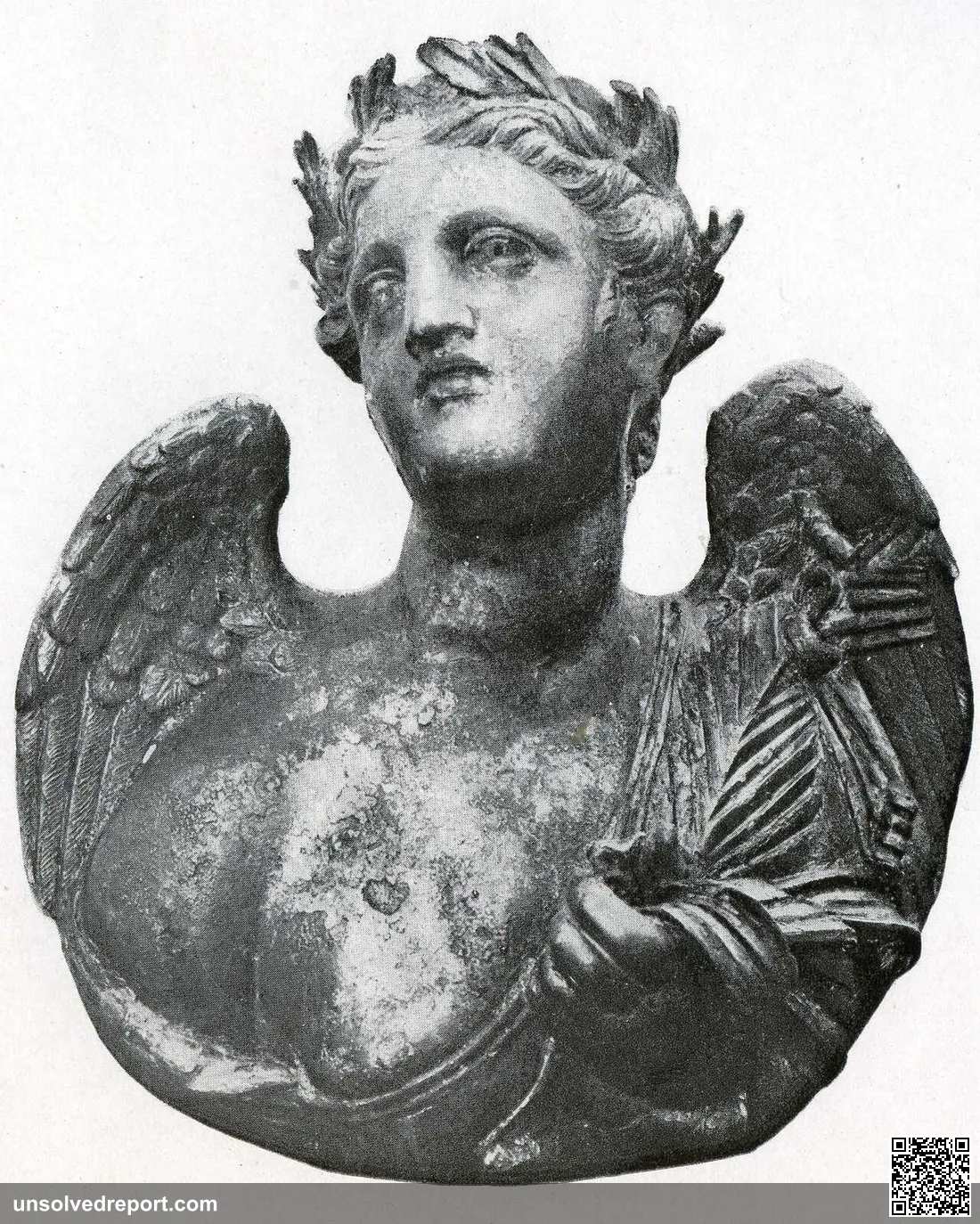
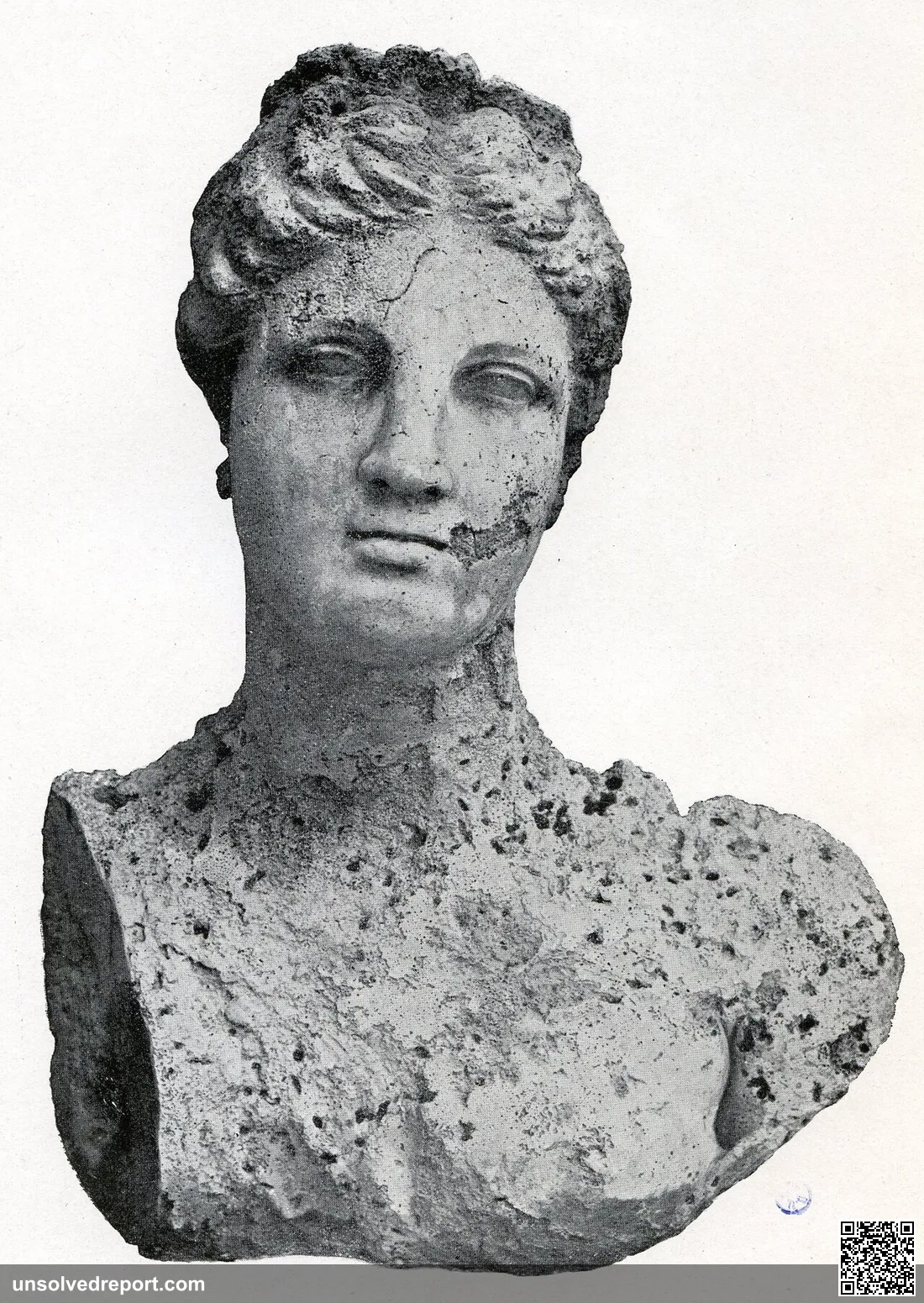
What they raised is hard to believe. This ship had been hauling top-shelf Greek art and architecture, apparently headed for Roman buyers: several dozen marble columns, with later surveys counting somewhere in the range of 60 to 70 Attic-marble column shafts that together weighed around 200 tons, plus the capitals and bases to go with them (MaSS). And then there were the statues. Bronzes of the very first rank, including a herm of Dionysus signed with the name of its maker, Boethos of Chalcedon, and a winged, olive-wreathed young man that scholars read as either Eros or Agon (Wikipedia). The haul also held a marble bust often taken to be Ariadne, two bronze figurines of dancing dwarfs, decorative bronze fittings, candelabra, fittings from klinai (the couches Romans reclined on at dinner), and big marble vessels. Even the lead anchor parts told a story: their isotopes point to Spanish ore — a tiny clue to just how far Mediterranean stuff traveled.
The ship itself was no little fishing boat. Reconstructed, it ran somewhere near 40 meters long. The pottery found with it dates the wreck to roughly 80 to 60 BC, dropping it squarely into the late Hellenistic age (Wikipedia; MaSS). The usual reconstruction goes like this: the ship set out from Piraeus, the port of Athens, was caught by a storm on its way toward Italy, and got driven onto the North African coast — where it sank for good.
The rescued objects went to the Musée National du Bardo in Tunis, and they're still the heart of the collection. Then, in 1948, the wreck got famous a second time. Jacques-Yves Cousteau, along with Philippe Tailliez and Frédéric Dumas, dropped down to the site using the newly perfected Aqua-Lung. It's widely cited as the first underwater archaeological dig ever done with self-contained breathing gear — a founding moment for the entire field (French Ministry of Culture, "The Pioneers"). Decades on, in the 1990s, surveys co-led by Mensun Bound of Oxford and Fethi Chelbi of Tunisia's Institut National du Patrimoine used side-scan sonar to map the site without digging it up. A 1993 check found the leftover wreckage falling apart, and around the same time German and Tunisian specialists did major conservation work on the salvaged sculptures (Wikipedia).
The Question the Treasure Can't Answer
Here's the strange part. With all of it on the table — the bronzes, the columns, the dancing dwarfs — the one thing the treasure can't tell us is the thing we most want to know. Why was a single ship carrying this much art and architecture, and where on earth was it going?
Look at the cargo and it gets weirder the longer you stare. Brand-new luxury bronzes. Antique masterworks. And on top of that, enough building columns to stock a small quarry. That's a very odd mix for one buyer's order. So which was it? A commercial run — a dealer's grab-bag of Greek art for the red-hot Roman market? A single huge commission for one villa or one public building? Or loot — the stripped ornament of conquered Greek cities being shipped west? And the maddening part: no inscription, no manifest, no destination port has ever come up out of that water. The "Piraeus to Italy" route is a guess pieced together from the cargo and where the ship lies, not a logbook anyone can read. The exact endpoint — Rome, Puteoli, somewhere else entirely — is still a blank. Worse, the remains rotting on the seabed mean the rest of the answer may be quietly running out of time.
Three Ways to Read the Wreck
The most romantic answer is the Sulla spoils-of-war theory, and it's speculation. The Roman general Lucius Cornelius Sulla sacked Athens in 86 BC during his war against Mithridates, and ancient writers describe him carting off Greek treasures by the load. Some have wondered whether the Mahdia columns and statues were that plunder, shipped out on Sulla's orders (MaSS). It's a great story, and the timing is roughly right. But go easy on it: the pottery dating clusters around 80 to 60 BC — a bit too late for the sack — and a cargo blending fresh commercial bronzes with building stone fits an art shipment at least as neatly as a one-off war prize. Tempting, yes. Proven, no.
The cooler-headed reading, and the one a lot of archaeologists lean toward, sees the wreck as evidence of the late-Republican art market. Once Rome swallowed the Greek world, rich Romans developed a near-bottomless hunger for Hellenic sculpture and decor, and a busy trade carried both originals and copies westward to feed it. On this view, the Mahdia ship isn't loot or legend at all — it's a freeze-frame of everyday commerce, just an unusually fancy one: a freighter packed with goods for people decorating their villas and public squares.
And then there's the third angle, which is about what the wreck did for science rather than where it came from, and this part is documented. Whatever the cargo was for, Mahdia rewired how we study the past underwater — from Merlin's pioneering helmet-diver salvage, to Cousteau's 1948 scuba survey, to the gentle sonar mapping of the 1990s that read the site without disturbing it.
What nobody argues about is the sheer wonder of it. One storm, two thousand years ago, scattered a museum's worth of Greek masterpieces across the seafloor — much like the fortunes still sitting in other famous shipwrecks around the world — then packed them in sand and silence and held them there, waiting, until a generation of sponge divers and scientists could finally lift them back into the light. The art has surfaced. The ship's last secret hasn't moved an inch.
Sources & Further Reading
- Wikipedia, "Mahdia shipwreck": https://en.wikipedia.org/wiki/Mahdia_shipwreck
- French Ministry of Culture, Underwater Archaeology, "Heavy gear and the Mahdia shipwreck": https://archeologie.culture.gouv.fr/archeo-sous-marine/en/heavy-gear-and-mahdia-shipwreck
- French Ministry of Culture, Underwater Archaeology, "The Pioneers": https://archeologie.culture.gouv.fr/archeo-sous-marine/en/pioneers
- MaSS, Cultural Heritage Agency of the Netherlands, "Mahdia wreck": https://mass.cultureelerfgoed.nl/mahdia-wreck
Llanganates Treasure: The 750 Tons of Inca Gold Nobody Can Find
Llanganates treasure: a doomed Inca emperor, 750 tons of vanished gold, a wilderness that swallows hunters whole. Is any of it still down there?
Irish Crown Jewels Theft 1907: The Safe That Emptied Itself
No forced lock. No alarm. No suspect ever charged. Four days before a king arrived, Dublin Castle's safe was found open and empty — so who had a key?
Awa Maru Gold: 40 Tons Vanished, 2,004 Died, No Answer
The US promised in writing not to sink the Awa Maru — then a submarine did anyway, taking 2,004 lives and (maybe) 40 tons of gold. Did it ever exist?