Awa Maru Gold: 40 Tons Vanished, 2,004 Died, No Answer
The US promised in writing not to sink the Awa Maru — then a submarine did anyway, taking 2,004 lives and (maybe) 40 tons of gold. Did it ever exist?
Picture a ship glowing in the dark. April 1, 1945, the Taiwan Strait at night, and here comes a Japanese liner lit up like a floating festival — every electric light blazing, giant white crosses painted across her hull and her decks. She was the safest ship on the ocean, and everybody knew it. The United States had promised, in writing and over the radio, not to lay a finger on her.
A few minutes after a submarine's torpedoes hit, more than two thousand people were dead.
And out of that wreckage swam a rumor that has outlived nearly everyone who touched it: that somewhere on the seabed off China lies a fortune in gold, a glitter of diamonds, and the lost bones of one of our oldest ancestors.
This is the story of the Awa Maru — and of the thin, stubborn line between what we can prove and what we only wish we knew.
What We Know for Certain
Start with the ship herself. The Awa Maru was a modern passenger-cargo liner of 11,249 gross tons, built by Mitsubishi at Nagasaki and finished in March 1943 (Wikipedia, "MV Awa Maru"). By early 1945 she'd been handed an unusual job: hauling Red Cross relief supplies to Allied prisoners of war scattered across Japanese-occupied Asia. In return for that mission of mercy, the United States gave her something almost unheard of in wartime — formal safe passage.
This wasn't a vague gentleman's agreement. It was an order, broadcast loud and clear. On March 28, 1945, Vice Admiral Charles Lockwood radioed his submarines: "LET PASS SAFELY THE AWA MARU CARRYING PRISONER OF WAR SUPPLIES. SHE WILL BE PASSING THROUGH YOUR AREA BETWEEN MARCH 30 AND APRIL 4. SHE IS LIGHTED AT NIGHT AND PLASTERED WITH WHITE CROSSES" (U.S. Naval Institute, Proceedings, "Let Pass Safely the Awa Maru," 1974). Her exact route and schedule went out again and again, in plain language anyone could read.
So how does a ship like that end up on the bottom?
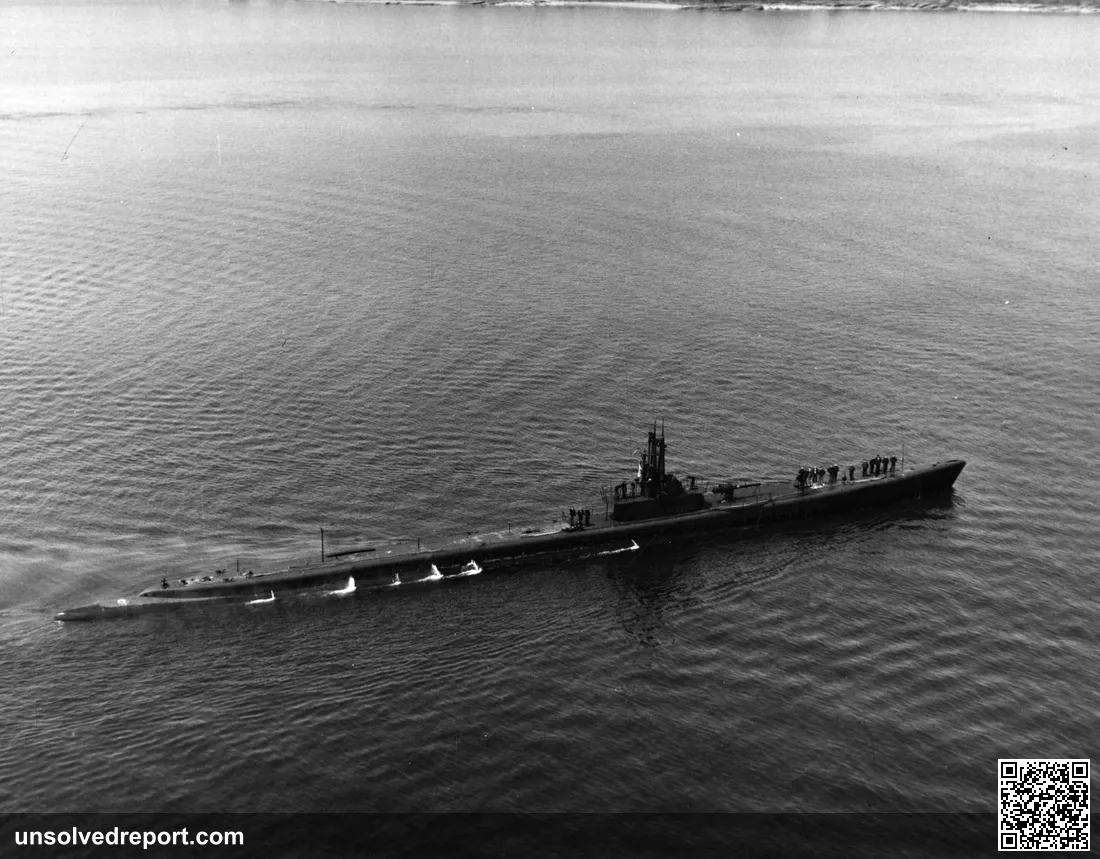
The system broke at the last link. The submarine USS Queenfish (SS-393), under Commander Charles Elliott Loughlin, caught a fast surface contact in heavy fog. On radar it looked like a destroyer. Here's the gut-punch: Loughlin had never been personally briefed on the Awa Maru, and copies of those safe-conduct broadcasts had reportedly never been put in front of him (Proceedings, 1974). The Queenfish fired. The liner went down in minutes.
The human cost isn't in dispute, and it's almost unbearable. Of the 2,004 people aboard, exactly one walked away alive — a crewman named Kantora Shimoda, the captain's personal steward, fished out of the water afterward (Wikipedia). And here's the strange part: accounts say it was the third time Shimoda had been the only soul, or nearly the only soul, to survive a sinking ship.
What came next was a reckoning. The U.S. Navy court-martialed Loughlin. The board threw out the gravest charges but found him guilty of negligence — and handed down nothing more than a letter of admonition. That feather-light sentence so enraged Admiral Chester Nimitz, the convening authority, that he formally rebuked the members of the court for letting Loughlin off so easily (Proceedings, "The Treasure of the Awa Maru," 1982; UPI Archives, 1982). Japan demanded payment. On August 14, 1945 — the very day it surrendered — Tokyo put the damages at roughly 227 million yen, about $52.5 million. The bill was never paid. The matter was quietly closed in 1949 (Wikipedia).
That's the part everyone agrees on. Now comes the part that won't sit still.
The Question That Won't Die
Here's the mystery no one has been able to bury: what was actually packed into the Awa Maru's holds when she went down?
The boring answer — and boring answers are often the true ones — is industrial. The more credible sources describe her return cargo as raw materials: tin, rubber, lead, sugar, nickel. Add to that roughly 1,700 merchant seamen and around 80 first-class passengers being evacuated from Singapore back to Japan (Wikipedia). And one small detail quietly stabs the treasure legend in the heart: when Japan filed its formal damage claim, it listed loss after loss — but said nothing about gold bullion (Wikipedia; Proceedings, 1982). Think about that. A government billing the U.S. for everything it lost would have every reason to mention tons of gold — and no reason at all to hide it.
And yet. The rumors were specific. They were stubborn. They swept across Asia for decades: that a desperate Japan had stuffed the "safe" ship with looted wealth — usually pegged at 40 tons of gold, a stash of platinum, and around 150,000 carats of diamonds, echoing the same wartime looted-gold mythology that grew up around Yamashita's Gold in the Philippines. In some retellings the hoard was worth five billion dollars or more (Wikipedia; Proceedings, 1982). People took it seriously, too. In 1976 an American salvage syndicate — reportedly including former Mercury astronaut Scott Carpenter and Jon Lindbergh — went after the rights to the wreck.
Then came the move that turns this from a tall tale into a genuine puzzle.
China didn't hand over those rights. Instead, the People's Republic of China quietly found the wreck itself — reportedly in 1977 — and launched a recovery effort of staggering scale, on par with the costliest shipwreck treasure hunts in history. Over roughly five years, at a reported cost near $100 million, China sent down scores of divers and hundreds of support crew to take the hull apart piece by piece (Wikipedia; UPI Archives, 1982). And the result, by the public accounting? Human remains, returned to Japan. Some personal belongings. And no treasure.
Sit with that. If 40 tons of gold had been down there, one of the most relentless salvage operations of the age never said it found a single bar. That silence is the whole mystery in a nutshell.
So Where Did the Gold Go?
Maybe there never was any. This is the explanation that fits the paper trail best, and it's almost embarrassingly simple: the Awa Maru carried industrial raw materials, the gold story grew out of wartime whispers about plundered Asian riches, Japan's own claim named no bullion, and China's exhaustive dig turned up nothing. By this reading, the "phantom gold" was always a phantom — the same way Lake Toplitz's Nazi treasure turned out to be only half true once divers actually looked. The only act of faith it asks of you is trusting the official inventories — and it's the version the surviving evidence wears most comfortably.
Or maybe the gold sailed the other way — and got there. Some accounts pin a twist on declassified U.S. signals intelligence: that gold was in the picture, but it was being shipped from Japan to Southeast Asia earlier in the voyage, and was safely delivered before the ship was reloaded with tin and rubber for that doomed final leg home (Wikipedia, citing NSA analysis). We weren't able to read the underlying declassified study ourselves, so treat this as a reported claim, not a proven one. But if it holds up, it's elegant — it would explain both the gold rumors and the empty wreck in a single stroke.
And then there's the bone that haunts the whole thing. The most chilling legend has nothing to do with money. The fossil bones of "Peking Man" — Homo erectus pekinensis — vanished in December 1941 while being evacuated out of China, and have never resurfaced (NUMA, "Divers Seek Bones of Peking Man," 2012) — a disappearance as clean and unexplained as how Japan's own Honjo Masamune sword vanished after the war. Investigator Christopher Janus chased tips that the bones had ended up aboard the Awa Maru, and a surviving steward reportedly described trunk-like containers on the ship. Tantalizing — but it falls well short of proof, and the documented trail of those fossils points somewhere else entirely. Call it an evocative possibility. Not a finding.
What's certain is the part no theory can soften: a ship that sailed under a written promise of safety, lost with all but one soul aboard. The gold may be a ghost. The loss never was.
And those vanished bones of Peking Man? They were last seen heading for a ship — and the search for them is a mystery all its own.
Sources & Further Reading
- Wikipedia, "MV Awa Maru"
- U.S. Naval Institute, Proceedings, "Let Pass Safely the Awa Maru" (1974)
- U.S. Naval Institute, Proceedings, "The Treasure of the Awa Maru" (1982)
- UPI Archives, "Full story told of WWII sinking of the Awa Maru" (1982)
- National Underwater and Marine Agency (NUMA), "Divers Seek Bones of Peking Man" (2012)
King John Lost the Crown Jewels: The Tide That Ate a King's Treasure
King John lost the crown jewels to a tide in 1216 — or did he? Two chroniclers tell wildly different stories, and 800 years of searching found nothing. Here's why.
El Carambolo Treasure: The Gold That Wasn't Supposed to Exist
3 kilos of 2,700-year-old gold, buried under a Seville shooting club — and a lab test that quietly demolished the Atlantis theory. What it actually proves is stranger.
11 Shipwrecks That Swallowed Fortunes Still Missing
Galleons of silver, ships of gold, royal emeralds lost to the sea — here are 11 famous shipwreck treasures, and the fortunes still unaccounted for below.