Newgrange: The Tomb That Catches the Sun Once a Year
Older than the pyramids, this Irish mound swallows one winter sunrise a year and aims it straight at the dead. Nobody left a note explaining how, or why.
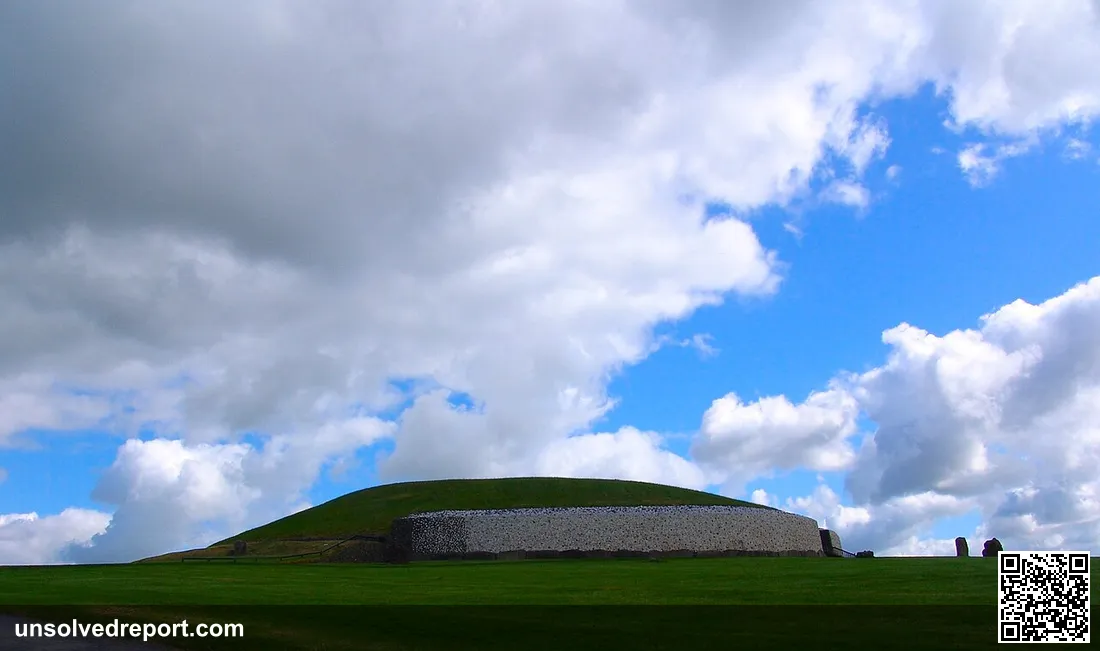
For thousands of years, people walked past it and saw a hill. A big green hump on a ridge above a bend in the River Boyne, in County Meath, Ireland. Grass on top. The size of a sports stadium. Just a hill.
It is not a hill.
It is Newgrange, and it was built on purpose around 3200 BCE. Stop and sit with that number. It is older than Stonehenge in the form we know today. It is older than the Great Pyramids of Giza. And once a year, on the shortest, darkest mornings of winter, this 5,000-year-old mound performs a trick so precise it still works perfectly today, and the people who designed it left behind not one written word telling us how, or why.
Here is the rare thing about this mystery. The facts are rock solid. And somehow the wonder survives every single one of them.
What We Can Actually Prove
Newgrange is the star of Bru na Boinne, a cluster of Neolithic monuments scattered across the Boyne Valley alongside the giant mounds of Knowth and Dowth. In 1993 the whole complex was named a UNESCO World Heritage Site, one of the richest pockets of prehistoric carved stone art anywhere in Europe, as described by UNESCO.
And it is huge. Not "big for its age" huge. Just huge. Drawing on the survey figures summarized by Wikipedia:
- The mound stretches roughly 85 meters across and rises about 12 meters high, packing something like 200,000 tonnes of stone and earth.
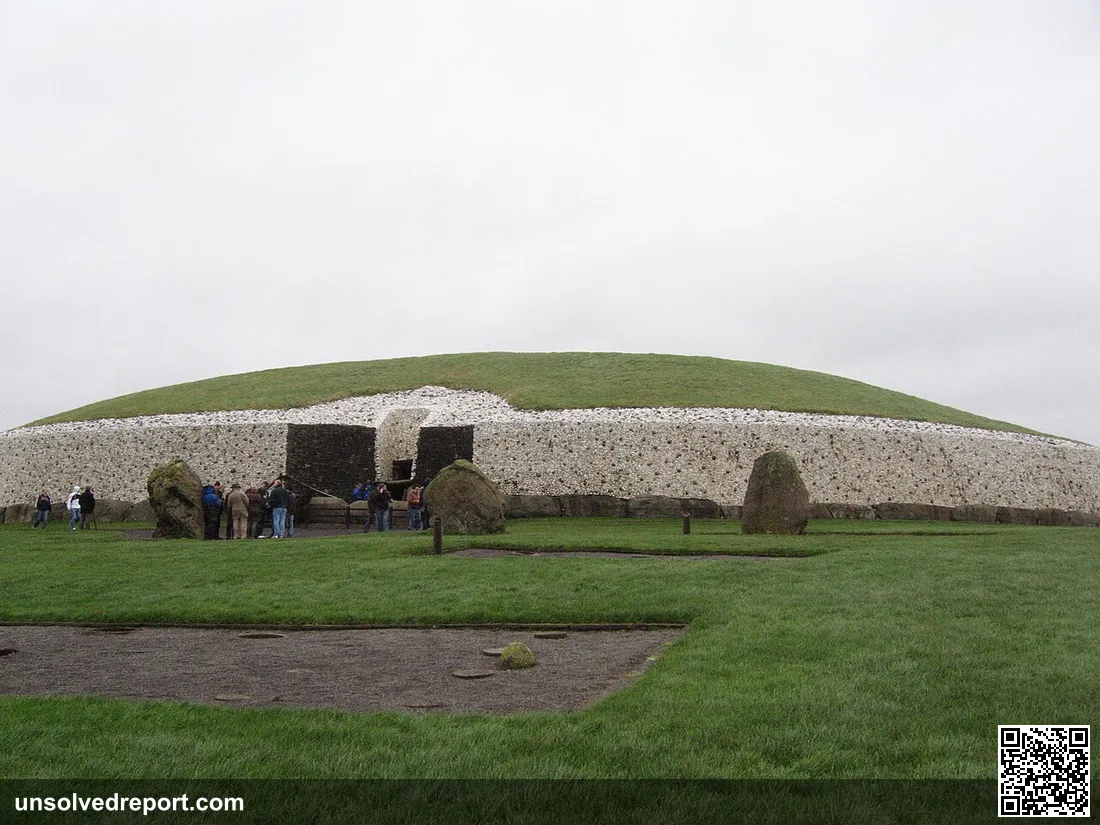
- A ring of 97 massive kerbstones circles its base, laid end to end, many of them carved.
- One stone-lined passage cuts about 19 meters straight into the mound, opening into a cross-shaped chamber with three side rooms.
- The roof is a corbelled vault, flat stones stacked and overlapping up to a single capstone. No mortar. None. And it has kept the inner chamber bone-dry for five thousand years.
Then there is the art, and it is staggering. The great stone guarding the entrance is cut with a bold triple spiral, one of the most famous images in all of European prehistory. Spirals, diamonds, zigzags ripple across stones all over the site. These were people with a real visual language, and they carved it into hard rock using nothing but other stones.
Inside, diggers found human remains, some burned, some not, tucked in with grave goods like beads and pendants. That is why archaeologists first filed Newgrange under "passage tomb." Fair enough. People were buried here. But here is the catch that many specialists now press: burial may have been only one job this building did.
It is worth slowing down on the raw materials, because that is where the achievement stops being a fact and starts being a feeling. This mound was not scraped together from nearby dirt. The builders chose and dragged hundreds of huge structural stones, the kerbstones, the passage uprights, the roof slabs, some weighing several tons, many hauled from sources kilometers away. The dazzling white stone on the front is quartz, and geologists trace it to the Wicklow Mountains far to the south. The rounded granite cobbles set among it seem to come from the Mourne Mountains, way up north. Picking out these exact, faraway stones and carrying them to one ridge above the Boyne was a deliberate, organized campaign by a people with no wheels, no metal, no horses or oxen to pull a load. The Boyne Valley monuments are one of the great muscle-and-bone construction projects of Neolithic Europe.
The Sunrise Trap
Now for the part that turns Newgrange from impressive into spine-tingling. It sits right above the entrance: a small, carefully built opening called the roof-box. For 360-odd days a year, it just sits there doing nothing you would notice.
Then comes the winter solstice. In the dawn window of roughly December 19 to 23, the rising sun lifts clear of the horizon, and a thin blade of light slips through the roof-box, races the full 19 meters down the dark passage, and lands on the floor of the inner chamber. It lights the room for about 17 minutes. Then it withdraws, and the dark closes back in for another year.
This is not a legend told around a fire. It was documented in modern times by the archaeologist Michael J. O'Kelly, who excavated and conserved Newgrange between 1962 and 1975. On December 21, 1967, he stood inside that chamber and watched the light come, and wrote it down. The aim is no accident. The roof-box, the slope of the passage, and the chamber were arranged so the deep midwinter sunrise, and basically no other, would strike that floor.
A few honest details that usually get lost when this story gets passed around:
- The beam comes in through the purpose-built roof-box, not the main doorway. That is exactly why nobody clocked the effect until the box itself was spotted.
- It happens across several mornings around the solstice, not on one magic date. The sun's rising spot barely shifts near the solstice, and tiny changes have crept in over thousands of years.
- Want to be inside that chamber when it happens? So does everyone else. The handful of spots are handed out by an annual public lottery that pulls tens of thousands of hopefuls for a literal handful of seats, as reported by National Geographic.
And here is what really seals it: Newgrange is not a one-off fluke. Just up the valley, the passage tomb of Knowth has two passages pointing roughly east and west, plausibly at the equinox sunrises and sunsets. Taken together, the great Boyne tombs look like a whole society leaning into the movements of the sun, over and over. Cross the Irish Sea, cross the Continent, and you find the same instinct, Maeshowe in Orkney among them, other megaliths lined up with the sky. Newgrange is the most spectacular and best-preserved of a wide Neolithic habit: building the heavens into stone. Not a lone freak. The crown jewel of a tradition.
The Questions Nobody Can Answer
Here is where the firm ground ends. We cannot read the builders' minds. Neolithic Ireland had no writing, no inscriptions, no note pinned to the wall explaining what they were thinking. So the real, honest debates are not about the facts. They are about meaning.
- What was Newgrange actually for? A tomb, yes. But the deliberate solar aim, the sheer scale, the art, all of it hints that it was also a ceremonial place, maybe somewhere the turning year, death, and rebirth were all marked together. "Temple" is a fair word for that. But it is an interpretation, not a documented fact.
- How on earth did they nail the alignment? To pull this off you need years of patiently watching exactly where the sun rises until you pin down the solstice, then the engineering chops to freeze that knowledge in stone. The astronomy is real and genuinely impressive. How they gathered and passed down that knowledge, we simply do not know.
- The white wall. That dramatic, near-vertical sheet of white quartz visitors gawk at today? It is a modern reconstruction from the 1970s, built from quartz and granite cobbles found collapsed in a heap at the front of the mound. Whether the original wall ever stood that steeply, or in that shape at all, is honestly still argued among archaeologists. So know this: the showstopper facade is a reasoned guess, not an untouched 5,000-year-old survival.
- Who was buried here, and why so few? The human remains pulled from the chamber add up to only a small number of people, far fewer than the centuries of use and the size of the place would lead you to expect. Was this the resting place of a chosen elite? A focus for honoring ancestors? Were the burials cleared out, or never many to begin with? Not settled.
There is also the strange afterlife of the place. Newgrange did not just sit untouched for five millennia. Around the start of the Common Era, long after the passage had dropped out of its original use, people came and left Roman-era objects at the entrance, coins, jewelry, hinting that later visitors still felt the mound was special, maybe sacred. In Irish myth it became Bru na Boinne, a home of the supernatural Tuatha De Danann, tied to the god Dagda and his son Aengus. The actual builders stay faceless. But the layers of meaning that later cultures wrapped around their work are part of the story too.
The Theories That Go Too Far
Because Newgrange is ancient, lined up with the sky, and dripping with eerie carvings, it draws claims that sail way past the evidence. That it was built by some lost super-civilization. That it hides secret advanced knowledge. That nobody local could possibly have managed it without outside help.
None of that holds up, and none of it is needed. Newgrange is solidly the work of the indigenous Neolithic farming communities of the Boyne Valley, and it sits inside a wide family of passage tombs stretching across Ireland and Atlantic Europe. The solstice trick is a stunning triumph of patient human watching and organizing, not a flicker of the supernatural. And honestly? Calling it alien or magical cheapens the harder, far more amazing truth: a farming society more than five thousand years ago read the sky well enough to catch a single sunrise and hold it in stone.
Why It Still Stops Your Breath
Stand at that entrance on a clear midwinter morning. The monument does precisely what its builders meant it to do, and it does it before writing existed in Ireland, before the pyramids climbed out of the sand, before Stonehenge took the shape we picture.
The sun comes back. The light pours down the long dark passage. And the chamber that holds the dead briefly floods with the year's first reborn morning.
The people who arranged this are anonymous. They were not primitive. Newgrange is their argument, still standing after five thousand years, that they understood their world with real precision, and that they wanted to say something that would last about light, about death, and about the one thing you can always count on: the sun comes back.
Sources & further reading
- Newgrange - Wikipedia - https://en.wikipedia.org/wiki/Newgrange
- Bru na Boinne - Archaeological Ensemble of the Bend of the Boyne - UNESCO World Heritage - https://whc.unesco.org/en/list/659/
- Newgrange Winter Solstice - Knowth.com / Boyne Valley - https://www.knowth.com/newgrange.htm
- Newgrange Winter Solstice Sunrise Alignment - Newgrange.com - https://www.newgrange.com/winter_solstice.htm
- You have to win a lottery to attend this winter solstice event - National Geographic - https://www.nationalgeographic.com/travel/article/newgrange-lottery-winter-solstice-event

Longyou Caves: China's 2,000-Year-Old Caverns Nobody Can Explain
In 1992, farmers pumped out a 'bottomless' pond and found a hand-carved underworld with zero written record. Who built it, and why does nobody know?
Antikythera Mechanism: The Greek Computer Nobody Can Explain
Divers pulled a corroded lump from a Roman shipwreck. Inside: the Antikythera Mechanism, a gear-driven computer 2,000 years too early. Who built it?
Carthage's Tophet: Sacrificed Babies or a Misread Cemetery?
20,000 burnt infant urns sit beneath Tunis. Ritual child sacrifice to the gods, or a cemetery for babies who died naturally? Scientists can't agree.