Stonehenge Altar Stone Origin: 450 Miles, and No One Knows How
Stonehenge's Altar Stone origin isn't Welsh — it's Scottish, 450 miles away. Glaciers are ruled out. So who moved six tons of rock that far, and how?
For over a hundred years, the flat slab lying at the heart of Stonehenge carried a quiet little label that nobody bothered to question: Welsh. Like the monument's other "bluestones," it surely came from Wales. Everyone agreed. Case closed.
Then, in 2024, geologists chipped off two tiny fragments of that stone and slid them under instruments precise enough to read the age of individual mineral grains — single specks of rock, dated one by one. The answer that came back didn't point to Wales at all. It pointed to the far northeast of Scotland. Roughly 450 miles away.
That single result tore up a chapter of British prehistory and replaced it with a question nobody can answer: how did Stone Age people drag a six-ton slab the entire length of an island?
What We Actually Know
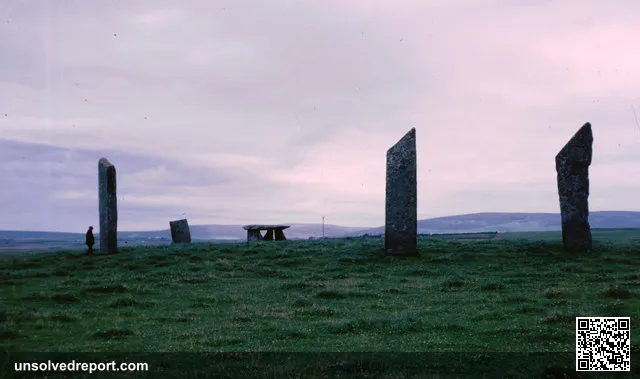
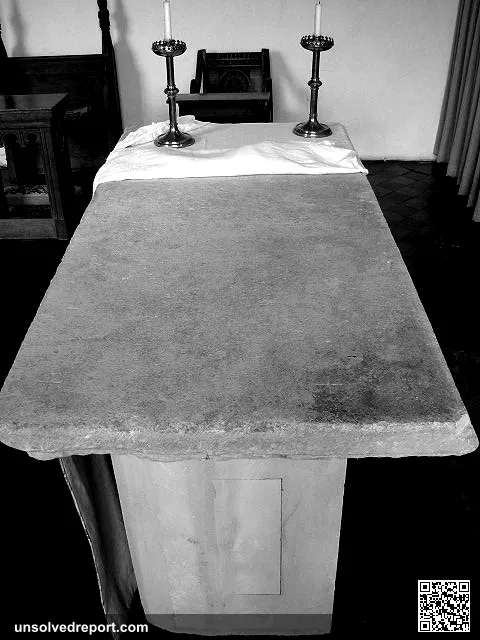
Start with the stone itself. The Altar Stone is the biggest of Stonehenge's so-called bluestones, and it doesn't even stand up — it lies flat on the ground, recumbent, right near the center of the monument. It's about 4.9 by 1.0 by 0.5 meters (roughly 16 feet long) and weighs around six tonnes. Picture about 13,000 pounds of pale green, sparkly sandstone (Clarke et al., Nature, 2024). And here's the first clue: geologically, it's a total stranger. It doesn't match Stonehenge's giant sarsen uprights, and it doesn't match the other bluestones either.
That oddness matters, because Stonehenge is a stitched-together patchwork of rock from wildly different places. The huge sarsens — the iconic uprights and lintels, hauled up around 2500 BC — came from the Marlborough area, only about 15 miles north. Most of the smaller bluestones are igneous rocks traced to the Preseli Hills of southwest Wales, roughly 140 miles away, where University College London and partner researchers identified specific quarry sites. For decades, scholars simply tucked the Altar Stone into that Welsh story, guessing it came from the Old Red Sandstone of the Anglo-Welsh Basin, maybe near the Brecon Beacons (Britannica).
The 2024 study put that comfortable guess on the table and tested it head-on. The team — led by Anthony Clarke of Curtin University in Australia, working with colleagues at Aberystwyth University, the University of Adelaide, and University College London — used uranium-lead dating on three kinds of mineral grains locked inside two fragments of the Altar Stone: zircon, apatite, and rutile.
The numbers were jaw-dropping. The zircon grains spread across ages from 498 to 2,812 million years, with big clusters around 1,000–1,100 million years. The apatite and rutile grains huddled tightly near 451–462 million years (Nature, 2024). Together, those ages form a kind of chemical barcode — an "age fingerprint" baked into the stone.
And that fingerprint did not say Wales.
It said the Orcadian Basin in northeast Scotland — a region of Old Red Sandstone sprawling across Caithness and reaching toward Orkney and Shetland. When researchers ran the statistics (a Kolmogorov–Smirnov test), the Scottish match couldn't be rejected, with P-values above 0.05, while the old Welsh favorites could be (PMC open-access copy). The straight-line distance from the Orcadian Basin to Salisbury Plain? At least 750 kilometers — about 460 miles. As Nature's news team summarized it, that's the longest journey ever documented for any stone in a British Neolithic monument.
So now we know where it's from. Which only makes the next part stranger.
The Question Nobody Can Answer
Knowing where the Altar Stone came from doesn't solve the mystery. It sharpens it to a point. Because now we have to ask: how on earth did it get to Stonehenge?
There are really only two ways to explain it. Either nature moved it, or people did.
Door number one is the glacier. The idea goes that during an earlier Ice Age, a sheet of moving ice ripped the slab out of Scotland and shoved it south, dumping it on Salisbury Plain — where, thousands of years later, Stone Age builders stumbled across it lying there, free for the taking. Door number two is far more astonishing: people deliberately hauled six tons of rock across the entire length of Britain, by hand.
So in 2026, a study in the Journal of Quaternary Science — again involving Clarke, this time with glaciologist Remy Veness — went looking for the glacier. They combined ice-sheet modeling with the mineral data and asked whether any path of moving ice could have carried the stone from northeast Scotland down to southern England.
The answer: no. They found no ice flow that could have done it. Some ice could have dragged debris as far as Dogger Bank out in the North Sea — but here's the kicker: Dogger Bank drowned beneath the waves roughly 8,000 years ago, thousands of years before Stonehenge even existed. So even if a glacier got the stone partway, there's no way to bridge that final stretch (Smithsonian Magazine; study summary, ScienceDaily).
That leaves the unsettling option. People did it.
But which way? We still don't know the route. The original Nature authors pointed out that dragging that much rock overland across Britain's hills and rivers would have been brutally hard — maybe impossible — and suggested a route by sea along the coast as the saner bet (PMC). The 2026 work leans toward a relay: a staged journey stitching together overland hauls, river crossings, and coastal hops. And the exact quarry? Still a blur. The trail points toward Caithness, with the Sarclet area noted as one close match — but it's a region, not an X-marks-the-spot. The deepest question of all still hangs in the air: how did a Stone Age society pull off something this enormous?
Theories, Hunches, and Educated Guesses
Everything below this line goes beyond what the data can prove right now. Treat it as informed guessing, not settled fact.
The seafarers. This is the front-runner among the study authors: coastal shipping. Moving six tonnes by water is far, far easier than dragging it overland — and if that's how it happened, it means Neolithic communities had seaworthy boats and the navigational know-how to work their way down the whole British coastline. It's a smart inference drawn from how miserable the overland option looks, not a smoking gun. No Neolithic vessel up to the task has ever been found.
The unity stone. Some researchers wonder whether hauling a stone from so far north was a deliberate handshake across the island — a way to bind the Grooved Ware communities of Orkney, the people who shaped Late Neolithic Britain, to the people of the south. It's a beautiful idea, and it fits the sheer effort involved. But the builders left no writing, so any meaning we read into the journey is just that — a reading.
The glacier holdouts. A minority of researchers have argued for years that glaciers, not people, delivered Stonehenge's far-flung stones, sparing the builders an impossible march. The 2026 modeling weighs heavily against that idea for the Altar Stone specifically — but the wider glacier-versus-human argument over the bluestones hasn't entirely disappeared from the scientific literature.
Here's what's certain, though, and it's the part that gives you chills. The heart-stone of Britain's most famous monument began life as Scottish sandstone, hundreds of miles to the north. And whoever placed it there did something we still cannot fully explain. The exact path it took home — and the human story behind that staggering journey — is still wide open. Which raises a quieter question worth sitting with: if they could move this, what else were these people capable of that we haven't figured out yet?
Sources & Further Reading
- Clarke, A. J. I., et al. "A Scottish provenance for the Altar Stone of Stonehenge." Nature (2024). nature.com · open-access PMC copy
- "A Scottish origin for Stonehenge's Altar Stone." Nature News (2024). nature.com
- "How Did Stonehenge Get Its Altar Stone?" Smithsonian Magazine (2026). smithsonianmag.com
- "Stonehenge's most mysterious stone traveled 700 kilometers across Britain." ScienceDaily (2026). sciencedaily.com
- "Stonehenge 'bluestone' quarries confirmed 140 miles away in Wales." UCL News (2015). ucl.ac.uk
- "Building Stonehenge." English Heritage. english-heritage.org.uk
- "Stonehenge." Encyclopaedia Britannica. britannica.com
Nazca Lines Purpose Mystery: The Giant Art Nobody Can Explain
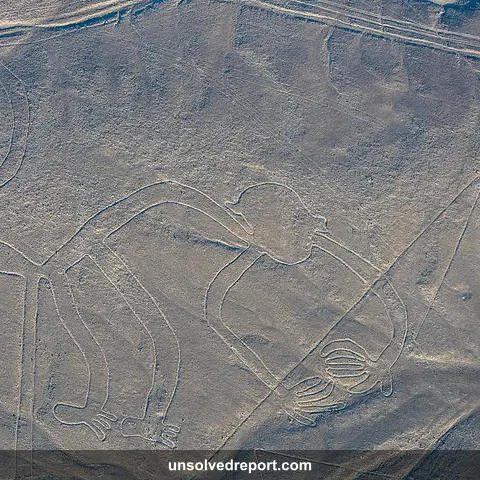
A desert people carved a hummingbird the size of a soccer field — then could never see it whole. Why? An AI just doubled the mystery. Here's what the Nazca Lines evidence actually says, and what still can't be explained.
Cahokia: The American City That Outgrew London, Then Vanished
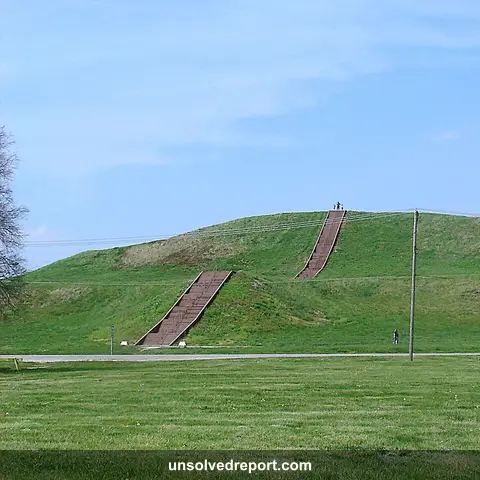
Cahokia once out-grew London. Then 20,000 people quietly vanished, no war, no fire, no famine. Every leading theory has collapsed. What really happened?
Mount Nemrut: Stone Gods Guard a Lost King
Mount Nemrut's stone gods guard a king's hidden tomb. Seismic scans and 70 years of digging still haven't found his body. Where is he really buried?