Dark Energy: The Invisible Force Ripping Space Apart
Dark energy makes up 70% of the universe and is tearing it apart faster every second — but nobody actually knows what it is. So what's really behind it?
1998. Two teams of astronomers point their telescopes at stars that blew up billions of years ago. They already know what the numbers will say — everyone does. The universe is expanding, sure, but all that gravity from all that matter should be slowly putting on the brakes. Expansion is winding down. That's the answer they're expecting.
The data say no.
The cosmos isn't braking. It's flooring it. Faster and faster, every second, in every direction. And the thing pushing the pedal? Nobody can see it, nobody can catch it, and nobody — to this day — knows what it is. We just gave it a name: dark energy. It might be the single deepest unsolved puzzle in all of physics.
Here's what we actually know, what's still a real mystery, and which answers are still nothing more than smart guesses.
What We Actually Know
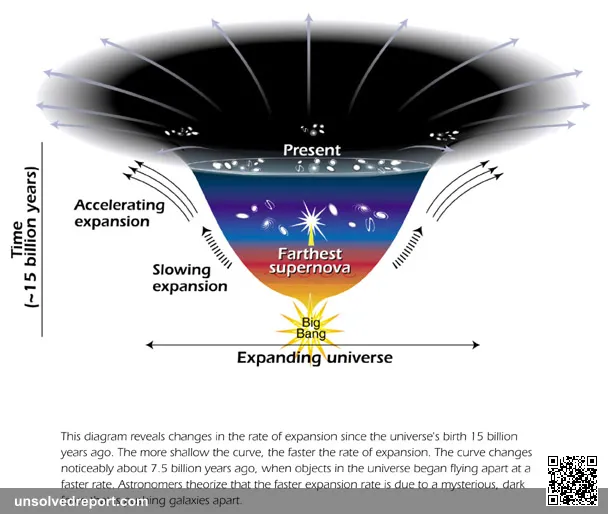
The universe is speeding up — and that should be impossible. In 1998, two independent groups raced to the same shocking finish line. One was the Supernova Cosmology Project led by Saul Perlmutter. The other was the High-z Supernova Search Team led by Brian Schmidt, with Adam Riess at the heart of it. Both measured the distances to far-off exploding stars. Both found that cosmic expansion "was not slowing down, as was predicted, but in fact was inexplicably speeding up" (W. M. Keck Observatory). The result rewrote the textbooks so completely that all three astronomers shared the 2011 Nobel Prize in Physics (NobelPrize.org).
The proof came from a cosmic measuring stick. How do you measure a distance you can't possibly walk? You find a light you already know the true brightness of. The teams used a special kind of stellar explosion called a Type Ia supernova. These blasts all peak at almost exactly the same brightness, which makes them perfect "standard candles" — compare how bright one should look against how bright it actually looks, and the gap tells you how far away it is (Keck Observatory). The distant supernovae came back too faint. Too faint means too far. Farther than a slowing universe had any right to put them.
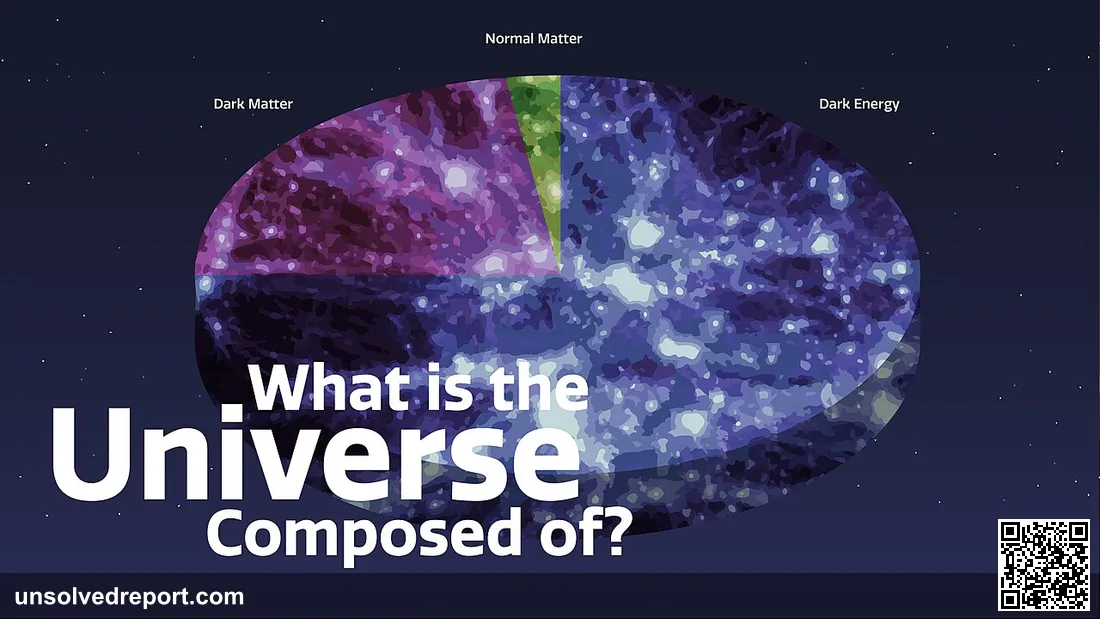
This stuff is most of everything. Whatever is doing the pushing isn't a side character — it's the main act. NASA pegs dark energy at roughly 68–70% of the entire content of the universe, leaving dark matter and ordinary matter — every star, every planet, every person who has ever lived — to split what's left (NASA Science). Sit with that. Everything you can see, touch, or name is a thin little rounding error sitting on top of two invisible unknowns.
It only switched on recently. For most of cosmic history, gravity was winning. Expansion was slowing, just like everyone expected. Then something flipped. According to NASA, the acceleration only kicked in about 9 billion years after the Big Bang — a mere few billion years ago — once the universe had stretched out enough for this repulsive push to finally beat gravity's pull (NASA Science). The pedal hasn't always been down. It got slammed.
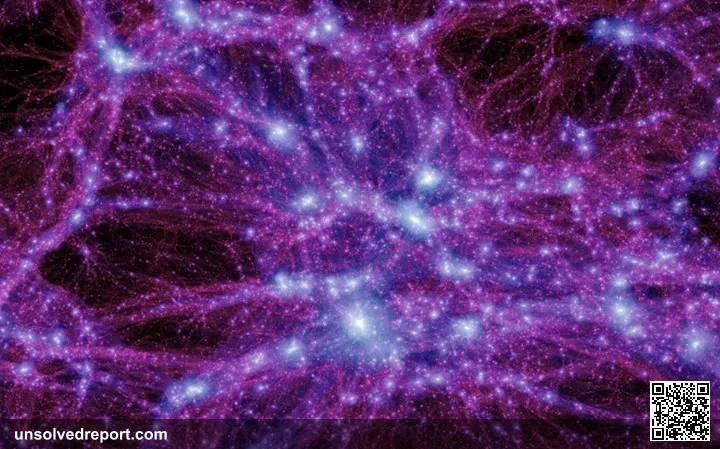
And no — it is not dark matter. People mix these two up constantly, so let's nail it. Dark matter is hidden mass. It pulls things together with gravity and helps galaxies keep their shape. Dark energy does the exact opposite: it acts like a pressure that shoves space apart (NASA Science). They share one word — "dark," meaning "we can't see it" — and basically nothing else. One holds the universe together. The other tears it apart.
The Question Nobody Can Answer
So what is it? Here's where science gets refreshingly honest. As NASA flat-out admits, "dark energy is just the name that astronomers gave to the mysterious 'something' that is causing the universe to expand" (NASA Science). We've measured what it does with stunning precision. We have no idea what it is.
And it gets worse — gloriously worse. The mystery hardens into a now-legendary humiliation called the cosmological constant problem. The most obvious guess is that dark energy is the energy of empty space itself — the energy of the vacuum, the nothing between everything. Fine. So physicists tried to calculate that vacuum energy using quantum field theory, our best playbook for the very small. The number came back monstrously bigger than what the actual sky shows. How much bigger? Estimates of the mismatch run as high as 120 orders of magnitude — a gap so absurd it's been called "the worst theoretical prediction in the history of physics" (Scientific American). Being wrong by a number with 120 zeros after it isn't a typo. It's a flare in the night sky telling us something huge is missing from our entire picture of reality.
Then a newer, slipperier question crept in: is dark energy even constant? In 2024 and 2025, the Dark Energy Spectroscopic Instrument (DESI) stitched together maps from millions of galaxy measurements — and saw faint hints that dark energy might be fading over cosmic time instead of holding rock-steady (CERN Courier). Before you get chills, the scientists themselves are pumping the brakes. This is not a confirmed discovery. The signal hasn't crossed the strict "five sigma" line physicists demand before they'll call something real, and how strong it looks depends on which extra datasets you feed in (CERN Courier). It's a tantalizing maybe, not a verdict.
The whole field just survived a public gut-check, too. In late 2025, one study threw down a challenge: maybe the supernova evidence was flawed all along — maybe an aging effect in those exploding stars was faking the look of acceleration. If true, the whole story could wobble. Then, in June 2026, a University of Southampton–led reanalysis — with Nobel laureates Adam Riess and Brian Schmidt on board — tore into that claim, found two methodological errors in it, and concluded the evidence for cosmic acceleration "remains robust." Team member Phil Wiseman put it plainly: "the previous and well accepted measurements were, in fact, fine" (ScienceDaily; published in Monthly Notices of the Royal Astronomical Society). The acceleration is real. The thing causing it still doesn't have a name beyond a placeholder.
The Theories — And Where They Stand
Everything from here on is the part scientists are still fighting about. These are live hypotheses, not settled answers. Read them as the best guesses on the table.
Theory 1: It's the vacuum (the cosmological constant)
The frontrunner says dark energy is a fixed, ever-present "vacuum energy" stitched right into the fabric of space — and it's mathematically the same thing as the cosmological constant Einstein once jammed into his equations and later wished he hadn't (NASA Science). It fits a huge amount of the data with eerie elegance. Its fatal flaw? That same 120-orders-of-magnitude calculation that refuses to add up. Speculation status: the leading suspect — but one we can't yet explain.
Theory 2: A force that shifts over time
Other physicists say forget "constant" entirely. Maybe dark energy is a dynamic field — sometimes nicknamed "quintessence" — that grows and shrinks across cosmic history. If those DESI hints of fading dark energy survive more data, this is the direction they'd point (CERN Courier). Speculation status: a thrilling possibility riding on a signal that hasn't been confirmed.
Theory 3: Maybe gravity itself is wrong
And then there's the boldest camp of all, the one that asks: what if there's no "stuff" called dark energy at all? What if Einstein's general relativity simply breaks down on the biggest scales, and a rewritten law of gravity could explain the acceleration with no new ingredient required? Speculation status: a minority view, but a serious one — though no modified-gravity model has yet beaten standard cosmology across all the observations.
So which is it? The answer won't come from arguing. It'll come from hardware. NASA's Nancy Grace Roman Space Telescope, teaming up with the Euclid and Rubin observatories, is built to sweep up hundreds of millions of galaxies and tens of thousands of supernovae — all to settle one question: is dark energy steady, or is it changing? (NASA Science)
Here's where that leaves us. We can chart the runaway universe down to exquisite decimal places, and still have no honest idea what's behind the wheel. Roughly 70% of everything that exists is a giant question mark — and that question mark might be the most thrilling invitation to wonder that science has ever handed us. Somewhere out there, the answer is waiting. We just haven't seen it yet.
Sources and Further Reading
- NASA Science, "What Is Dark Energy? Inside Our Accelerating, Expanding Universe"
- NobelPrize.org, "The Nobel Prize in Physics 2011 — Popular Information"
- W. M. Keck Observatory, "Nobel Prize in Physics Awarded for Accelerating Expansion of the Universe"
- CERN Courier, "DESI hints at evolving dark energy"
- Scientific American, "The Cosmological Constant Is Physics' Most Embarrassing Problem"
- ScienceDaily, "Dark energy survives major challenge as universe keeps accelerating"
- NASA Science, "Dark Energy — Nancy Grace Roman Space Telescope"
Cosmic Ray Knee: The Galaxy's Speed Limit Nobody Can Explain
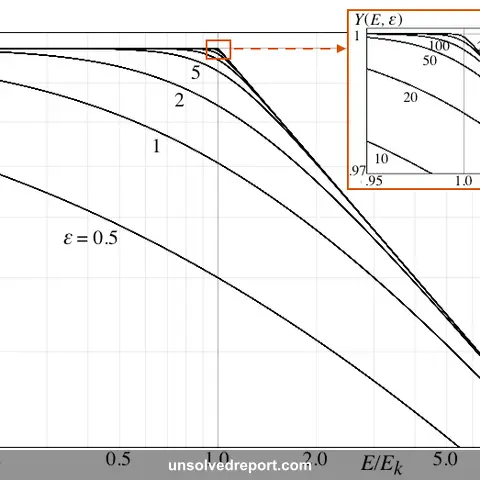
At 3.7 quadrillion electron-volts, something in our galaxy hits a wall — precisely, every time. The cosmic ray knee is measured to the percent. So why can't anyone name the machine that draws it?
Hoag's Object: The Perfect Ring Galaxy No One Can Explain
Hoag's Object: a flawless ring galaxy 600 million light-years away with no collision, no wreckage, no source. 70 years on, how did it form?

Hypervelocity Stars: Flung From the Galaxy at 4 Million MPH
Hypervelocity stars are escaping the Milky Way forever at 4 million mph. Astronomers traced one straight back to a black hole — but most don't point there. So what's firing the rest?