The Hubble Tension: Two Right Answers That Can't Both Be Right
Two flawless measurements of cosmic expansion disagree by 9% at 5-sigma or more. The Hubble tension has no known fix. So what is the universe hiding?
Two teams set out to measure the exact same thing: how fast the universe is flying apart. They used completely different methods, on opposite ends of cosmic history. Both were careful. Both checked their work, then checked it again, then handed it to rivals to tear apart. And their answers came back roughly 9 percent apart - way past the point where either team is allowed to shrug and blame noise.
Here's the unnerving part. Nobody can find the mistake.
This stubborn little gap has a name: the Hubble tension. And it has quietly become one of the biggest unsolved problems in all of physics. Either there's a flaw so subtle that thousands upon thousands of hours of expert scrutiny have walked right past it - or our entire picture of the universe is missing something real.
The one number everything hangs on
It all comes down to a single value, the Hubble constant, written H0. Think of it as the universe's speedometer. It tells you how fast distant galaxies are rushing away from us, scaled by how far away they are. The units are a mouthful - kilometers per second per megaparsec (km/s/Mpc) - but the idea is simple. A value of 70 means that for every megaparsec farther out a galaxy sits (about 3.26 million light-years), it's fleeing about 70 kilometers per second faster.
This number is not a footnote. It sets the size of the cosmos. It sets the age of the cosmos. Nearly every cosmic distance you've ever read about leans on it. Get H0 wrong, and a lot of other things tip over with it.
Two roads, one destination
What makes this mystery so delicious is that the two measurements don't just disagree - they come from totally different worlds. Different eras of the universe. Different physics. They have almost nothing in common except the answer they're supposed to produce.
Road one: the cosmic ladder (the nearby, recent universe). One team measures the expansion right here in our cosmic neighborhood by literally building a ladder of distances, rung by rung. The headline effort is the SH0ES team, led by Nobel laureate Adam Riess. Picture climbing it:
- Start close. Measure distances to nearby stars using parallax - the tiny wobble in a star's position as Earth swings around the Sun.
- Step up. Use those distances to calibrate Cepheid variable stars, which blink with a rhythm locked to their true brightness. Know how bright they really are, compare it to how bright they look, and the distance falls out.
- Step up again. Find Cepheids in galaxies that have also hosted a Type Ia supernova, and use them to calibrate those supernovae - cosmic flashbulbs so brilliant you can spot them halfway across the universe.
Each rung steadies the next, until you can reach far enough out to read the expansion rate straight off the sky. SH0ES lands near 73 km/s/Mpc, with a recent value around 73.2 and an uncertainty under 1. That's a confident number.
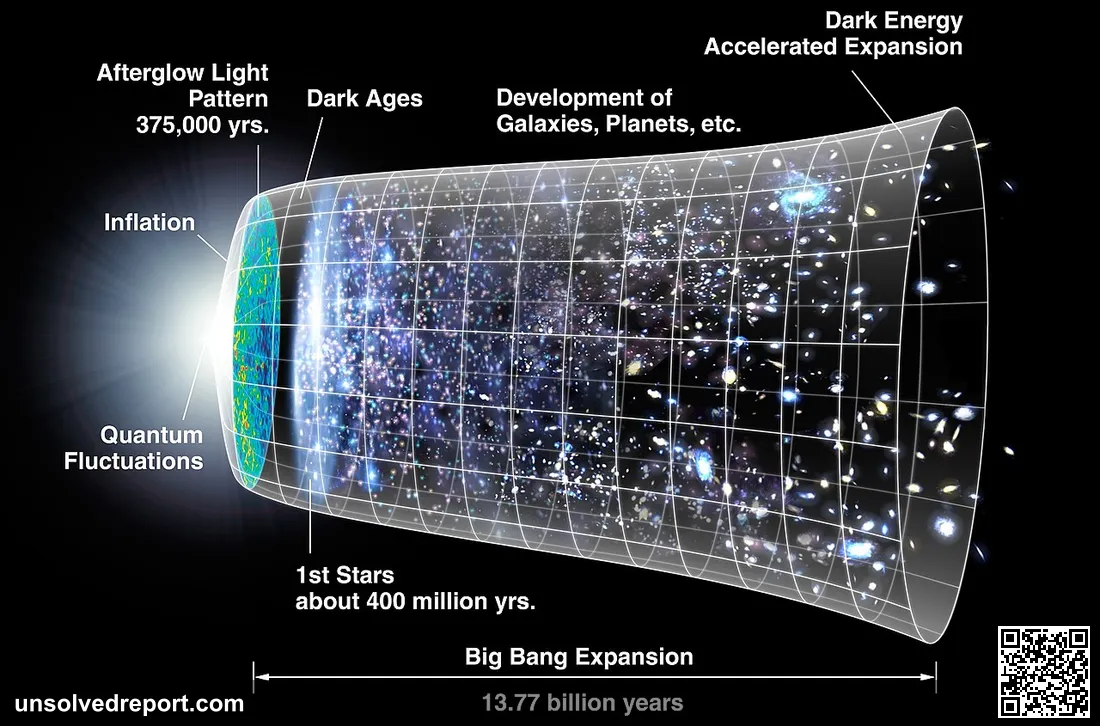
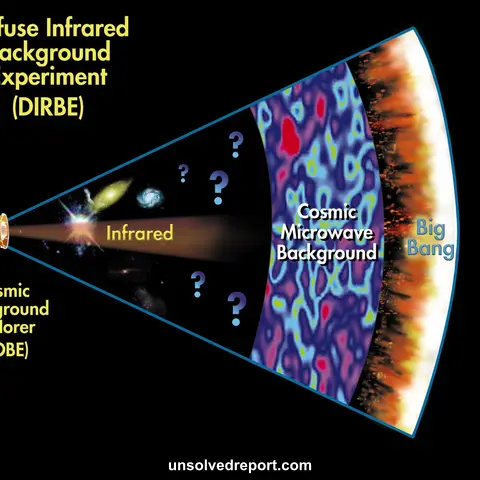
Road two: the baby picture (the early, distant universe). The other team doesn't measure local expansion at all. Instead, the Planck satellite photographed the oldest light there is - the cosmic microwave background, or CMB, the faint afterglow of the Big Bang, set free when the universe was just 380,000 years old. That same ancient light has its own strange puzzles baked in, like the CMB Cold Spot, a chilly patch that shouldn't be there at all. The speckled pattern of hot and cold spots in that ancient light is a fingerprint of the infant cosmos: what it was made of, how it was shaped. Feed that fingerprint into our standard cosmological model, Lambda-CDM, and the math spits out what the expansion rate should be today. That prediction comes to about 67.4 km/s/Mpc.
So the baby picture says about 67. The grown-up measurement says about 73. Same universe. Two different answers. Pick a side.
So how bad is the disagreement, really?
Bad. The gap is around 9 percent - and that's huge next to how tight each team's error bars have become. Physicists measure how serious a mismatch is in "sigma," a unit of statistical surprise. The Hubble tension now sits at roughly 5 sigma or higher, with recent work quoting figures around 5 to 6 sigma.
Five sigma is sacred ground. It's the bar particle physicists demand before they're allowed to announce a discovery. It means the odds of this gap being a random fluke are well under one in a million. Read that again. These aren't two fuzzy numbers that happen to be close. They are sharply, stubbornly different - and the sharper the measurements get, the worse it looks. That's why a lot of cosmologists have stopped saying "tension" and started whispering "crisis."
Couldn't somebody just have screwed up?
That's the very first thing any honest scientist asks - and believe me, they have hunted for the screwup with everything they've got. The fear is that some sneaky systematic error - a cracked rung in the distance ladder, or a flaw in how the CMB is modeled - is quietly nudging one of the answers off true.
The distance ladder was the obvious suspect. So many steps, so many delicate calibrations - plenty of places for an error to hide. The toughest test yet came from the James Webb Space Telescope - the same instrument that has separately turned up galaxies that look too mature for how early they appear, another sign that the early universe still has surprises for Lambda-CDM. With its razor-sharp infrared eyes, JWST went back and re-observed the very Cepheid stars SH0ES had used, and threw in fresh, independent distance markers for good measure. If crowded or mistaken stars had been poisoning the Cepheid data, JWST should have caught it red-handed.
It didn't. The Webb observations broadly backed up the earlier distances, leaving the high local value of H0 standing as tall as ever.
And the suspect on the other side? The CMB has been cross-examined too, by entirely separate windows into the early universe. Measurements of baryon acoustic oscillations - including recent results from the DESI survey - line up with the lower, Planck-like value when paired with CMB data. Meanwhile, local methods that ditch Cepheids altogether (using, say, the tip of the red giant branch as a distance marker) tend to land somewhere in the middle, though plenty still lean higher than Planck predicts.
The verdict so far: no smoking gun. Nobody has caught either side cheating. And the harder people look, the more the tension digs in its heels. Which is exactly what makes it so hard to look away from.
And if it's not a mistake?
Then buckle up - because that means our standard model of the universe has a hole in it.
Remember, the 67 isn't really a measurement. It's a prediction, one that assumes Lambda-CDM perfectly describes everything between the baby-picture era and right now. The 73 is what we actually see out the window. If both are correct, then something happened - or something exists - that Lambda-CDM simply doesn't know about.
Ideas are flying. The most talked-about contenders:
- Early dark energy. A hypothetical burst of extra energy that flared up briefly in the very early universe, tweaking the physics that sets the CMB's scale and nudging the inferred H0 upward toward the local value.
- Strange neutrinos, or extra speedy particles lurking in the young cosmos.
- A change to gravity itself, or to the way dark energy behaves over cosmic time.
But here's the honest catch, and it matters: none of these is proven. None. Each one patches the Hubble tension only by smuggling in brand-new ingredients - and most of them, in fixing this one problem, wreck the gorgeous fit Lambda-CDM otherwise gives across a mountain of other data. There's no winner yet. The tension is a clue, a finger pointing somewhere in the dark. We just can't tell where.
It's not just two teams anymore
Part of why this hardened from curiosity into crisis: the two original rivals are no longer out there alone. Over the past few years a whole squad of independent techniques has stepped up to take its own crack at H0 - and the picture they paint isn't tidy. It's gloriously messy.
- Bent quasar light. When light from a distant quasar gets warped around a galaxy in front of it, it travels several paths and arrives at slightly different times. Time those delays and you get H0. Early results leaned toward the higher, local-like value, though sharper analyses have since widened the uncertainty.
- Cosmic chimes. Crashing neutron stars and black holes ring out gravitational waves that act as "standard sirens" - a way to measure distance that doesn't touch the cosmic ladder at all. The uncertainties are big for now, but as detections pile up, standard sirens could someday settle this fight all by themselves.
- Ripples in the ancient gas. Those same baryon acoustic oscillations, mapped by surveys like DESI and combined with CMB data, keep favoring the lower, Planck-like value - reinforcing the early-universe camp.
Not one of them has landed a knockout blow yet. But together they prove this isn't the quirk of one obstinate pair of teams. The tension is baked into the data itself.
What's actually on the table: the age of everything
The Hubble constant isn't some dusty bookkeeping figure. It directly shapes how old we think the universe is - because, all else equal, a faster expansion today implies a slightly younger cosmos. The two rival values translate into ages a few hundred million years apart.
Against a backdrop of roughly 13.8 billion years, that sounds like rounding. But cosmology is a tightly wound machine, pinned down from a dozen directions at once. Even a small nudge to H0 has to stay consistent with the ages of the oldest stars - the same kind of bookkeeping problem that made the Methuselah star look older than the cosmos itself - and with how cosmic structure grew over time. Shift H0 for real, and the tremor runs through the whole framework. That's why the stakes feel so enormous.
What we know vs. what we don't
Locked in:
- The local distance-ladder measurement (SH0ES) puts H0 near 73 km/s/Mpc.
- The early-universe inference from the CMB (Planck) plus Lambda-CDM gives about 67 km/s/Mpc.
- The gap is roughly 9 percent, at 5 sigma or more.
- JWST has so far propped up the high local value, not knocked it down.
Still wide open:
- Whether some undiscovered systematic error in one method secretly explains the whole gap.
- Whether new physics beyond Lambda-CDM is required - and if so, what on earth it is.
- Which, if any, of the proposed fixes turns out to be right.
Why this one keeps cosmologists up at night
The Hubble tension is thrilling precisely because nobody's being sloppy. This isn't one careless team versus a careful one. It's two rigorous, battle-tested results that flat-out refuse to agree. And history has a habit of remembering moments like this. Clean, stubborn cracks like this one have, more than once, been the very seams through which whole new chapters of physics slipped into the light.
Maybe this one dissolves into a quiet calibration glitch and we all move on. Or maybe it's the first clear signal that the universe runs on rules we haven't written down yet. Figuring out which is one of the great quests of cosmology this decade - and somewhere out there, in the oldest light or the next gravitational chime, the answer is waiting.
Sources & further reading
- Wikipedia - Hubble tension - https://en.wikipedia.org/wiki/Hubble_tension
- Wikipedia - Hubble's law - https://en.wikipedia.org/wiki/Hubble%27s_law
- NASA - Hubble Constant and the expanding universe - https://science.nasa.gov/mission/hubble/science/science-behind-the-discoveries/hubble-dark-energy/
- Riess et al. (SH0ES) JWST Cepheid results, The Astrophysical Journal Letters - https://iopscience.iop.org/article/10.3847/2041-8213/ad1ddd
- ESA - Planck mission and the cosmic microwave background - https://www.esa.int/Science_Exploration/Space_Science/Planck
- CERN Courier - The Hubble tension - https://cerncourier.com/a/the-hubble-tension/
Final Parsec Problem: Black Holes Stuck Forever—Or Are They?
The final parsec problem says merging black holes should freeze forever, one parsec short of collision. So why does the universe hum like they don't?

Pulsar Glitch Mystery: The Clock Nobody Can Explain
Pulsar glitch mystery: the universe's steadiest clocks suddenly speed up, no warning. One glitch was caught live — so why can no one predict the next?
CMB Cold Spot: The Patch of Sky Colder Than Physics Allows
One patch of the Big Bang's afterglow is colder than it has any right to be. A giant void sits right there — but it can't explain the whole gap. So what does?