AlphaZero's 'Alien' Chess: The AI Moves No Grandmaster Would Dare Play
AlphaZero taught itself chess in 4 hours, then never lost a single game to the world's best engine. Grandmasters say it plays like an alien. So why can nobody explain how it thinks?
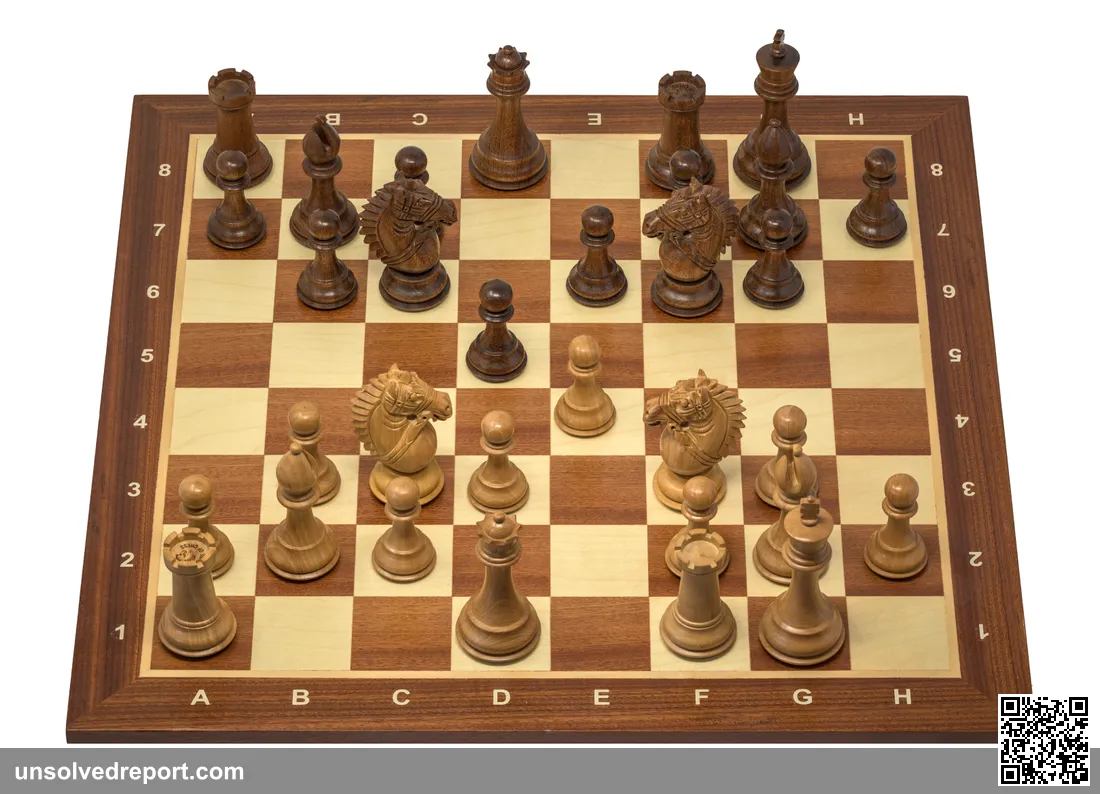
Picture the smartest chess machine on the planet, sitting across the board. It has read every game ever recorded. It calculates millions of positions a second. And then a stranger sits down — a program that learned the game just hours earlier, knowing only the rules — and shoves a piece into the corner of the board for no reason any human can see.
Then it wins. Again. And again. And it never loses.
That stranger was AlphaZero. And the chess world's reaction wasn't pride. It was something closer to fear.
The Documented Facts
In December 2017, the AI lab DeepMind unveiled a program called AlphaZero. The setup was almost unbelievable: it was given the rules of chess and nothing else — no opening books, no famous games, no human coaching. It learned entirely by playing against itself, over and over, millions of times.
After roughly four hours of self-play, AlphaZero was already strong enough to challenge Stockfish 8 — at the time, the reigning champion of computer chess. In a 100-game match, AlphaZero won 28 games, drew 72, and lost zero (Chess.com). Not a single loss against the best engine humanity had ever built.
The full method was later published in the peer-reviewed journal Science, where the DeepMind team described "a general reinforcement learning algorithm that masters chess, shogi, and Go through self-play" (Science, 2018). The same program, with no changes, also conquered shogi (Japanese chess) and the ancient game of Go.
But the scores aren't the spooky part. The style is.
DeepMind co-founder Demis Hassabis described it plainly: "It doesn't play like a human, and it doesn't play like a program. It plays in a third, almost alien, way" (MIT Technology Review). He pointed to one moment where AlphaZero shoved its queen into the corner — "a very bizarre trick with a surprising positional value." He called the whole thing "chess from another dimension."
AlphaZero loved giving pieces away. It would sacrifice a bishop, sometimes even a queen — the most powerful piece on the board — not by accident, but on purpose, trading raw material for an advantage so subtle that humans only understood it many moves later, if at all.
Grandmaster Peter Heine Nielsen, who has coached world champions, summed up the feeling for the BBC: "I always wondered how it would be if a superior species landed on Earth and showed us how they played chess." Then he added the chilling part: "Now I know" (ScienceAlert).
The Genuine Open Question
Here's the puzzle that still hasn't been fully solved: *nobody can clearly explain why AlphaZero's strange moves work.*
A traditional engine like Stockfish, for all its strength, thinks in numbers humans can follow. It counts material. It scores positions. You can ask it "why this move?" and trace the math.
AlphaZero is different. It built up a kind of intuition inside a neural network — a tangle of millions of tuned values that even its creators can't read like a sentence. It "knows" the corner-queen move is brilliant the way you "know" a face is friendly: instantly, and without being able to spell out the reasoning.
That's the open question scientists call epistemic opacity — the unsettling fact that an AI can be reliably right while being unable to show its work (ResearchGate). It's the same unease researchers felt when Facebook's negotiation bots invented their own private shorthand — a system that works perfectly but speaks a language its own creators can't parse. AlphaZero discovered chess wisdom no human ever wrote down. But it can't teach it to us in words. We can only watch, copy, and wonder.
So the genuine mystery isn't "did the AI cheat?" It didn't. The mystery is: what does it understand that we don't?
Theories and Interpretations
People have offered very different answers. Some are grounded. Some are wild. Let's keep them honest.
Theory 1 — It just calculates deeper (mainstream). Many experts believe there's no magic at all. AlphaZero's "alien" moves only look alien because the payoff is 15 or 20 moves away — past the horizon of even elite human calculation. To AlphaZero, the corner-queen idea is simply correct. Plausible and widely accepted, but it doesn't fully explain the human-like intuition the network seems to use.
Theory 2 — The match was rigged in its favor (a fair criticism). This one is real, not fringe. Grandmaster Hikaru Nakamura called the 2017 match "dishonest," arguing Stockfish was crippled — forced to play without its usual opening book and on hardware some considered unfavorable (Chess.com). This is a legitimate, documented dispute about the testing conditions — though later rematches with better setups still showed AlphaZero performing extremely well.
Theory 3 — "Maybe our idea of chess was too small" (philosophical, speculative). Hassabis floated the gentle, mind-bending suggestion that humans simply boxed chess in — that AlphaZero found doors we never noticed (MIT Technology Review). Interesting framing, but it's interpretation, not proof.
Theory 4 — It's "thinking" or sentient (unproven, almost certainly false). Because Nielsen's "superior species" line spread so far, a corner of the internet now treats AlphaZero as a glimpse of conscious, alien-like machine intelligence — even whispering about sentient AI. It's the same leap a Google engineer made when he insisted the chatbot LaMDA was alive, and the same illusion people fell for with ELIZA, the 1966 chatbot that just reflected their own words back at them. There is zero evidence for this. AlphaZero has no awareness, no goals, no inner life. It is a pattern-matcher that got staggeringly good at one closed game. The "alien" label is a metaphor for its style, not a claim about a mind. Label this clearly: unproven speculation, bordering on myth.
AlphaZero showed us a machine that could be brilliant beyond explanation inside the tidy 64 squares of a chessboard. But chess has rules. The real world doesn't. So what happens when we hand that same silent, alien intuition something far messier than a game — a face, a voice, a photo that was never real?
That's where things start to get strange.
Sources & Further Reading
- AlphaZero's "Alien" Chess Shows the Power, and the Peculiarity, of AI — MIT Technology Review
- A general reinforcement learning algorithm that masters chess, shogi, and Go through self-play — Science (2018)
- Google's AlphaZero Destroys Stockfish In 100-Game Match — Chess.com
- It Took 4 Hours For Google's AI To Master Chess — ScienceAlert
- Mastering Chess and Shogi by Self-Play — arXiv preprint (1712.01815)
- Chess, Artificial Intelligence, and Epistemic Opacity — ResearchGate
DeepDream: The AI Nightmare Nobody Can Fully Explain
DeepDream made a Google AI hallucinate dogs and eyeballs into every photo in 2015. It knows why. It still can't answer the stranger question left behind.

Deepfake History: The Lab Trick That Grew Into a $25 Million Heist
A 2014 lab experiment. A Reddit ban. A $25 million video call that never happened. The full deepfake history — and why nobody can reliably catch one anymore.

ELIZA Effect: The 1966 Chatbot Trick Nobody Can Switch Off
In 1966, an MIT chatbot fooled a woman who watched it get built. She still begged for privacy. Why can't our brains resist the ELIZA effect — even today?