Beale Ciphers: The $60M+ Code Nobody Has Cracked in 141 Years
One Beale cipher decoded, one fortune still buried. The location code has stumped everyone since 1885 — real $60M+ treasure or genius hoax? Here's the proof.
Picture roughly three tons of gold, silver, and jewels sitting in an iron-lined vault, six feet down, somewhere in the green foothills of Bedford County, Virginia. A man named Thomas Jefferson Beale is said to have put it there. The contents are no mystery — one of the three coded messages he left behind has actually been solved, and it reads out the haul like a shopping list. The page that tells you where to dig, though, is still a wall of numbers 141 years after it was first published, and nobody has ever read it. This piece lays out exactly what's been proven, what's still just numbers on a page, and what the latest research is chasing.
> The 60-Second Brief
> - 1822: A stranger calling himself Thomas J. Beale hands innkeeper Robert Morriss a locked iron box in Lynchburg, Virginia, then vanishes for good.
> - 1845: Morriss finally opens it — two plain letters, three pages of pure ciphertext, no key.
> - 1885: James B. Ward publishes The Beale Papers for 50 cents, printing all three ciphers.
> - 1 of 3 solved: Cipher No. 2 decodes cleanly against the Declaration of Independence; Ciphers No. 1 and No. 3 turn to gibberish under the same key.
> - ~$60M–$96M+: Modern value estimates for the described haul, with gold alone priced around $96.3 million as of October 2024.
> - 0: Verified excavations that have ever recovered the treasure, as of 2026.
What We Can Actually Prove
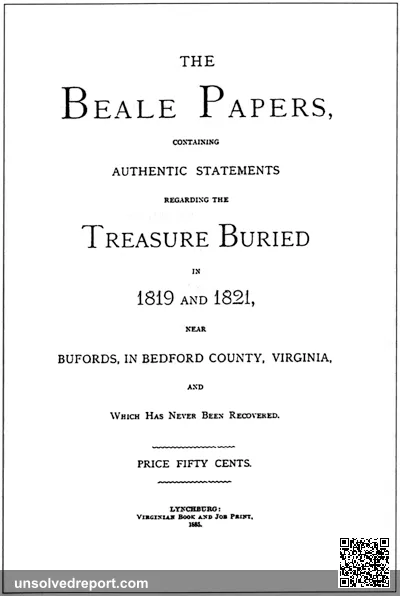
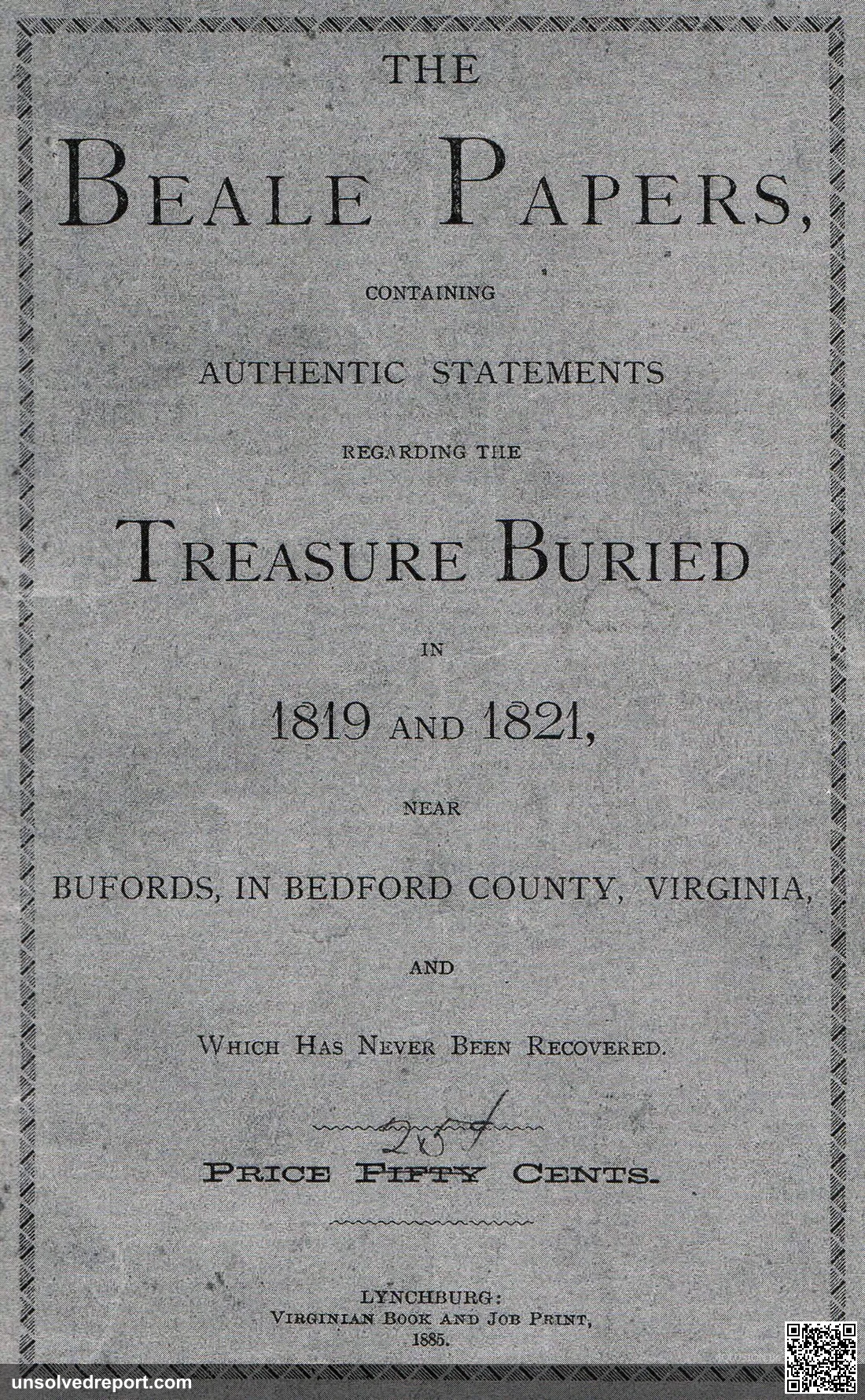
Start with something solid: a pamphlet. In 1885, a Virginian named James B. Ward published a slim booklet called The Beale Papers, sold it for 50 cents, and laid out the whole story — three ciphers printed right there on the page (Wikipedia, "Beale ciphers"). According to that pamphlet, here's how the tale goes.
In 1822, a stranger named Thomas J. Beale handed a locked iron box to Robert Morriss, an innkeeper in Lynchburg, Virginia — then rode off and was never seen again (Wikipedia; Mental Floss). The letters Beale left behind told the rest. He and a party of about 30 Virginia adventurers had struck a rich vein of gold and silver out west, near Santa Fe, and hauled the metal back east to bury it in Bedford County where it would be safe (Explorersweb).
Morriss didn't open the box until 1845. By then Beale was long gone. Inside: two plain letters and three pages of nothing but numbers (Cipher Mysteries). Each cipher was supposed to lock away a different secret. Cipher No. 1: the exact spot where the vault was buried. Cipher No. 2: a description of what was inside. Cipher No. 3: the names and next of kin of all 30 men who owned a share (Wikipedia).
And now the detail that makes this legend impossible to shrug off: one of those three pages cracked open. An unnamed friend of Morriss — presented in the pamphlet as its anonymous author — broke Cipher No. 2 with a trick called a book cipher. Every number in the text points to a word in the United States Declaration of Independence. Take the first letter of each numbered word, line them up, and a message spells itself out (Mental Floss; Wikipedia). Decoded, Cipher No. 2 opens with a line that has haunted treasure hunters ever since:
> "I have deposited in the county of Bedford, about four miles from Buford's, in an excavation or vault, six feet below the surface of the ground …" (Mental Floss)
The same decoded page then counts out the loot: roughly "ten hundred and fourteen pounds of gold, and thirty-eight hundred and twelve pounds of silver," plus jewels valued at around $13,000 at the time (Explorersweb; Wikipedia). By weight, that's close to three tons of precious metal. As of January 2025, popular estimates put the total value at over $60 million, with the gold portion alone worth roughly $96.3 million and the silver around $1.8 million at October 2024 commodity prices (Wikipedia).
So here's what's not up for debate. A real 1885 pamphlet exists. A real cipher inside it genuinely decodes against the real Declaration of Independence. And the message it spits out describes a real kind of buried cache in a real Virginia county. Those facts are rock solid.
The Hole at the Center
The mystery is everything Cipher No. 2 won't tell you.
It describes the prize but hides the address. The directions — the exact spot, four miles from Buford's tavern — live only in Cipher No. 1, and Cipher No. 1 still hasn't budged (Wikipedia). Cipher No. 3, the list of heirs, is locked tight too. And here's the part that genuinely baffles people who study this: that same Declaration-of-Independence key, the one that perfectly unlocks Cipher No. 2, turns Ciphers No. 1 and No. 3 into pure gibberish (Cipher Mysteries).
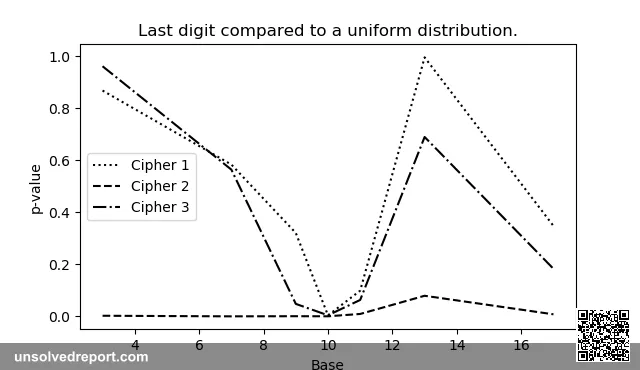
Think about how odd that is. If one man wrote all three pages at the same sitting, why does only the middle one open with the obvious key? Either the other two ride on a different key book nobody has spotted, or they're built some other way entirely — or, the uncomfortable option, they don't spell out meaningful English at all. Later codebreakers have pointed out that the unsolved ciphers carry statistical fingerprints that just don't look like normal encrypted English (Wikipedia). More than a hundred years of attention from sharp amateurs and trained professionals, and still: no verified, repeatable solution to Cipher No. 1 has ever surfaced. That blank space is the whole mystery.
So What's Really Going On?
From here we step off solid ground and into interpretation — competing readings of the same evidence, none of them settled.
Theory 1: It's real, and we just lost the key. (Speculation.) The argument is simple. Cipher No. 2 demonstrably works, so the system is genuine — which means Ciphers No. 1 and No. 3 must lean on a second source text, a different book or document or edition that nobody has correctly pinned down yet. On this reading, the gold is out there right now, waiting on the right page of the right book.
Theory 2: It's a 19th-century con. (Speculation — but well argued.) Plenty of specialists land here. In 1980, cryptographer Jim Gillogly ran Cipher No. 1 through the Declaration and found, in one stretch, a near-alphabetical run of letters — something so wildly unlikely to happen by chance that he pegged the odds at less than one in a hundred million million. His read: the text was manufactured, not truly encrypted (Wikipedia). Then, in 1982, writer and investigator Joe Nickell came at it from another angle. He argued the pamphlet's prose closely matches Ward's own writing, and that words like "stampede" and "improvised" show up suspiciously early for letters supposedly written in the 1820s (Wikipedia; Explorersweb). Nickell also noticed that the innkeeper Robert Morriss, as the pamphlet paints him, doesn't square with the historical record of when he actually ran his hotel (Wikipedia).
Theory 3: A hoax with a real seed inside it. (Speculation.) A middle path: maybe something true sits underneath — a real cache, a real frontier expedition, a real local rumor — that someone later dressed up, embellished, and wrapped in unbreakable codes to move pamphlets. The trouble is you can't test this one without finding the vault first.
What no honest account can offer is a confirmed dig that pulled up the gold. As of today, the treasure has never been found, the location cipher has never been solved, and whether Thomas Jefferson Beale even existed is still an open question. That's the rare mystery that's fully documented and genuinely unresolved — a sealed iron box that, in a way, we're all still standing in front of, staring at the lock.
The Three Ciphers, Side by Side
The whole case turns on the fact that the three pages behave completely differently. Laid out together, the asymmetry is what jumps off the table — one page opens with the obvious key, the other two refuse it.
| Cipher | Supposed contents | Status | Key that works |
|---|---|---|---|
| No. 1 | The exact burial spot — "about four miles from Buford's" | Never solved | None found; Declaration key yields gibberish (Wikipedia) |
| No. 2 | Inventory of the cache | Solved (book cipher) | United States Declaration of Independence (Mental Floss) |
| No. 3 | Names and next of kin of the ~30 owners | Never solved | None found; Declaration key yields gibberish (Cipher Mysteries) |
And here is what the one solved page (Cipher No. 2) actually claims is in the ground:
| Item | Amount stated in decoded Cipher No. 2 |
|---|---|
| Gold | ~1,014 pounds in a first deposit ("ten hundred and fourteen pounds"), plus ~1,907 pounds in a second (Explorersweb; Wikipedia) |
| Silver | ~3,812 pounds in a first deposit ("thirty-eight hundred and twelve pounds"), plus ~1,288 pounds in a second (Explorersweb; Wikipedia) |
| Jewels | ~$13,000 in value at the time (Wikipedia) |
| Modern estimate | Over $60 million as of January 2025 — gold portion ~$96.3 million, silver ~$1.8 million at October 2024 prices (Wikipedia) |
A Dated Timeline of the Legend
Pulling the sourced dates into order shows how much of this story is a 19th-century paper trail rather than a buried-gold event anyone witnessed.
- 1822 — A stranger giving the name Thomas J. Beale hands a locked iron box to innkeeper Robert Morriss in Lynchburg, Virginia, then rides off and is never seen again (Wikipedia; Mental Floss).
- 1845 — Morriss finally opens the box, finding two plain letters and three pages of numbers (Cipher Mysteries).
- 1885 — James B. Ward publishes the pamphlet The Beale Papers for 50 cents, printing all three ciphers and crediting an anonymous friend of Morriss with cracking Cipher No. 2 via the Declaration of Independence (Wikipedia; Mental Floss).
- 1980 — Cryptographer Jim Gillogly finds near-alphabetical runs of letters when Cipher No. 1 is run through the Declaration, odds he pegs at less than one in a hundred million million, suggesting the text was manufactured (Wikipedia).
- 1982 — Investigator Joe Nickell argues the pamphlet's prose matches Ward's own writing, flags anachronistic words like "stampede" and "improvised," and notes Morriss's portrayal clashes with when he actually ran his hotel (Wikipedia; Explorersweb).
- November 22, 2024 — Popular Mechanics publishes a feature on researchers still actively working the ciphers, underscoring that the case remains an open, ongoing pursuit rather than a closed historical curiosity.
- January 2025 — The most recent widely cited valuation puts the described treasure at over $60 million, with the gold and silver components separately priced against October 2024 commodity rates (Wikipedia).
The Latest: Still No Verified Break, But the Search Is Active
No credible source has announced a verified solution to Cipher No. 1 or Cipher No. 3 as of this writing. What has changed recently is attention, not answers: Popular Mechanics ran a feature on November 22, 2024 profiling researchers still chasing the ciphers, and Wikipedia's most recent valuation figures — over $60 million as of January 2025, with gold priced near $96.3 million and silver near $1.8 million using October 2024 commodity prices — show the story is still being actively re-priced and re-covered rather than fading into pure history (Wikipedia). Various online forums and independent researchers have circulated claimed solutions to Ciphers No. 1 and No. 3 in recent years, but none of these have been independently verified or accepted by cryptography specialists, so they are not treated as fact here.
Frequently Asked Questions
Has anyone ever actually found the Beale treasure?
No. As of 2026, there is no verified account of anyone recovering the gold, silver, or jewels described in Cipher No. 2. The location cipher, Cipher No. 1, has never been solved, so no one has a confirmed dig site to search (Wikipedia).
Why does the Declaration of Independence only work on one of the three ciphers?
That's the central puzzle. Cipher No. 2 decodes cleanly when each number is matched to the first letter of the corresponding word in the Declaration of Independence, but applying the same key to Ciphers No. 1 and No. 3 produces gibberish. Researchers disagree on why — a lost second key text, a different encoding method, or evidence the other two ciphers were never meaningful text at all (Cipher Mysteries).
Is there real evidence the Beale story is a hoax?
Yes, credible evidence exists on the hoax side, though it isn't conclusive. Cryptographer Jim Gillogly found a statistically improbable near-alphabetical letter run in Cipher No. 1 in 1980, and investigator Joe Nickell argued in 1982 that the pamphlet's prose matches publisher James B. Ward's own writing style and contains words that seem too modern for the 1820s (Wikipedia).
How much is the treasure supposedly worth today?
Widely cited estimates place the value at over $60 million as of January 2025, with the gold portion alone worth roughly $96.3 million and the silver around $1.8 million based on October 2024 commodity prices — though the final figure moves with metal prices (Wikipedia).
Did Thomas Jefferson Beale actually exist?
There is no independent historical record confirming a person matching Beale's description ever lived. Everything known about him comes from the 1885 pamphlet, which is itself the subject of authorship disputes, making his existence one of the case's open questions rather than a settled fact (Wikipedia).
Where is the treasure supposed to be buried?
The decoded Cipher No. 2 states it is "in the county of Bedford, about four miles from Buford's, in an excavation or vault, six feet below the surface of the ground." That description is a starting point, not a map — the precise coordinates were meant to be spelled out in the still-unsolved Cipher No. 1 (Mental Floss).
More than 140 years after a Virginia publisher put three pages of numbers into print, the ratio hasn't moved: one page decoded, two still silent. Until Cipher No. 1 gives up an address that a spade can actually test, the Beale treasure stays exactly where it has always been — unconfirmed, unfound, and impossible to fully dismiss.
Sources and Further Reading
- Wikipedia: "Beale ciphers" — overview, decoded Cipher No. 2 text, value estimates (including January 2025 and October 2024 figures), Gillogly and Nickell analyses.
- Mental Floss: "The Quest to Break America's Most Mysterious Code" — decoded opening line, Declaration-of-Independence method, value estimate.
- Explorersweb: "Exploration Mysteries: Beale Ciphers" — Santa Fe expedition story, treasure inventory, anachronism arguments.
- Cipher Mysteries: "Beale Papers" and "The Beale Papers Paradox" — primary-source detail and the single-key puzzle.
Nazi Gold Train: The Dig That Found Absolutely Nothing
Two treasure hunters swore radar showed a buried Nazi gold train in Poland. A government official said he was 99% sure. So why did the dig come up empty?
Bactrian Gold: 20,600 Pieces, No Independent Count Since 2004
A 1978 Afghan dig yielded 20,600 gold pieces that survived three wars in a secret vault. No outside party has counted them since April 2004 — here's why.
Childeric's Golden Bees: A King's Hoard Lost in One Night
300 golden bees buried with a Frankish king in 1653 vanished in one night in 1831. Only two survived. So what happened to the rest of Childeric's treasure?