Famous Lost Treasures Still Missing: New Digs, Old Fortunes, No Gold
Fresh 2025-2026 digs are underway for the Amber Room and the Nazi gold train. Twelve famous lost treasures still missing — what's proven, what's legend.
Billions of dollars in gold, gems, and irreplaceable art are sitting somewhere right now, waiting. Not stolen and resold. Not melted down. Just lost. Swallowed by a flooded mine shaft, a sunken hull, a sealed crate, the last delirious sentence of a dying gangster. And here's the part that should bother you more than it does: we have the paperwork. We know these things were real. Ground-penetrating radar crews are back digging for two of them right now. This is what the records actually prove, what's still legend, and what's happening on the ground in 2025 and 2026.
> The 60-Second Brief
> - Twelve famous treasures, still missing, ranging from a 1216 royal crown to a 1945 gangster's strongbox.
> - The Amber Room vanished in early 1945 after Nazi forces stripped it from the Catherine Palace in 1941 and packed it into 27 crates; Polish researchers got permission in August 2025 to drill a radar anomaly at a former SS site in Dziemiany, Poland.
> - The Nazi gold train legend traces to 1945; an anonymous letter in 2025 reignited an official search near Wałbrzych, Poland — the same town where a 2015 radar "find" turned out to be natural rock.
> - The Copper Scroll, engraved in copper around 1952's Cave 3 discovery at Qumran, lists 64 locations — zero have produced confirmed treasure.
> - The Treasure of Lima hunt has run since 1820; one searcher's ~20-year effort yielded just six gold coins, and Costa Rica later banned the hunt.
> - A 2014 flea-market find (a $14,000 gamble) turned out to be a lost Fabergé egg, and in November 2025 the "missing" Florentine Diamond turned up safe in a Canadian bank vault — proof some of these stories still have happy endings.
What the Records Actually Prove
1. The Amber Room. Imagine an entire chamber paneled in carved amber, gold leaf, and mirrors, glowing like the inside of a jewel. That was the Amber Room, installed at the Catherine Palace near St. Petersburg. Then the war came. In 1941 German forces tore it off the walls in just 36 hours, crated it into 27 boxes, and shipped it to Königsberg Castle in East Prussia (Wikipedia; HISTORY). The panels were last verifiably seen in early 1945. An official report claims they burned during the Battle of Königsberg that April. Trouble is, nobody ever confirmed it. The most beautiful room in the world simply walked out of recorded history.
2. Flor de la Mar. Night, November 20, 1511, off the coast of Sumatra. A Portuguese carrack named the Flor de la Mar goes down, and with her goes the looted treasure of the Sultanate of Malacca. Her commander, Afonso de Albuquerque, clings to a raft and lives. The cargo does not (Wikipedia). It has never been found.
3. The Copper Scroll. On March 14, 1952, diggers in Cave 3 at Qumran pulled out a Dead Sea Scroll like no other. The rest are texts and scripture. This one is a shopping list — etched into copper laced with about one percent tin. When researchers finally unrolled it, it named 64 locations, 63 of them holding gold and silver (Wikipedia; Biblical Archaeology Society). A two-thousand-year-old treasure map, in metal. Not one site it names has ever produced confirmed treasure.
4. King John's Crown Jewels. October 1216. England is tearing itself apart in the First Barons' War, and King John's baggage train is picking its way across the marshes of The Wash in the east. Then the tide comes in fast — too fast. Royal plate and at least one crown reportedly went under the water and the mud. John died of dysentery days later (Wikipedia; History Today). A king's crown, lost in a swamp, never seen again.
5. The Missing Fabergé Imperial Eggs. The House of Fabergé made roughly fifty jeweled eggs for the Romanovs. Several are simply gone — including eggs from 1886, 1888, 1889, and 1903 (History Hit). Think they're gone for good? In 2014 a scrap-metal dealer's $14,000 flea-market gamble turned out to be the long-lost 1887 Third Imperial Egg (Wartski). A multimillion-dollar masterpiece, hiding in plain sight at a market stall. The others could be anywhere.
6. The Treasure of Lima. The story goes like this. In 1820, Captain William Thompson of the Mary Dear was handed the church wealth of Lima for safekeeping — then turned pirate and buried it all on Cocos Island off Costa Rica (Wikipedia). Hundreds have dug. Treasure hunter August Gissler gave the island nearly twenty years of his life. His total haul? Six gold coins.
7. The Lost Dutchman's Mine. A German immigrant named Jacob Waltz (c. 1810–1891) claimed he'd found a fabulously rich gold mine deep in Arizona's Superstition Mountains, and on his deathbed he let slip a handful of clues. People have been chasing those clues for more than a century. They've found nothing. What they have found is death — searcher after searcher has died or disappeared in that wilderness (Wikipedia; Arizona State Parks).
8. The Oak Island Money Pit. Since 1795, people have been digging a single hole on a small Nova Scotia island — a shaft that floods, lined with mysterious wooden platforms the deeper you go. Two centuries of excavation. Modern machinery. A whole TV crew. And still, not one significant piece of treasure has come up (Wikipedia).
9. Montezuma's Treasure. During the conquistadors' panicked 1520 flight out of Tenochtitlán, mountains of Aztec gold were reportedly lost in the causeways as men and treasure tumbled into the water (Wikipedia). For centuries that was all just legend — until 1981, when a gold bar surfaced in Mexico City. In 2019, testing dated it to Montezuma's era. It's the only physical thread anyone has ever tied back to the hoard.
10. The Nazi Gold Train. The legend won't die: an armored train, heavy with gold, rolling out of Breslau in 1945 and disappearing into a tunnel near Wałbrzych, Poland. In 2015 the world held its breath when a ground-radar "discovery" made global headlines. Then the crews dug. It was a natural rock formation (Wikipedia; CBS News).
11. Dutch Schultz's Strongbox. Newark, October 23, 1935. The gangster Dutch Schultz lies dying, and the police standing by take down every fevered, rambling word. Later his lawyer told Collier's that Schultz had buried a steel box stuffed with cash, bonds, and diamonds somewhere near Phoenicia, New York (Mental Floss). People have been reading those deathbed mutterings like a treasure map ever since.
12. The Treasure of the Knights Templar. When the Order was crushed in 1307 and its leaders arrested across France in a single coordinated sweep, something didn't add up. Contemporary accounts say the vast Templar wealth everyone expected to seize was never fully accounted for. Where the missing portion went — if it ever existed on the scale the legends claim — has never been documented at all.
The Real Question Nobody Wants to Ask
Strip away the romance, and one question ties all twelve together: where exactly is the line between lost and never real?
For some, the existence is rock solid and only the location is missing. The Amber Room, the Flor de la Mar, the Fabergé eggs, the Copper Scroll — these are documented beyond reasonable doubt. We have inventories. Photographs. Ship manifests. An actual engraved metal list. The treasure was real; the trail just went cold.
For others, the legend is far heavier than the record. The Costa Rican government eventually concluded there's no treasure on Cocos Island at all and banned the hunt (Wikipedia). And the only piece of gold ever certifiably identified as part of Montezuma's treasure is a single bar — and one bar, as the assessment goes, doesn't constitute a hoard (Sky HISTORY). And geologists have argued the Superstition Mountains, being volcanic in origin, are about the last place you'd expect to find a rich gold mine.
So that's the honest mystery. Not "where is the gold," but "was there gold to begin with." The best treasure stories live right there in the fog — just enough fact to keep hope burning, just enough doubt to keep the prize forever out of reach.
Theories and Interpretations
What follows are popular theories, not established facts.
Maybe the Amber Room burned all along. Some researchers think the answer is grimly simple: the panels went up in the 1945 fires at Königsberg, and every "secret bunker" rumor since has been wishful thinking. Others insist the crates were smuggled out by sea or rail before the flames. The catch is that no recovered panel has ever proven either story — so this remains speculation on both sides, and it's the theory now being tested on the ground (see Recency section below).
Maybe the Copper Scroll is a metaphor. A minority of scholars read its staggering quantities as symbolic, or as Temple ritual property rather than literal buried bullion. The more common theory ties it to real wealth hidden before Rome destroyed the Jerusalem Temple in 70 CE. Both readings are still unproven — speculation, not conclusion.
Oak Island theories go completely off the rails. Over the years people have proposed pirate gold, lost Shakespearean manuscripts, even the Ark of the Covenant buried by the Knights Templar (Wikipedia). But the dullest explanation — natural sinkholes and limestone — fits the evidence at least as well, and that's worth sitting with before you reach for the Ark. The exotic versions remain speculation.
Maybe the gangster's last words mean nothing. Enthusiasts treat Dutch Schultz's deathbed ramblings as a coded map to his strongbox. It's a fun idea. It's also speculation — a dying man burning with fever is not a reliable cartographer.
And here's the quietly hopeful footnote to all of it. In 2014 a flea-market trinket turned out to be a multimillion-dollar Fabergé egg. Then in November 2025, the long-"missing" Florentine Diamond surfaced — not in a tunnel or a shipwreck, but sitting safely in a Canadian bank vault, where it had been quietly tucked away for decades (Smithsonian). Sometimes the treasure isn't gone at all. It's just waiting for the right person to open the right box. The question is which of the other eleven is waiting too — and where.
Recency: Two of These Digs Are Active Right Now
Two of the twelve cases above have live excavations underway, both freshly authorized in 2025.
The Amber Room: In August 2025, Poland's regional monuments conservator granted researcher Jan Delingowski's team — working with geophysicists from AGH University of Science and Technology — permission to drill at a former SS training ground in Dziemiany, in the Kashubia region of northern Poland. Ground-penetrating radar had detected "a large anomaly" at the site, which Delingowski theorizes could be a wartime bunker used to hide looted valuables, possibly including the Amber Room (Notes from Poland). Geophysics professor Sławomir Porzucek cautioned that the anomaly "could also turn out to just be a geological structure or buried debris" — the same caveat that has sunk previous Amber Room leads.
The Nazi Gold Train: In 2025, an anonymous letter reached the Silesian Treasure Hunters' Foundation claiming to pinpoint three camouflaged rail carriages hidden in a tunnel near Wałbrzych, tied to the Nazi-era Riese Project tunnel network. Historian Łukasz Kazek called it "the most credible lead we've had in years," while noting the foundation's own caution given past disappointments — including the 2015 excavation that found only natural rock. The plan is non-invasive radar and LIDAR surveys before any digging begins (The Yeshiva World).
Neither dig has produced a confirmed find as of this writing. Both are worth watching precisely because they're testing the exact gap identified above: an unconfirmed 1945 fire report, and a legend that has burned through one false radar "discovery" already.
Twelve Treasures at a Glance: Documentation vs. Legend
The table below compresses the twelve cases into the two things that actually matter for each: how solid the paper trail is, and what searching has produced so far. Every entry restates facts and sources already cited above — no new claims.
| Treasure | Last verifiable trace | Is the treasure itself documented? | What searching has produced |
|---|---|---|---|
| Amber Room | Early 1945, Königsberg Castle, after 1941 removal in 27 crates (HISTORY) | Yes — installed room, photographed | No recovered panel; a new radar anomaly near Dziemiany, Poland is being drilled as of August 2025 |
| Flor de la Mar | Sank night of November 20, 1511, off Sumatra (Wikipedia) | Yes — looted Malacca cargo on a named Portuguese carrack | Wreck and cargo never found |
| Copper Scroll | Scroll recovered March 14, 1952, Cave 3, Qumran (Wikipedia) | The scroll exists; the 63 gold/silver caches it lists do not (yet) | Not one of its 64 named sites has produced confirmed treasure |
| King John's crown jewels | October 1216, The Wash (History Today) | Reported loss of royal plate and at least one crown | Never seen again |
| Missing Fabergé eggs | Eggs of 1886, 1888, 1889, 1903 unlocated (History Hit) | Yes — from a documented run of roughly fifty imperial eggs | The 1887 Third Imperial Egg resurfaced in 2014 at a flea market (Wartski) |
| Treasure of Lima | 1820 story of the Mary Dear and Cocos Island (Wikipedia) | No — rests on the later legend; Costa Rica's government believes no treasure exists on the island | August Gissler's ~20-year hunt yielded six gold coins; Costa Rica banned the hunt |
| Lost Dutchman's Mine | Jacob Waltz's deathbed clues, 1891 (Arizona State Parks) | No — the mine exists only in Waltz's claim | Nothing found; numerous searchers have died or disappeared |
| Oak Island Money Pit | Digging under way since 1795 (Wikipedia) | No documented treasure — only the shaft and its platforms | No significant treasure in two centuries |
| Montezuma's treasure | Gold reportedly lost in the 1520 flight from Tenochtitlán (Sky HISTORY) | No documented hoard — only one gold bar has ever been certifiably tied to it (Sky HISTORY) | One gold bar (surfaced 1981, dated in 2019 to Montezuma's era) |
| Nazi gold train | 1945 legend of a train leaving Breslau (Wikipedia) | No — no documented train or cargo | 2015 radar "find" excavated as a natural rock formation; a new 2025 tip has reopened the search near Wałbrzych (CBS News) |
| Dutch Schultz's strongbox | Deathbed transcript after the October 23, 1935 Newark shooting (Mental Floss) | Only his lawyer's later claim to Collier's of a buried steel box | Nothing recovered near Phoenicia, New York |
| Templar treasure | Order crushed and leaders arrested in 1307 | Contemporary accounts note seized wealth fell short of expectations; the "missing" portion is undocumented | Nothing ever documented |
Read the middle column top to bottom and the pattern is hard to miss: the first five cases have real documentation and a missing location; most of the last seven have a location and a story, but shaky or absent documentation.
The Paper Trail in Order: Every Date the Records Give Us
Strung onto one timeline, the verifiable moments in these twelve stories — the events the cited records actually attest, as distinct from the legends around them — look like this:
- October 1216 — King John's baggage train is caught by the tide crossing The Wash; royal plate and at least one crown reportedly lost. John dies of dysentery days later (History Today).
- 1307 — The Knights Templar are crushed and their leaders arrested across France in a single coordinated sweep; contemporary accounts say the expected wealth was never fully accounted for.
- November 20, 1511 — The Portuguese carrack Flor de la Mar sinks off Sumatra with the looted treasure of Malacca; commander Afonso de Albuquerque survives on a raft (Wikipedia).
- 1520 — During the conquistadors' flight from Tenochtitlán, Aztec gold is reportedly lost in the causeways (Sky HISTORY).
- 1795 — Digging begins at the Oak Island "Money Pit" in Nova Scotia (Wikipedia).
- 1820 — Captain William Thompson of the Mary Dear is said to have absconded with Lima's church wealth and buried it on Cocos Island (Wikipedia).
- 1891 — Jacob Waltz dies, leaving deathbed clues to a gold mine in Arizona's Superstition Mountains (Arizona State Parks).
- October 23, 1935 — Dutch Schultz is shot in Newark and dies about a day later; police record his feverish last words, which treasure hunters have combed for clues ever since (Mental Floss).
- 1941 — German forces strip the Amber Room from the Catherine Palace in 36 hours and ship it in 27 crates to Königsberg Castle (Wikipedia; HISTORY).
- Early 1945 — The Amber Room panels are last verifiably seen; an official report says they burned in the April Battle of Königsberg, but this was never confirmed.
- March 14, 1952 — The Copper Scroll is pulled from Cave 3 at Qumran; unrolled, it lists 64 locations, 63 holding gold and silver (Wikipedia; Biblical Archaeology Society).
- 1981 — A gold bar surfaces in Mexico City; testing in 2019 dates it to Montezuma's era — the sole physical thread to the hoard (Sky HISTORY).
- 2014 — A scrap-metal dealer's $14,000 flea-market purchase is identified as the lost 1887 Third Imperial Fabergé Egg (Wartski).
- 2015 — A ground-radar "discovery" of the Nazi gold train near Wałbrzych makes global headlines; excavation reveals a natural rock formation (CBS News).
- 2025 — An anonymous letter reopens the Nazi gold train search near Wałbrzych, and Polish researchers get permission to drill a radar anomaly at a former SS site in Dziemiany believed possibly linked to the Amber Room (The Yeshiva World; Notes from Poland).
- November 2025 — The long-"missing" Florentine Diamond is revealed to have been sitting in a Canadian bank vault for decades (Smithsonian).
Two of the last three entries are recoveries or active digs. That's the timeline's quiet argument: the record doesn't only end trails — every so often it reopens one.
What Would Actually Settle Each Case
Sorting these twelve into "documented but lost" versus "legend-heavy" is only half the job. The sharper test is falsifiability: for each case, what single find or document would close the question — and why nothing found so far has managed to. No new facts below; this is what the evidence already cited adds up to.
The Amber Room — one panel, or one confirmed report. Both live explanations (burned in April 1945, or smuggled out first) are stuck on the same gap: the official fire report was never confirmed, and nothing from the 27 crates shipped to Königsberg in 1941 has ever verifiably resurfaced. Either a single authenticated panel or independent corroboration of the Königsberg fire would end the argument. The August 2025 Dziemiany drilling is one attempt at exactly that — but geophysicists on the project itself warn the radar anomaly could just be geology or debris. Until a panel appears, both camps are reasoning from silence.
The Copper Scroll — one cache. The scroll itself is not in dispute; whether its list is literal is. A confirmed find at any one of the 64 named locations would settle the literal-versus-symbolic debate instantly. Going zero-for-64 since the scroll's 1952 recovery weighs against the literal reading — but on a map two thousand years old, sites lost or built over make absence of finds weak evidence either way.
The Treasure of Lima and Montezuma's hoard — a document, not a dig. In both cases the weak link is the existence claim itself: the Lima story rests on later legend — Costa Rica's government concluded no treasure exists on Cocos Island — and only a single gold bar has ever been certifiably tied to Montezuma's treasure. More excavation cannot repair a documentary hole. What would actually move these cases is a period record surfacing in an archive — which is essentially how the Florentine Diamond resolved in 2025: through a vault and a paper trail, not a shovel. The 1981 gold bar, dated in 2019 to Montezuma's era, shows only that contact-era gold was lost in Mexico City; it does not establish an organized, recoverable hoard.
The Lost Dutchman, Oak Island, and the Nazi gold train — the null result is the evidence. These three have absorbed the most intensive searching of the twelve: a long roll of searcher deaths in the Superstitions, two centuries of digging on Oak Island, and a full 2015 excavation of the Wałbrzych radar anomaly that produced natural rock. A fresh 2025 tip has the gold train search running again in the same area — the same test, repeated. Geology independently cuts against two of them — the volcanic Superstitions are an unlikely host for a rich gold mine, and sinkhole-and-limestone explains the Money Pit's features at least as well as any vault. No search can prove a negative, but in all three the search itself has become the story, and each further empty season is data.
The rest — waiting on luck or a wreck. King John's regalia and the missing Fabergé eggs are documented losses, so nothing about their existence needs settling; recovery waits on chance, and the 2014 flea-market egg is the exact precedent for how that chance looks. The Flor de la Mar needs a located wreck, full stop. Dutch Schultz's strongbox and the Templar treasure sit at the bottom of the evidence ladder: one rests on a lawyer's later claim to Collier's, the other on a shortfall in 1307 seizure accounts — single-thread claims that only a physical find could vindicate.
The asymmetry is worth stating plainly. For the documented cases, one lucky recovery ends the mystery. For the legend-heavy ones, no amount of searching ever can — only a document could, and the absence of one is itself the strongest clue on the table.
Ranked: Closest to Solved, and Likely Never
If you line these twelve up by how near each is to an ending — using only the facts already established above — a clear spectrum emerges, and it runs opposite to how famous each case is.
Effectively closed (the answer is in, even if it disappoints). Two of the twelve are functionally resolved. The Nazi Gold Train's original testable lead — the 2015 Wałbrzych radar anomaly — was dug out and shown to be a natural rock formation, with no documented train behind it to begin with; a fresh 2025 letter has reopened the search, but historians still note the train's existence has never been proven. The Treasure of Lima rests on a later legend that Costa Rica's own government rejected outright, banning the hunt after concluding there is no treasure on Cocos Island. Neither is "found," but both questions have practical answers: probably nothing was there.
One lucky break from resolution. The documented-but-misplaced cases sit here, because their existence is beyond dispute and only a location is missing. The Fabergé eggs already have their proof of concept — the 1887 Third Imperial Egg walked back into history from a flea-market stall in 2014 — so the remaining eggs need only chance. The Flor de la Mar needs one located wreck. King John's regalia needs one productive dig in The Wash. For all three, a single recovery ends the mystery outright.
Genuinely open, and stubborn. The Amber Room and the Copper Scroll are the true live ones. Both have ironclad documentation — a photographed room, an engraved metal list of 64 sites — yet each hinges on a gap that has resisted decades of work: an unconfirmed 1945 fire report for the Amber Room, now being tested again at a 2025 dig site in Dziemiany, and a zero-for-64 search record for the Copper Scroll that neither proves nor disproves its literal reading.
Likely never (the null result is the verdict). At the far end sit the cases where searching has become the story and further empty seasons only harden the answer. The Lost Dutchman's Mine and the Oak Island Money Pit have absorbed the most sustained hunting of the twelve — over a century of searcher deaths in the volcanic Superstitions, two centuries of digging on Oak Island — with geology quietly arguing against both. Montezuma's treasure offers only a single gold bar, which shows contact-era gold was lost but not that an organized hoard survives. And Dutch Schultz's strongbox and the Templar treasure rest on the thinnest threads on the table — a lawyer's later claim and a shortfall in 1307 seizure accounts — the kind of single-source stories only a physical find could ever vindicate.
The irony is that the best-documented treasures here are the ones most likely to be recovered, and the most legendary are the ones most likely to stay lost — because for them the missing piece was never a map, but proof the prize existed at all.
Frequently Asked Questions
Is anyone actively searching for the Amber Room right now?
Yes. In August 2025, Poland's regional monuments conservator authorized researcher Jan Delingowski's team, working with AGH University of Science and Technology geophysicists, to drill a radar anomaly at a former SS training ground in Dziemiany, Poland, on the theory it may be a wartime hiding site (Notes from Poland). A project geophysicist has cautioned the anomaly could turn out to be nothing more than geology or buried debris.
Has the Nazi gold train ever actually been found?
No. The most publicized modern attempt, a 2015 ground-radar "discovery" near Wałbrzych, Poland, was excavated and found to be a natural rock formation, not a train (CBS News). Historians note the train's existence in the first place has never been documented. A new anonymous tip in 2025 has reopened the search in the same area, using non-invasive radar and LIDAR surveys before any digging.
What is the most valuable lost treasure on this list?
There's no verified appraisal for most of these because none have been recovered, but the Amber Room is frequently cited as one of the most valuable, given six tonnes of amber paneling and its status as an irreplaceable 18th-century artwork (Wikipedia). The Copper Scroll's listed caches, if real and recovered whole, would also represent an enormous sum, though no site named on it has ever produced treasure.
Has any famous lost treasure actually been found in recent years?
Two adjacent cases show it can happen. In 2014, a scrap-metal dealer's $14,000 flea-market purchase turned out to be the long-lost 1887 Third Imperial Fabergé Egg (Wartski). In November 2025, the long-"missing" Florentine Diamond was found to have been sitting safely in a Canadian bank vault for decades rather than lost at all (Smithsonian). Neither is one of the twelve treasures in this article, but both show recovery is possible even after decades.
Why does Costa Rica no longer allow searching for the Treasure of Lima?
The Costa Rican government concluded there is no treasure buried on Cocos Island and banned further hunting there (Wikipedia). This followed nearly two centuries of searches, including one by treasure hunter August Gissler that lasted almost 20 years and produced only six gold coins.
Is the Copper Scroll's treasure map literal or symbolic?
Scholars are split. A minority read the scroll's listed quantities as symbolic or as Temple ritual property rather than literal buried bullion, while the more widely held view ties it to real wealth hidden before Rome destroyed the Jerusalem Temple in 70 CE. Neither reading is proven; no site among the scroll's 64 listed locations has ever produced confirmed treasure (Wikipedia).
Twelve treasures, two live digs, and a Florentine Diamond that spent decades in a bank vault instead of a shipwreck — the record keeps making the same point. The gold doesn't announce itself. It waits for someone to open the right box, drill the right anomaly, or read the right letter. Most of these boxes are still closed.
Sources and Further Reading
- Wikipedia: Amber Room, Flor de la Mar, Copper Scroll, Lost jewels of King John, Treasure of Lima, Lost Dutchman's Gold Mine, Oak Island mystery, Montezuma's treasure, Nazi gold train
- HISTORY: The Amber Room mystery
- Biblical Archaeology Society: Dating the Copper Scroll
- History Today: King John's Lost Treasure
- History Hit: The missing Fabergé eggs; Wartski: The lost Third Imperial Egg
- Arizona State Parks: Legend of the Lost Dutchman
- CBS News: Nazi gold train dig
- Mental Floss: Dutch Schultz's treasure
- Smithsonian: The Florentine Diamond resurfaces
- Notes from Poland: Polish researchers obtain permission to search potential Amber Room site
- The Yeshiva World: Mystery letter reignites hunt for Nazi gold train

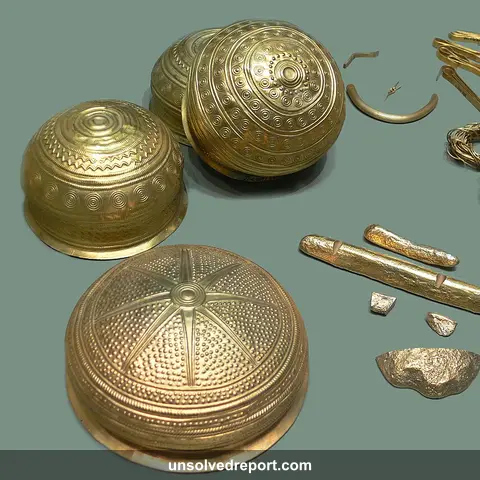
Eberswalde Hoard: Germany's Gold That Vanished in 1945
Germany's largest Bronze Age gold hoard vanished from a Berlin museum in 1945. It took 59 years to find out where it went — and who still won't give it back.

Sroda Treasure: The $100M Crown Nobody Can Name
The Sroda Treasure's $100M crown may not belong to who everyone thinks — and most of the hoard vanished before authorities arrived. What's still missing?
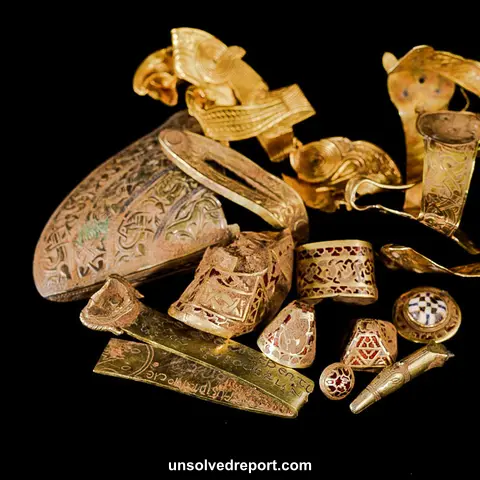
Staffordshire Hoard: 4,000 Pieces of War Gold Nobody Can Explain
Staffordshire Hoard: 4,000 pieces of torn-up Anglo-Saxon war gold — and one question experts still can't answer: who buried it, and why?