Childeric's Golden Bees: A King's Hoard Lost in One Night
300 golden bees buried with a Frankish king in 1653 vanished in one night in 1831. Only two survived. So what happened to the rest of Childeric's treasure?
A workman's shovel hits something hard under a church floor. It is the spring of 1653, the town is Tournai, and the something is gold. Not a coin or two — a whole grave of it. He has just broken into the burial of a fifth-century Frankish king: weapons, jewels, hundreds of coins, and a glittering swarm of tiny golden insects, each no bigger than your thumbnail — a discovery as accidental as the boy who once tripped over a Khan's buried gold an ocean away.
Hold that image, because here is the cruel part. Nearly two centuries later, almost all of it disappears in a single night — melted in a thief's pot or thrown into the Seine. Today you can count what physically survives on one hand. Everything else we know only because a careful seventeenth-century doctor drew it first.
This is the story of Childeric's golden bees. A real treasure. A real crime. And a knot of questions scholars still can't untie.
What we actually know
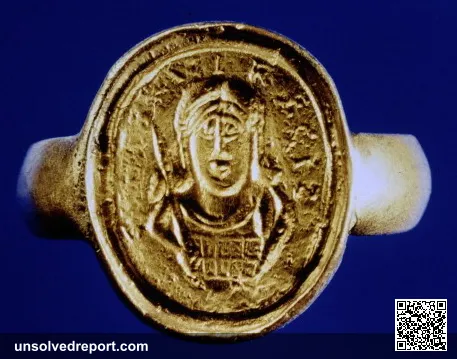
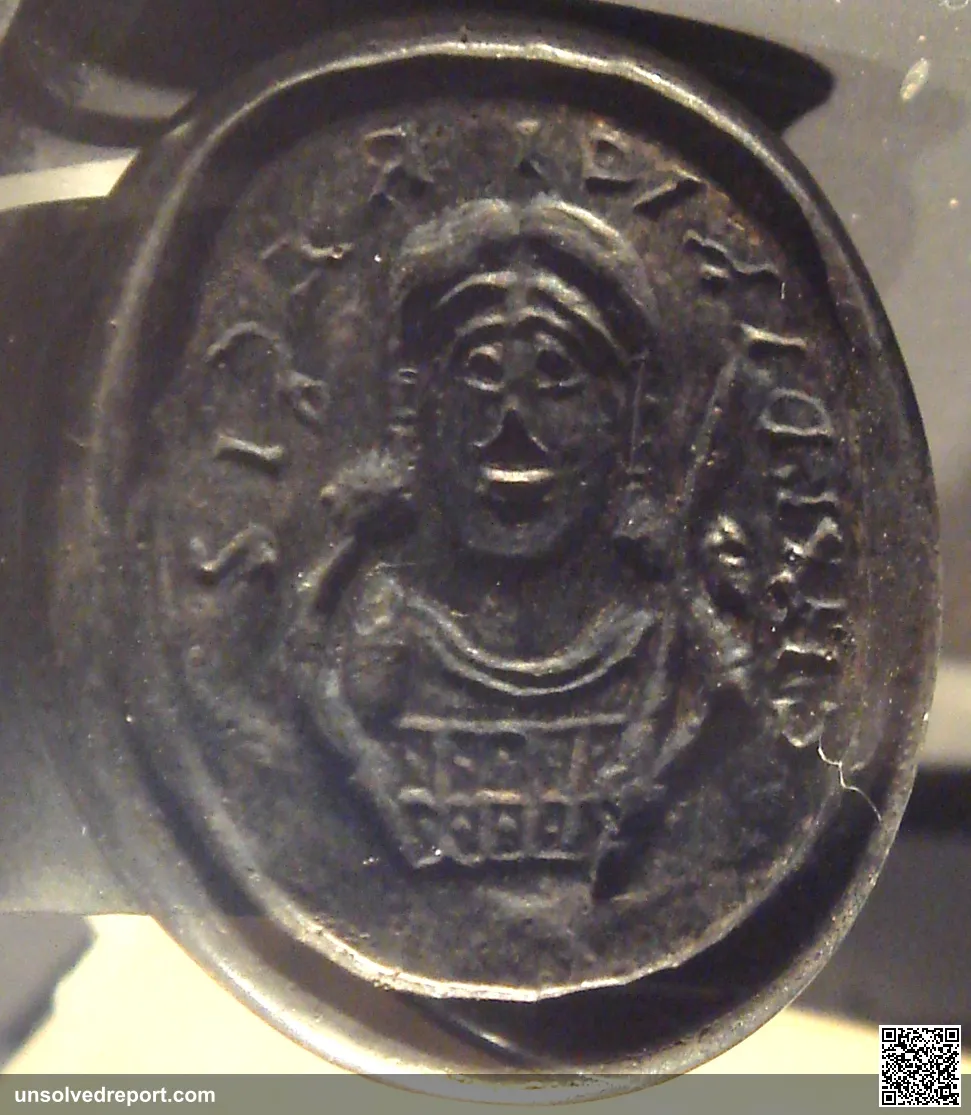
Start with a name and a date: Adrien Quinquin, a mason, May 27, 1653. He was working near the church of Saint-Brice in Tournai, in what is now Belgium, when he hit the rich grave (The History Blog; Encyclopedia.com). One object settled the question of who was buried there: a gold signet ring stamped CHILDERICI REGIS — "of Childeric the king." That pinned the tomb to Childeric I, father of Clovis, an early ruler of the Merovingian Franks, who died around 481 (Wikipedia: Childeric I) — identified by his grave goods much like the anonymous ruler behind Sutton Hoo a century later.
What lay around that ring was staggering. A ceremonial sword and a scramasax — a single-edged blade — both dressed in gold and garnet cloisonné. A gold bracelet. A small gold bull's head. Hundreds of coins. And, most famous of all, roughly 300 small golden ornaments shaped like winged insects, each fitted with red garnet or glass "wings," each measuring only about 1.6 by 1 centimeter (Heart of Hearts Jewels; Encyclopedia.com) — a hoard on the same scale as the war gold later dug up in the Staffordshire Hoard. Tradition calls them "bees."
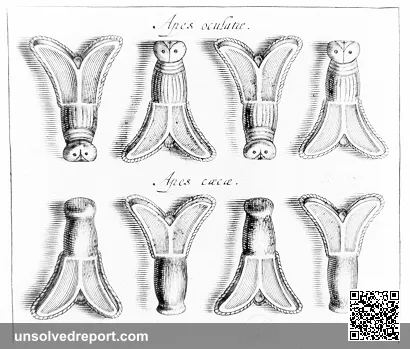
We know this in rare detail for one reason: someone studied the find almost the moment it came out of the ground. Archduke Leopold Wilhelm, the Habsburg governor of the Spanish Netherlands, handed the job to his physician, Jean-Jacques Chifflet. In 1655 Chifflet published Anastasis Childerici I Francorum Regis — a 367-page folio with 27 plates of meticulous engravings. Historians often call it one of the first genuinely scientific archaeological publications, written before "archaeology" was even a word (The History Blog; Encyclopedia.com).
Then the treasure started moving. The Habsburgs shipped it to Vienna, and in 1665 Emperor Leopold I gave it as a diplomatic gift to Louis XIV of France (Encyclopedia.com; Wikipedia). It joined the French royal collection and ended up in the Cabinet des Médailles of the royal library — the institution that would become the Bibliothèque nationale de France.
The bees had one more moment in the spotlight. In 1804, Napoleon needed an imperial emblem — something that reached deep into France's past without dragging up the Bourbon fleur-de-lis. His court landed on Childeric's golden insects. Soon bees were embroidered across his coronation robes and hangings, a signature of the First Empire (Heart of Hearts Jewels; The Frame Blog). Worth knowing: those coronation bees were freshly made of gilt metal and wire. The ancient garnet originals were judged far too small for the spectacle.
And then came the night of November 5–6, 1831. Thieves broke into the Cabinet des Médailles and walked out with more than 2,000 gold objects — roughly 80 kilograms of them — and Childeric's treasure was in the haul (The History Blog; Wikipedia). The country was scandalized. Investigators clawed back around 1,500 pieces — about 75 of the 80 kilograms — much of it hauled up in leather sacks from the Seine, where the thieves had dumped jewel-heavy items too awkward to melt or sell (The History Blog; Encyclopedia.com). The plainer gold? Melted down into anonymous bullion.
For Childeric, the loss was almost total. By most accounts, just two of the roughly 300 bees came back, along with two coins and the gold-and-garnet cloisonné fittings from the king's sword and scramasax (The History Blog; Wikipedia). The signet ring — the one that named the king — was gone for good, surviving only as Habsburg-era reproductions and wax seal impressions (The History Blog), the same fate that befell a Visigothic king's gold crown decades later. The few real fragments sit today in the BnF's Cabinet des Médailles. Which means Chifflet's 1655 engravings are now, in a very literal sense, the treasure.
The part nobody can answer
This is where the solid record stops and the honest questions begin. Several of them have never been closed.
Start with the most basic one: are they even bees? "Bees" is convention, not fact. The little ornaments read just as easily as flies, and some specialists have argued they were never meant to be bees at all (University of Chicago / Penelope).
Next: what were they for? Here the evidence pulls two directions. Chifflet reportedly found them near the remains of a horse and harness — yet each ornament has small holes, the kind you'd use to stitch it onto cloth. That second detail props up the long-popular idea that they once covered a royal cloak (Encyclopedia.com). Both readings are still on the table.
And then the numbers themselves get slippery. How many actually reached France, and how many truly survived? Sources say "about 300" were found — but some accounts suggest only a fraction, maybe around thirty, ever made it into Louis XIV's collection, and the recovery counts wobble from one retelling to the next. Since the originals were destroyed, nobody can recount them against the real objects anymore. The math is gone with the gold.
Theories worth weighing
The cicada idea. One widely repeated view says the insects were meant to be cicadas — old symbols of death and rebirth, a fitting choice for a king's grave (geriwalton.com). It's a tidy fit. But it leans on symbolic reasoning, not on any inscription or text from Childeric's own day, so it stays a plausible guess rather than a proven one.
The parade-horse idea. Other researchers think the bull's head and the "bees" decorated the king's harness and mount, not his clothing — picture a gleaming parade horse instead of a gleaming cloak (Encyclopedia.com). Their practical point lands: 300 garnet-studded ornaments sewn to one garment would make it heavy and stiff.
The Vidocq legend. Plenty of popular tellings hand the 1831 case to Eugène-François Vidocq — the ex-criminal who founded the Sûreté — as the detective who cracked it. But his role in this particular recovery is uncertain and reported inconsistently. Treat the "master detective recovers the king's gold" story as colorful tradition, not documented fact.
Here is what is not in doubt. A king's grave, 1,400 years old. Recorded with extraordinary care in 1655. Reduced, in one November night, to two small golden bees and an old doctor's engravings. The drawings outlived the gold — and somewhere in the silt of the Seine, or in some long-forgotten crucible, the rest of a king's swarm simply stopped existing.
Sources & Further Reading
- The History Blog — "The great find and great loss of Childeric's treasure"
- Encyclopedia.com — "Tomb of Childeric"
- Wikipedia — Childeric I
- University of Chicago (Penelope) — "A Note on Childeric's Bees"
- Heart of Hearts Jewels — Napoleon and the Bees
- The Frame Blog — The Napoleonic Bee

Treasure of Guarrazar: The Visigothic Crown That Vanished in 1921
The Treasure of Guarrazar: a Visigothic gold crown survived 1,300 buried years, then vanished from a locked royal palace in 1921. Where did it go?
The Copper Scroll: 64 Gold Caches, Zero Found in 73 Years
A scroll of pure copper lists 64 sites of buried gold from the Dead Sea caves. Tons of treasure, never found in 73+ years. A 2026 theory changes the story.
Hoxne Hoard: A Lost Hammer, Britain's Richest Roman Fortune
A Suffolk hammer hunt uncovered Britain's richest Roman hoard: 15,000 coins, a lost fortune, and an owner who vanished without a trace. Who were they?