Bujang Valley: SE Asia's Oldest City Is 90% Buried
Beneath Malaysian palm groves lies what may be Southeast Asia's oldest civilization — iron furnaces, river jetties, and 90% still buried. So how old is it really?
Walk into a rubber estate in Kedah, Malaysia, kick aside a few oil-palm fronds, and you may be standing on the oldest city in Southeast Asia. Most of us learn that the region's great civilizations start with the famous stone giants — Angkor, Borobudur. But south of the brooding peak of Gunung Jerai, hidden under those orderly rows of crops, lies a place that quietly rewrites that story: the Bujang Valley, or Lembah Bujang in Malay. It may have hosted an organized, industrial, trading society centuries before either of those wonders rose. And here's the strangest part. It isn't what archaeologists found that unsettles them. It's how little they've actually uncovered. By their own estimate, they've dug up roughly ten percent of the valley. The other ninety percent is still down there, in the dark.
What we know for sure
Start with the lay of the land. The Bujang Valley sprawls across some 224 square kilometers of Kedah, threaded along rivers that once spilled into the Strait of Malacca (Tourism Malaysia; Archaeology Magazine). For most of the twentieth century, one thing made it famous: its candi — Hindu-Buddhist temple ruins. More than fifty have been recorded. The most celebrated, Candi Bukit Batu Pahat (you'll also see it called Site 8), was dug in 1936–1937 by the English archaeologist H.G. Quaritch Wales and his wife Dorothy, who between them documented around thirty ancient sites. That granite temple was rebuilt on the spot in 1960, and it still stands as the showpiece beside the Bujang Valley Archaeological Museum in Merbok (Archaeology Magazine; Penang Travel Tips).
Then 2007 changed everything. A team from Universiti Sains Malaysia's Centre for Global Archaeological Research (CGAR), led by Professor Mokhtar Saidin and later Nasha Rodziadi Khaw, started turning over the soil at a cluster nobody had studied: the Sungai Batu Archaeological Complex (The Rakyat Post; Citizens Journal). What surfaced wasn't a serene temple precinct. It was something far grittier — an industrial port. Iron-smelting workshops. River jetties. Administrative buildings. Ritual sites. A landscape that worked rather than one that merely prayed (Al Jazeera). And the diggers kept pulling up tuyeres by the heap — the clay nozzles that blast air into a smelting furnace. This was metalworking on a serious, industrial scale (Wikipedia: Sungai Batu).
One find stops you cold. A brick monument with an unusual shape — a round brick floor crowned by a square structure — has been dated to around 110 CE, and described as the oldest recorded man-made structure in all of Southeast Asia (The Rakyat Post). The kingdom these sites belonged to has a name: Ancient Kedah, or Kedah Tua, a trading power that flourished roughly between the 2nd and 14th centuries CE, pulling in merchants from China, India, and the Middle East. As Nasha Rodziadi Khaw puts it, "Multiculturalism is not new in the Malay peninsula and Ancient Kedah. It started with trade in the 2nd century" (Al Jazeera). And the cosmopolitan picture keeps filling in. In August 2023, the same research center reported intact stucco Buddha statues carrying Pallava-script inscriptions at the nearby Bukit Choras stupa — echoing the vanished Buddhist capital of Champa further up the coast — and added a detail that should make you pause: only about forty percent of that single site has been excavated (Al Jazeera).
The question nobody can answer yet
Now we hit the honest part — the place where curiosity runs straight into uncertainty. The blockbuster claim is this: Sungai Batu pushes the start of organized civilization in Kedah back to the 6th century BCE, maybe earlier. That claim leans heavily on radiocarbon dates from charcoal scooped out of furnace remains. Some of the figures that have circulated reach all the way back to 788 BCE, or 535 BCE (Citizens Journal; Wikipedia: Sungai Batu). If those dates hold up across the whole site, Ancient Kedah wouldn't just be old — it would outrank Angkor and Borobudur by a thumping margin.
But several respected archaeologists have raised a hand and said: slow down. John Miksic of the National University of Singapore points out that "archaeologists do not normally depend on individual radiocarbon dates." Charles Higham calls the earliest figures outliers — numbers that must "fit into the entire scenario of the maritime silk road." And Stephen Chia, based at USM himself, notes that the boldest early dates haven't always been published in peer-reviewed venues by regional specialists (Wikipedia: Sungai Batu). Other work, using Bayesian chronological modeling, puts most of the activity in the 2nd to 10th centuries CE — still staggeringly old, just not the millennium-deep antiquity of the headlines. So the real mystery has two halves. Exactly how old is Ancient Kedah? And what does that untouched ninety percent still hold? Until far more of the valley is carefully dug and dated, both questions stay wide open.
What it might all mean
What follows is interpretation, flagged plainly as such — not settled fact.
Theory 1 — a "lost" first civilization (speculation). The boldest reading, favored by some Malaysian researchers and popular writers, goes like this: Sungai Batu was an independent civilization that grew up locally, centuries before Indian religious influence ever arrived, then slipped almost entirely from memory. It's a thrilling possibility. But it stands or falls on one thing — whether those earliest radiocarbon dates survive peer review and turn up again and again across the site. As we've seen, that's exactly what's still being argued.
Theory 2 — an iron-export economy (plausible, partly evidenced). The more cautious read: Kedah got rich by smelting iron and selling it to the maritime traders sailing past, with temples and bureaucracy following the money once it started flowing. The mountains of tuyeres and the river jetties make this economically tidy. You'll sometimes hear that this iron reached far-off empires like Rome — the way Oc Eo further south really did trade with Rome — but we found no solid documentation for that particular trade route here, so treat it as unverified legend, not fact.
Theory 3 — why so little is dug (institutional, not eerie). Part of the answer to "why ninety percent buried?" is almost boringly practical. Excavation is slow, costly, and much of the valley sits on private farmland. That fragility turned tragic in late 2013, when a developer flattened an ungazetted temple site — reported as Site 11, possibly some twelve centuries old — to clear ground for housing, and the country erupted in outcry (The Star). It's a grim reminder: the ninety percent still underground isn't safely preserved just because it's hidden.
The Bujang Valley sits on a knife-edge between the firmly documented and the genuinely unknown. The temples, the furnaces, the jetties — all real, all datable, all astonishing. But how deep this story runs through time, and what the buried remainder is keeping from us, is a mystery still waiting — quite literally — to be dug out of the ground. The next spade might move the clock another thousand years. Or it might not move it at all. Nobody yet knows which.
Sources & further reading
- Archaeology Magazine — Off the Grid: Lembah Bujang, Malaysia (Nov/Dec 2022): https://archaeology.org/issues/november-december-2022/off-the-grid/otg-malaysia-bujang-valley/
- Al Jazeera — Ancient find reveals new evidence of Malaysia's multicultural past (2024): https://www.aljazeera.com/news/2024/3/10/ancient-find-reveals-new-evidence-of-malaysias-multicultural-past
- Wikipedia — Sungai Batu (summarizes the dating debate and structures; secondary, cites scholars Miksic, Higham, Chia): https://en.wikipedia.org/wiki/Sungai_Batu
- The Rakyat Post — Oldest civilization in Southeast Asia is in Sungai Batu, Kedah (2022): https://www.therakyatpost.com/living/2022/06/21/did-you-know-that-the-oldest-civilization-in-southeast-asia-is-in-sungai-batu-kedah/
- Citizens Journal — Bujang Valley archaeology rewrites Southeast Asian history: https://cj.my/153968/bujang-valley-archaeology-rewrites-southeast-asian-history/
- Tourism Malaysia — The Ancient Kingdom of Bujang Valley: https://www.tourism.gov.my/media/view/the-ancient-kingdom-of-bujang-valley-1
- The Star — Outrage over Bujang Valley development after tomb temple destroyed (2013): https://www.thestar.com.my/news/nation/2013/12/01/bujang-valley-candi-demolished
- Penang Travel Tips — Candi Bukit Batu Pahat (Site 8), Bujang Valley, Kedah: https://www.penang-traveltips.com/malaysia/kedah/candi-bukit-batu-pahat.htm
Sacsayhuaman: The 100-Ton Stones That Won't Budge
No mortar, no iron tools, no wheels, yet these 100-ton Inca stones fit so tight a paper can't slide between them. How did Sacsayhuaman get built?
Sanxingdui Bronze Masks Mystery: China's Buried, Burned Gods
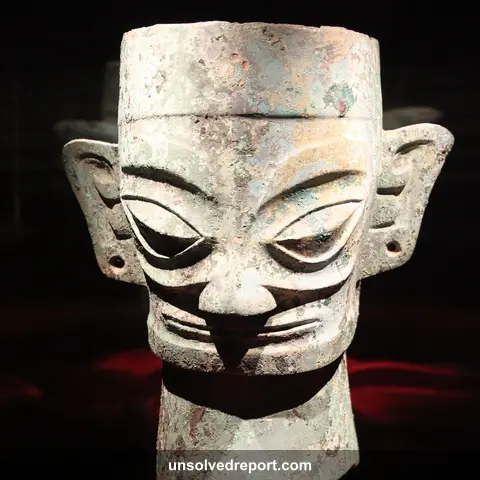
Sanxingdui's bronze masks bulge eyes on stalks and hide a 3,000-year secret — smashed, burned, buried by their makers. Why destroy your own gods?

Rongorongo: The Writing No Living Person Can Read
Easter Island's rongorongo script has 15,000 glyphs and zero living readers. A 2024 test just rewrote its origin story. Can it ever be deciphered?