Dong Duong: Champa's Buddhist Capital Nobody Can Explain
A Hindu kingdom built Southeast Asia's greatest Buddhist monastery, then let it vanish within a few generations. Historians still can't agree why.
One brick gateway. That's it. It leans in a quiet stretch of farmland in central Vietnam's Quang Nam province, held upright by a cage of iron struts so it won't topple. Local people call it Thap Sang, the "Bright Tower." And almost nothing else stands above ground.
But once, this field held the grandest Buddhist sanctuary in the entire Cham world: the monastery of Dong Duong, beating heart of a lost capital called Indrapura. For a few dazzling generations more than eleven centuries ago, a king poured his kingdom's wealth into compassion carved in stone. Then the monastery emptied. The capital moved. Even the dynasty's chosen faith faded out of the record, as if someone had quietly closed a door.
What flourished here? And why did it vanish so completely? The answer lives in that uneasy space between what we can prove and what we'll probably never know.
What We Actually Know
Start with the rare good news: for an ancient Southeast Asian site, the founding of Dong Duong is unusually well documented. We know the date because the founder carved it in stone. In 875 CE, King Indravarman II built a Buddhist monastery and temple here, dedicated to the bodhisattva Laksmindra-Lokesvara Svabhayada, a royal form of Avalokitesvara, the bodhisattva of compassion (Smarthistory; Wikipedia, "Indravarman II (Champa)")). Indravarman II ruled from roughly 854 to 893, and historians generally count him as the founder of Champa's "Sixth Dynasty." He had a flair for grand origin stories, too: he claimed descent from the sage Bhrigu of the Mahabharata, and insisted that Bhrigu himself had founded Indrapura in ancient times (Wikipedia, "Indravarman II (Champa)")).
Now here's the strange part. Champa wasn't a Buddhist kingdom. It was overwhelmingly Hindu and Shaivite, its spiritual capital the great temple-city of My Son. Yet for a stretch of the 9th and 10th centuries, this one dynasty at Indrapura turned to Mahayana Buddhism, laced with Tantric elements, and made it the faith of the court (Britannica, "Southeast Asian arts") — a swerve not unlike the one traced at Oc Eo, the lost port city of the Funan kingdom, where Southeast Asian rulers were just as willing to remake their faith and trade networks overnight. Indrapura, the place we now call Dong Duong village, served as a capital of Champa from about 875 to around 1000 CE.
And the scale of it was staggering. The complex sprawled across three walled clusters strung along a single east-west axis. Heritage records put the outer citadel walls at roughly 155 by 326 meters, with a processional road running some 760 meters eastward toward a rectangular valley (Danang Fantasticity). Picture walking that road as a monk a thousand years ago, the towers rising ahead of you the whole way. When the French archaeologist Henri Parmentier of the École française d'Extrême-Orient (EFEO) came to dig in 1901-1902, working alongside the epigrapher Louis Finot, he ran one of the most extensive excavations ever attempted at any Cham site, publishing his findings in volumes in 1909 and 1918. Out of the ground came hundreds of sculptures and inscribed stones.
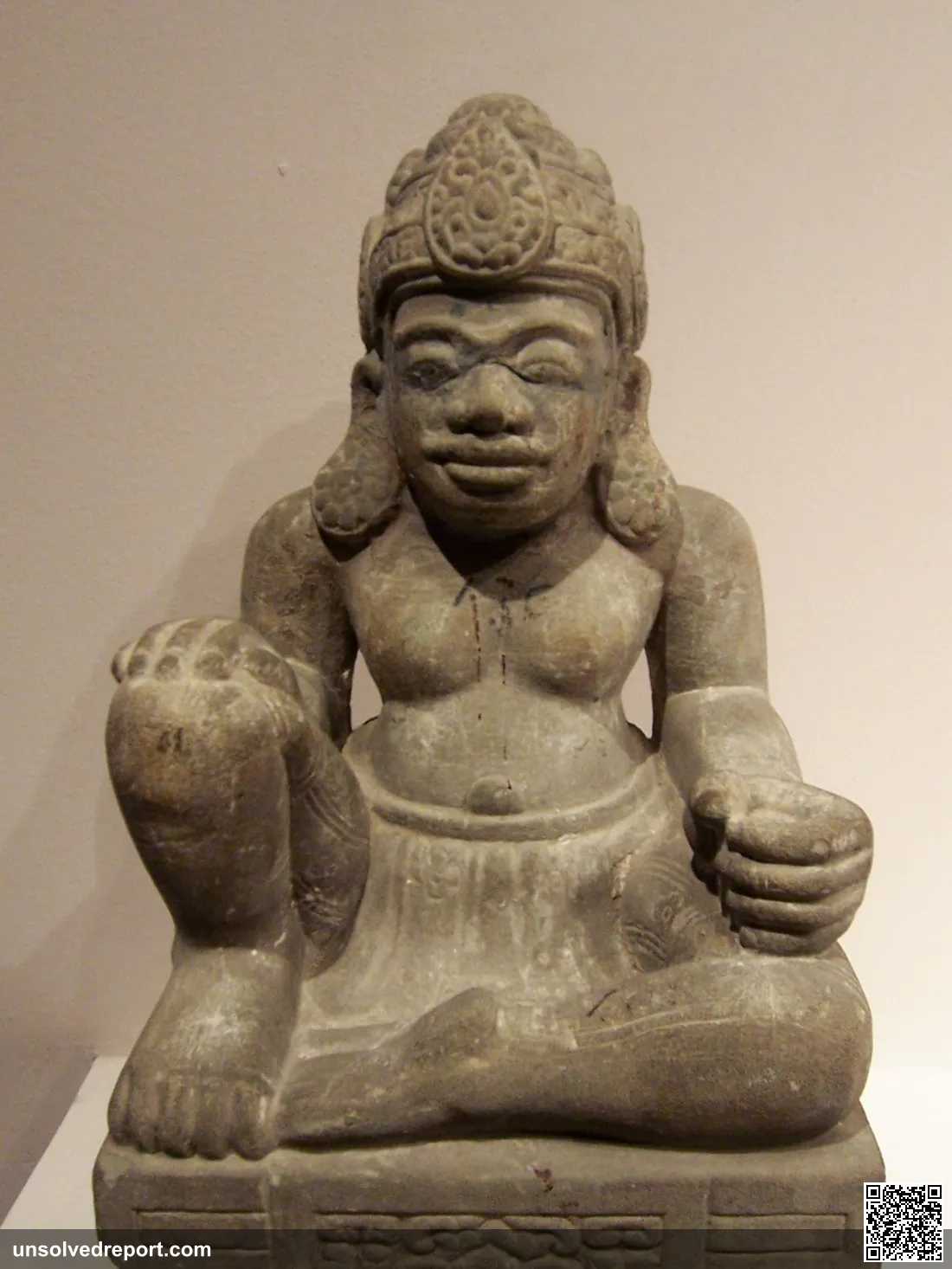
Those sculptures were so distinctive they gave their name to an entire era of art. Art historians call it the "Dong Duong style" of the late 9th century, and one description tags it with the phrase "artistic extremism": heavy, continuous eyebrows, broad noses, thick unsmiling lips, and faces that stare back at you with an intensity bordering on severe, like nothing before or after in Cham art (Britannica, "Southeast Asian arts"). Colossal guardian figures, the dvarapalas, once loomed over the gateways. They're still counted among the masterpieces of Cham sculpture.
But the most famous object from Dong Duong wasn't dug up by Parmentier at all. It waited until 1978, when farmers in the village struck metal by accident and pulled a bronze goddess out of the earth, graceful, about 1.14 meters tall, the largest bronze sculpture known from the whole of Champa civilization (Da Nang Museum of Cham Sculpture, via Google Arts & Culture) — a farmer's-spade discovery in the same tradition as the Buddhist relics turned up at Malaysia's Bujang Valley, another Southeast Asian holy city that spent centuries buried before anyone knew it was there. Today she's a recognized national treasure of Vietnam.
So how did the golden age end? That, too, is on the record, and it's brutal. In 982 CE, King Le Hoan of Dai Viet marched an army into Indrapura, sacked it, and killed the Cham king Paramesvaravarman I (Wikipedia, "History of Champa"). Around the year 1000, the Cham court pulled its capital south to Vijaya, putting distance between itself and the Viet frontier, and the kingdom's religious center of gravity slid back toward Shaivism and My Son. After that came centuries of weathering, looting, and damage during the Vietnam War of the 1950s-1970s. What's left is foundations and that propped-up Bright Tower gate (VietnamNet). On December 22, 2016, the site was finally named a Special National Relic.
The Question the Stones Won't Answer
Here's what all those inscriptions never explain: why Buddhism rose at Indrapura in the first place, and why it disappeared so utterly afterward.
Think about how odd this is. In a kingdom whose kings had honored Shiva for centuries, Indravarman II raised the most ambitious Buddhist foundation in all of Cham history. And within a few generations, the whole experiment was over. No surviving document tells us what sparked that conversion. We don't know how deeply it ran among ordinary Cham people versus the royal court. We can't even say whether the monastery died mainly because of the Dai Viet invasion, an internal religious backlash, an economic shift, or some tangle of all three that historians still can't weigh.
And the monks themselves, the community that lived and studied along that 760-meter axis, left almost nothing of their daily lives behind. We have the king's declarations in stone. From everyone else, silence.
Theories, and How Much to Trust Them
A play for the world stage (the scholarly read). One widely cited interpretation, echoed across academic summaries, is that Indravarman II embraced Mahayana Buddhism to plug Champa into the larger Buddhist world, linking his court to the powerful civilizations of India, Sri Lanka, and Tang China, marking out his new dynasty as sophisticated and serious. It's a reasonable reading. But it's still a guess about a dead king's motives, not a statement he ever wrote down.
Who is she, really? The 1978 bronze goddess sparks a debate that's still wide open. The French scholar Jean Boisselier identified her as the goddess Tara. The researcher Trian Nguyen argued she's actually Laksmindra-Lokesvara, the dynasty's own personal deity (VietnamNet). A tiny seated Amitabha Buddha tucked into her hair points toward the Avalokitesvara family of identities, which would seem to settle it, except the objects she once held, reportedly a lotus and a conch, are now missing. So the clue that might have answered the question is gone. Both names are in use today, and nobody has closed the case.
How "Tantric" was any of it? Sources can't quite agree. They describe the faith at Dong Duong as Mahayana, or Mahayana spiced with Tantric elements, or proto-Vajrayana. The honest reason for the disagreement is that the inscriptions are thin, so scholars hedge. Treat this one as an open characterization, not a settled fact.
A word of caution before you reach for something dramatic. It's tempting to imagine some grand, mysterious force erasing all of this, the way people once did for the lost Khmer mountain city of Mahendraparvata before laser scans found it hiding under Cambodia's jungle canopy. But the plain answer is sturdier: a military defeat, a capital that packed up and moved, a religious tide rolling back in, and a thousand years of tropical weather are more than enough to dissolve a brick monastery into farmland. The real mystery here isn't supernatural at all. It's just how much was lost. What survives, from the Bright Tower to that enigmatic bronze now sitting in Da Nang, is proof that an entire spiritual world once burned bright in this field, and that we still can't read most of its story. The door is closed. We can only knock.
Sources and further reading
- Smarthistory, "The Dong Duong Buddhist temple complex": https://smarthistory.org/dong-duong-buddhist-temple-complex-vietnam/
- Britannica, "Southeast Asian arts: Vietnam, kingdom of Champa": https://www.britannica.com/art/Southeast-Asian-arts/Vietnam-kingdom-of-Champa-c-2nd-15th-century
- Wikipedia, "Indravarman II (Champa)": https://en.wikipedia.org/wiki/Indravarman_II_(Champa)
- Wikipedia, "History of Champa": https://en.wikipedia.org/wiki/History_of_Champa
- Da Nang Museum of Cham Sculpture, Dong Duong Gallery (Google Arts & Culture): https://artsandculture.google.com/story/da-nang-museum-of-cham-sculpture-dong-duong-gallery/oAJyMaCjrd7wJg
- Danang Fantasticity, "The Archaeological and Architectural Relic of Dong Duong Buddhist Monastery": https://danangfantasticity.com/en/the-archaeological-and-architectural-relic-of-dong-duong-buddhist-monastery
- VietnamNet, "Dong Duong Buddhist monastery needs emergency restoration": https://vietnamnet.vn/en/dong-duong-buddhist-monastery-needs-emergency-restoration-2329474.html
- VietnamNet, "A thousand-year return: The spiritual homecoming of Tara Bodhisattva": https://vietnamnet.vn/en/a-thousand-year-return-the-spiritual-homecoming-of-tara-bodhisattva-2480074.html
Stonehenge Altar Stone Origin: 450 Miles, and No One Knows How
Stonehenge's Altar Stone origin isn't Welsh — it's Scottish, 450 miles away. Glaciers are ruled out. So who moved six tons of rock that far, and how?
Nazca Lines Purpose Mystery: The Giant Art Nobody Can Explain
A desert people carved a hummingbird the size of a soccer field — then could never see it whole. Why? An AI just doubled the mystery. Here's what the Nazca Lines evidence actually says, and what still can't be explained.
Cahokia: The American City That Outgrew London, Then Vanished
Cahokia once out-grew London. Then 20,000 people quietly vanished, no war, no fire, no famine. Every leading theory has collapsed. What really happened?