Sacsayhuaman: The 100-Ton Stones That Won't Budge
No mortar, no iron tools, no wheels, yet these 100-ton Inca stones fit so tight a paper can't slide between them. How did Sacsayhuaman get built?
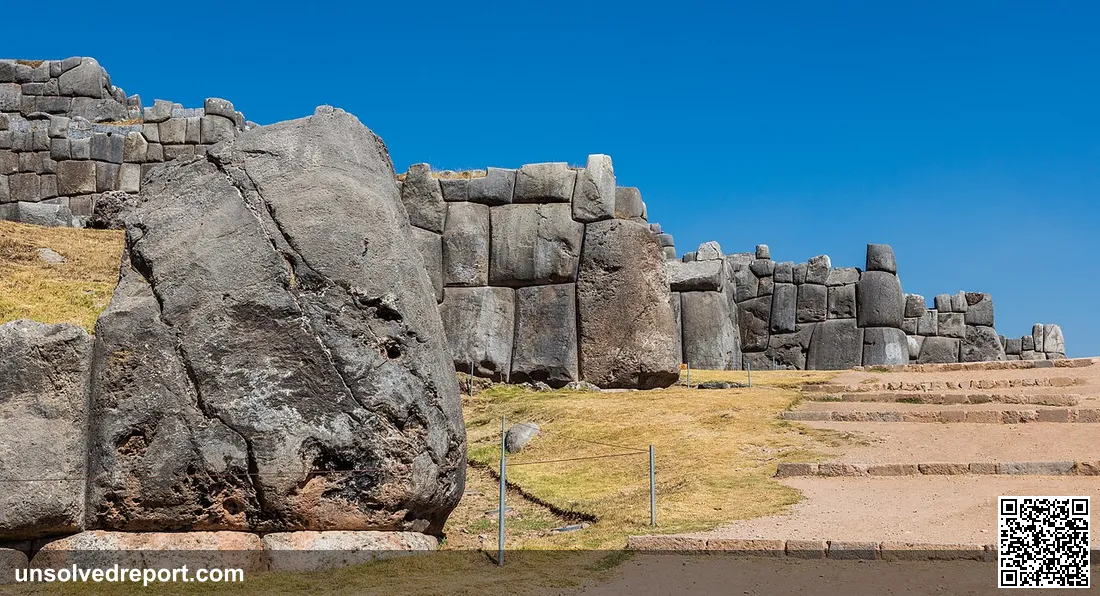
Try this. Stand at the wall above Cusco, Peru, slide a sheet of paper toward the seam between two giant stones, and push. In place after place, it won't go in. The blocks meet that closely. Some of them stand taller than you do and weigh more than a fully loaded eighteen-wheeler. Nothing glues them together. No mortar. No cement. And here's the part that breaks your brain a little: the edges aren't square. Every massive block is its own strange polygon, carved to lock into the ones around it like a 3D jigsaw made of rock, the same impossible-looking fit found at Puma Punku elsewhere in the Andes. The walls of Sacsayhuaman (sometimes spelled Saqsaywaman) have held for about five hundred years. Earthquakes that flattened the Spanish buildings nearby? The walls just shrugged.
So picture the puzzle. No iron tools. No horses or oxen to haul. No wheel for moving cargo. And somehow people lifted, shaped, and fit stones this huge with joints this tight. That is the real Sacsayhuaman walls mystery, and trust me, it's far stranger and far better than the tabloid version.
What We Actually Know
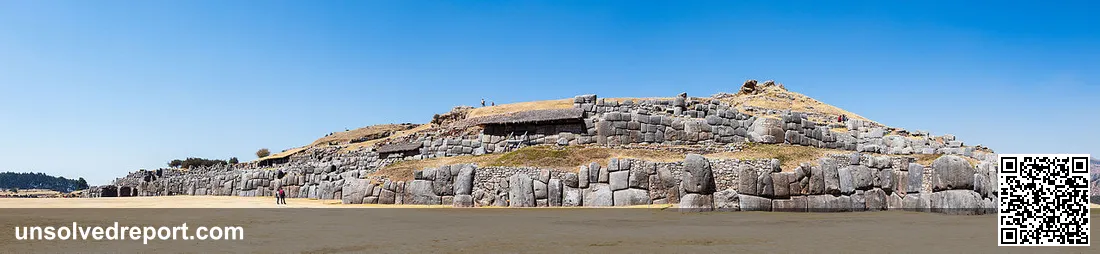
Start with the basics, because they're wild on their own. Sacsayhuaman sits on a hilltop about 755 feet (230 meters) above Cusco, and it went up in the 15th century. Most of the work is credited to the Inca ruler Pachacuti, who reigned roughly 1438-1471, and to the kings who came after him (Britannica; World History Encyclopedia). In 1983, Cusco and Sacsayhuaman together were named a UNESCO World Heritage Site.
Now the numbers, and they really are staggering. The site is built as three terraced walls zigzagging across the slope. According to the World History Encyclopedia, those walls run more than 540 meters and fold into as many as 40 segments, with the biggest outer blocks standing over four meters tall and tipping the scales at more than 100 tons. Britannica clocks individual stones taller than 27 feet (about 8.2 meters). You'll see even bigger numbers thrown around too, up to roughly 200 tons for the largest blocks, but here's the honest catch: nobody has put these stones on a scale. Those weights are estimates, so take the headline-grabbing figures as ballpark, not gospel.
What nobody argues about is the fit. The blocks were stacked with no mortar at all, and the seams between them are legendary. Britannica describes stones "laid together without the use of mortar" that "seem to be immovable by nature." And this isn't just for looks. A 2024 engineering study in the journal Engineering Failure Analysis built a computer model of a Sacsayhuaman wall to figure out why this dry-stone, interlocking masonry holds up so well when the ground starts shaking (ScienceDirect). The answer: those irregular, often trapezoidal blocks spread the stress around and let the wall flex and settle instead of cracking apart. That's the secret to how it outlasted Cusco earthquakes that wrecked the buildings raised centuries later.
We also know, in broad strokes, who built it. The Spanish chroniclers and the dirt itself tell the same story: a colossal, state-run labor machine. The World History Encyclopedia reports that some 20,000 workers were called up under the Inca mit'a system, a kind of rotating labor draft, with thousands sent to quarry stone and thousands more to dig foundations and trenches. The design is credited to four named architects. Crews shaped the blocks with harder hammerstones and bronze tools, then dragged them into place with ropes, logs, levers, and earthen ramps. Look closely and some stones still wear the little bumps and notches the workers used to grip them and pry them along.
The closest thing we have to a clean lab answer comes from a man who decided to just try it himself. Architect and scholar Jean-Pierre Protzen spent years crawling over Inca quarries and stonework, including at nearby Ollantaytambo. In peer-reviewed research, including "Inca Quarrying and Stonecutting" in the Journal of the Society of Architectural Historians (1985), Protzen showed he could split, dress, and shape stones using nothing but hammerstones of the kind scattered around Inca quarries. Pound the surface long enough and you get that same pecked finish you see all over Inca masonry. And those impossibly tight joints? Protzen argued they came from patient trial and error: set a block, see where it snags against its neighbor, lift it, hammer down the high spots, lower it again, and repeat until it drops into place like it grew there.
There's a dark ending, too. After the conquest, the same one that gave rise to the legend of Atahualpa's lost ransom gold, the Spanish tore down big chunks of Sacsayhuaman and hauled the smaller stones downhill to build churches and colonial Cusco. The largest blocks, though? Too enormous to budge. So they sit exactly where the Inca left them, the ones that were never meant to be moved and never were.
So Where's the Real Mystery?
Here's where an honest person has to draw a careful line, between "we understand how this was done" and "we have the full play-by-play."
Archaeology has a solid, evidence-backed answer for how this kind of masonry was made: hammerstone pounding, grinding and abrasion, endless trial fitting, and an enormous, organized workforce. Protzen's experiments prove the toolkit is enough to make the finish and the joints. That's not a hunch. That's someone doing it with his own hands.
What's genuinely still open is the fine engineering of the very biggest blocks. The Inca left no written instructions, because they didn't use a writing system the way Europeans did. Every eyewitness account we have comes from Spanish chroniclers who showed up later, not from the people who actually stacked the stones. So the exact ramps, the rope rigs, the crew sizes, the precise order of moves used to walk a 100-ton-plus polygon into a wall and seat it snugly against several neighbors at once? All reconstructed and debated, not recorded. How many people leaned on the ropes? How did they tilt and spin a block into its final spot without crushing a hand or chipping the matching face? How long did a single mega-block take, start to finish? Real questions. Answerable questions. Researchers keep chipping away at them with experiments and analysis.
So the mystery isn't whether regular humans could pull this off. The mystery is the lost logistics, the step-by-step we never got to write down.
The Theories, Sorted Out
The mainstream view (the one with the evidence behind it). The walls are Inca engineering plus muscle on a massive scale: hammerstone shaping, stubborn trial-and-error fitting, sledges, rollers, levers, ropes, and ramps, all marshaled by a powerful state. The proof is everywhere, in the quarries, the half-finished blocks left behind, the tools found on site, Protzen's hands-on replication, and the chronicle record. Of every explanation out there, this one carries by far the most weight.
The "softened stone" idea (a fun story, but no evidence). There's a stubborn legend that the Inca knew some plant juice or secret trick that could melt rock into a moldable paste, like clay. It's a great campfire tale. It's also got zero chemical or archaeological backing, and the pecked, pounded tool marks all over the stones scream mechanical shaping, not melting.
Aliens or a "lost super-civilization" (speculation, not supported). Pop media loves to whisper that work this precise must have needed extraterrestrials or some forgotten advanced race, the same argument endlessly recycled for Peru's own Nazca Lines. Scholars file this under pseudoarchaeology: it waves away the piles of Inca tools and methods sitting right there on the hillside, and it has never earned credible support in peer-reviewed research (overview of the ancient-astronaut concept). We bring it up only to set it firmly apart from what the record actually shows, the same record that quietly debunks similar claims at other megalithic sites nobody can fully explain.
And maybe that's the most jaw-dropping thing about Sacsayhuaman: the truth doesn't need aliens. A society that summoned tens of thousands of people, mastered the slow, patient art of fitting stone to stone, and raised walls that outlived the empires that came after, that's a wilder story than any legend. And it's the one the stones themselves keep telling, to anyone who comes up the hill, slides in a sheet of paper, and feels it stop.
Sources & Further Reading
- Britannica, "Sacsayhuamán"
- World History Encyclopedia, "Sacsayhuaman"
- UNESCO World Heritage Centre, "City of Cuzco" (inscribed 1983)
- Jean-Pierre Protzen, "Inca Quarrying and Stonecutting," Journal of the Society of Architectural Historians (1985)
- Seismic numerical analysis of an Inca stone wall in Sacsayhuaman, Engineering Failure Analysis (2024)

Sanxingdui Bronze Masks Mystery: China's Buried, Burned Gods
Sanxingdui's bronze masks bulge eyes on stalks and hide a 3,000-year secret — smashed, burned, buried by their makers. Why destroy your own gods?

Rongorongo: The Writing No Living Person Can Read
Easter Island's rongorongo script has 15,000 glyphs and zero living readers. A 2024 test just rewrote its origin story. Can it ever be deciphered?
Ggantija Temples: Built Before the Wheel, Then Its Builders Vanished
Ggantija's 50-ton stones predate the wheel, Stonehenge, and the pyramids — and the people who raised them vanished without a trace. What actually happened?