Sutton Hoo: The King Who Left No Body
Sutton Hoo's 90-foot ship hid a king's fortune in gold — and no body. Where did the corpse go, and whose was it? The soil finally gave up its secret.
Summer, 1939. A Suffolk field. A self-taught excavator named Basil Brown is on his knees, brushing sand off a low grassy mound — and the sand is brushing back a story. Line by line, an outline appears. It is the shape of an enormous ship, ghosted into the earth.
Inside that ship lay the richest untouched early medieval grave ever found in Britain. A gold belt buckle, alive with twisting beasts. A jeweled sword. Silver carried all the way from the Mediterranean. And a fierce iron-and-bronze helmet that would go on to become the face of Anglo-Saxon England — the one you've seen in a hundred textbooks, staring back with hollow eyes.
But here's the strange part. At the very center of all that treasure, something was missing.
There was no body.
Nearly a century later, the experts still can't tell you for sure whose grave this was. The most famous burial in English archaeology is, quite literally, a hole in the ground.
What we know actually happened
The grave sits at Sutton Hoo, near Woodbridge in Suffolk. In 1939 the land belonged to Edith Pretty, who looked at the cluster of strange earthen mounds on her property and hired Basil Brown to dig in.
In June, Brown found it. Not a ship, exactly — the wooden hull had rotted to nothing centuries before. What survived was its iron rivets and a "ghost" pressed into the sand: the perfect imprint of a vessel, what the National Trust describes as the shape of a ship revealed in the sandy soil (National Trust). Stretch it out and it ran roughly 88 to 90 feet long (Smithsonian Magazine; Live Science). Picture a ship nearly the length of a basketball court, buried whole.
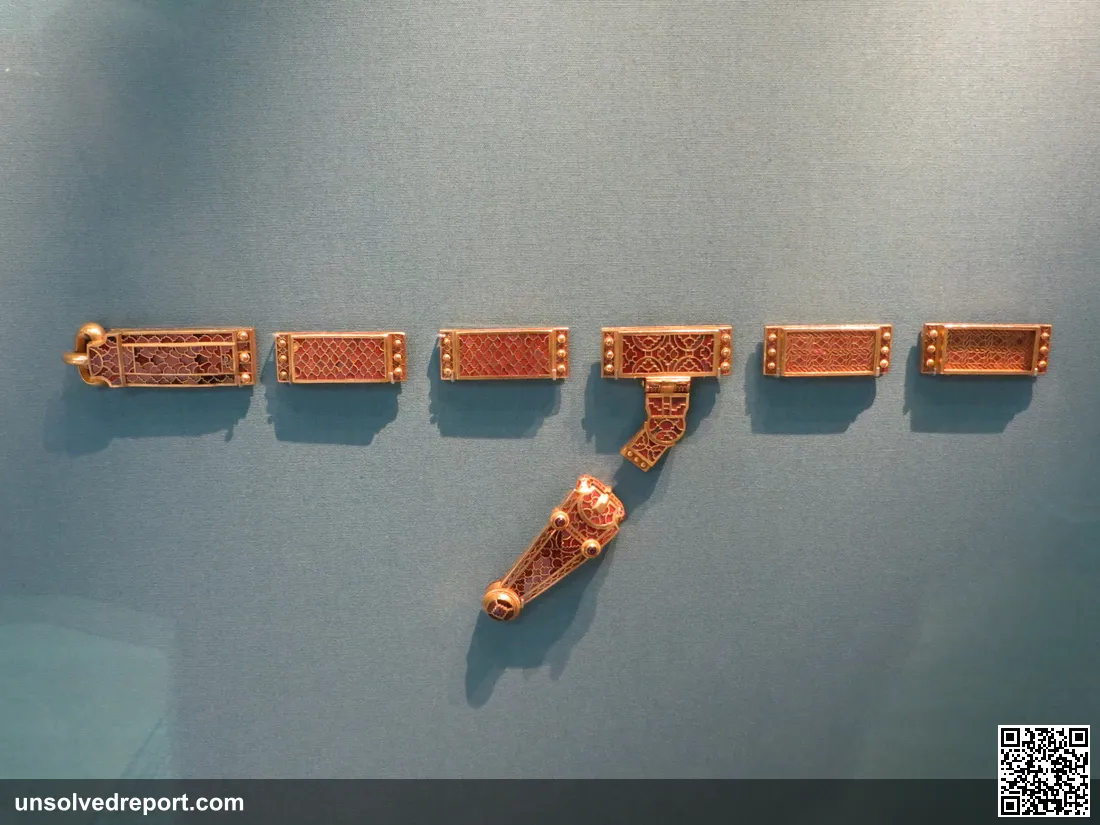
Right in the heart of that ship stood a timber chamber, and that chamber was crammed. Live Science counts 263 artifacts: the helmet of gold, silver and other metals; that gold belt buckle worked with interlacing snakes and beasts; silverware shipped in from the Byzantine Empire; and gold dress fittings set with garnets that had traveled from as far away as Sri Lanka (Live Science). Let that sink in — gemstones from the other side of the world, in a Suffolk field. The British Museum, which keeps the collection today, calls it the richest intact early medieval grave in all of Europe.
This was not a farmer's grave. The treasure screams royalty, and it whispers a date, too. Tucked in the chamber was a purse holding 37 gold tremisses from Merovingian Gaul, along with blank coins and gold ingots (carlanayland.org). The catch: these Frankish coins name their mints and the men who struck them, but no kings — so they pin the burial down only loosely. Coin experts settle on the early decades of the 7th century, and the number people love to quote is around 625 AD (Smithsonian Magazine). Hold onto that date. It lands smack in the reigns of the East Anglian kings written down by the monk Bede a century later.
And then — the absence. The thing at the center of everything.
The British Museum puts it plainly: any remains were "claimed by the acidic local soil," leaving "only a human-shaped gap among the treasures within." The 1939 diggers went over the body area inch by inch. No bone. No teeth. Nothing. For decades that one fact opened a chilling door: maybe Sutton Hoo was a cenotaph — a grand, empty monument to someone whose body lay somewhere else entirely. A king's tomb with no king in it.
That question gnawed at people. It drove a major British Museum re-excavation under Rupert Bruce-Mitford between 1965 and 1971. And later, the soil itself gave up a clue. Chemists found unusually high phosphate levels in the sand right under the chamber — exactly the chemical shadow a body leaves behind as it breaks down (National Trust; British Museum). So the verdict most specialists now reach is this: someone really was buried here. The hungry, fast-draining Suffolk soil simply ate the skeleton whole, down to the last fleck of bone.
The part science can't crack
So we know a person was laid in that ship. Here's what no test, no scan, no chemistry can do.
It cannot give that person a name.
There's no inscription. No surviving bone to study. No document from the time that says "the king lies here." Everything we've got is circumstantial: a grave that is unmistakably aristocratic, almost certainly royal; a date stamped within about a quarter-century; and a short list of kings who happened to die inside that window. As Live Science sums it up, "Historical records dating to the period are limited, and the remains of those buried at the site are completely decayed, leaving no physical remains to analyze."
So the identity of Britain's greatest ship burial rides entirely on inference — clever, careful, but still a guess. The British Museum, the National Trust and the Smithsonian all say the honest, slightly haunting thing: we may never know for certain who this was. And this isn't a blank waiting for one lucky shovel to fill it. Short of some find nobody sees coming, the mystery is permanent. Baked in.
Best guesses — and why none of them stick
One name leads the pack by a mile: King Rædwald of East Anglia (died around 624–627).
Read this as the front-runner, not the answer. But it's a strong front-runner. By Bede's account, Rædwald was the most powerful English king of his day — exactly the kind of man you'd row into the earth in a ship full of gold — and he died at just about the right moment (Smithsonian Magazine).
There may even be a tiny symbolic fingerprint. Among the grave goods sat a pair of silver spoons — and many read one as inscribed "Saulos" and the other "Paulos," an apparent nod to the apostle Paul's conversion, maybe a gift for a baptism (Google Arts & Culture; National Trust). It fits eerily well, because Bede tells us Rædwald was baptized a Christian yet kept a temple with two altars side by side — one Christian, one pagan. A man hedging his bets between gods. And what is this grave if not that exact hedge: Mediterranean Christian silver lying beside a gloriously pagan ship burial? One word of caution, though — the "Saulos/Paulos" reading is itself argued over, and some specialists think the second spelling is just a sloppy copy, not a deliberate message. So hold that clue with a loose grip.
Because the case is not closed. Historians cheerfully name other suspects who also fit the window: his son Eorpwald, who ruled briefly after him, and the joint kings Sigeberht and Ecgric. Alex Woolf of the University of St Andrews captured the whole frustrating mood in one line: "If you held a gun to my head, I would say Raedwald, but equally I wouldn't be at all surprised if it turned out to be someone else" (Live Science). And there's a darker wrinkle still — there were members of the East Anglian royal line in the 7th century about whom almost nothing survives at all. Any one of them could be the man in the ship, a king so thoroughly forgotten we don't even have his name to guess with.
So here's all we can truly say, and it's plenty: someone of staggering wealth and power was rowed into the ground in a 90-foot ship, ringed by treasure from across the entire known world, some fourteen centuries ago — and then erased so completely by the earth that all we're left holding is a shape in the sand, a phosphate shadow, and a question.
The treasure made Sutton Hoo famous. The empty space at its heart is what won't let it rest.
Sources & further reading
- British Museum — The Anglo-Saxon ship burial at Sutton Hoo: https://www.britishmuseum.org/collection/death-and-memory/anglo-saxon-ship-burial-sutton-hoo
- National Trust — History of Sutton Hoo: https://www.nationaltrust.org.uk/visit/suffolk/sutton-hoo/history-of-sutton-hoo
- Smithsonian Magazine — The True History Behind Netflix's 'The Dig' and Sutton Hoo: https://www.smithsonianmag.com/history/true-history-behind-netflixs-dig-and-sutton-hoo-180976923/
- Live Science — Who was buried at Sutton Hoo?: https://www.livescience.com/who-was-buried-sutton-hoo.html
- Britannica — Sutton Hoo: https://www.britannica.com/place/Sutton-Hoo
- Carla Nayland — The Merovingian coins from Sutton Hoo: https://www.carlanayland.org/essays/sutton_hoo_coins.htm
- Google Arts & Culture (British Museum) — Silver bowls and spoons from the ship-burial at Sutton Hoo: https://artsandculture.google.com/asset/silver-bowls-and-spoons-from-the-ship-burial-at-sutton-hoo/-wENdEIg-TTEWQ

HD 139139: The Star That Blinks With No Pattern
HD 139139 blinked 28 times in 87 days — no orbit fits, no glitch explains it, and astronomers even checked for aliens. So what's really out there?
Venus Retrograde Rotation: The Mystery Nobody Can Explain
Venus spins backward so slowly its day outlasts its year. The retrograde rotation mystery has two rival theories, and neither has won yet.
The Faint Young Sun Paradox: Earth Should Be Frozen
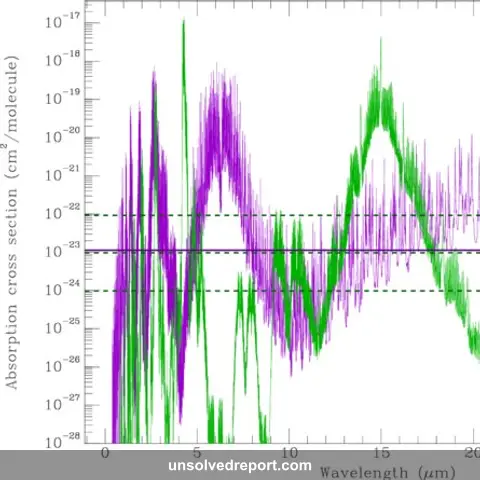
The Sun was 25% dimmer 4 billion years ago—Earth should've been frozen solid. The rocks say oceans existed anyway. Over 50 years later, no one has a clean answer.