Pereshchepina Treasure: 800 Objects, One Unproven Royal Grave
75kg of gold and silver, 800+ objects, one boy's stubbed toe in 1912 — is the Pereshchepina Treasure really Khan Kubrat's grave? The evidence still splits historians.
A barefoot shepherd boy was walking the sandy dunes near the village of Mala Pereshchepina, somewhere between 13 and 20 kilometers from Poltava in what is now Ukraine. It was the summer of 1912. His foot caught on something hard sticking out of the sand — the rim of a golden vessel. He had just stubbed his toe on more than 800 objects of gold and silver: weapons wrapped in precious metal, a Byzantine ceremonial sword, and a small cluster of signet rings whose tiny engraved letters would, decades later, whisper a single famous name. More than a century of scholarship later, the two biggest questions still aren't settled — was this really a grave, and does the evidence name one ruler or two? Here's what the objects, the coins, and the inscriptions actually support, and where the case still runs on inference.
> The 60-Second Brief
> - A shepherd boy discovered the hoard in summer 1912 near Mala Pereshchepina, 13–20 km from Poltava, Ukraine.
> - The site held 800+ objects: roughly 16–17 gold vessels, 19–20 silver vessels, plus bracelets, rings, a rhyton, a gold staff, and a nearly half-kilogram gold buckle.
> - Total weight: gold alone tops 21 kg, silver adds roughly 50 kg more — about 75 kg combined.
> - The youngest coins in the hoard belong to Byzantine emperor Constans II, dated to around 647 AD, giving scholars a hard "no older than this" floor.
> - In 1983, Byzantine seal specialist Werner Seibt read engraved signet rings as ΧΟΒΡΑΤΟΥ ΠΑΤΡΙΚΙΟΥ — "of Kubrat the Patrician."
> - Kubrat founded Old Great Bulgaria in the 630s; the treasure has sat in the State Hermitage Museum, Saint Petersburg, since the early 20th century.
What we actually know
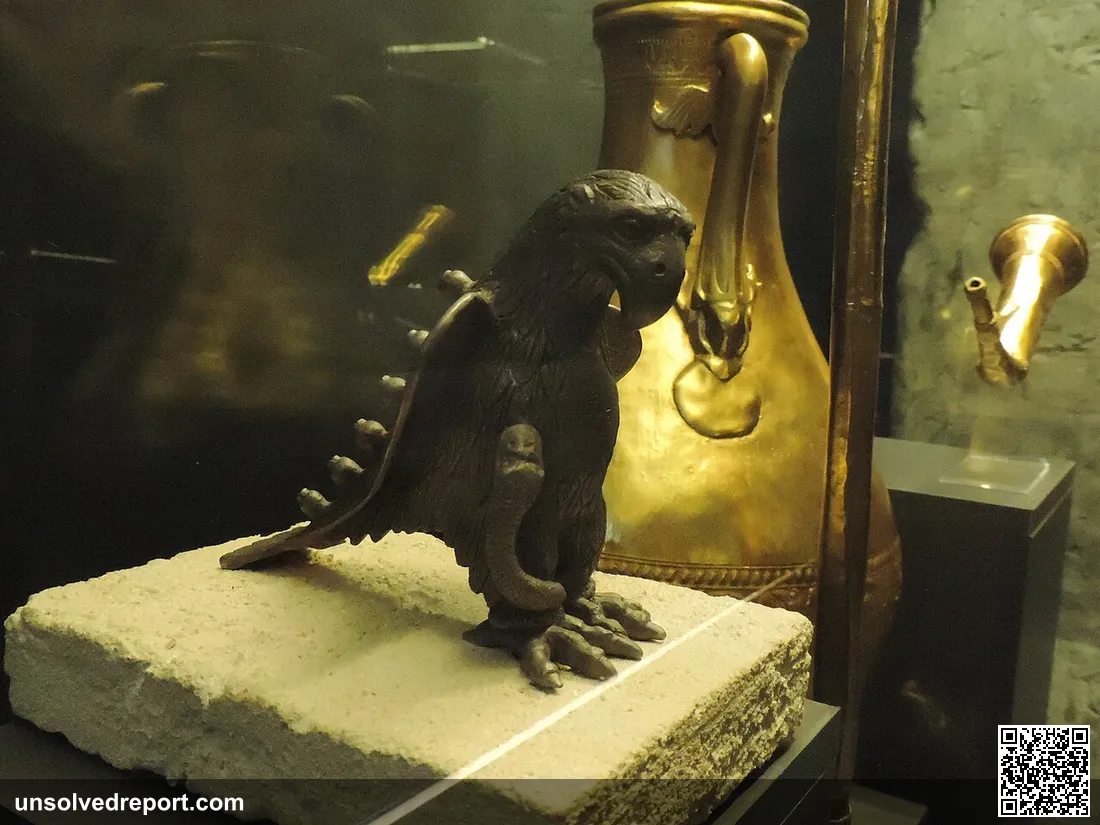
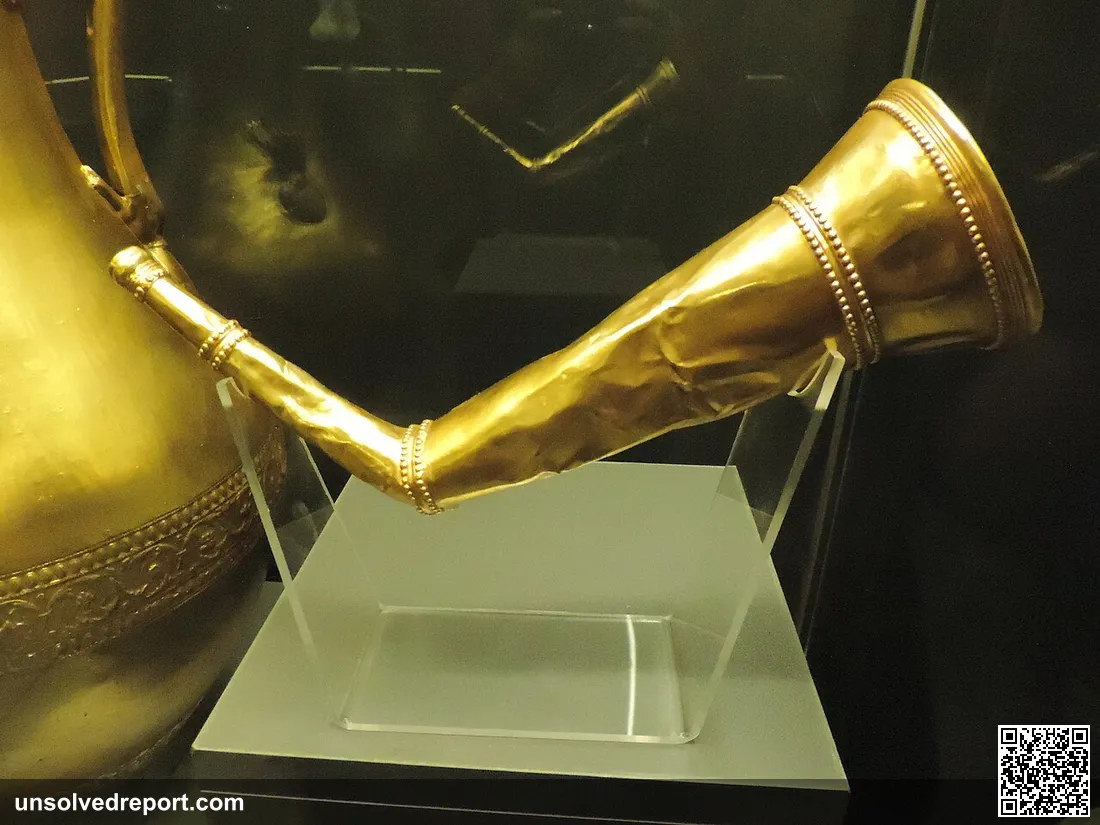
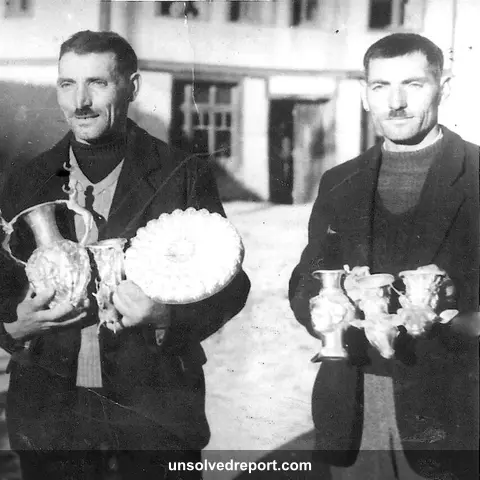
Start with the solid ground, because there is a lot of it. This find is real, and it has been catalogued down to the gram. After the boy's discovery in 1912, the Russian archaeologist Count Aleksey Bobrinsky took charge of the site and published a full description in 1914 (Wikipedia: Pereshchepina Treasure). Picture the haul: roughly 16 to 17 gold vessels, another 19 to 20 in silver, plus bracelets, rings, a striking drinking rhyton, a gold staff or scepter, and one enormous gold buckle that tips the scale at nearly half a kilogram. Sources argue over the exact weight, but the gold alone passes 21 kilograms, and the silver pieces add around 50 more (Wikipedia).
Here's the part that makes historians lean in. These objects came from all over the map and from different centuries, all jumbled together in one spot. There's a Sasanian Persian dish showing a Persian king. There's a Byzantine dish with a sixth-century bishop's inscription scratched into it. And there are Byzantine gold coins running from the late 500s into the mid-600s (Wikipedia). One detailed history of the period points out that the youngest coins belong to the Byzantine emperor Constans II and date to around 647 AD — which hands scholars a hard floor, a terminus post quem. Translation: the treasure cannot be older than that (Institute history page citing W. Seibt's work). Since the early twentieth century, the whole glittering pile has lived in the State Hermitage Museum in Saint Petersburg.
Now, the name. The link to Kubrat isn't a campfire story — it came out of patient detective work on a few engraved letters. In 1983, the Austrian-based Byzantine seal expert Werner Seibt took a fresh look at the Greek monograms carved into the gold signet rings and read them as ΧΟΒΡΑΤΟΥ ΠΑΤΡΙΚΙΟΥ — "[the seal] of Kubrat the Patrician" (Institute history page; Walters Art Museum journal). And that reading fits the history books like a key in a lock. Kubrat — also spelled Kuvrat or Kurt — was the khan who founded Old Great Bulgaria, a confederation of Onogur-Bulgar tribes north of the Black Sea, back in the 630s (Wikipedia: Kubrat). The chronicler John of Nikiu, writing close to the events, says Kubrat was baptized in Constantinople and grew up inside the imperial palace; Patriarch Nikephoros adds that he rose up against the Avars and signed a treaty with Emperor Heraclius (Wikipedia: Kubrat). And that Byzantine court title on the ring, patrikios — patrician — is exactly the honor a man of his rank would have carried. The Hermitage and the National Gallery of Bulgaria have even put on display together the so-called "Sword of Khan Kubrat," a Byzantine-made blade read as a gift straight from the imperial court (National Gallery Bulgaria / Hermitage exhibition) — it isn't the only spectacular gold hoard to turn up on Bulgarian soil; see the Panagyurishte Treasure.
The questions nobody can close
This is where the floor gets soft. The treasure came with no label, no signed note, nothing to tell us flatly what it was. Two simple questions still split the experts right down the middle.
First: was this a grave, or just a buried stash? Some scholars read the deposit as the burial of a top-ranking ruler. They point to traces that look like an interment — the boy's stumble is sometimes described as breaking through into "what is believed to be the grave," and one detailed account even describes a wooden coffin sheathed in roughly 250 gold plates (Wikipedia; Institute history page). Others are more careful. They call it a treasure deposit and shrug at the burial details, because the site was never dug under controlled conditions — a kid found it by accident, and a lot of the context was scrambled before anyone could record it. Wikipedia threads the needle: the careful consensus says "the hoard represents, at least in its earlier phase, the treasure of Kubrat" — language that pointedly refuses to call it his tomb (Wikipedia).
Second: do the rings name one man, or several? Here's the catch — the Pereshchepina rings carry more than one monogram, and not every reading is locked down. Some specialists have argued that a separate ring names Organa, a Bulgar leader tied to Kubrat. But others, Seibt among them, doubt the squiggles really support two independent royal names ([WebSearch summary of Seibt and the Walters catalogue]). The 2006 exhibition catalogue The Road to Byzantium says the rings possibly name the khans Organa and Kuvrat — and that little word possibly is doing a lot of heavy lifting. So even the keystone piece of evidence comes with an asterisk.
And there's one more thread worth pulling, honestly. A handful of scholars have floated entirely different owners — some pointing to the Khazars rather than the Bulgars (Wikipedia). To be clear, the Kubrat reading is the strongest one going, and the one most experts back. But it's an inference stitched together from monograms, coin dates, and how neatly the history fits — not a signed deed of ownership.
So who really owned it?
Theory 1 — it's the royal tomb (the popular favorite). Plenty of historians read Pereshchepina as Kubrat's grave or memorial deposit — the same kind of argument that swirls around the still-unfound tomb of Genghis Khan, another steppe ruler whose burial refuses to give up its secrets. The patrician ring, the Byzantine sword, the emperor-grade gifts, and coins that stop around the mid-640s all point at a powerful ruler who, by most estimates, died sometime in the 650s or 660s (Wikipedia: Kubrat). This is interpretation, not proof — but it's the reading the surviving evidence backs best.
Theory 2 — it's a treasury, not a burial. On this view, the gold is an accumulated state or personal fortune, deposited or hidden away, and the "grave" details got blown out of proportion by the chaos of how it surfaced. It still keeps the Kubrat link through the rings — it just refuses to assume there was ever a body down there at all.
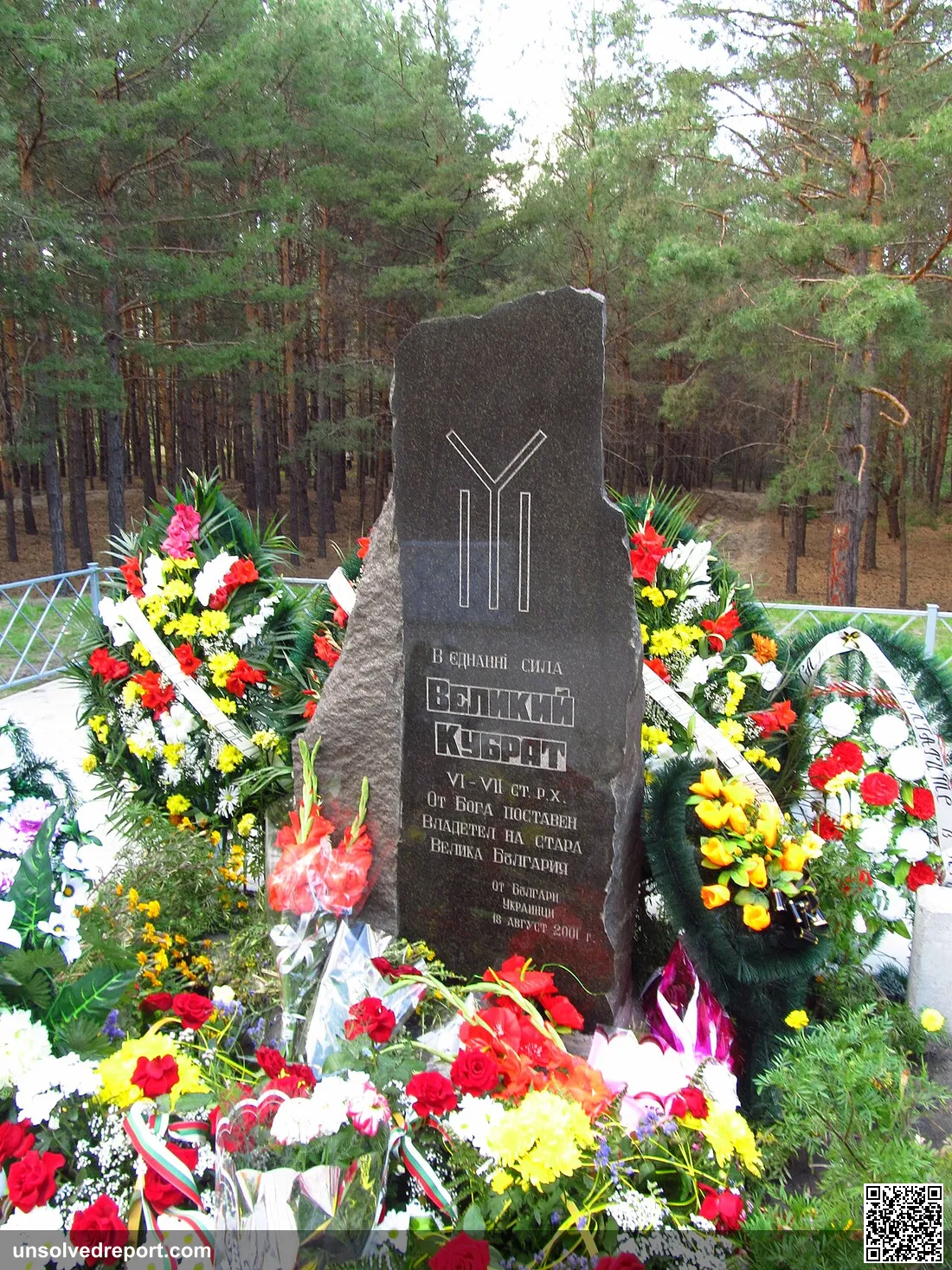
And then the legend — flagged as legend. Bulgarian tradition wraps Kubrat in a famous parable: the bundle of sticks. Dying, the story goes, he gathered his five sons and showed them that a tied-together bundle of sticks cannot be snapped, while a single stick breaks with ease — begging them to stay united. It's a teaching tale repeated in later sources, not a documented event. And here's the bittersweet ending: the sons scattered anyway. Under pressure from the Khazars, the confederation cracked apart, and Asparukh led the group that crossed the Danube and founded the Bulgarian state that still exists today (Wikipedia: Kubrat).
What survives beyond any argument is the gold itself — some 75 kilograms of seventh-century splendor that a barefoot boy kicked loose by pure accident. Whether it once cradled a king's body or only a king's wealth, the Pereshchepina treasure is still one of the most eloquent objects we have from a steppe empire that vanished off the map. And it leaves you wondering how many other kings are still out there in the sand, waiting for someone to trip over them.
No new archival release, excavation, or peer-reviewed reattribution of the Pereshchepina hoard itself surfaced in 2025–2026 research checks for this article. The one dated, verifiable recent activity found is thematically adjacent rather than a direct development on the case: the Burgas Regional Historical Museum in Bulgaria has been displaying museum copies of the Kubrat treasure pieces (the originals remain in the Hermitage) in its "The Memory of Great Bulgaria" exhibit, most recently reopened for a second run due to visitor demand around the Night of Museums in mid-May — a public-history echo of the find, not a new fact about who owned it (Burgas Regional Historical Museum).
Frequently Asked Questions
Is the Pereshchepina Treasure definitely Khan Kubrat's grave?
No. Scholars agree the objects likely belonged to Kubrat based on the inscribed signet rings, but whether the site was actually a burial — as opposed to a hidden treasury — is unresolved, since the find was made by accident in 1912 and never excavated under controlled archaeological conditions (Wikipedia).
How do we know the treasure is linked to Kubrat at all?
In 1983, Byzantine seal expert Werner Seibt read Greek monograms on gold signet rings from the hoard as ΧΟΒΡΑΤΟΥ ΠΑΤΡΙΚΙΟΥ, "of Kubrat the Patrician" — a court title that matches Kubrat's known status as a Byzantine-recognized patrician (Institute history page; Walters Art Museum journal).
How much gold and silver did the hoard contain?
Sources vary slightly on exact figures, but gold alone tops 21 kilograms and silver adds roughly 50 kilograms more, across more than 800 individual objects including vessels, bracelets, rings, a rhyton, and a gold staff (Wikipedia).
Could the treasure belong to someone other than Kubrat?
It's possible. A handful of scholars have proposed Khazar ownership instead of Bulgar, and even within the Bulgar reading, some argue a second ring may name another leader, Organa. The 2006 exhibition catalogue The Road to Byzantium says the rings "possibly" name both Organa and Kuvrat, leaving the single-owner reading short of certainty (Wikipedia).
Where is the treasure kept today?
The entire hoard has been held at the State Hermitage Museum in Saint Petersburg since shortly after its 1912 discovery. Museum-made copies of key pieces have also been exhibited in Bulgaria, including at the Burgas Regional Historical Museum (Burgas Regional Historical Museum).
What happened to Kubrat's empire after his death?
Old Great Bulgaria fractured under pressure from the Khazars. Bulgarian tradition frames this with the "bundle of sticks" parable, in which the dying Kubrat urged his five sons to stay united — a teaching tale, not a documented event. The sons scattered regardless, and Asparukh led one group across the Danube to found the Bulgarian state that still exists today (Wikipedia: Kubrat).
Sources & further reading
- Wikipedia, "Pereshchepina Treasure"
- Wikipedia, "Kubrat"
- Institute of Biomedical Sciences history page citing W. Seibt, "The Birth of Great Bulgaria"
- The Journal of the Walters Art Museum, "Reading and Displaying Monograms on Byzantine Signet Rings"
- National Gallery of Bulgaria / State Hermitage, "The Sword of Khan Kubrat"
- O. V. Komar, "A Gold Buckle from Bohdan Khanenko's Collection: Notes on the History of the Mala Pereshchepina Complex" (academic paper)
- Burgas Regional Historical Museum, "The Treasure of Khan Kubrat Shines in the Treasure Hall of Burgas Museum"
São João Shipwreck 1552: The Treasure No One Has Ever Found
One of the richest ships to ever sail from India broke apart on a wild African coast in 1552. Her treasure vanished. Nobody has ever found it — why?
Panagyurishte Treasure: Solid Gold Mistaken for Whistles
Three brothers digging clay in 1949 Bulgaria pulled nine solid-gold vessels from the ground and reportedly tried to blow into them like whistles. Who buried them, and why did they never come back for the gold?
12 Lost Treasures the World Has Never Found
A king's jewels eaten by the tide. A room of amber that blinked out of history. Twelve real fortunes that left a paper trail, then simply vanished.