Dwarka Submerged City: The Sunken Ruins Nobody Can Explain
Divers found cut stone walls and 120+ anchors submerged off Dwarka, India. Is it Krishna's legendary drowned city? The age nobody can pin down.
A diver's gloved hand sweeps through the warm, silty murk of the Arabian Sea, a few meters down off the temple town of Dwarka on India's Gujarat coast. The fingers close on an edge. A straight, cut edge. Stone walls. The curved footing of a bastion. Dressed building blocks scattered across the seabed like furniture in a flooded house. And anchors, heavy stone anchors, dozens upon dozens of them, the kind that once held trading ships steady in a busy port. Someone built here. Then the sea came up and took it.
For more than forty years, this drowned ground has held one of South Asia's most stubborn arguments, one of several lost cities the earth swallowed whole. Was this the legendary Dwarka of the god Krishna, the golden city the Mahabharata swears vanished beneath the waves? Here's the honest answer, and it is more interesting than a yes or a no. The seabed really does hold ruins. And it also holds a genuine mystery that careful science, after decades of work, still has not closed. So let's do the one thing the legend can't: separate what divers actually wrote down from what's still beautifully, frustratingly up for grabs.
What the Divers Actually Found
Start with the people who went down with cameras and measuring tapes. The underwater work off Dwarka was run mainly by the Marine Archaeology Unit of India's National Institute of Oceanography (NIO), under archaeologist S.R. Rao. Between 1983 and the early 1990s, across roughly a dozen field campaigns, teams worked the waters off modern Dwarka, the nearby island of Bet Dwarka, and Somnath (NIO/NOAA archive).
And what they brought back is solid. In water 3 to 12 meters deep, surveys revealed "stone building blocks such as remains of wall, pillar and bastion," plus stone anchors in several distinct shapes, three-holed, prismatic, and triangular (NIO/NOAA archive). Over a hundred anchors logged in all. That's not a chance scatter of rock. That density screams working harbor. The divers fixed each find with underwater cameras, video, and measured drawings, pinned object positions with sextants, and covered the ground on SCUBA, towed along by an underwater scooter.
Now look closer at those anchors, because they carry a quiet punch. Researchers noticed that the Dwarka anchors of the late Harappan type predate visually identical late-Bronze-Age anchors known from Cyprus and Syria by a couple of centuries (researchgate / NIO study). Read that again. This coast was holding ships with sophisticated gear before the famous Mediterranean ports were doing the same thing.
On dry land, the ground gets even firmer. Digs on Bet Dwarka island turned up a Late Indus seal carved with a three-headed animal, and pottery, including Lustrous Red Ware, datable to roughly 1600–1500 BCE (NIO/NOAA archive). Then there's thermoluminescence dating, a clever trick that measures how long ago a piece of fired clay last sat in a kiln or a fire. It placed pottery from the Bet Dwarka area in the late Harappan period, with one widely cited result landing near 1500–1700 BCE (researchgate / TL study). And the island kept living long after, right into the Maurya era (Wikipedia: Bet Dwarka).
So the floor under your feet is steady. A fortified, harbor-equipped settlement stood on and near this coast in the second millennium BCE, and a long seafaring history rolled on from there. Nobody serious disputes that part.
The Question Nobody Can Close
Here's the strange part. The mystery was never whether ruins exist. It's what they are, exactly how old the underwater structures are, and whether any of it can be tied to the city of legend.
Two problems sit right at the center, and they refuse to budge.
First: dating drowned masonry is genuinely, maddeningly hard. Thermoluminescence ages fired pottery beautifully, but it can't date a bare stone wall. The walls have to be inferred from the stuff found around them and the context they sit in, and the offshore blocks have stubbornly refused to lock onto a single date. Marine erosion gnaws at them. Sediment shifts. People reused the same stone across centuries. The timeline smears.
Second: there's a chronological gap you could drive a chariot through. Rao dated the earliest Dwarka remains to around 1700 BCE. But traditional calculations for Krishna's lifetime, worked out from the epics, often land near 3100 BCE. That's a gulf of more than a thousand years, and it makes any clean "this is Krishna's Dwarka" claim wobble (splainer.in). And yet, tellingly, nobody has given up. In early 2025, the Archaeological Survey of India sent divers back down off Dwarka, a team led by additional director-general Alok Tripathi, to re-examine the site with modern methods (Deccan Herald). When a fresh survey launches like that, it tells you something simple: the case is still open.
Three Ways to Read the Stone
From here, the hard evidence runs out and informed reading begins. So take everything below as interpretation, not settled fact. There are three honest ways to look at this seabed, and that's exactly what makes it so hard to put down.
The legend-is-real reading (speculative). This is the romantic one. The drowned harbor is the historical seed of the Mahabharata's tale, a magnificent coastal city the sea reclaimed, remembered down the centuries in the shape of an epic. Its supporters point to the fortifications, the sheer scale of the port, and the deep antiquity of the seafaring culture, and they ask: isn't that the kind of place a civilization would never forget? Some scholars find the idea genuinely exciting, even while stopping short of proof. Delhi University historian Nayanjot Lahiri, for one, has spoken of being thrilled by what the finds might mean for how we understand early Indian cities (splainer.in). Hold it as an evocative hypothesis, though. Not a proven identification.
The keep-your-cool reading (the mainstream skeptical view). Other specialists pump the brakes, and their objection bites. Much of the offshore interpretation, they note, came from marine scientists rather than trained excavating archaeologists, and big loaded words like "civilization" and "acropolis" ran out ahead of what the evidence could actually carry (splainer.in), the same overreach that fuels the manmade-or-natural fight over Japan's Yonaguni Monument. The danger has a name: reverse archaeology. You start with a beloved story, then go hunting the seabed for confirmation, instead of letting the stone speak first. By this reading the ruins are real and important, full stop, but pinning them to Krishna remains unproven.
The slow-drowning reading (geological). And then there's a quieter, less cinematic possibility that earns its seat at the table. Sea levels along this coast have shifted a lot since the Bronze Age, and storms are on record damaging and submerging structures here. There's a protection wall on Bet Dwarka tied to destruction by a sea storm (Wikipedia: Bet Dwarka). No single apocalyptic flood required. An old harbor town could have been swallowed slowly, water creeping up, storms hammering it down, over centuries, much like Egypt's own sunken port of Thonis-Heracleion, which is precisely how a great many ancient coastlines were quietly lost.
And here's what makes Dwarka so hard to walk away from: all three readings can sit at the same table without anyone telling a lie. The stone is really down there. The anchors really do outnumber coincidence. And whose city this was, and exactly when it slipped under, really is unanswered. As one careful summary put it, science can verify a drowned harbor; it can never "prove" what is held in faith (splainer.in). So the divers keep going down. The sediment keeps its secrets. And the walls wait, just a few meters below the surface, for the next careful look. Whatever the 2025 survey pulls up, the sea has been keeping this one quiet for a very long time, and it isn't done yet.
Sources and Further Reading
- National Institute of Oceanography, Marine Archaeology of Dwarka (NOAA archive): https://www.nodc.noaa.gov/archive/arc0001/9900162/2.2/data/0-data/jgofscd/htdocs/organisation/archaeology/Dwarka.htm
- "An Ancient Harbour at Dwarka: Study Based on Recent Underwater Explorations" (ResearchGate): https://www.researchgate.net/publication/27667093_An_ancient_harbour_at_Dwarka_Study_based_on_the_recent_underwater_explorations
- "Cultural Sequence of Bet Dwarka Island Based on Thermoluminescence Dating" (ResearchGate): https://www.researchgate.net/publication/27667061_Cultural_Sequence_of_Bet_Dwarka_island_based_on_Thermolumincence_dating
- Wikipedia, "Bet Dwarka": https://en.wikipedia.org/wiki/Bet_Dwarka
- Splainer, "Dwarka: Debate over the Indian Atlantis": https://splainer.in/sections/2024/Lost-Kingdom/big-story
- Deccan Herald, "ASI begins fresh underwater surveys at Gujarat's Dwarka" (2025): https://www.deccanherald.com/india/gujarat/asi-begins-fresh-underwater-surveys-at-gujarats-dwarka-to-uncover-its-past-legends-3466136

Mercury Large Iron Core Mystery: The Planet That Shouldn't Exist
Mercury's iron core swallows 85% of the planet, more than double any rocky world's share. Something added metal or stole the rock, but the evidence contradicts itself. See why.

Lost Peacock Throne: Gone Since 1747, Not One Piece Survives
Nader Shah looted the most jeweled throne on Earth in 1739 — then it vanished. Not one verified piece survives. Where did Shah Jahan's Peacock Throne go?
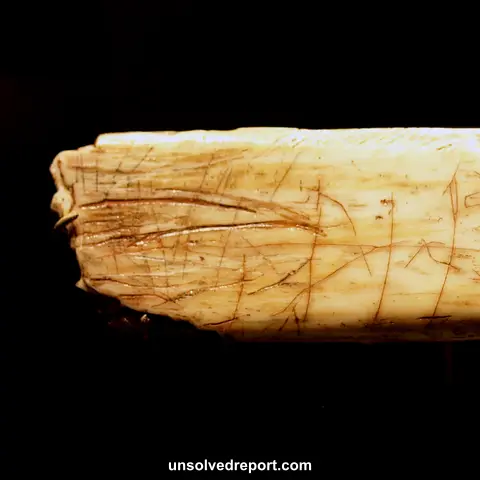
The Sherborne Bone: A 700-Year-Old Lie
The Sherborne Bone fooled Britain's top scientists for 80 years as genuine Ice Age art. Then radiocarbon exposed a 700-year-old fake — so who really carved it?