Yonaguni Monument: The Underwater 'Pyramid' Japan Won't Call Real
26 meters down off Japan sits a 'staircase' officials won't call a ruin. Is Yonaguni Monument a lost city, or does the rock hide a simpler answer?
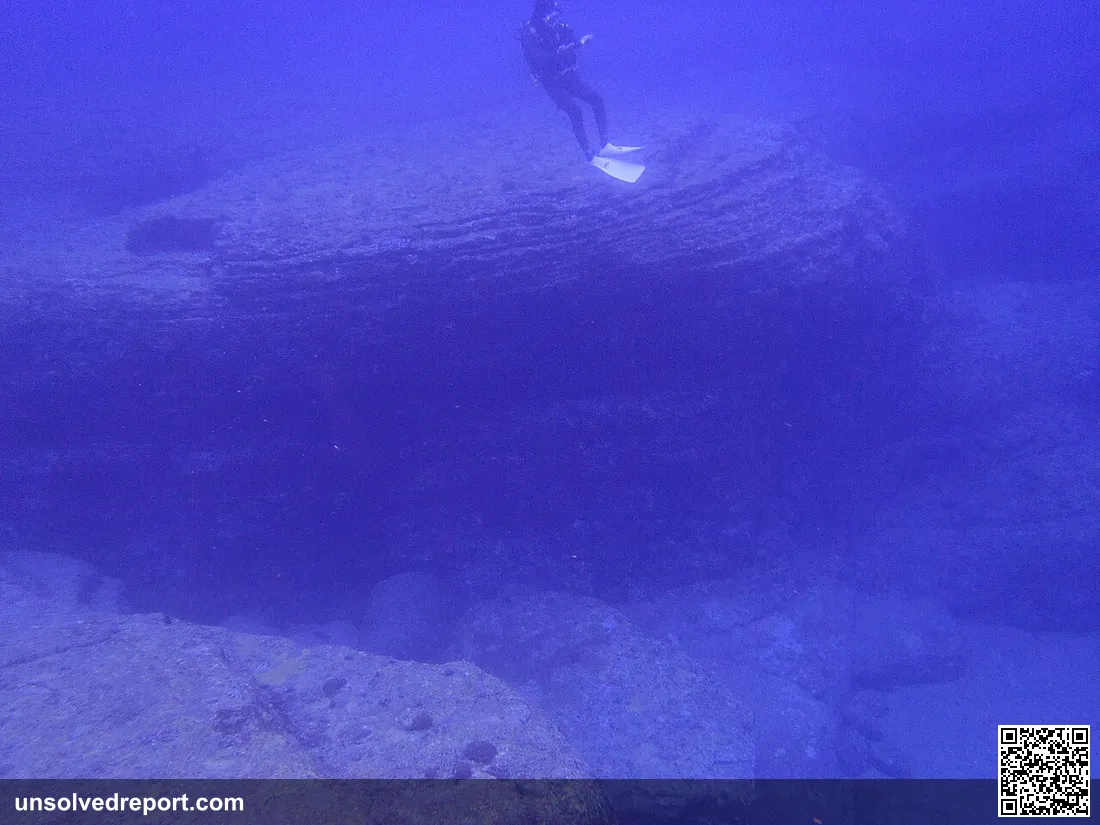
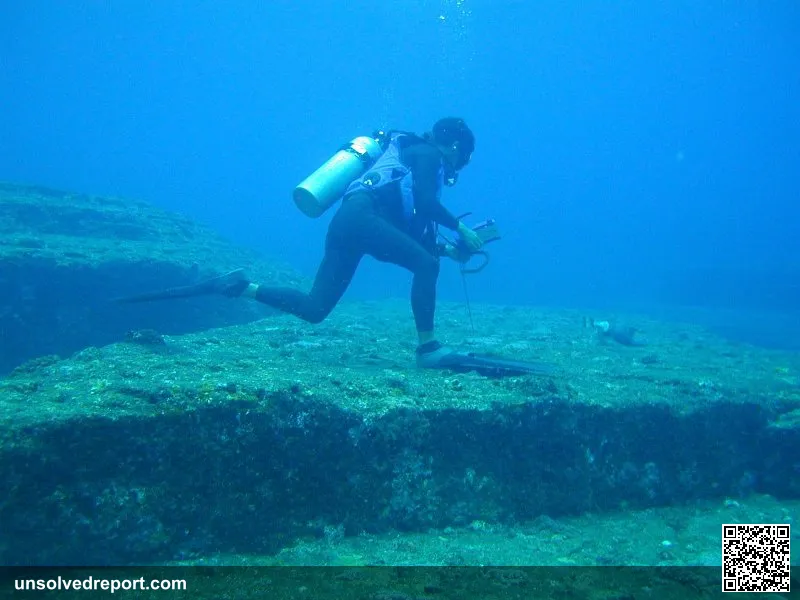
You sink 25 meters into the dark off Japan's westernmost island, and the seabed turns into a staircase. Flat tops. Sharp right-angle corners. Steps. Platforms. Channels cut into the rock like someone laid them out with a ruler. Your gut screams one word before your brain can argue: built.
A drowned city. Japan's Atlantis - the same pull behind the submerged legends of Dwarka off India's coast.
That gut reaction is exactly the trap. Because here's the strange part of the Yonaguni Monument: almost nobody denies something extraordinary is down there. The fight isn't about whether it's real. It's about who made it - nature, or human hands. And that one question has divided scientists for nearly forty years.
What's actually down there
Start with what nobody argues over.
The formation sits off Yonaguni Island, in the southern Ryukyu chain, about 100 kilometers east of Taiwan, tucked below the Arakawabana cliff. It rests roughly 26 meters (about 85 feet) under the surface. A local diving-tourism official named Kihachiro Aratake found it in 1986 - and he wasn't even hunting for ruins. He was scouting a good spot to watch hammerhead sharks when the terraces loomed up out of the blue. The basics are laid out in the Wikipedia entry on the Yonaguni Monument.
Now the detail that decides everything: the rock.
It's sandstone and mudstone - medium-to-fine, layered, part of the Early Miocene Yaeyama Group, laid down around 20 million years ago. Boring on its own. But hold that thought, because how this particular rock breaks is the whole ballgame.
One more thing, and it's a big one. During the last Ice Age, the sea sat far lower than today, and this patch of seabed was dry land thousands of years ago. So if people carved it, they carved it before the ocean swallowed it. When the ice sheets melted, the seas climbed fast and drowned coastlines all over the planet. For Yonaguni's steps to be man-made and now sit 26 meters down, someone had to cut them while the ground was still dry - deep in the Stone Age, surrounded by hunter-gatherers who left no other monuments anywhere nearby.
Read that again. That's why this claim is so wild. It doesn't just push history back a little. It rewrites who we think the Stone Age was.
The believer: Masaaki Kimura
Meet the man who staked his name on "built."
Masaaki Kimura is a marine geologist, formerly of the University of the Ryukyus, and he's dived this site over and over for decades - not from a photo, not from a desk, but in the water, again and again. The shapes are too regular to be an accident, he argues. He points to terraces. A road. Walls. Steps. Carvings. Over the years he's claimed to spot a pyramid - the same kind of claim that later unraveled at Indonesia's Gunung Padang - castle-like structures, monuments, even a stadium-sized space.
But here's the catch with Kimura: his clock keeps moving.
At first he floated dates over 10,000 years old, and even tied the place to Mu, the mythical lost continent. Later he walked that back - to something more like 2,000 to 3,000 years, now linked to known regional cultures. That shift matters, and we'll say it straight: a date that keeps sliding is a softer thing to test than a date that stays put.
Give him this, though. He did the work - years of it, in the cold and the current - instead of just shouting from a boat. Some of what he sees isn't crazy on its face: certain alignments, shapes he reads as drainage or post holes. The real argument isn't believer versus liar. It's the same rock, seen two ways. Where critics dig in is the jump - from "that looks like a stair" to "that is a castle." Because to make that jump, you have to wave off a natural explanation the geology hands you for free.
What is that explanation? Keep going.
The skeptic: Robert Schoch and the way rock breaks
On the other side stands the heavy weight of scientific consensus: it's natural.
Geologist Robert M. Schoch of Boston University dived Yonaguni too, and surfaced with a flat verdict - plain geology, nothing more. His key point goes back to that boring sandstone. The Yaeyama layers are stacked with clean, parallel bedding planes that split apart like pages in a book. And they're cut through by sets of straight, vertical cracks - natural fractures called joints.
Now picture what happens when rock with flat horizontal layers and straight vertical cracks lets go.
It snaps into blocks. Right angles. Steps. Flat ledges. The exact "architecture" that stops a diver's heart - produced by nothing but the rock obeying its own grain. Schoch also caught something a "unique lost city" can't easily survive: the same kind of formation shows up elsewhere along Yonaguni's coast, above water and below - the same rock-versus-ruins fight now playing out over a disputed formation under Lake Michigan. One drowned metropolis is a marvel. A whole coastline of them is just geology. Other researchers backed him up, including geographer Patrick Nunn of the University of the South Pacific and geologist Wolf Wichmann - same site, same conclusion: natural.
And then there's the quietest, loudest clue of all.
Neither Japan's Agency for Cultural Affairs nor Okinawa Prefecture treats Yonaguni as a cultural or archaeological site. No official excavation. No preservation order calling it man-made. Think about how strange that is. A genuine prehistoric stone city in Japanese waters would be a national treasure and a tourism goldmine - every reason in the world to claim it. The fact that the authorities haven't, after decades of cameras and documentaries, isn't them shrugging. It's them following the geology.
Here's the mechanism in plain terms. Blocky, columnar cracking in sandstone isn't exotic - it happens anywhere this rock gets stressed and weathered. Step-terraces form when water undercuts softer bands and washes them out, leaving the tough layers jutting like shelves. Right angles appear where the flat layers meet the vertical cracks. Show that to a diver expecting a temple, and they see stairs and walls. Show it to a geologist, and they see exactly what this rock always does.
So who's right?
Lay the evidence on the table.
The rock type alone explains the flat faces, the steps, and the right angles - no humans required. Lookalike formations sit nearby, which guts the idea that this one is special. The roads and carvings and stadium Kimura describes lean hard on interpretation, and the people who study how this rock fractures read those same shapes very differently. And after decades of diving, nobody has pulled up the one thing that would settle it: a real artifact.
The weight comes down on natural. We'll say it plainly, the way an evidence-first reader deserves: the Yonaguni Monument is most likely a natural rock formation, shaped by the stubborn way its sandstone splits.
But don't close the book yet. Because there's a question hiding inside this one that nobody has answered.
The question that's still alive
What if people touched it?
Not built it - touched it. When this rock was dry land, did ancient people who lived here ever use these natural shapes? Carve a natural ledge into a path? Flatten a natural platform into a workspace? Humans have done exactly that for as long as there have been humans. It's not crazy to imagine someone lightly reworking a natural formation before the sea rose and hid the evidence.
But "not crazy" isn't "proven." Right now there's no solid sign of even partial human tinkering.
And there's a clean test that cuts through the fog: the artifact test. Real human building leaves litter behind - stone tools, broken pottery, hearths, worked timber, inscriptions in a known script, or building stone hauled in from somewhere else. At Yonaguni, the "monument" is carved straight out of the bedrock, right where it sits, and decades of dives have turned up no clear toolkit of people living and working there. The famous "carvings" stay stubbornly ambiguous - shapes geologists chalk up to weathering and erosion. When a so-called monument has none of the everyday junk its supposed builders should have dropped, that emptiness speaks loudly. And it speaks for nature.
What it is NOT
You'll see Yonaguni dragged out as proof of Atlantis, of Mu, of some lost worldwide super-civilization. None of it holds.
The Mu connection is pure 19th and 20th century fiction with zero archaeological footing - and even Kimura backed away from it. Waving Yonaguni around as the smoking gun for a lost super-race is exactly the kind of leap this site exists to call out.
The bottom line
Yonaguni is real, dramatic, and genuinely beautiful - a giant staircase swallowed by the sea, the way the sea swallowed the seven pagodas of Mahabalipuram on India's coast. The mainstream verdict is that it's natural, the predictable result of Yaeyama sandstone splitting along its layers and cracks. The honest mystery left over is the small, human one: did anyone ever lay a hand on it before the water came?
And that's the thing about the ocean. It keeps the best secrets exactly where we can't reach them - which is why the next drowned "ruin" might be the one that finally breaks the pattern.
Sources & further reading
- Wikipedia - Yonaguni Monument - https://en.wikipedia.org/wiki/Yonaguni_Monument
- Wikipedia - Masaaki Kimura - https://en.wikipedia.org/wiki/Masaaki_Kimura
- National Geographic - Japan's Ancient Underwater Pyramid Mystifies Scholars - https://www.nationalgeographic.com/history/article/yonaguni-jima-japan-underwater-city
- Robert M. Schoch - The Enigmatic Yonaguni Monument - https://www.robertschoch.com/yonaguni.html

Lycurgus Cup Mystery: The Roman Glass That Bleeds Red
A 1,600-year-old Roman cup turns jade green to blood red depending on where the light hits it. Scientists found the nanotech inside — but not who built it, or why.
GD-1 Stellar Stream: An Invisible Object Too Dense to Explain
Something invisible punched a hole through the GD-1 stellar stream — and it's too dense to be ordinary dark matter. So what actually hit it?

10 Deep-Space Signals Science Still Can't Explain
A 72-second blast nobody could repeat. A rock that sped up with no tail. Ten deep-space signals our telescopes recorded and still cannot explain.