G Objects Sagittarius A: 6 Things That Should Be Dead, But Aren't
Six objects orbit our galaxy's black hole wearing gas clouds like disguises. One was due to be shredded in 2014. It walked away. Why?
Early 2014. Telescopes on three continents were aimed at the same dark spot in the sky, waiting for something to die. A cloud of gas was about to fall toward the monster at the center of our galaxy, and the math was brutal: it should be stretched, torn, and swallowed in a burst of light. Astronomers had front-row seats to a cosmic shredding.
It never happened.
The cloud sailed past and kept going, intact, as if the black hole hadn't even noticed. That single non-event cracked open one of the strangest puzzles in modern astronomy. The thing that survived wasn't alone, either. It belongs to a small, baffling family that astronomers can't sort into any box they own. The members look like puffy clouds of gas and dust. They move and endure like stars. They're called the G objects, and after twenty years of watching, nobody can say for sure what they are.
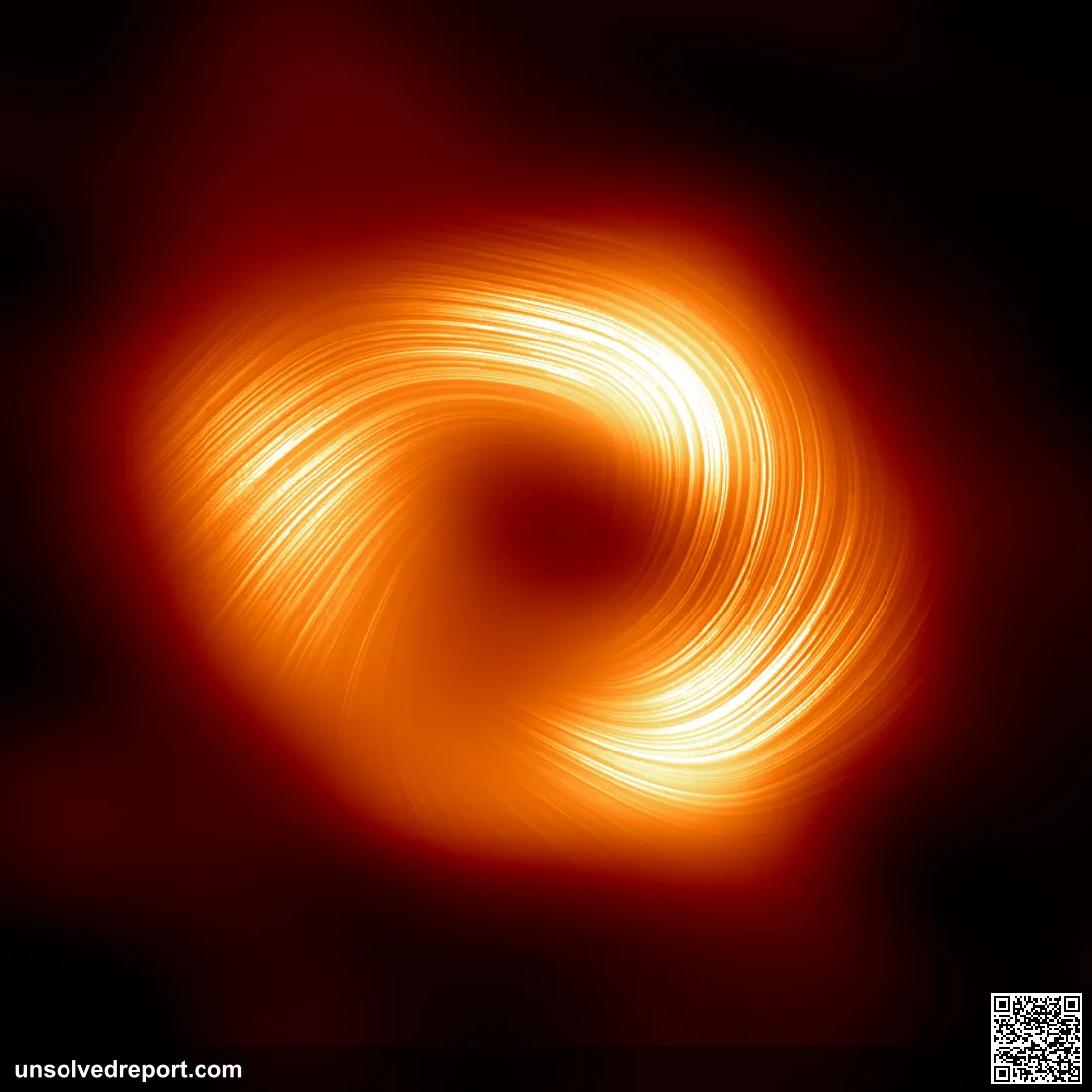
The home address is the Milky Way's core, about 26,000 light-years from Earth, where a supermassive black hole called Sagittarius A* sits with roughly four million times the mass of the Sun. It is one of the most violent neighborhoods in the galaxy, a place violent enough to fling entire hypervelocity stars clean out of the galaxy. And these things orbit right inside it.
What We Actually Know
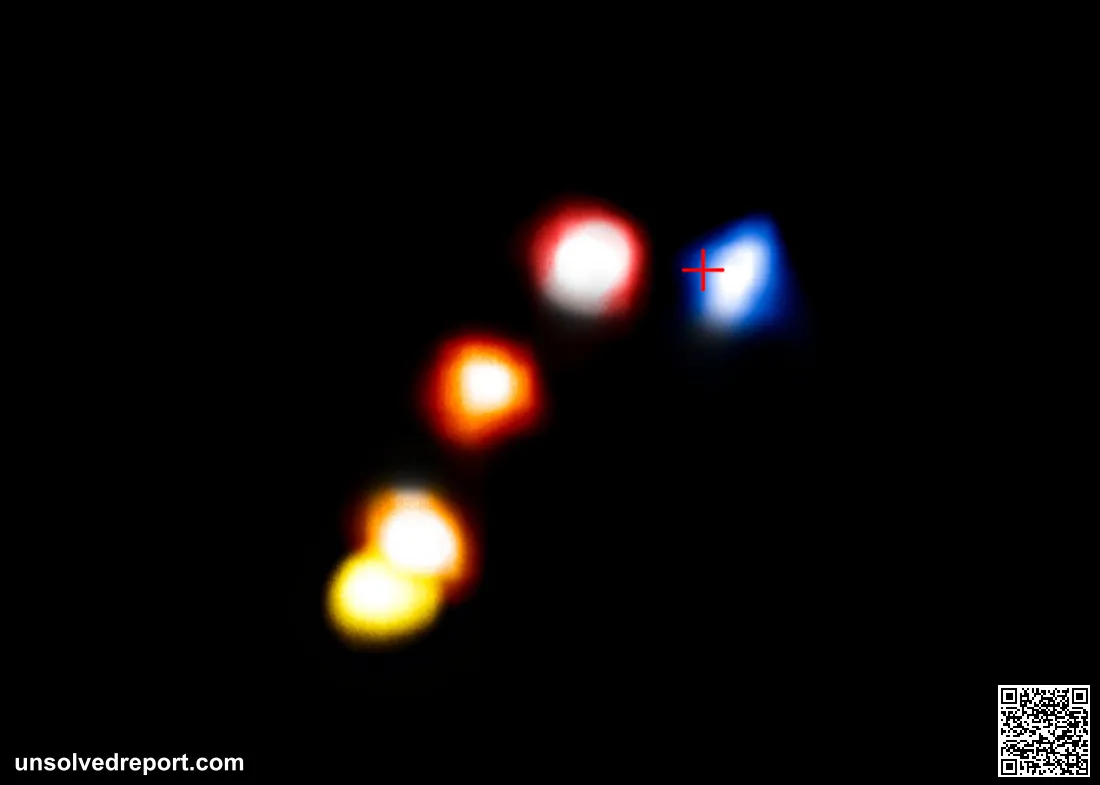
It started with two oddballs. The first, now called G1, was hiding in data going all the way back to 2004–2005, spotted by astronomers tracking the galactic center. The second, G2, made headlines in 2012 when Stefan Gillessen and colleagues at the Max Planck Institute for Extraterrestrial Physics described it in Nature as a dusty, ionized cloud riding a wildly stretched orbit around Sagittarius A (Gillessen et al., Nature* 481, 2012; nature.com). Stretched is an understatement. G2's orbit has an eccentricity of about 0.98, a long thin loop that whips it in close, and the calculations said its closest approach, its pericenter, would come in early 2014.
That close pass was supposed to be the execution. If G2 was just a clump of gas, the black hole's tidal forces would yank it apart, and infalling material would light up in X-rays or radio. So the world watched. And the disruption simply did not come. UCLA astrophysicist Andrea Ghez put it bluntly: "G2 survived and continues happily on its orbit; a gas cloud would not do that" (ScienceAlert). Campaign after campaign confirmed it. Sagittarius A threw no dramatic flare at pericenter, and follow-up studies turned up no clear microwave or X-ray response (see, e.g., MAGIC collaboration, A&A*, 2017; aanda.org). G2 came through as a compact source, still tracing a clean gravitational orbit, as though nothing had been trying to kill it.
Then the pattern got bigger. On January 15–16, 2020, a UCLA team led by postdoctoral researcher Anna Ciurlo, with Andrea Ghez, Randy Campbell, Mark Morris, and Tuan Do among the co-authors, published "A population of dust-enshrouded objects orbiting the Galactic black hole" in Nature (volume 577, pages 337–340; nature.com). Sifting more than 13 years of imaging and spectroscopy from the W. M. Keck Observatory in Hawai'i, gathered through the UCLA Galactic Center Orbits Initiative, they pulled four more out of the data: G3, G4, G5, and G6. Suddenly there were six (UCLA Newsroom).
How do you even see something that small, that far away, packed into the most crowded corner of the sky? The trick is adaptive optics, a technology Ghez helped pioneer that cancels out the blur of Earth's atmosphere in real time and lets a ground telescope resolve fine detail near the galactic center. All six G objects sit within about 0.13 light-years of Sagittarius A*, on orbits that take anywhere from roughly 100 to 1,000 years to complete (Keck Observatory). And here is the signature that keeps repeating: they carry the spectral fingerprint of gas and dust, yet they move with the discipline of compact, star-mass bodies. Ciurlo and Ghez nailed it in the phrase that now defines the whole class: "These objects look like gas but behave like stars" (Universe Today).
There's one more clue, and it's the eeriest of all. When G2 made its close pass, its outer envelope of gas really did get stretched by the black hole's pull, exactly as a cloud should. But the dusty core stayed tight. It refused to scatter (Keck Observatory). Something inside is gripping the whole thing together.
The Real Mystery
Here's the honest center of the puzzle: nobody knows what the G objects are.
They don't act like the gas clouds they resemble. They aren't quite stars either. A real cloud would have been ripped to shreds. A plain star wouldn't be swaddled in such a big, easily stretched shell of gas and dust. The G objects live in the gap between those two ideas, and no settled category in stellar astrophysics explains both halves at once: the soft, cloudy look and the stubborn refusal to come apart.
And whatever hides inside the dust is still hidden. The observations point hard toward a compact, heavy object buried in the heart of each one, but its exact nature, how these things formed, and whether they only exist in the wild conditions next to a supermassive black hole are all still open. The G objects might be a stage in a star's life that only the galactic center lets us watch.
The Best Guesses So Far
These are the leading scientific interpretations. Every one of them is still being argued over, not signed and sealed.
The binary-merger idea (the front-runner). The Ciurlo–Ghez team's favored story is that each G object is the bloated leftover of two stars that once circled each other as a pair, then slammed together under the constant gravitational stress of Sagittarius A* (UCLA Newsroom). In that picture, the merger blows out a huge envelope of gas and dust and leaves the object swollen for an astonishingly long time. Ghez's team estimates it could stay puffed up for more than a million years before finally calming down into something that looks like one ordinary star. If they're right, the G objects are a freeze-frame of a strange but natural process, visible here only because the black hole shoves binaries together far more often than anywhere else. That's the interpretation, not a confirmed fact.
The hidden-young-star idea. Other researchers have argued that G2-type objects might be young, low-mass stars wrapped in their own dust and gas, maybe driving a stellar wind, rather than merger leftovers (e.g., Scoville & Burkert, ApJ, 2013; arxiv.org). This one explains the survival at pericenter while keeping the origin story close to plain old star formation. It's a live debate, not a verdict.
The work still in progress. Newer modeling keeps testing the "dust-enshrouded star" framing against the data (see the preprint Galactic center G objects as dust-enshrouded stars, arxiv.org/abs/2410.00304; a preprint, not yet peer-reviewed as of this writing). A few more exotic origin stories have surfaced in the literature too, but those stay speculative and a long way from proven.
What nobody disputes is the strangeness itself. Six dusty objects circle the heart of our galaxy, looking like one thing and acting like another, walking away from an encounter that should have ended them. They're a quiet reminder that even inside our own Milky Way, the most extreme places still keep real secrets, the kind that only give themselves up to someone willing to watch for decades. The black hole at the center has more questions waiting, from a strange antimatter glow explained by positron annihilation to a gamma-ray excess nobody has pinned down. We've only started counting them.
Sources & Further Reading
- Ciurlo, A., Campbell, R. D., Morris, M. R., Do, T., Ghez, A. M., et al. "A population of dust-enshrouded objects orbiting the Galactic black hole." Nature 577, 337–340 (2020). nature.com/articles/s41586-019-1883-y
- UCLA Newsroom: "Astronomers discover class of strange objects near our galaxy's enormous black hole." newsroom.ucla.edu
- W. M. Keck Observatory: "Astronomers Discover Class of Strange Objects Near Our Galaxy's Enormous Black Hole." keckobservatory.org/g-objects-2
- Gillessen, S., et al. "A gas cloud on its way towards the supermassive black hole at the Galactic Centre." Nature 481 (2012). (Discovery of G2.)
- MAGIC Collaboration. "Observations of Sagittarius A during the pericenter passage of the G2 object with MAGIC." Astronomy & Astrophysics* (2017). aanda.org
- Scoville, N. & Burkert, A. "The Galactic Center Cloud G2 — a Young Low-Mass Star with a Stellar Wind." ApJ (2013), preprint. arxiv.org/pdf/1302.6591
- Universe Today: "There Are Strange Objects Near the Center of the Galaxy. They Look Like Gas, but Behave Like Stars." universetoday.com

Hegra: The Nabataean City Whose People Vanished Without a Trace
Hegra's dead left 100+ signed, dated tombs carved in stone. Its living city? Almost nothing survived. Where did everyone go — and why so quietly?

Olmec Colossal Heads: 17 Giant Faces Nobody Can Name
17 stone giants, each cut from a single multi-ton boulder 3,000 years ago, stare with individual faces — and not one name survives. So who were they?
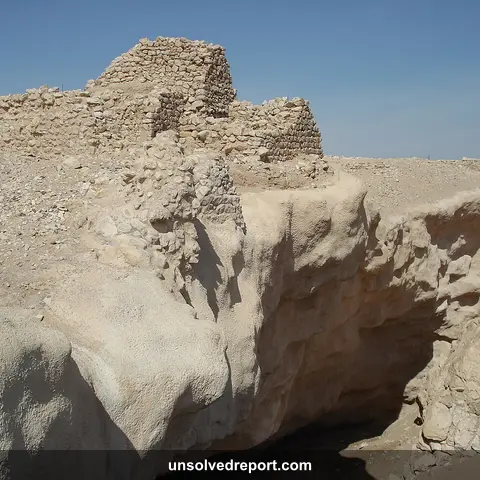
Ubar & Iram of the Pillars: Oman's Lost City Nobody Can Confirm
NASA satellites found a buried fortress under Oman's sand in 1992. Explorers swore it was Ubar, the lost Iram of the Pillars — scholars still disagree.