Galactic Center Gamma-Ray Excess: Dark Matter or 35,000 Dead Stars?
A real gamma-ray glow at the Milky Way's core has survived 15 years of scrutiny. Dark matter or dead stars? A 2026 AI analysis just reopened the case.
Strip the Milky Way's center of every light we can name — every star, every gas cloud, every flicker of known radiation — and something refuses to leave. A faint smear of gamma rays still glows where nothing should be glowing. It has shrugged off more than fifteen years of scrutiny, sharper data, and dozens of models built to make it disappear. It is still there.
And here is the part that keeps physicists up at night. The two best explanations for that glow are about as far apart as two ideas can be. One is the most boring object in the cosmos: a dead star. The other is the invisible stuff that outweighs everything you can see, the dark matter that built the universe.
This is the galactic center gamma ray excess. It might be the most tantalizing unsolved signal in all of astrophysics — and we still can't tell which answer is staring back at us.
What We Actually Know
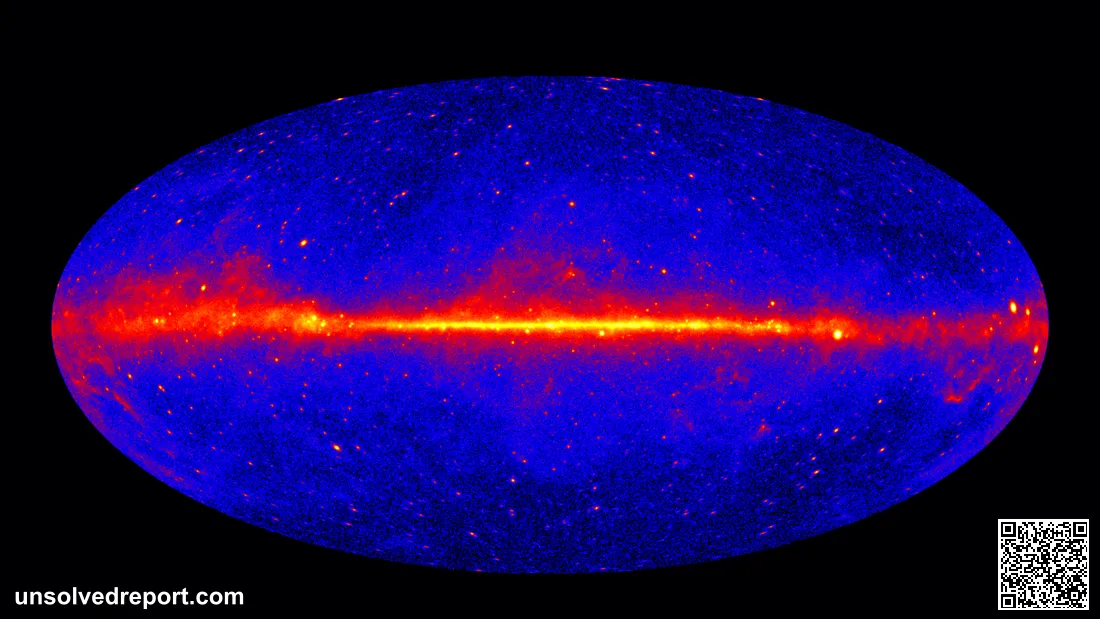
It starts with a telescope pointed at the wrong-looking part of the sky. NASA launched the Fermi Gamma-ray Space Telescope in 2008, and its main eye — an instrument called the Large Area Telescope, or LAT — spends its life mapping gamma rays across the whole sky. In 2009, two physicists, Lisa Goodenough and Dan Hooper, did the careful bookkeeping. They subtracted every known source, including the bizarre G objects orbiting Sagittarius A* and everything else cataloged near the galactic core. They subtracted the galaxy's messy diffuse background. And in the innermost few degrees of the Milky Way, an excess of GeV-energy gamma rays simply would not subtract away (Goodenough & Hooper 2009, arXiv:0910.2998).
Other teams checked. The glow held up. Its fingerprints are now well mapped: it shows up most clearly between roughly 1 and 10 GeV, and its spectrum peaks around 1 to 3 GeV (Ackermann et al., Astrophysical Journal 2017) — a different gamma-ray signature from the galaxy's core than the 511 keV positron annihilation line that also glows from that same crowded neighborhood. And it is stubborn. Throw any model of the galaxy's complicated diffuse emission at it, and the excess survives. One review put it bluntly: the signal "persists across all existing models of the astrophysical diffuse emission and has not been attributed to any known astrophysical sources or mechanisms" (Fermi-LAT collaboration analysis, arXiv:1704.03910).
Now for the part that turned a stubborn glow into a sensation. The shape and the strength of this thing line up — eerily well — with something theorists had predicted years earlier, completely independently. Its roughly spherical haze and its few-GeV peak are just what you'd expect from a particular dark matter candidate annihilating in space: a weakly interacting massive particle, a WIMP, weighing somewhere around 10 to 60 GeV, vanishing at almost exactly the "thermal relic" rate you'd predict if dark matter was forged in the fires of the early universe (Daylan et al. 2016, Physics of the Dark Universe) — the same invisible substance that famously seems to be missing entirely from a galaxy called NGC 1052-DF2. Translation: the excess looks like the smoking gun particle physicists had been chasing for decades.
That's the solid ground. Step off it, and you fall straight into the mystery.
The Question Nobody Can Answer Yet
Here's the catch. A smooth glow from annihilating dark matter is not the only way to paint a few-GeV haze over the galactic center. There's a much more ordinary culprit that could fake the exact same picture: a dense, hidden crowd of millisecond pulsars. These are ancient neutron stars, spinning hundreds of times a second, wrapped in magnetic fields so violent they churn out gamma rays like factories — the same class of dead stars whose sudden pulsar glitches reveal just how strange their interiors are. Pack enough of them too far away to see one by one, and they'd blur together into — you guessed it — a spherical few-GeV glow.
So everything hangs on one question, easy to ask and brutal to answer: is the glow smooth, or is it lumpy?
Think about what each answer would mean. Dark matter is spread out like fog, continuous and featureless, so its gamma rays should fall like clean random noise — smooth from pixel to pixel, with nothing clustering anywhere. A swarm of thousands of pulsars, each too faint to pin down on its own, would betray itself differently: the light would come out subtly grainy, photons huddling around the brightest hidden sources instead of spreading evenly (Snowmass 2021 dark matter report, arXiv:2203.06859). Measure that graininess cleanly and you'd close the case. There's just one problem. Those sources sit right at the ragged edge of what any telescope can detect, buried in one of the most crowded, least understood corners of the entire sky.
So that's the honest state of things in 2026: a real, rock-solid signal whose texture is just a hair too faint to read.
Three Ways to Read the Glow
The pulsar story (strong evidence, hotly fought). For a while, the pulsar camp looked like the clear winner. In 2016, two independent teams landed influential papers in the same issue of Physical Review Letters. Bartels, Krishnamurthy, and Weniger ran a wavelet technique across the data and reported photons clustering exactly as a hidden pulsar crowd would cluster them — at high significance (Bartels et al. 2016, arXiv:1506.05104). Lee, Lisanti, Safdi, Slatyer, and Xue, working separately, dug out statistical evidence for unresolved point sources in the inner galaxy (Lee et al. 2016, arXiv:1605.04766). Then, in 2018, a Nature Astronomy paper threw in a clincher about shape: the excess seemed to trace the boxy, X-shaped bulge of old stars at the galaxy's heart, not a perfectly round dark-matter halo — precisely what you'd expect if the gamma rays came from an aged stellar population like pulsars (Macias et al., Nature Astronomy 2018). But hold on. Those wavelet and photon-statistics results are clever readings of very subtle data, not photographs of pulsars. Nobody has actually resolved the swarm. It's inferred, not seen.
The dark matter story (back from the dead). And the pulsar verdict didn't hold. Later reanalyses found that the apparent point-source signal might be partly a mirage — an artifact of imperfect background modeling — and that some analyses actually prefer a round shape over a bulge-hugging one after all (Robustness of the GCE morphology, arXiv:2401.02481). The biggest jolt came in June 2026. Florian List, Nick Rodd, and collaborators at the University of Vienna and Lawrence Berkeley National Laboratory turned a machine-learning model loose on the problem, trained on more than a million simulated observations. Their trick was to use information earlier studies had mostly thrown away: the energy of each individual photon. Fold that in, they found, and dark matter "cannot currently be ruled out." Worse for the pulsar camp, any pulsar population dim enough to explain the excess would need something like 35,000 sources — not the few hundred to few thousand everyone had assumed — and that many faint sources would smear into a glow nearly impossible to tell from a smooth one (List et al. 2026, via Phys.org).
Be careful what you take from that, though. It does not prove dark matter. What it does is pry open a door the earlier work seemed to be swinging shut. The excess still fits both stories — and a mix is very much alive too: some pulsars plus some dark matter, or pulsars plus a stellar-bulge glow.
How this actually gets solved. The good news? This isn't a riddle doomed to sit unanswered forever. It's testable. Radio surveys keep turning up new millisecond pulsars toward the galactic bulge (new bulge MSPs, arXiv:2512.16699) — find enough of them and you've proven the swarm is real, full stop. The upcoming Cherenkov Telescope Array has been floated as a way to put the pulsar idea to the test at higher energies (CTA forecast, arXiv:2212.08080). Even gravitational-wave observatories might get a vote, squeezing the pulsar population through continuous-wave searches (gravitational-wave test, arXiv:2301.10239).
For now, though, the galactic center keeps its secret. A faint glow, balanced on a knife's edge between the dullest thing in the universe and the most revolutionary, waiting on instruments sharp enough to tell a swarm of dead stars from the dark matter that built the cosmos. We are closer than we've ever been to knowing which one is looking back.
Sources and Further Reading
- Goodenough & Hooper (2009), discovery paper — arXiv:0910.2998
- Daylan et al., dark-matter interpretation — arXiv:1402.6703
- Ackermann et al., ApJ (2017), Fermi-LAT GCE characterization — IOPscience
- Bartels, Krishnamurthy & Weniger (2016), wavelet/pulsar evidence — arXiv:1506.05104
- Lee et al. (2016), non-Poissonian point-source evidence — arXiv:1605.04766
- Macias et al., Nature Astronomy (2018), stellar-bulge morphology — Nature Astronomy
- GCE morphology robustness (2024) — arXiv:2401.02481
- List, Rodd et al. (2026), machine-learning reanalysis — Phys.org summary
- Snowmass 2021 dark matter white paper — arXiv:2203.06859
- CTA test of the pulsar hypothesis — arXiv:2212.08080
The Hubble Tension: Two Right Answers That Can't Both Be Right
Two flawless measurements of cosmic expansion disagree by 9% at 5-sigma or more. The Hubble tension has no known fix. So what is the universe hiding?
Final Parsec Problem: Black Holes Stuck Forever—Or Are They?
The final parsec problem says merging black holes should freeze forever, one parsec short of collision. So why does the universe hum like they don't?

Pulsar Glitch Mystery: The Clock Nobody Can Explain
Pulsar glitch mystery: the universe's steadiest clocks suddenly speed up, no warning. One glitch was caught live — so why can no one predict the next?