511 keV Positron Annihilation: The Galaxy's Antimatter Fountain Nobody Can Explain
The Milky Way's core glows with antimatter dying by the trillion-trillion every second, at exactly 511 keV. Fifty years of data and still no source. Here's why.
Right now, deep toward the heart of the Milky Way, antimatter is dying. Quietly. Constantly. Every second, positrons, the mirror-image twins of electrons, drift up to ordinary electrons, touch, and disappear in a flash of gamma rays. We're talking ten thousand trillion trillion trillion of them, every single second. And here's the eerie part: every flash rings out at exactly the same note. 511 kiloelectronvolts, the precise energy you get when an electron and a positron destroy each other. Stack up that faint, steady shimmer across the galaxy and you're looking at one of the biggest antimatter furnaces we've ever found. We've watched it for more than fifty years. And nobody can tell you what's feeding it.
Now, this isn't fringe stuff. No UFOs, no cover-ups. It's a real, well-documented headache in high-energy astrophysics, and scientists even have a nickname for it: "the positron puzzle." Let me walk you through what we actually know, where the genuine mystery hides, and which suspects are still in the lineup.
What we know for sure
It started with a balloon. In 1970, detectors lofted on balloons by a Rice University team caught a gamma-ray line drifting in from the direction of the galactic center. The first numbers, published by Johnson, Harnden and Haymes (1972) and Johnson and Haymes (1973), were fuzzy: somewhere between 473 and 485 keV. Low enough that nobody wanted to commit to calling it antimatter just yet. Then 1978 settled it. The Bell-Sandia group flew a sharp-eyed germanium detector and nailed the line dead on 511 keV, the unmistakable fingerprint of electrons and positrons annihilating (review in Prantzos et al., Reviews of Modern Physics, 2011).
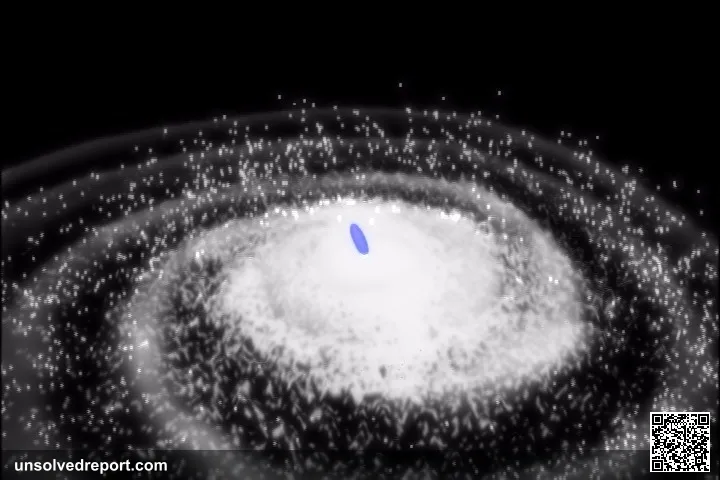
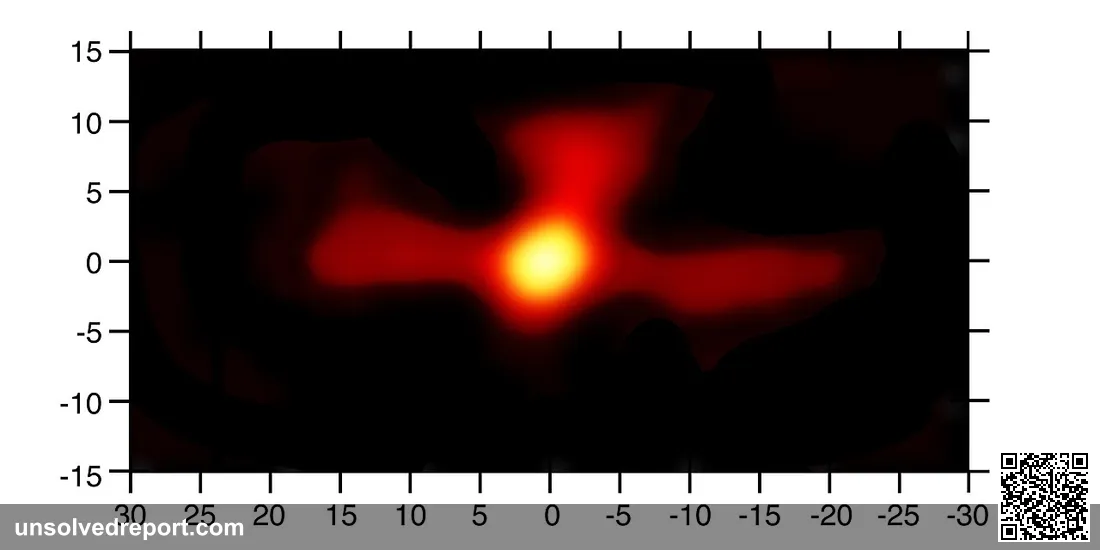
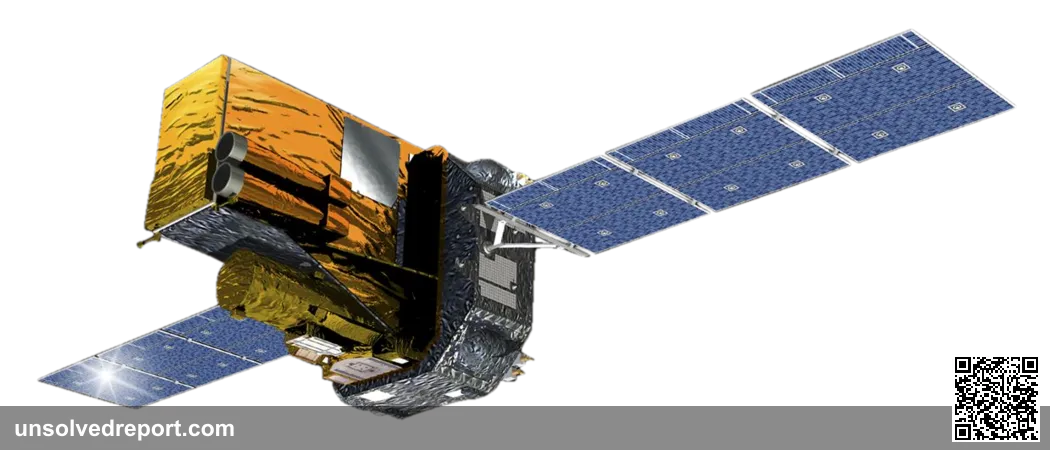
But a single spectral line isn't a mystery yet. The mystery is the shape it makes on the sky. Through the 1990s, NASA's OSSE instrument aboard the Compton Gamma Ray Observatory showed the glow was crammed toward the galactic bulge, that dense crowd of ancient stars surrounding the center, the same crowded neighborhood that hosts the strange G objects near Sagittarius A*. Then Europe's INTEGRAL satellite arrived and mapped the whole thing. Its SPI spectrometer revealed something astronomers see at no other wavelength: a bright, almost perfectly round ball of 511 keV light, glowing far more fiercely against the thin galactic disk than any normal collection of stars has any right to (Prantzos et al., 2011). The 2011 review pins the consensus rate at roughly two times ten-to-the-forty-third positrons winking out per second. Try to picture that number. You can't. Nobody can.
In 2025, a team stacked twenty years of INTEGRAL/SPI data, February 2003 all the way to August 2023, and the blur snapped into three parts: a brilliant core within about three degrees of the center, an extended near-spherical bulge wrapped around it, and a fainter disk smeared along the galactic plane. They measured a flux of about 1.36 times ten-to-the-minus-three photons per square centimeter per second from the bulge region, and about 2.09 times ten-to-the-minus-three across the broader plane (Y. et al., Astronomy & Astrophysics, 2025). They also spotted faint whispers, around two-sigma, of new structure, but they were careful to say so out loud: not yet a firm detection.
Two more clues pin down whatever's behind this. First, the positrons are sluggish. Beacom and Yüksel (2006) worked through the math and showed that if these positrons were born hot, full of energy, they'd light up the 1-to-100 MeV band as they coasted to a stop, a telltale glow that the gamma-ray data flatly do not show. So they must be born gentle, below roughly a few MeV. Second, they die in a cool, ordinary patch of space. Most of them pair off first into fragile little electron-positron atoms called positronium before vanishing, a fraction measured near 0.76 by the COSI instrument (Kierans et al., 2020) and near 0.97 in earlier reviews. Cool, slow antimatter, dying in the quiet dark. Remember that. It rules a lot of suspects out.
The question that won't go away
Let's be clear about what's actually mysterious here. It is NOT whether antimatter is dying near the galactic center. We see that happening. That's settled. The real question is sneakier: where do all these positrons come from, and why do they pile up in that bright central ball?
Here's the snag. The galaxy's usual positron factories run on stars, and stars trace the disk and the spiral arms, those long sweeping pinwheel patterns, not a smooth glowing sphere parked in the middle, and even the galaxy's hypervelocity runaway stars, flung outward from that same central region, can't account for a bulge this bright. That 511 keV bulge-to-disk brightness ratio is, in the literature's own words, larger than at any other wavelength (Prantzos et al., 2011). No familiar population of stars naturally makes that round shape, at that rate, while also keeping the positrons cool enough to obey that slow-injection clue. As the 2025 INTEGRAL team put it, with refreshing bluntness, "no single scenario fully explains the observed flux and spatial distributions." That's the people holding the best data in the world, shrugging. That's the headline.
The suspects
Several explanations are still being argued over. All of them are guesses to one degree or another. None is proven.
Radioactive stardust (the strong, partial lead). Massive stars and supernovae forge unstable isotopes deep inside, aluminum-26, titanium-44, nickel-56, and as those decay, they spit out positrons. Aluminum-26 even has its own gamma-ray signature, a 1809 keV line, and we've mapped it independently. It hugs the disk (Wang et al., COSI, 2022). So this can plausibly account for much of the disk glow. The trouble is the bulge, the bright round heart of the whole thing, which it just can't seem to explain.
Compact objects (plausible). Low-mass X-ray binaries, the jets of microquasars, and even ordinary neutron stars, whose own mass limits are a puzzle in their own right, can fling positrons out into space. And here's a tantalizing wrinkle: a 2008 Nature study found the disk emission is lopsided, brighter on one side than the other, mirroring the layout of certain hard X-ray binaries (Weidenspointner et al., 2008). The lopsidedness is real. What it means is still a fight.
Light dark matter (speculative). Because the bulge is roughly spherical, the same shape we expect a dark-matter halo to take, some physicists floated a bolder idea: maybe dark-matter particles weighing around an MeV are annihilating or decaying and seeding the positrons themselves, an echo of the still-unresolved debate over whether the galactic center's gamma-ray glow comes from dark matter or dead stars. To be plain about it, this is a minority hunch, hemmed in tightly by other data and nowhere near established.
A fresh twist (new, and disputed). In 2025, a team dug through old COMPTEL archives and reported the first apparent sighting of positrons annihilating in flight, pointing to a narrow injection energy near 2 MeV, and they argued this works against broad-spectrum sources like pulsars and plain radioactive decay (Berteaud et al., A&A, 2025). It's brand new, though, so it's still waiting on someone else to confirm it.
The good news? Sharper eyes are on the way. NASA's COSI mission, a wide-field germanium gamma-ray telescope, is set to launch around 2027, and mapping the 511 keV sky is one of its main jobs (Tomsick et al., 2023). Until then, the galaxy's antimatter fountain just keeps glowing, steady and beautiful and utterly silent about where it comes from. Fifty years of staring, and it still hasn't said its name.
Sources & further reading
- Prantzos et al., "The 511 keV emission from positron annihilation in the Galaxy," Reviews of Modern Physics 83, 1001 (2011): https://arxiv.org/abs/1009.4620
- "Imaging the positron annihilation line with 20 years of INTEGRAL/SPI observations," Astronomy & Astrophysics (2025): https://www.aanda.org/articles/aa/full_html/2025/10/aa55895-25/aa55895-25.html
- Weidenspointner et al., "An asymmetric distribution of positrons in the Galactic disk revealed by gamma-rays," Nature (2008): https://www.nature.com/articles/nature06490
- Berteaud et al., "Detection of positron in-flight annihilation from the Galaxy," Astronomy & Astrophysics (2025): https://www.aanda.org/articles/aa/full_html/2025/08/aa56046-25/aa56046-25.html
- Kierans et al., "Detection of the 511 keV Galactic Positron Annihilation Line with COSI," ApJ (2020): https://iopscience.iop.org/article/10.3847/1538-4357/ab89a9
- Wang et al., "Measurement of Galactic 26Al with the Compton Spectrometer and Imager," ApJ (2022): https://iopscience.iop.org/article/10.3847/1538-4357/ac56dc
- Tomsick et al., "The Compton Spectrometer and Imager (COSI)," (2023): https://arxiv.org/abs/2308.12362

NGC 1052-DF2: The Galaxy With No Dark Matter Nobody Can Explain
NGC 1052-DF2 shouldn't exist—a galaxy with almost no dark matter, then a second one turned up nearby. So what's really missing? Here's what the data says.
Dark Energy: The Invisible Force Ripping Space Apart
Dark energy makes up 70% of the universe and is tearing it apart faster every second — but nobody actually knows what it is. So what's really behind it?
Cosmic Ray Knee: The Galaxy's Speed Limit Nobody Can Explain
At 3.7 quadrillion electron-volts, something in our galaxy hits a wall — precisely, every time. The cosmic ray knee is measured to the percent. So why can't anyone name the machine that draws it?