Lady of Elche: The Buried Face That Won't Stop Lying
A farmhand's tool hit stone in 1897 and a 2,400-year-old face stared back. Real Iberian icon or a clever Victorian fake? Scientists finally tested her paint.
A teenage farmhand's tool hit something hard in the dirt. It was an August afternoon in 1897, near the town of Elche in southeastern Spain, and he was just clearing land on a private estate. He kept digging. The soil fell away. And a face looked back at him — calm, beautiful, framed by two enormous wheel-shaped coils, carved with a steady confidence that seemed to reach right across two and a half thousand years.
Within weeks she was gone. Crated up, shipped to Paris, sold, and slapped with a price tag. She would become one of the most fought-over objects in all of European archaeology. More than a century later, the Lady of Elche still won't talk. And one question hangs over her that simply refuses to die: is she even ancient at all?
What We Actually Know
Start with the things nobody disputes.
She came out of the ground on August 4, 1897, at a spot called La Alcudia, about two kilometers south of Elche (locals say Elx), near Alicante. And this is where it gets good: that field sits right on top of a buried city. First the Iberians lived there, then the Romans, and they called it Ilici (Museo Arqueológico Nacional, Madrid). The young laborer who found her is often named as Manuel Campello, swinging his tool while he cleared ground to farm it (VisitElche).
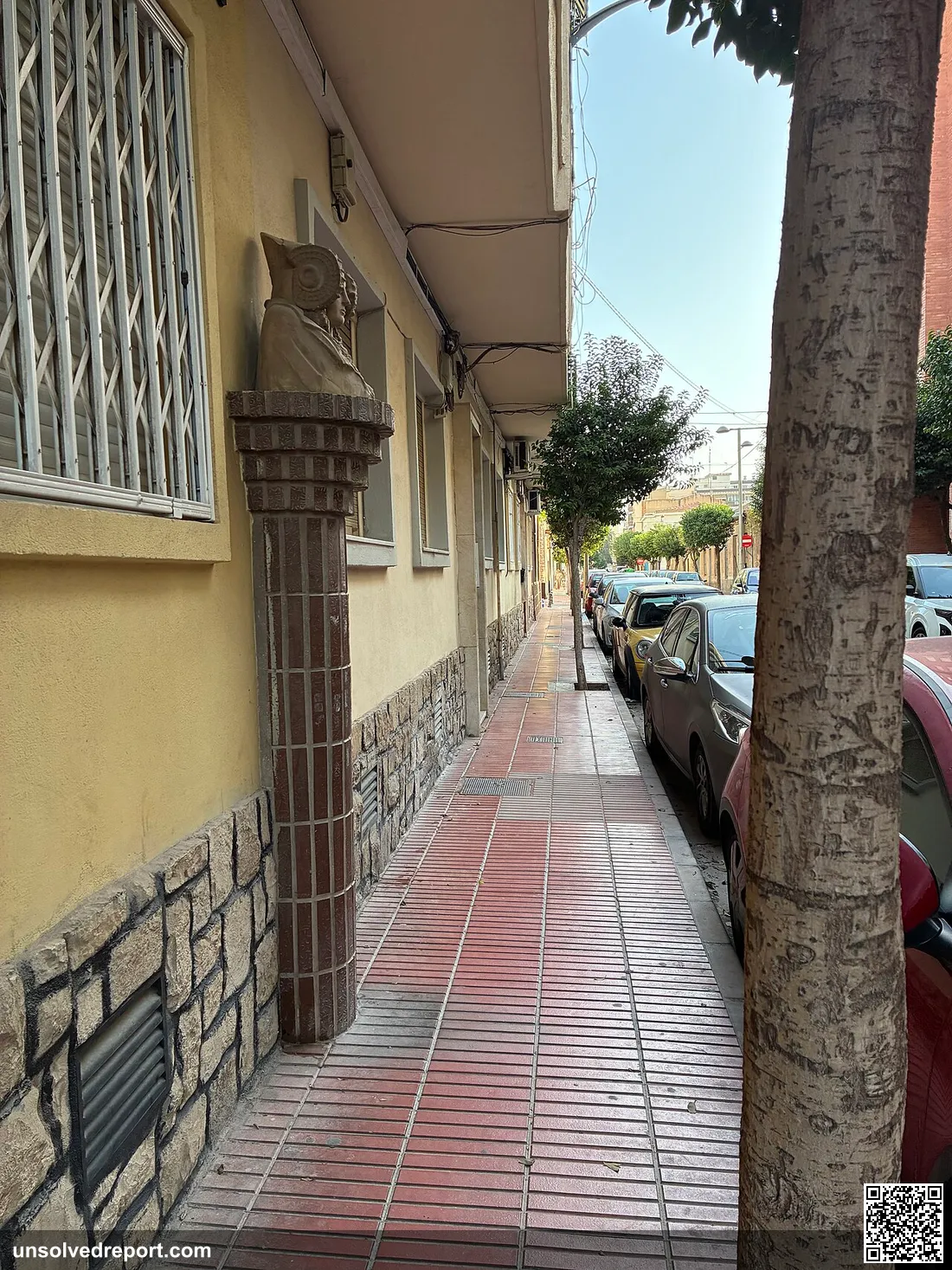
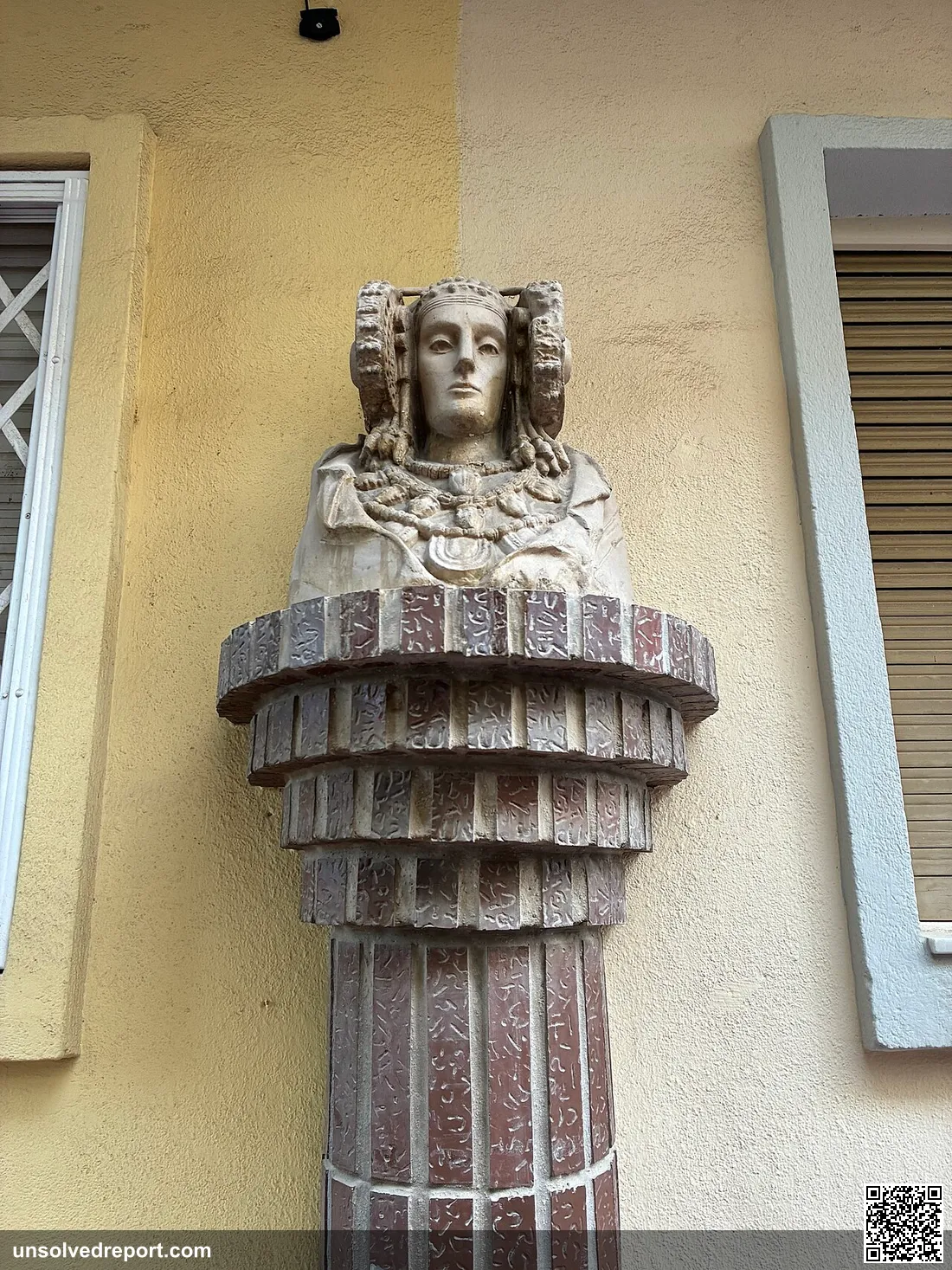
She's a bust carved from local limestone, the kind packed with tiny fossils, and she stands about 56 centimeters tall — roughly the size of a large cat curled up (Wikipedia, Lady of Elche). Most scholars date her to the 5th or 4th century BC, right in the golden age of Iberian sculpture — the same broad world of Tartessian and Iberian goldwork behind finds like El Carambolo — with a clear Greek (Hellenistic) flavor and maybe a Punic one too (Live Science). Then there are those two giant spirals coiled beside her face — the rodetes — plus heavy necklaces, a headdress, and a veil. Once seen, never forgotten.
Two more details matter, and they'll come back later.
First, she wasn't always this pale. She was painted. Real flecks of color still cling to her, and modern lab work has pulled ancient pigments off her surface (Materials and Structures, 2005). Second — and this one's strange — someone deliberately carved a hollow cavity into her back. An opening. A space meant to hold something (Museo Arqueológico Nacional). Hold that thought.
Her life after the dig reads like a heist movie. A French archaeologist named Pierre Paris took one look and knew exactly what she was. He moved fast, arranging to buy her for the Louvre — reportedly around 4,000 francs, the whole deal sewn up within weeks of her surfacing (Wikipedia). She'd stay in Paris for more than forty years. Then, in 1941, with World War II raging, she came home to Spain in a cultural swap brokered between the Vichy French government and Franco's regime (Live Science). Today she sits in the National Archaeological Museum (Museo Arqueológico Nacional) in Madrid, a national treasure (Museo Arqueológico Nacional).
So far, so solid. Now for the part nobody can pin down.
The Question Nobody Can Answer
Here's the truth that drives experts a little crazy: we don't know who she is. And we don't really know how she came out of the ground, either.
Think about when she was found — 1897. This was long before archaeologists learned to dig slow and careful, brushing away one thin layer at a time and writing down every scrap they touched. She wasn't excavated. She was yanked out fast and sold faster. So there's no field record nailing her to a known, documented layer of earth — the kind of paper trail that lets a scientist say, with confidence, exactly where she lay and what was buried beside her.
That missing record is the crack in the wall. And for over a hundred years, doubt has been growing right through it. It's also why the simple question — what was she? — is still genuinely open, not closed.
So take your pick. Was she a goddess, maybe the Punic-Phoenician deity Tanit, or some Iberian divinity cut from the same cloth? A priestess, presiding over secret rites? Or a flesh-and-blood noblewoman of Ilici, frozen forever in stone? Serious sources keep all three on the table as real possibilities, not settled answers (Live Science). The honest answer? The experts don't agree.
But remember that hollow in her back? It coughed up one clue. In 2011, a study in the Journal of Cultural Heritage put tiny particles from inside that cavity under an electron microscope — and found traces that match human bone ash. The reading: this bust was reused, or maybe even built from the start, as a cinerary urn. A vessel for someone's ashes (ScienceDirect, de Luxán et al., 2011). So now we know a little about what she did. We still don't know her name.
Three Stories People Tell
Story one: she's a 19th-century fake. (This is speculation, and these days it's the minority opinion.) In 1995, art historian John F. Moffitt published a book with a bold title — Art Forgery: The Case of the Lady of Elche — making the case that she's a modern hoax. His pitch: maybe a gifted Spanish sculptor carved her, then dressed her in the dreamy, swirling Art Nouveau style that was all the rage in the late 1800s (Stanford Libraries catalog). The believers point at her face and ask: isn't it too perfect? The carving too crisp? Some even swear she looks like the curvy poster women painted by the artist Alphonse Mucha (Biblical Archaeology Society Library). And the argument had a real weak spot to feed on — that missing dig record, the same kind of gap that fuels forgery fights like the Sinaia lead plates or the Sherborne Bone.
Story two: she's the real ancient deal, and science says so. (This is where most scholars land today.) Put the forgery idea under a microscope and it starts to crumble. A peer-reviewed 2005 study in Materials and Structures, run by de Luxán, Prada, and Dorrego, was the first to systematically test her paint and her surface — and it found the classic ancient colors: Egyptian blue and vermilion (natural cinnabar), laid over a gypsum base layer. Its verdict was blunt: no anachronisms. Nothing in the paint, the coating, or any other part of her points to a modern forger's hand — the same kind of hard material testing that later caught out the crystal skull fakes under a microscope (Materials and Structures, 2005). Stack that next to the 2011 bone-ash inside the cavity, and the physical evidence keeps lining up with an Iberian workshop, not a Victorian one (ScienceDirect, 2011). Most specialists now call her authentic.
Story three: real, but touched up. (Speculation — a middle path some have floated.) This softer version says maybe there's a genuine ancient core, but somebody cleaned her, sharpened her edges, or "improved" her a little after she was dug up. That would explain why her surfaces strike certain eyes as suspiciously fresh — without making her a total fraud. It's an idea, though. Not a proven one.
So why won't this fight ever end? Partly because the evidence cuts both ways: the material case for her age is now strong, but a perfect archaeological record of her burial is gone forever — and you can't recover what was never written down. Partly because she's a national symbol, and symbols always draw a crowd of skeptics. And partly, maybe, because a face this calm and this eerie — gazing out across 2,400 years — is just too good to leave alone. Science has answered "is she real?" with a confident yes. But that other question — who were you? — she keeps locked behind those serene stone eyes, and she isn't telling.
Sources & Further Reading
- Museo Arqueológico Nacional (Spain) — man.es
- de Luxán, Prada & Dorrego, "Dama de Elche: Pigments, surface coating and stone of the sculpture," Materials and Structures (2005) — Springer
- de Luxán et al., human bone ash / cinerary urn study, Journal of Cultural Heritage (2011) — ScienceDirect
- Live Science, "Lady of Elche: A 2,400-year-old bust..." — livescience.com
- "Lady of Elche," Wikipedia — en.wikipedia.org
- John F. Moffitt, Art Forgery: The Case of the Lady of Elche (1995) — Stanford Libraries
- Biblical Archaeology Society Library, "Is the Lovely Dama de Elche a Fake?" — biblicalarchaeology.org
- VisitElche, "La Dama de Elche" — visitelche.com
Nebra Sky Disc: The Bronze Age Star Map Looters Nearly Erased
The Nebra Sky Disc may be the oldest star map on Earth — but looters buried its proof. Is it 3,600 years old, or a thousand years younger than we think?
The 520-Ton Stone Aksum Couldn't Stand Up
A 33-meter, 520-ton stone—the heaviest humans ever tried to raise—lies shattered in Ethiopia. Nobody knows how Aksum moved it, or why it fell.
Dancing Girl of Mohenjo-daro: Why Her Identity Is Still Unsolved
A four-inch bronze girl outlasted 4,000 years of silence — then made 2026 headlines when a textbook altered her body. Nobody has ever known her name.