Lelu Ruins, Kosrae: The Coral City Nobody Can Explain
Lelu Ruins hid a city of coral tombs where kings were buried, dug up, and reburied at sea. Which came first, Lelu or Nan Madol? Scientists still disagree.
There is a city most history books forgot to mention. It sits on a tiny lagoon island off the eastern shore of Kosrae, in the Federated States of Micronesia, and almost no traveler has heard its name. Yet walk its overgrown lanes and you find the bones of one of the Pacific's great stone cities: Lelu (also spelled Leluh). Chiefs once ruled here. Royal corpses were laid inside pyramids built from living coral. And a kingdom organized thousands of workers to stack walls of stone — centuries before a single European ever saw the place.
People sometimes call Lelu the "forgotten twin" of the more famous Nan Madol on neighboring Pohnpei. That nickname hides a real, still-unsolved riddle. We'll get to it. First, the city itself.
What we actually know
Lelu is no legend. It is a real, mapped, protected archaeological site. It sits on Lelu Island, a little satellite islet of the bigger island of Kosrae — and here's the first surprise: much of the city is not natural ground at all. The builders extended the islet themselves, dragging land out of the lagoon to make room for their capital. The site was added to the U.S. National Register of Historic Places on August 16, 1983 (Wikipedia: Leluh archaeological site).
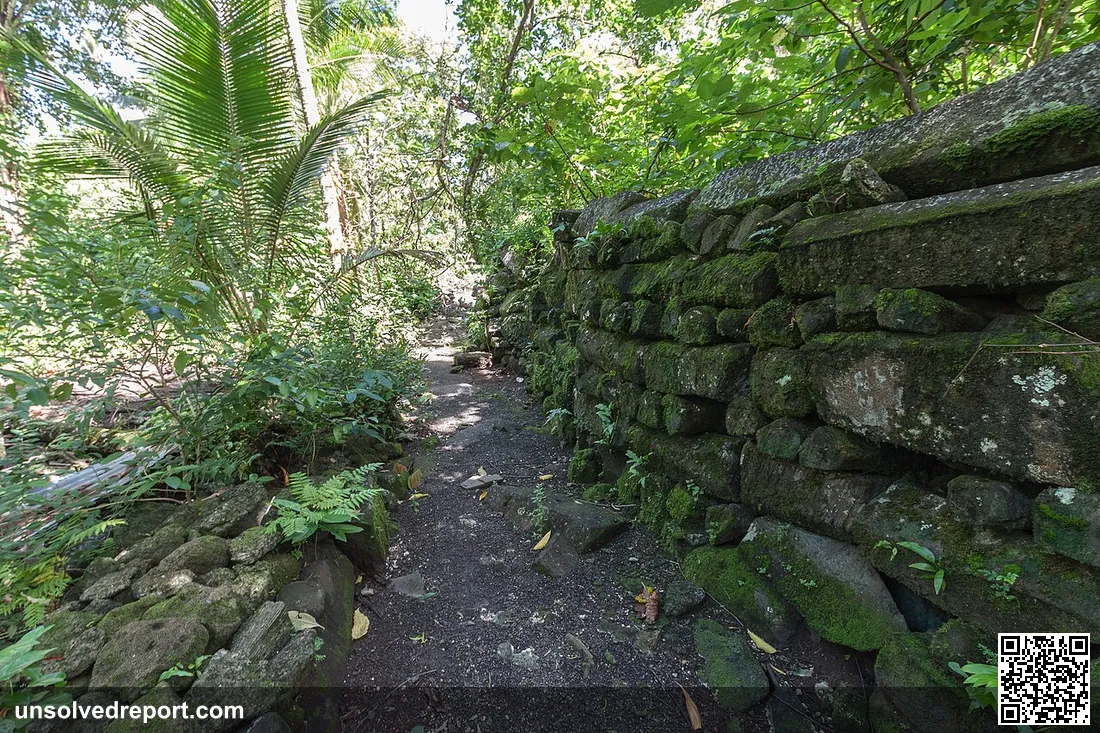
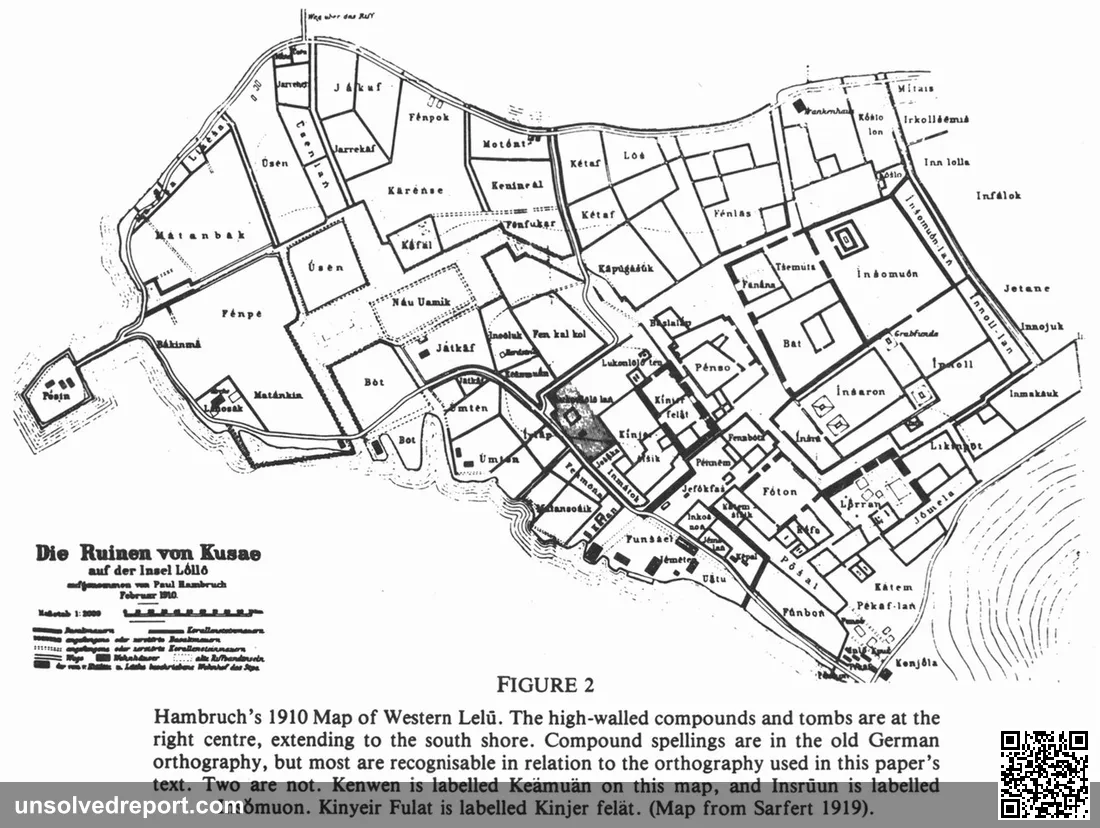
The size is what stops visitors cold. Sources disagree on the exact footprint, but the city sprawled across roughly 20 to 27 hectares of dense, packed urban fabric — and more than 180,000 square meters of that was land reclaimed from the sea. Researchers count over 100 walled compounds, laced together by canals and paved roads, and shielded by a seawall that stands more than 3 meters tall and runs over a kilometer long (Australian Museum). The walls themselves were stacked from two stones: prismatic basalt columns — the same naturally six-sided volcanic rock used at Nan Madol — and blocks of coral.
Now think about that basalt for a second. Those columns are not from Lelu. Archaeologists believe they were quarried from volcanic sources deep in Kosrae's interior, possibly near Utwe about 15 kilometers away, and then floated to the city on rafts (Archaeology Magazine). Picture columns of solid rock riding the water to be lifted into a wall by hand — a feat of hauling monumental stone that invites the same disbelief as the moai of Easter Island, whose builders were once assumed to have needed help they never actually had.
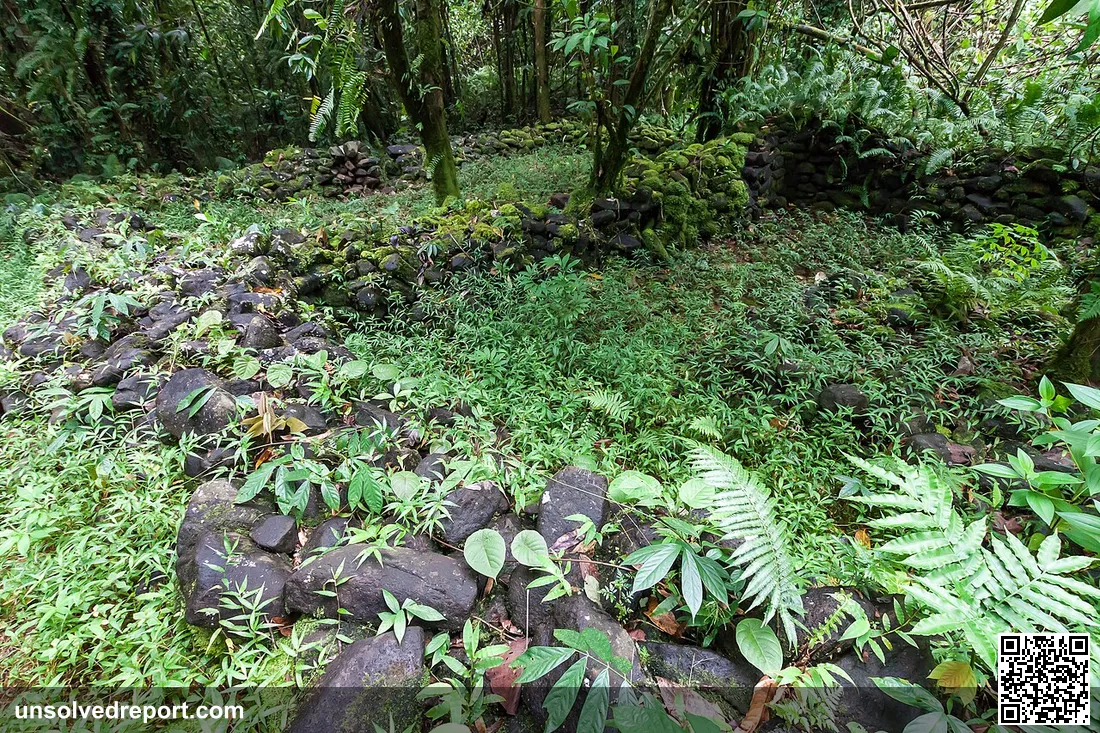
The people who pulled this off lived in a society with sharp dividing lines, and the city itself put those lines on display. The king and the highest nobles lived in the central district, tucked behind heavy basalt fortifications. Lesser aristocrats got more modest coral-walled enclosures to the west. Commoners lived in simple thatched huts (Wikipedia). How many people in all? Sources differ. The resident city is often put at around 1,500, while the whole island's population when Europeans arrived in the early 1800s has been estimated as high as roughly 6,000. Then came the whalers, traders, missionaries — and the diseases that traveled with them. By 1870, that number had crashed to around 200 (Wikipedia).
But the strangest part of Lelu is what they did with their dead.
The royal tombs — called saru — sat clustered in a compound named Insaru. They were pyramid-shaped, built from coral, and here's the twist: they were temporary. When a high chief died, his body was rubbed with coconut oil, wrapped in mats and cords, and laid inside a saru for a stretch of weeks to a few months. Then the bones were dug back up, cleaned, and reburied out in the nearby reef (Archaeology Magazine). A pyramid, but a borrowed one. A way station for the dead.
Those same coral tombs handed scientists a clock. In 2014–2015, marine scientists Zoe Richards and Jean-Paul Hobbs, funded by the Australian Museum Foundation, sampled coral from three saru in the Insaru compound and ran uranium-thorium (Th/U) dating on the coral itself. Their results, published in Science Advances, placed the tombs at roughly the 14th century — about 300 years earlier than anyone had thought, which makes them around 700 years old (Science Advances, Skopal et al. 2015; Australian Museum). All told, Lelu reigned as Kosrae's capital from roughly A.D. 1250 until the mid-19th century.
The question nobody can answer
Here's what keeps scholars circling back to Lelu — not the scenery, the puzzle. Lelu and Nan Madol are eerily alike. Both are artificial islet-cities of stacked basalt columns and coral. Both housed a single ruling elite at the top. Both cling to the eastern edge of Micronesia, about 550 kilometers apart. So the question almost asks itself: which one came first — and who learned this trick from whom?
Pohnpeian oral tradition gives a flat, confident answer. It says the builders of Lelu on Kosrae sailed to Pohnpei and used the skill they'd sharpened at home to raise Nan Madol. In that story, Kosrae is the parent. Pohnpei is the child.
The lab dates seem to flip the whole thing around. The monumental phase of Nan Madol is generally dated to roughly A.D. 1180–1200, while Lelu's stone city — and certainly its dated coral tombs — looks to come later, with the heavy building happening in the 13th and 14th centuries. Reading that chronology straight, several archaeologists argue the influence ran the other way: Nan Madol shaped Lelu, not Lelu Nan Madol (Wikipedia: Leluh archaeological site). And then the 2015 redating muddied even that, yanking Lelu's tombs three centuries earlier than the old estimate, shrinking the gap between the two cities. It's a sharp reminder of how much these answers wobble on just a handful of coral samples and which buildings happen to get dated. Which city taught the other — or whether each invented its own monumental style out of a shared Micronesian heritage — is genuinely, honestly, still up in the air.
Three ways to read the riddle
What follows is interpretation, not settled fact.
Nan Madol as the blueprint (the mainstream view). The most-cited reading simply follows the dates: Nan Madol's basalt architecture came first, the idea of a stone islet-capital spread east to Kosrae, and Kosraean chiefs reworked it with the coral they had in abundance. It's a fair inference from what we know now — but it leans on comparing two different kinds of evidence at two different sites, and a single new excavation could tip it over.
The oral tradition as real memory. Other researchers warn against tossing out Pohnpeian and Kosraean oral histories. Stories of migration and shared ancestors may carry the memory of real movements of people and real trade networks — even if they scramble the "who built first" detail. Oral history and radiocarbon dates are measuring different things, and squaring the two is interpretive work, not arithmetic.
One tradition, two islands. A third reading says neither city copied the other at all. Instead, both are expressions of a broader eastern-Micronesian drive toward grand chiefly architecture, built from whatever stone each island had on hand. Backers of this idea have even floated a joint UNESCO World Heritage nomination that would group Lelu with Nan Madol as "Ceremonial Centers of Eastern Micronesia" — though as of 2025, nothing of the kind has been finalized.
One thing, though, is beyond argument: the sheer human achievement. Whether Kosrae taught Pohnpei or the reverse, both demanded exactly what marine biologist Zoe Richards saw written into the saru — a "highly structured social order that could organize and demand significant labor and logistical support" (Archaeology Magazine). Lelu is not a lost-civilization fantasy. It needs no riddle of outside hands, the way Great Zimbabwe once had to fight off colonial-era myths about who really built it. It is the documented work of the Kosraean people — and maybe the most solvable mystery here is why so few of us have ever heard its name.
Sources & further reading
- Wikipedia — Leluh archaeological site
- Australian Museum — Corals of Kosrae: The Lelu Ruins
- Archaeology Magazine — Leluh Island's Temporary Royal Tombs Are 700 Years Old
- Science Advances — New precise dates for the ancient and sacred coral pyramidal tombs of Leluh (Kosrae, Micronesia)
- Facts and Details — Nan Madol, Lelu and the Grand Civilizations of Micronesia
- UNESCO World Heritage Centre — Tentative Lists
Puma Punku: Stones Cut Too Perfect to Be Ancient?
Puma Punku's stones interlock like factory parts, cut 1,500 years ago. Archaeologists know how — but one real mystery about them still has no answer.
10 Lost Cities the Earth Swallowed Whole
A Saharan gold hub. A drowned Egyptian port. A town buried alive by a volcano — with no bodies. Real lost cities, and the questions nobody can answer.
Qin Shi Huang's Tomb: The Mercury Rivers Nobody Has Seen
Ancient scrolls said Qin Shi Huang's tomb held rivers of liquid mercury. Lasers just found the mercury leaking out. So is the legend true?