Qin Shi Huang's Tomb: The Mercury Rivers Nobody Has Seen
Ancient scrolls said Qin Shi Huang's tomb held rivers of liquid mercury. Lasers just found the mercury leaking out. So is the legend true?
About twenty-two centuries ago, a crew of laborers sealed a chamber deep under a man-made hill outside what is now Xi'an, China — and walked away forever. What they left buried, according to a historian writing a hundred years later, was an entire empire shrunk down small. A palace. A ceiling painted with stars. And rivers and seas of liquid mercury, set flowing by hidden machines.
Here's the part that should make the hair on your arms stand up. The Terracotta Army standing guard outside has been picked over by scientists for fifty years. But the emperor's real burial chamber? Never opened. Not once. And when researchers aimed sensitive instruments at the silent mound, the dirt and the air gave up a secret the ancient text had promised all along: mercury.
A 2,000-year-old legend and a modern sensor reading, pointing at the same thing. That almost never happens. So let's pull them apart carefully — what we actually know, and what's still locked in the dark.
What we actually know
Qin Shi Huang did something no one had ever done: he hammered the warring Chinese states into one country and crowned himself its first emperor in 221 BCE. He died in 210 BCE. His tomb complex sits near Lintong, in Shaanxi Province, about 30 kilometers east of Xi'an, at the foot of Mount Li.
And we only know it's there because of a lucky strike. In March 1974, farmers digging a well hit chunks of fired clay — and pulled up the first of what turned out to be the Terracotta Army: thousands of life-sized clay soldiers, horses, and chariots lined up in pits (World History Encyclopedia; Smithsonian Magazine). In 1987, UNESCO put the Mausoleum of the First Qin Emperor on its World Heritage List (UNESCO World Heritage Centre).
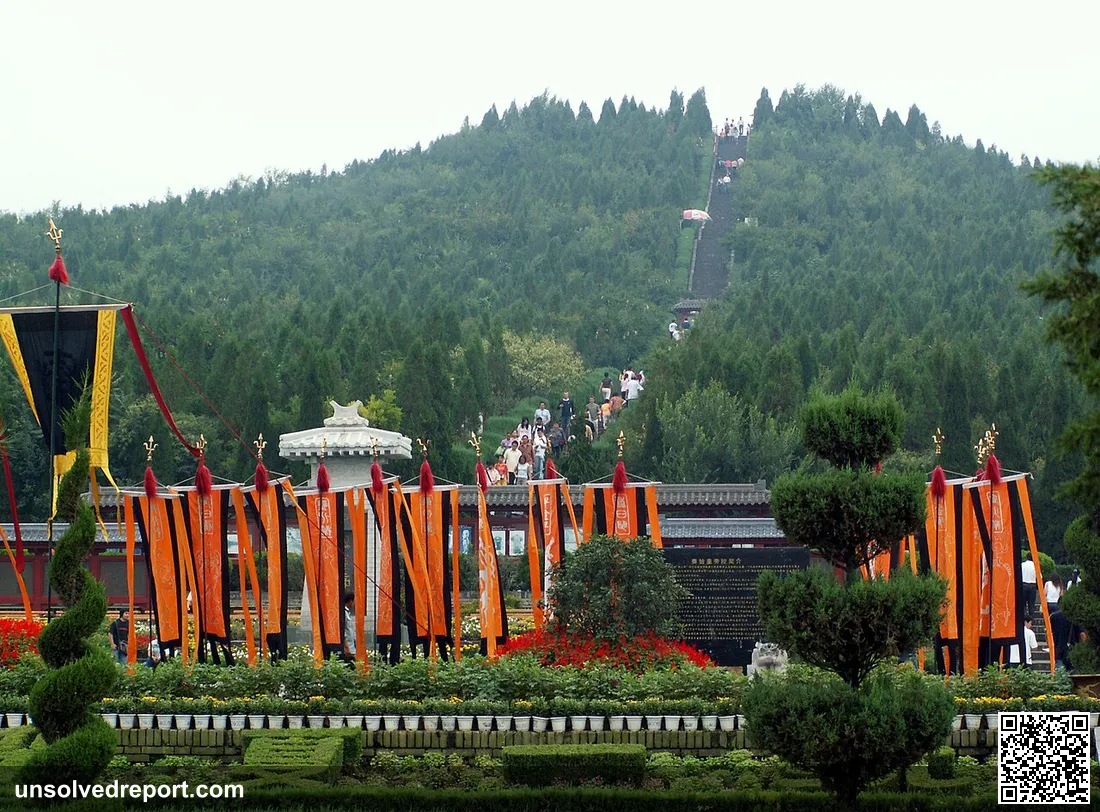
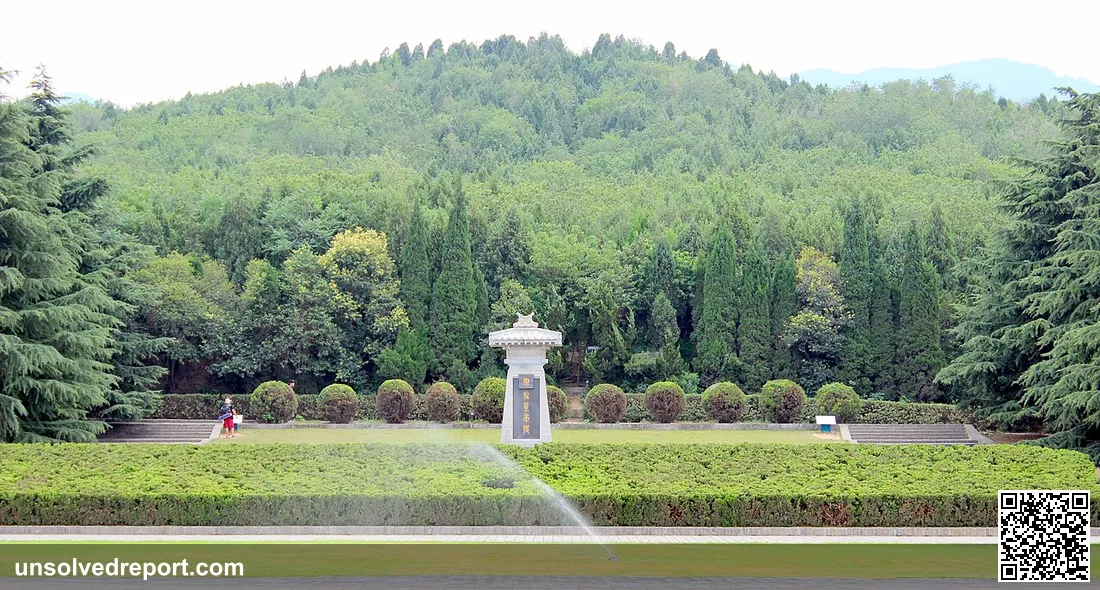
But the clay army? They're just the doormen. The real prize sits at the center: a stepped, pyramid-shaped earthen mound covering the actual burial chamber. Surveys describe a sprawling complex — estimates of the wider necropolis run into the dozens of square kilometers — with the still-unopened tomb at its heart (World History Encyclopedia).
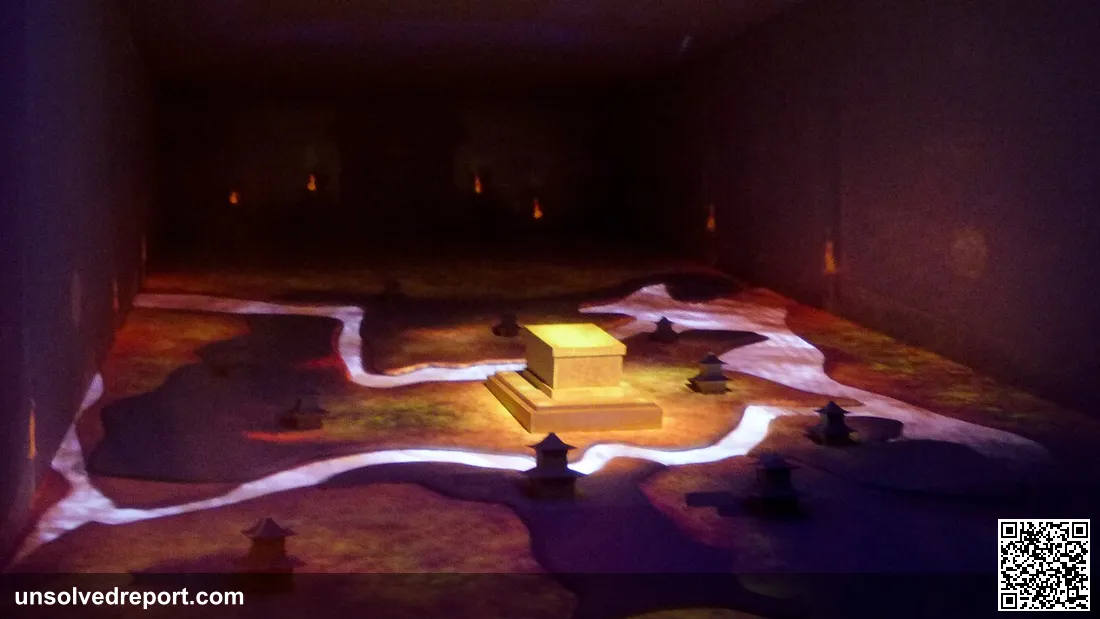
Now here's the strange thing. Almost everything we "know" about the inside of that chamber comes from one man and one book: the Shiji, or Records of the Grand Historian, written by the Han-dynasty historian Sima Qian. He set it down roughly a century after the emperor died — around 100 BCE. So remember this: he never saw inside either. His account is a record passed down, not an eyewitness peering through the door (Khan Academy). What he wrote, though, is unforgettable. Artisans, he said, shaped mercury into copies of the hundred rivers, the Yangtze and the Yellow River, and the seas — "constructed in such a way that they seemed to flow." Above it all, the heavens. Below it, the earth. He also described automatic crossbows rigged to fire on anyone who broke in, and noted that staggering numbers of conscripts were worked into the ground building the place (World History Encyclopedia).
For centuries, those mercury rivers sounded like a poet getting carried away. Then chemistry walked in. In the 1980s, researchers from China's Institute of Geophysical and Geochemical Exploration scooped soil samples from all over the burial mound — and the readings jumped. Mercury levels far above the surrounding land, with the hottest spot clustered right over the center of the mound, not smeared evenly across it (Journal of Geochemical Exploration, 1985).
Decades later, a sharper tool brought the picture into focus. In 2020, a team led by Guangyu Zhao published results in Scientific Reports (a Nature-family journal) using a mobile differential absorption lidar (DIAL) system — a laser tuned to mercury's exact absorption wavelength near 254 nanometers — to sniff mercury vapor in the air above the mound. They clocked atmospheric mercury up to 27 ng/m³, well above the local background of roughly 5–10 ng/m³. And the strongest readings sat on the pyramid slopes, lining up almost perfectly with the soil samples from decades before (Scientific Reports, 2020; open access via PMC). The authors called the mercury a "geophysical tracer gas" — a chemical fingerprint seeping up from below — and read the steady leak as a sign of a chamber still sealed, still intact.
So: two completely different methods, decades apart, both found unusual mercury concentrated over the tomb. That part is solid. On the record. No argument.
The thing nobody can answer
But here's where the lights go out. Nobody — not one living person — has seen inside that chamber. The central tomb of Qin Shi Huang has never been excavated, and it sits sealed to this day (World History Encyclopedia).
And the mercury, as eerie as it is, only whispers. It doesn't confirm. High mercury in the soil and air fits Sima Qian's rivers beautifully — but the surveys can't tell us the shape of what's down there: how much mercury, in what form, arranged how. Flowing rivers? A star-map ceiling? A chamber that's flooded, or caved in, or perfectly preserved like a sealed jar? The instruments catch a signal. They can't read a blueprint.
And leaving the tomb closed isn't laziness — it's a hard, deliberate choice. Chinese authorities have said again and again that they simply don't have the technology to open it without wrecking what's inside. The warning sits right next door. The Terracotta warriors were originally painted in vivid color, and once the diggers exposed them to open air, much of that pigment curled up and faded in a matter of weeks. Archaeologists have flatly said there's no plan to crack the inner chambers, because the methods to protect what's inside just aren't ready (Smithsonian Magazine). Add toxic mercury vapor to that, and you've got a dig where the air itself could poison you. So the most important archaeological site in China is being, on purpose, left alone — a rare case where doing nothing is the official plan.
So what's actually in there?
Theory 1: The rivers really are down there, more or less as described. Plausible, and partly backed up. When an ancient text and two separate mercury surveys all point the same way, a lot of researchers lean toward this: a serious amount of liquid mercury really was poured into that tomb. The peer-reviewed 2020 study adds weight — though it carefully stops short of saying "rivers."
Theory 2: The "100 tonnes" number is a guess wearing a lab coat. Careful here. You'll see it everywhere — the tomb holds about 100 tonnes of mercury. But no instrument has ever measured that. It's an upper-bound estimate, sometimes worked backward from how much mercury the era could even produce. Treat that exact tonnage as speculation, not fact.
Theory 3: The mercury was about meaning and preservation, not just looks. An interpretation. In early Chinese thought, mercury — and its ore, cinnabar — was tangled up with immortality. Some scholars think the rivers were a tiny cosmic model of the empire, and that the mercury vapor may have been meant to act as an antiseptic, keeping the body and the chamber from rotting. And here's the grim twist: Qin Shi Huang is widely believed to have died from swallowing mercury-laced "immortality" elixirs. If his tomb really is flooded with the very metal that killed him, the irony is almost too perfect (Khan Academy).
Theory 4: The booby-trap crossbows. Unverified. Sima Qian's self-firing crossbows make for a thrilling image — automatic weapons waiting two thousand years in the dark for a tomb robber. But whether they ever existed, or could possibly still fire after 2,200 years, is completely unconfirmed. There's only one way to find out, and nobody's volunteering to open the door.
So here's the honest bottom line. The mercury is real, and it's strange. The rivers remain a documented claim — written down, hinted at by the chemistry, but never confirmed, because no one is in any rush to try. The First Emperor wanted his death left undisturbed for eternity. More than two thousand years later, he's still getting exactly what he asked for. And somewhere under that quiet hill outside Xi'an, the mercury keeps leaking up through the soil — patient, poisonous, waiting.
Sources & Further Reading
- Mausoleum of the First Qin Emperor — UNESCO World Heritage Centre
- Terracotta Army — World History Encyclopedia
- What You Need to Know About China's Terra-Cotta Warriors — Smithsonian Magazine
- The Tomb of the First Emperor — Khan Academy / Smarthistory
- Zhao et al., "Mercury as a Geophysical Tracer Gas," Scientific Reports (2020) — open access via PMC7319949
- Application of mercury survey technique over the mausoleum, Journal of Geochemical Exploration (1985)
15 Ancient Mysteries Archaeologists Still Can't Explain
A 2,000-year-old computer. A temple older than farming. A book no one can read. Fifteen real ancient mysteries, all documented, all still wide open.
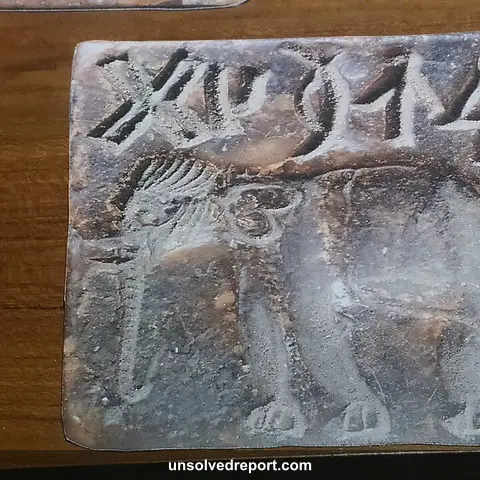
Indus Script Undeciphered: The 4,000-Year Code Nobody Can Crack
Thousands of Indus Valley seals. Over 100 failed attempts. A $1 million prize still unclaimed. So what is this ancient script actually hiding?
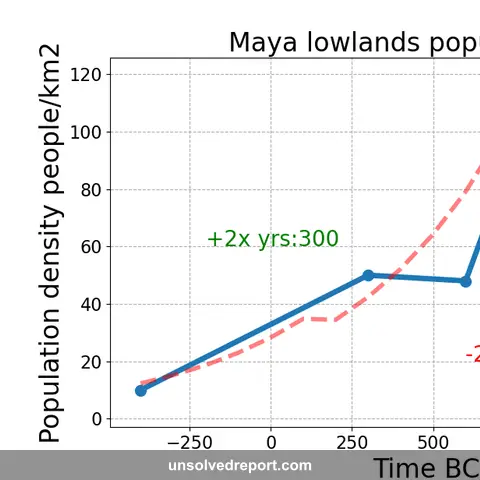
Classic Maya Collapse Mystery: One City Didn't Even Have Drought
Tikal and Copán emptied by 900 CE, population fell 90%. Now a 2025 lake-sediment study found one city collapsed with no drought at all. So why did it fall?