The Lost Ninth Legion: How 5,000 Men Vanished
Five thousand Roman soldiers marched into the 2nd century and never marched out. No battle. No bodies. No record. Here's what the stones actually say.
Five thousand men. That was a Roman legion — and it was far more than soldiers. It was a whole marching town: bakers, surveyors, doctors, accountants, the works. Something that big does not simply blink out. You cannot misplace a town.
Somebody misplaced this one.
Sometime in the 2nd century, one of Rome's proudest units walked off the edge of history and never walked back. Legio IX Hispana — the Ninth "Spanish" Legion. No ancient writer tells us when it died. Not where. Not how. And here's the part that should make the hair stand up: this was a legion that stamped its name onto roof tiles and chiseled it into stone all over Britain. It was loud. It was everywhere. Then it went quiet — completely, eerily quiet.
That quiet is the whole mystery. For nearly two thousand years it has refused to fade. So let's do the thing the legends almost never bother with: separate what the stones actually say from the stories we've draped over them.
What we can actually prove
Start on solid ground — because, for once, there is some.
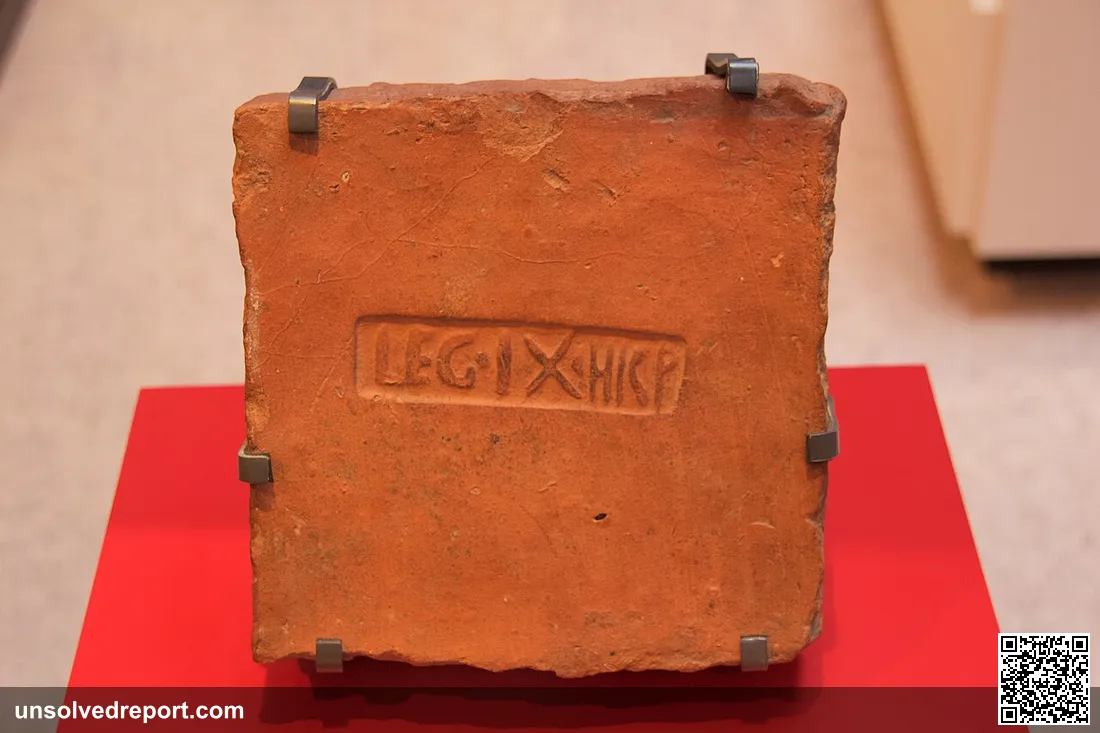
The Ninth was old, with real history at its back. By the early days of Rome's conquest of Britain it was already a fixture on the bloody northern frontier, and from around AD 71 it settled into its home base: the fortress at York, which the Romans called Eboracum. It stayed for decades. It stamped tiles and built in stone like it owned the place (Roman Inscriptions of Britain) — the same durable habit of leaving objects behind that, elsewhere in the empire, produced oddities as baffling as the Roman dodecahedron.
Now look at one slab of stone. It sits today in the Yorkshire Museum, it was dug out of York in 1864, and it is the single most important clue we have. It records the rebuilding of the fortress gateway "by agency of the Ninth Legion Hispana" — and the titles of the emperor Trajan pin it to one exact year: AD 108 (Wikipedia summary of the epigraphy). That is the last firmly dated inscription naming the legion in Britain. After AD 108, the British trail just goes cold.
Here's where the famous legend starts to crack.
Because the trail doesn't actually end at York. Cross the North Sea to Nijmegen in the Netherlands — Roman Noviomagus, in the province of Germania Inferior — and archaeologists pulled tile-stamps out of the ground reading LEG HISP IX. Plus other military finds. Including a silver-plated bronze pendant inscribed for the legion. The material dates to roughly AD 104–120, and the Dutch archaeologist Jules Bogaers pieced the fuller picture together in the 1960s (Wikipedia). Whatever else this proves, it nails down one thing for certain: at least part of the Ninth was alive and working on the Rhine after its last dated appearance in York. Not rotting in a Scottish bog. On the Rhine.
The officers tell the same story. Senior men who served with the Ninth went on to hold high office well into the reign of Hadrian (AD 117–138) — which is awfully hard to square with the whole legion being wiped out around AD 108–120. As the historian Duncan B. Campbell and others have pointed out, an officer's inscription can effectively "post-date" a legion, because the man simply outlived his posting (Wikipedia).
And one last fact nails down the far end of the timeline. Two separate lists of the Roman legions, drawn up under Septimius Severus (who reigned AD 193–211), leave IX Hispana off entirely (Wikipedia). So whatever happened, it had happened before the 2nd century ran out. The legion was gone — struck from the rolls, finished as a fighting force.
So the window is real. But it's wide: somewhere between roughly AD 120 and 197, the Ninth ceased to exist. Seventy-odd years of darkness. And not one torch to shine into it.
The hole in the middle
Here's the honest heart of it.
We can prove the Ninth was alive after AD 108. We can prove it was dead by the 190s. What we cannot prove is anything that happened in between. Not a single ancient source names the battle that destroyed it. Or the year it was disbanded. Or the spot where it met its end.
Strange — but not impossible. Roman record-keeping was full of holes, and legions could be quietly merged, renamed, or scrubbed from the books after a disgrace nobody wanted to remember — Roman Britain has swallowed whole fortunes just as thoroughly, as the buried Hoxne Hoard shows.
But there's a deeper puzzle here, and it's the one that keeps people up at night. It isn't just a death. It's the absence of a trace — the same kind of silence that swallowed the lost army of Cambyses in the Egyptian desert twenty-five centuries earlier. Legions were like giant stamps pressed into the landscape — tombstones, dedications, tile-marks scattered wherever they marched. After Nijmegen, the Ninth leaves almost nothing at all. That's why every theory has to do double duty. It can't just explain a death. It has to explain a vanishing.
So where did they go?
Everything below is interpretation, not fact. Each idea has serious people behind it. Each one has a crack running through it.
Theory 1 — Slaughtered in the north of Britain. This is the one you've probably heard. The Ninth marched up into wild Caledonia and was butchered to the last man by native tribes. It's a thrilling image. It is also, honestly, mostly a literary one — burned into the public imagination by Rosemary Sutcliff's beloved 1954 children's novel The Eagle of the Ninth, later turned into the 2011 film The Eagle (Wikipedia: The Eagle of the Ninth). That said, some respected historians — Miles Russell among them — argue that fighting and dying in Britain in the late 110s or early 120s is still the simplest explanation. Treat it as speculation. And the Nijmegen finds are the obvious wrecking ball: at least part of the legion was over on the Rhine after the supposed massacre. You can't be slaughtered in Scotland and stamping tiles in Holland.
Theory 2 — Sent east, and lost out there. The scholar Eric Birley argued the Ninth was never destroyed in Britain at all. After its stint at Nijmegen, he reckoned, it moved east — and died there, in the 130s or 160s. Two candidate catastrophes usually get named: the savage Bar Kokhba revolt in Judaea (AD 132–135), where Rome admitted heavy losses, and the disastrous Parthian war under Marcus Aurelius, in which a Roman legion was annihilated in Armenia around AD 161 (Wikipedia). Speculation again — and it carries a fatal flaw. There is essentially no inscription placing the Ninth anywhere in the East between about AD 130 and 160. A neat story with the whole middle torn out.
Theory 3 — A British disaster Rome chose to bury. The newest entry comes from Erik P. Graafstal, in the peer-reviewed journal Britannia (Vol. 56, 2025). Graafstal ties the legion's vanishing to a security crisis on Britain's northern frontier around AD 122 — exactly when Hadrian visited, when work stopped at sites along the Wall, and when the famous expeditio Britannica unfolded. His suggestion: Roman authorities may have deliberately played the whole episode down (Cambridge Core / Britannia). Speculation, yes — but recent, and careful. It partly drags the British ending back to life while still accounting for the Nijmegen detachment, though the author himself stops short of declaring one final verdict.
So — what really happened to the Ninth?
The honest answer is that nobody knows, and the field doesn't pretend otherwise. The fortress at York is real. The AD 108 stone is real. The Nijmegen tiles are real. The Severan army list that quietly forgets the legion is real. Everything stretched between those fixed points is careful inference and educated guessing.
And maybe that's the Ninth's truest monument. Not famous for how it lived — famous for how completely it teaches us where the evidence stops, and the dark begins. Five thousand men walked into that dark. We're still standing at the edge of it, holding a torch that won't reach.
Sources & further reading
- Roman Inscriptions of Britain — Legionary Tile-stamps of Legion IX Hispana (entry 2462): https://romaninscriptionsofbritain.org/instrumentum/2462
- Wikipedia, 'Legio IX Hispana' (consolidated epigraphy, Nijmegen finds, Bogaers, Birley, Bar Kokhba and Parthian theories, Severan legion lists): https://en.wikipedia.org/wiki/Legio_IX_Hispana
- Erik P. Graafstal, 'What Happened Next? Hadrian's Wall, the expeditio Britannica and the Fate of the Ninth Legion,' Britannia, Vol. 56 (2025), Cambridge University Press: https://www.cambridge.org/core/journals/britannia/article/what-happened-next-hadrians-wall-the-expeditio-britannica-and-the-fate-of-the-ninth-legion/2939F9DCC38AC465ED8D2D3B13A3A044
- Wikipedia, 'The Eagle of the Ninth' (Rosemary Sutcliff, 1954 novel; 2011 film adaptation): https://en.wikipedia.org/wiki/The_Eagle_of_the_Ninth
- Yorkshire Museum / York Museums Trust — provenance of the AD 108 Trajanic building inscription (discovered York, 1864)

Sungbo's Eredo: The 100-Mile Wall Hidden in a Forest
Sungbo's Eredo: a 100-mile wall hidden in Nigeria's rainforest for centuries, taller than a six-story building. Who built it — and for what vanished queen?
Hessdalen Lights: The Valley Nobody Can Fully Explain
The Hessdalen lights blaze over a Norwegian valley on schedule since the 1980s. Scientists brought radar to catch it — what they found still baffles them.
Sutton Hoo: The King Who Left No Body
Sutton Hoo's 90-foot ship hid a king's fortune in gold — and no body. Where did the corpse go, and whose was it? The soil finally gave up its secret.