Golden Rhinoceros of Mapungubwe: The One-Horned Riddle Nobody Can Solve
A 1934 grave gave up a palm-sized golden rhino with an anatomically impossible one horn. Why did its makers change nature — and why did a gold kingdom vanish?
It fits in your palm. A tiny rhinoceros, sloped at the shoulder, wrapped in gold so thin it crinkles like a leaf. One horn points forward. Little ears, a little tail — each one teased into shape by a craftsman who died seven hundred years ago and left no name — the same kind of anonymous mastery behind the impossibly precise Igbo-Ukwu bronzes further north on the continent.
For most of a century, almost nobody knew it existed. A handful of scholars in South Africa, and that was it.
Today curators call this little animal the defining symbol of precolonial civilization in southern Africa. And it points back to something astonishing: a kingdom that rose, grew rich on gold, buried its rulers in the stuff — and then quietly emptied itself out, as if the whole place had simply walked away.
What We Actually Know
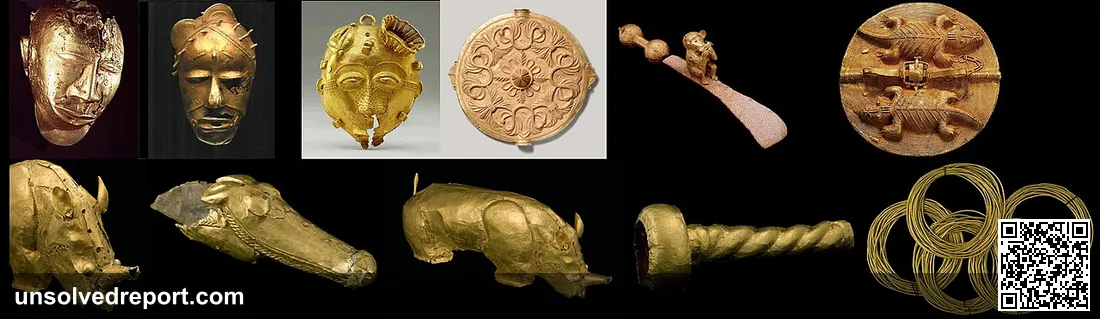
The rhino came out of a royal grave on top of Mapungubwe Hill, near the spot where the Limpopo and Shashe rivers meet, in what is now northern South Africa. The British Museum's John Giblin, an archaeologist who has written about the object, says it was pulled from the ground in 1934 and dates to the 13th century (The Conversation). The Metropolitan Museum of Art pins it to roughly 1220–1300, and explains how it was made in the plainest terms: thin sheets of gold foil, once tacked down with tiny pins around a carved wooden core (Metropolitan Museum of Art).
Here's how the whole thing got dug up. The story starts on December 31, 1932, when a local informant named Mowena led a farmer and prospector, E.S.J. van Graan, his son, and three companions onto Greefswald farm and up the hill — where they found gold lying in graves (South African History Online). The University of Pretoria locked in excavation rights in 1933 and kept working the site for years; the rhino is still part of the Mapungubwe Collection at the University of Pretoria Museums (Metropolitan Museum of Art).
And the rhino had company. Diggers opened grave after grave on the hilltop. Three of them held bodies sitting upright — a seated, royal pose — surrounded by gold and copper, exotic glass beads, and other treasures of the powerful. Beside the rhino lay a golden bowl, a golden sceptre, and a whole menagerie of beads and little animal figures (Mail & Guardian).
This was no village trinket hoard. This was a real state, the kind of planned, class-stratified settlement that puts it in the same league as Africa's other vanished planned cities at Dhar Tichitt. Mapungubwe flourished between roughly the 11th and 13th centuries, growing out of an earlier settlement called K2, also known as Bambandyanalo, before power moved up onto the hill in the early 1200s. UNESCO made the Mapungubwe Cultural Landscape a World Heritage Site in 2003, calling it the heart of the largest kingdom in the subcontinent before it faded in the 14th century (UNESCO World Heritage Centre).
So how did a kingdom in the African interior get so rich? Trade — the long-distance kind. Gold and ivory flowed east toward the Swahili ports on the Indian Ocean, and back came Chinese porcelain and glass beads from Persia and India (Metropolitan Museum of Art). At its peak the kingdom may have held thousands of people. And up on the hill sat the elite, with the commoners spread out below — a split that, in the Met's words, makes Mapungubwe the first known class-based society in southern Africa.
The Riddles Nobody Has Cracked
Now we step off solid ground. Because for everything the dig revealed, it left behind a few honest puzzles that still haven't been answered.
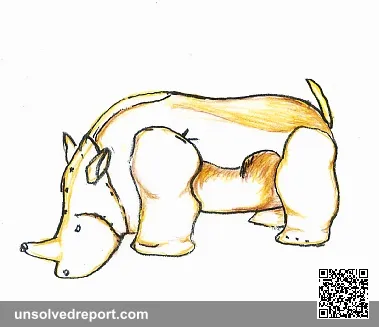
Start with the most charming one: the horn. African rhinos — white and black alike — carry two horns. The Mapungubwe rhino has one. And this isn't a piece that broke off. The excavators, conservators, and restorers who have studied the object up close all agree it never had a second horn (Wikipedia). So why would a craftsman, living in a land crawling with two-horned rhinos, build a one-horned one? Was it just a stylish simplification? A sacred rule we don't understand? Or — and this is the strange one — an echo carried down the same trade routes that brought the Chinese pottery, the shape of a single-horned Asian rhino the artist had only ever heard about?
Then there's the missing core. The gold is still here. The carving it once wrapped has rotted away completely. So we know how they did it — but not the full sculpture the goldsmith intended, and not how many of these figures they ever made. Which leads to another open question: what were these things for? Were they worn or shown off in life, royal bling for the living? Or were they made for the dead, to be buried and never seen again?
And looming over all of it — the biggest riddle of the lot — the kingdom's disappearance. Within about a hundred years of the rhino going into the ground, Mapungubwe was abandoned. The hilltop palaces, just left. The whole center of power and money drifted north, to Great Zimbabwe (South African History Online). What breaks a wealthy, well-connected state that completely? It's one of the central questions in the region's archaeology.
The Best Guesses
What follows is interpretation and educated guessing — not settled fact. Scholars argue about the details.
The one horn. Two front-runners. The first is simple artistic license: the maker just abstracted the animal down to its essentials. The second is more tantalizing — that contact with the wider Indian Ocean world planted the image of a one-horned Indian or Javan rhino in the artist's mind (Wikipedia). Neither can be proven from a single statue. The horn keeps its secret.
What it meant. The most popular reading stacks two symbols of power on top of each other: the rhinoceros, one of the region's most fearsome animals, made out of gold, the region's oldest emblem of wealth and rule. Buried with a member of the ruling class, the figure reads as a statement of royal status, not unlike how the golden raft of El Dorado once sealed a Muisca ruler's claim to power on another continent entirely. But notice — that's a reasonable scholarly guess, not a decoded message. The people of Mapungubwe left no writing at all. So the exact spiritual or political meaning stays an interpretation, nothing more.
Why it all fell apart. The most cited theory is environmental. As South African History Online lays it out, scholars believe the local climate shifted, making it harder to grow crops and keep herds alive — a change often tied to the cooling spell sometimes called the Little Ice Age. Drought, pressing down on a population packed together by trade, could have made the place impossible to hold. Other explanations point to trade routes that started favoring Great Zimbabwe instead. The evidence backs climate change as a major driver — but exactly how much was the weather versus the economy is still up for debate.
Why almost no one knew. And here's the last twist: why did this dazzling find stay so quiet for so long? The discoveries were kept relatively under wraps for much of the 20th century, and only broke into wide public view after 1994 (South African History Online). Writers including Giblin argue the rhino didn't fit an official story that downplayed how deep African history ran in the region (The Conversation). When democracy came, the little animal was embraced at last: it now sits at the heart of the Order of Mapungubwe, the country's highest honor, created in 2002 — with Nelson Mandela among the very first to receive it.
A golden animal the size of your palm, holding two mysteries at once. The small, intimate riddle of a single horn. And the vast silence of a kingdom that grew rich, buried its kings in gold, and walked off into the dust. Both of them are still waiting. Both of them keep asking you to look a little closer.
Sources and Further Reading
- Metropolitan Museum of Art — Mapungubwe (ca. 1050–1270)
- UNESCO World Heritage Centre — Mapungubwe Cultural Landscape
- The Conversation — Meet the 800-year-old golden rhinoceros that challenged apartheid South Africa
- South African History Online — Mapungubwe
- Mail & Guardian — 'The world must see our golden rhino'
- Wikipedia — Golden Rhinoceros of Mapungubwe
Mahdia Shipwreck: The Greek Treasure Ship No One Can Explain
Sponge divers off Tunisia found bronze gods and 200 tons of marble on the seabed — a 2,000-year-old cargo so strange, no one agrees why the ship was even sailing.
Llanganates Treasure: The 750 Tons of Inca Gold Nobody Can Find
Llanganates treasure: a doomed Inca emperor, 750 tons of vanished gold, a wilderness that swallows hunters whole. Is any of it still down there?
Irish Crown Jewels Theft 1907: The Safe That Emptied Itself
No forced lock. No alarm. No suspect ever charged. Four days before a king arrived, Dublin Castle's safe was found open and empty — so who had a key?