São João Shipwreck 1552: The Treasure No One Has Ever Found
One of the richest ships to ever sail from India broke apart on a wild African coast in 1552. Her treasure vanished. Nobody has ever found it — why?
February 1552. A brand-new Portuguese carrack pulls away from India so stuffed with pepper, porcelain, and treasure that the people who saw her called her one of the richest ships ever to point her bow toward home. Four months later, she's firewood on a wild African beach. Her cargo is rolling in the surf. And roughly 600 people are about to start walking down a coast no European had ever crossed on foot — a death march that would kill almost all of them.
This wreck became the most famous shipwreck story in the entire Portuguese language. But here's the part that still nags, nearly five centuries later: the riches she carried have never been found. Not most of them. Not really any of them. And the experts can't even agree on the spot where she hit.
What We Actually Know
The São João was a "great galleon" — a carrack — of the carreira da Índia, the Portuguese trade route to India and back that would claim the São Bento too, just two years later. The Nautical Archaeology Digital Library lays out the basics: she was built in Lisbon's shipyards in 1550, registered at roughly 900 tons, and ranked among the largest India-route ships of her day. She sank in 1552 on her very first voyage home (shiplib.org).
She left Cochin, India, on February 3, 1552, under captain Manuel de Sousa de Sepúlveda. In her hold: pepper, Chinese porcelain, silks, spices, and more. On her decks: about 600 people — crew, Portuguese passengers, and enslaved people (South African History Online). Among the passengers were the captain's wife, the noblewoman Dona Leonor de Sá, their children, and his brother-in-law Pantaleão de Sá. A family voyage. Remember that.
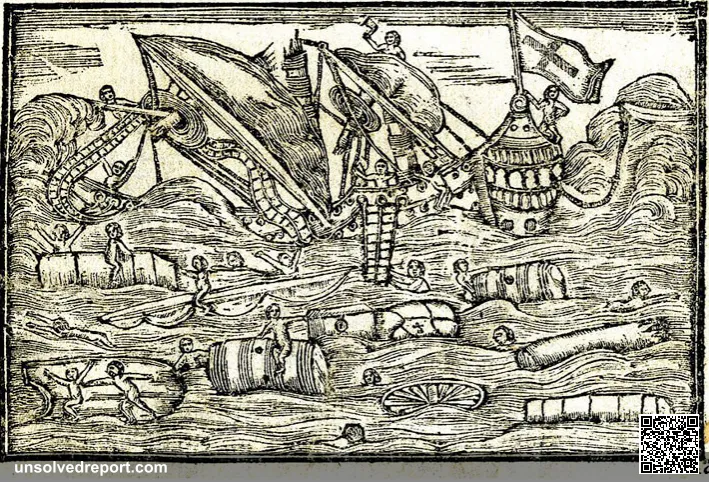
Then the storms found her. Off the bottom of Africa, the wind shredded her rigging and drove her onto the coast in early June 1552, and the hull cracked open against the rocks. Where exactly? That's where the record splits. South African History Online puts the wreck near the mouth of the Mzimvubu River, at present-day Port St. Johns. But the Nautical Archaeology Digital Library and South African heritage researchers point instead to the Inhlanhlinhlu River at Port Edward, around 31°02′S — where the Natal Museum dug up ceramic sherds and carnelian beads that match the cargo and the era (shiplib.org). Either way, the wreck itself killed somewhere between 100 and 110 people on the spot.
The survivors pulled themselves together on the sand. Then they made a terrible decision that was also their only one: walk. They aimed for a river charted earlier by Lourenço Marques (near modern Maputo, Mozambique), where Portuguese ships still called. That's several hundred leagues away. The walk took roughly five and a half months, through rivers, marshes, and the lands of peoples who had every reason to be wary of armed strangers. Hunger picked them off. So did exposure. So did fighting. The captain, Dona Leonor, and their children all died on the road. The story goes that Dona Leonor, stripped of her clothes, dug herself into the sand and died there — and that Sepúlveda, hollowed out by grief, simply walked into the bush and was never seen again (shiplib.org).
How many made it? The numbers are grim and they don't quite line up — and that mismatch is part of the honest record. South African History Online counts only seven Europeans and fourteen enslaved people — 21 souls — who finally reached Mozambique. Other accounts say about 25 reached the Maputo River. Pick either number. Of roughly 500 who started walking, fewer than two dozen finished.
What the disaster did next is almost stranger than the disaster itself: it became literature. The first published account hit print in 1554. Later the tale was gathered into the História Trágico-Marítima ("Tragic History of the Sea"), assembled by Bernardo Gomes de Brito and printed in two volumes in Lisbon in 1735 and 1736 (Wikipedia: História Trágico-Marítima). The São João is the first and most famous of its twelve shipwreck stories. And Portugal's national poet, Luís de Camões, folded the deaths of Sepúlveda and Leonor into Os Lusíadas (1572), tucking their fate inside the prophecy of the giant Adamastor. The wreck didn't just sink. It haunted a nation's imagination.
The Question Nobody Can Answer
Now for the part that doesn't add up.
The São João is described, again and again, as one of the most richly loaded ships of the entire India route — pepper counted in thousands of quintais, plus porcelain, silk, spices, and bullion, much like the Flor de la Mar, another Portuguese carrack whose fortune was never recovered. Popular retellings throw around the phrase "a cargo worth a million in gold." A floating fortune.
So where is it?
Because the honest answer is: nobody has it. There's no documented recovery of that wealth — none. What the archaeology can actually show you is heartbreakingly thin: a fragment of a bronze cannon a diver reported in 1980, scattered ceramic sherds, and carnelian trade beads the Natal Museum collected off the shoreline over years of patient looking. That's it. That's the haul from one of the richest ships ever to sail — a gap that echoes across history's most famous shipwreck treasures still missing.
A 900-ton carrack's cargo does not just evaporate. So which is it? Was it smashed to splinters and swallowed by shifting sand and surf? Carried off the beach in 1552 and traded inland through networks that left no European paperwork behind? Or is a real debris field still lying out there beneath the Wild Coast breakers right now — untouched, unexcavated, unrecorded? And remember: experts can't even settle whether to look at Port Edward or Port St. Johns. So part of the "lost riches" puzzle is literally where to start digging. That gap — an enormous documented fortune on one side, an almost empty archaeological ledger on the other — is the true unsolved heart of the São João.
Four Ways to Read It
The sea took it back. Lots of maritime historians lean on the simplest explanation: a wooden hull breaking apart on rocks spills its goods, and the goods either sink offshore or wash up and rot away. Pepper and silk decay. Porcelain shatters. Metal corrodes or gets buried. It's the tidiest reading, and it matches the thin recovered record — but notice it's still an inference, because no systematic dig has ever cataloged the site.
The beach picked it clean. It's entirely believable, though never documented in detail, that local communities and surviving castaways gathered up whatever floated ashore. Trade beads and porcelain slipping into regional exchange would explain why so little stayed put. Reasonable — but speculation. The survivor accounts are about suffering, not inventory lists.
The gold is still down there. Treasure-hunting lore swears a fortune in gold coins lies waiting in the surf zone. Gold pardaus from Portuguese India of that period do show up among collectors, sometimes tagged as "from the São João site" — but those tags are usually unverified. So take any claim of recoverable São João gold with a heavy pinch of salt.
The legend, named for what it is. That unforgettable image — Dona Leonor burying herself in the sand and dying beside her children — is the emotional core of the whole story. But it reaches us through a literary tradition (the 1554 account, the História Trágico-Marítima, and Camões), writing meant to move readers to tears, not a ship's logbook. The big facts hold up: the wreck happened, the catastrophic march happened. It's the most vivid deathbed details that are best read as treasured tradition rather than forensic certainty.
What isn't in doubt is the scale of it. A great ship. An enormous fortune. Hundreds of lives. All of it swallowed by a coast that has kept its secret for almost five hundred years — and may be keeping it still, somewhere just past the breakers, waiting for someone to finally know where to look.
Sources & Further Reading
- Nautical Archaeology Digital Library, "São João Shipwreck (1552)" — shiplib.org
- South African History Online, "Disaster strikes as Portuguese ship São João sinks" — sahistory.org.za
- Wikipedia, "História trágico-marítima" — en.wikipedia.org
- University of Pretoria, E. Burger (2004), thesis on Portuguese shipwreck narratives — repository.up.ac.za
- Luís de Camões, Os Lusíadas (1572), Canto V (Adamastor episode).
Panagyurishte Treasure: Solid Gold Mistaken for Whistles
Three brothers digging clay in 1949 Bulgaria pulled nine solid-gold vessels from the ground and reportedly tried to blow into them like whistles. Who buried them, and why did they never come back for the gold?
12 Lost Treasures the World Has Never Found
A king's jewels eaten by the tide. A room of amber that blinked out of history. Twelve real fortunes that left a paper trail, then simply vanished.

São Bento Shipwreck 1554: The Wreck That Won't Stop Giving Up Gold
The 1554 São Bento shipwreck scattered its treasure off South Africa's coast. Gold, porcelain, and beads still wash ashore — but is the legendary gold bar real?