Flor de la Mar: The Richest Wreck Never Found
A Portuguese carrack sank off Sumatra in 1511 loaded with a sultan's fortune. Centuries later, still no proof the Flor de la Mar was ever found. Here's why.
Late 1511, a storm-black night off the coast of Sumatra. A Portuguese carrack, her holds crammed with the looted wealth of an entire sultanate, slams onto the shoals and breaks apart. Her commander — one of the most feared admirals of the age — claws his way onto a makeshift raft and lives. The treasure goes down with the ship.
It is still down there. More than five centuries later, the Flor de la Mar — "Flower of the Sea" — lies somewhere under the murky water of the Strait of Malacca, the same waters that once funneled cargo like the Belitung shipwreck's hoard of Tang treasures, and despite multimillion-dollar searches, no one has ever proven they found her.
A real ship. A real catastrophe. A cargo nobody has ever recovered. That's the whole reason the Flor de la Mar haunts maritime history like no other wreck — earning its place among the most famous shipwrecks that swallowed fortunes still missing today. So let's pull the records apart from the legend and see what's actually true.
What the records actually say
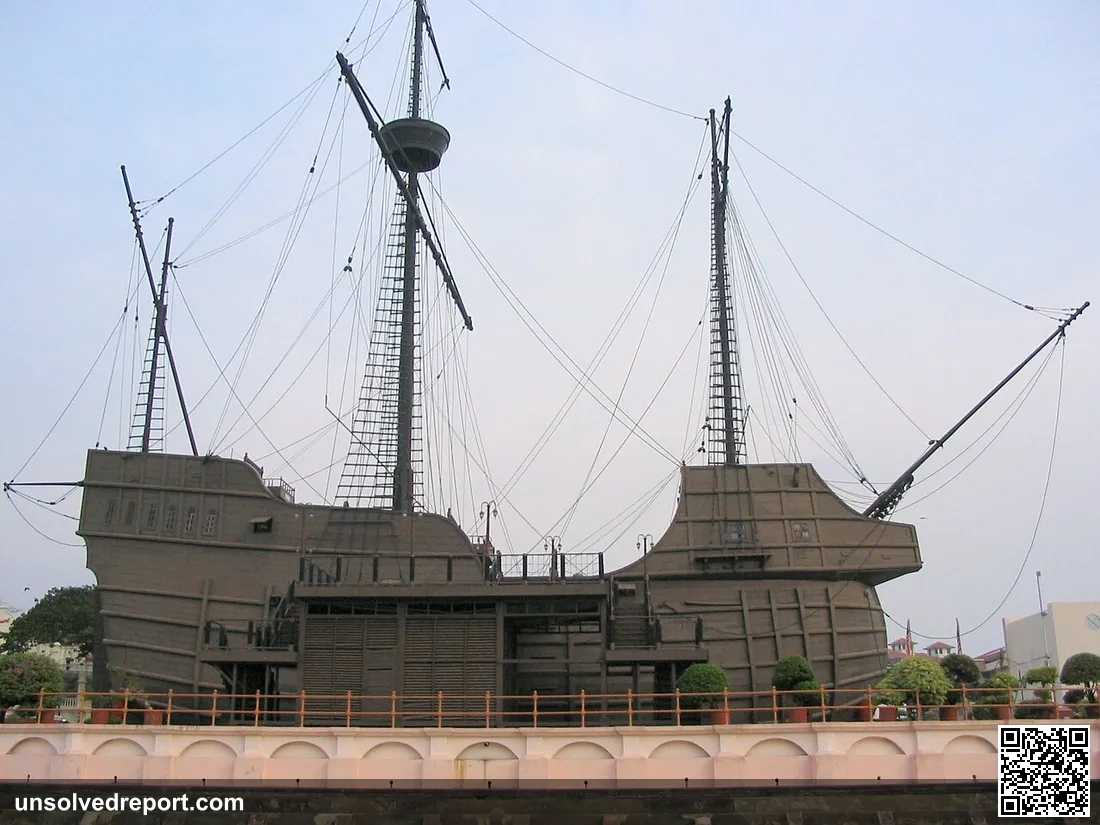
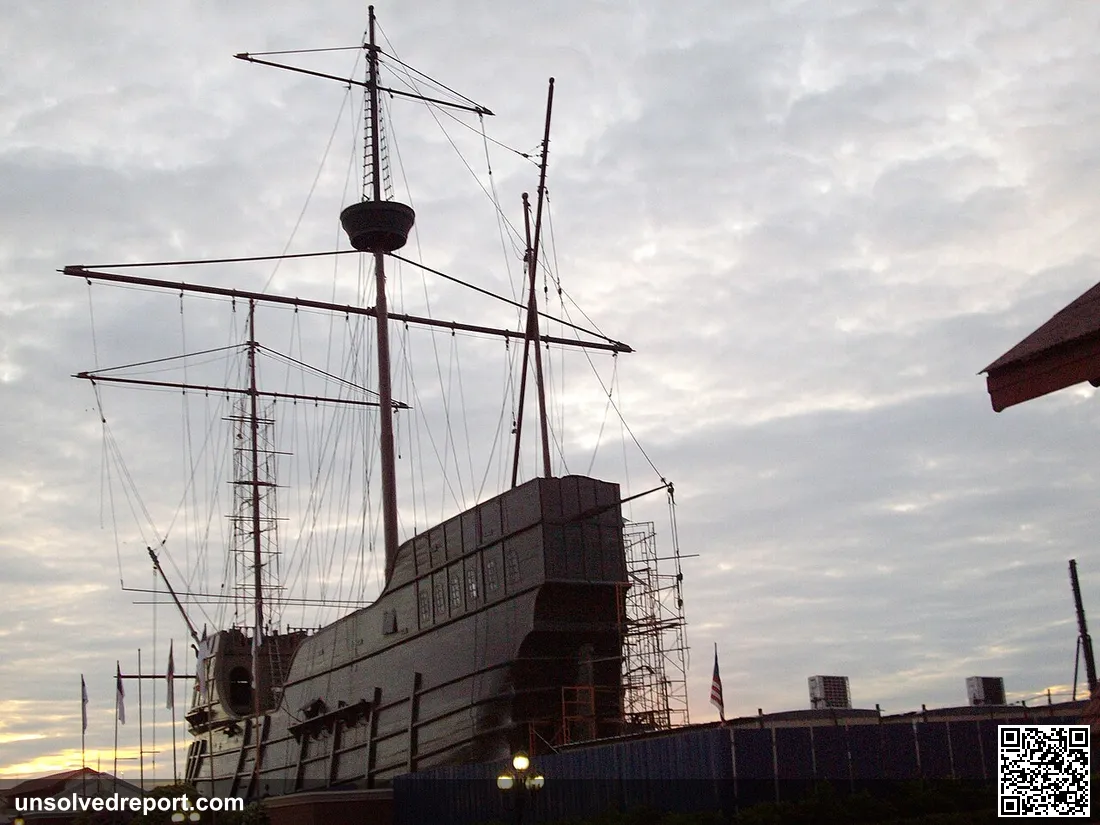
Start with the ship herself. The Flor de la Mar was a Portuguese nau, a carrack, built in Lisbon in 1502. At roughly 400 tons she was, for her moment, "the largest carrack yet built, nearly twice the size of the largest ships that had gone on previous runs" (Wikipedia, "Flor de la Mar"). Impressive on paper. A nightmare to sail.
She leaked. On her very first voyage home, loaded with spices, "her large size and weight made her hard to manoeuvre," her seams opened, and she had to lay up at Mozambique Island for nearly two months of repairs. That leaking followed her around for the rest of her life.
And yet she lasted. For nine years she served as a Portuguese warship in the Indian Ocean, and the records put her at the thick of it: the conquest of Socotra, the campaigns around Hormuz (Ormuz) and the Arabian coast, the Battle of Diu in 1509, the conquest of Goa in 1510, and finally the conquest of Malacca in 1511.
That last one is where the legend is born. Malacca sat on the Malay Peninsula, guarding the strait that funneled all the trade between China and India — control it, and you controlled the money. The Portuguese governor Afonso de Albuquerque, "conqueror of Goa (1510) in India and of Melaka (1511)," took the port in July 1511 (Britannica, "Afonso de Albuquerque"). Then he stripped the sultan's palace of its wealth and loaded all of it onto the Flor de la Mar to carry home to the Portuguese king.
Here's where it goes wrong. We know the next part from contemporary Portuguese chronicles — above all the Commentaries of the Great Afonso Dalboquerque, compiled by his son Brás de Albuquerque, and João de Barros's Décadas da Ásia. Sailing back along the Sumatran coast, the overladen, aging ship ran into a storm, struck shoals, and went down. Most accounts put the wreck on the night of 20 November 1511, off Timia Point in the Kingdom of Aru, near the northeastern Sumatran state of Pasé (Wikipedia; HeritageDaily). Albuquerque rode his raft to safety. More than 400 people aboard did not, and the cargo was, in the words of the record, "irretrievably lost."
Now the detail that makes the story ache. The chronicles tell us exactly how little came back. The Commentaries record that "nothing was saved except the crown and sword of gold and the ruby ring sent by the king of Siam" for King Manuel — and that Albuquerque grieved hardest over a bracelet he had hoped to show his king, and "some four (or six) bronze lions" he had meant for his own tomb. We have a firsthand list of what slipped through his fingers. That inventory of near-misses is half of why the wreck has loomed so large for so long.
The question nobody has answered
It comes down to this: where is the wreck, and is anything left down there to find?
The Flor de la Mar has never been conclusively located. And the place she sank is about the worst hunting ground imaginable — the Strait of Malacca runs strong currents, poor visibility, a shifting seabed, centuries of piled sediment, and some of the busiest shipping traffic on the planet (Discovery UK). Make it harder still: the old accounts give only a rough position, and they don't even agree on the basics. Some sources have the ship leaving Malacca in January 1512, not November 1511, which slides the whole search window. A vessel that shattered on shoals almost half a millennium ago could be smeared across a wide patch of seafloor and sunk deep in mud.
And then there's the awkward question hanging over everything: how much treasure was really aboard — and who would even own it? Salvage attempts keep crashing into the same wall, because "Portugal, Indonesia, and Malaysia all claim salvage rights," a tangle that has stalled expeditions before anyone could start digging in earnest. Until someone pulls up a verified piece of the Flor de la Mar and dates it, the wreck stays exactly what it has been since 1511: lost.
Where the record ends and the legend takes over
Everything below this line is speculation or contested claim. Past this point the documented record runs out, so read it as story, not fact.
The billion-dollar number
You'll see the cargo valued at "$2.6 billion" or more across countless articles. Don't trust it. Discovery UK's own write-up admits that "estimates of what was on board the Malacca treasure ship were likely exaggerated," and other historians note that "there are no reliable historical records detailing the exact contents of the cargo" (Discovery UK). The lurid shopping lists — "80 tons of gold," hundreds of chests of diamonds, solid-gold lions filled with perfume, a jeweled dining table — are legend stacked on top of a genuinely rich but undocumented haul. Treat those dollar figures as advertising for treasure hunts, not appraisals.
The 1992 "discovery"
In the early 1990s, American treasure hunter Robert "Bob" Marx announced he had found the wreck after just a few days of survey, reportedly pouring serious money into the effort. Then the project was shut down before any excavation could confirm it, and no recovered artifact ever backed the claim up. A 2010 expedition reportedly pulled a single silver coin from near Diamond Point, Sumatra — but that, too, was ruled inconclusive (Discovery UK). It's a familiar pattern in wreck-hunting — much like how Blackbeard's flagship turned up without his treasure — and to this day, no widely accepted, peer-reviewed identification of the wreck exists.
Scattered, buried, or quietly carried off?
Among researchers, three explanations compete, and not one is proven. The first: the ship broke up on the shoals and the currents scattered its contents across the seabed, so recovering it as a single "treasure" is effectively impossible. The second: sediment has simply swallowed whatever's left. The third is the quietest and maybe the most unsettling — that local people salvaged the reachable, non-perishable goods within years of the wreck, meaning the fabled hoard was picked clean centuries ago. There's no archaeological evidence to settle any of them.
Here's the one thing we can say without flinching, and it's the part that matters most: a real ship, carrying real plunder from the fall of Malacca, went down off Sumatra in the early 16th century, and it has shrugged off every attempt to find it since. The "Flower of the Sea" is the richest shipwreck never recovered — rivaling even the Atocha, whose richest cargo section is still unaccounted for — not because we know it holds billions, but because no one has ever been allowed to look inside. The sea is still keeping its receipt.
Sources & Further Reading
- Britannica — Afonso de Albuquerque
- Wikipedia — Flor de la Mar (citing the Commentaries of Afonso de Albuquerque and João de Barros's Décadas da Ásia)
- HeritageDaily — "Flor de la Mar: The lost treasure ship"
- Discovery UK — "What Happened to the Flor de la Mar Treasure Ship?"
Cuerdale Hoard: 88 Lbs of Viking Silver Nobody Ever Reclaimed
88 pounds of Viking silver, buried by a river in 905 AD and never dug up again. The largest hoard ever found — so who owned it, and what stopped them coming back?
Lohron Gold Trade: The Goldsmiths Nobody Remembers
Six-meter walls still stand empty in the Burkina Faso bush. The Lohron ran a gold fortune here, then vanished so fully their own neighbors can't name them. Why?
Belitung Shipwreck: A $32M Tang Hoard Inside an Arab Dhow
60,000 Tang treasures, one Arab dhow, no crew list. The Belitung shipwreck proved a lost Silk Road sea route — and no one agrees on the rest of the story.