Shigir Idol Mystery: The 12,500-Year-Old Face No One Can Read
The Shigir Idol mystery: gold miners pulled this 12,500-year-old wooden god from a Russian bog. It's covered in faces nobody can read. What is it hiding?
January 1890. Gold prospectors are digging through a cold peat bog about 100 kilometers from Yekaterinburg, in Russia's Middle Urals. They are hunting for gold. What they pull out of the muck instead is something far stranger — and it comes up in pieces. Blackened slabs of ancient wood. Human faces staring out of the grain. A web of carved lines crawling across every surface.
They had no idea what they were holding.
For more than a hundred years, the thing we now call the Shigir Idol sat quietly in a regional museum, a curiosity barely anyone outside Russia had heard of. Then scientists put it under radiocarbon dating, and the number that came back stopped everyone cold. This carved totem is older than Stonehenge. Older than the pyramids. Older than farming itself. And the message scratched all over its body? Nobody has ever been able to read it.
What We Actually Know
Start with the headline: the Shigir Idol is the oldest known monumental wooden sculpture on Earth. By rights, it should not exist at all. Wood rots. Bury it for twelve thousand years almost anywhere and it turns to nothing. But the Shigir bog is acidic, starved of oxygen, and hostile to the microbes that normally feast on dead wood — a natural deep-freeze that kept this thing intact while empires came and went above it (Smithsonian Magazine).
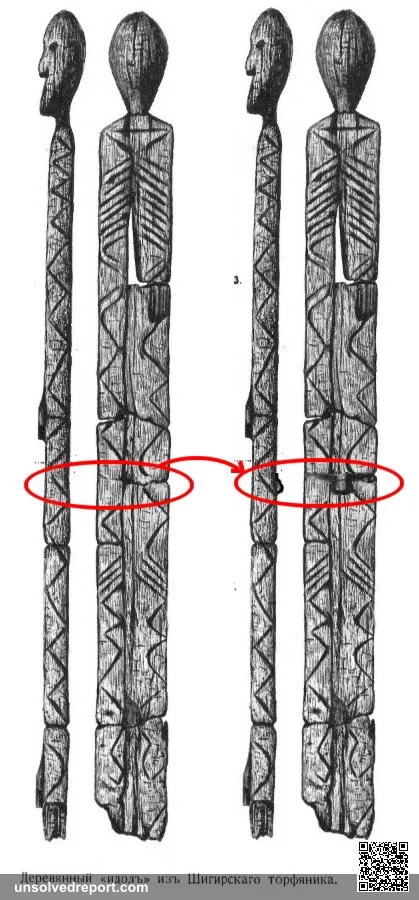
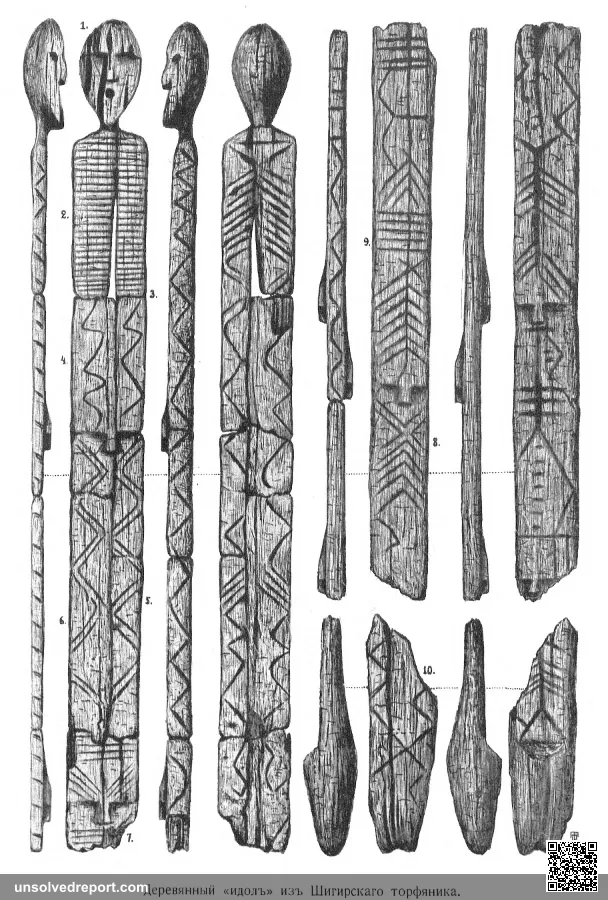
It was cut from a single trunk of larch. Count the tree's growth rings and the wood was at least 159 years old when it was felled (Wikipedia, citing the Antiquity study). Reassembled today, the idol stands about 2.8 meters — roughly 9 feet. But here's the unsettling part: it used to be much, much bigger. In 1914, archaeologist Vladimir Tolmachev sketched fragments that have since vanished, and his reconstruction suggests the complete figure once towered to about 5.3 meters — some 17 feet (Live Science). The lower section is gone. All we have left of it is a handful of old drawings.
Now look closer at the surface, because this is where it gets eerie. A flat, plank-like body, front and back, is carved deep with geometric ornament — endless zigzag lines — and studded along its length with human faces, stacked like a totem pole. And the faces keep multiplying. Every time researchers go back over that gnarled, weathered wood, they find another one. An animal-like face surfaced in 2003. In 2014, museum curator Svetlana Savchenko and Moscow archaeologist Mikhail Zhilin spotted yet another hidden face that everyone had missed — much like the second face hidden on Easter Island's Hoa Hakananai'a statue (Live Science). And the tools? Microscopic study of the cut marks shows the faces were carved last of all — using blades made from beaver lower jaws, incisor teeth still attached and sharpened to an edge (Wikipedia).
But the part that made the world sit up was the age. When Russian scientists first radiocarbon-dated the idol in the 1990s, they got roughly 9,500 years. A lot of researchers flatly refused to believe it. The idea that Ice Age hunter-gatherers in Siberia could carve art this complex felt impossible — the same disbelief that would later greet Göbekli Tepe, the stone temple hunter-gatherers raised millennia before farming existed — so the figure got waved away (Smithsonian Magazine). To settle the fight, an international team led by Thomas Terberger of the University of Göttingen drilled into the clean, untouched inner core of the wood — not the weathered, glue-treated outer skin — and ran accelerator mass spectrometry (AMS) dating on it. The verdict, published in the peer-reviewed journal Antiquity in 2018 and sharpened in Quaternary International, didn't just confirm the old date. It pushed it back further — to roughly 12,100 to 12,500 years, right at the end of the last Ice Age (ScienceAlert; Cambridge Core / Antiquity).
Today the idol stands in the Sverdlovsk Regional Museum of Local Lore in Yekaterinburg, with Savchenko still its curator.
The Question No One Can Answer
So what does it say?
Because make no mistake — this is not doodling. The faces are deliberate and each one is distinct. The geometric patterns repeat with a logic, the way real symbols do. Somebody meant this. It carried meaning for the people who carved it and for whoever stood before it twelve thousand years ago, when it likely rose straight and tall beside a bog, maybe visible from far across the land. Terberger and his colleagues call the carvings evidence of "complex symbolic behavior and of the spiritual world" of Late Glacial to Early Mesolithic hunter-gatherers (Smithsonian Magazine).
And yet.
The people who made it left no writing. No second object that acts like a key. No surviving tradition passed down through the ages to whisper what it all means. The hunter-gatherers of the post-Ice-Age Urals had no script at all. So the symbols might be a story. A map of the spirit world. A family line. A warning. A creation myth. All of those — or none of them. And remember that lost lower third? If any of this is a "text," a good chunk of it was destroyed sometime after 1914 and is never coming back. The honest answer, the one real scholars give, is that the meaning is genuinely unknown and may stay that way forever. We can read the chisel marks. We cannot read the message — no more than anyone has cracked the Indus Valley's own undeciphered script.
So What Were They Trying to Say?
Everything from here is informed guesswork, and the researchers themselves are careful to say so. These are possibilities, not solutions.
A creation myth — or a doorway between worlds. Curator Svetlana Savchenko has floated the idea that the faces might hide coded references to a creation myth, or mark the boundary between earth and sky (Smithsonian Magazine). She offers it as one believable reading — not a cracked code.
Guardians, ancestors, or something to fear. Other specialists wonder if the faces are forest spirits, mythological beings, or warnings about forbidden ground — figures meant to be recognized instantly by a community that all shared the same stories (Science / AAAS coverage). But these are echoes borrowed from much later cultures, not proof of what the carvers intended.
A way to make sense of a world coming apart. Terberger points out that the idol was made during a time of wild upheaval, as the Ice Age melted away beneath people's feet. That raises a haunting possibility — speculation, but a gripping one — that towering art like this helped people find their footing in a landscape transforming around them (ScienceAlert).
Here's what is not a guess, though — the lesson the Shigir Idol forces on all of us. As Terberger puts it: "hunter-gatherers had complex rituals and were capable of very sophisticated expression of ideas and art. These things didn't start with farmers, they began with hunter-gatherers much earlier" (ScienceAlert). The faces may keep their secret until the end of time. But the simple fact that someone carved them at all — twice as old as the pyramids, by people with no farms, no cities, and not a single written word — has already torn up everything we thought our ancestors could do. Which leaves you wondering what else is still down there in the bogs, waiting, with a face we haven't found yet.
Sources & Further Reading
- Smithsonian Magazine — "This Wooden Sculpture Is Twice as Old as Stonehenge and the Pyramids": https://www.smithsonianmag.com/smart-news/earliest-surviving-wood-sculpture-even-older-previously-thought-180977320/
- Antiquity (Cambridge University Press), Zhilin et al., "Early art in the Urals: new research on the wooden sculpture from Shigir": https://www.cambridge.org/core/journals/antiquity/article/early-art-in-the-urals-new-research-on-the-wooden-sculpture-from-shigir/1EE151AB1E571968B10267E48B78362A
- ScienceAlert — "The World's Oldest Known Wooden Statue Is Even Older Than We Thought": https://www.sciencealert.com/the-world-s-oldest-known-wooden-statue-is-even-older-than-we-thought
- Science / AAAS — "11,000-year-old statue unearthed in Siberia may reveal ancient views of taboos and demons": https://www.science.org/content/article/11000-year-old-statue-unearthed-siberia-may-reveal-ancient-views-taboos-and-demons
- Live Science — "Shigir Idol: World's oldest wood sculpture": https://www.livescience.com/archaeology/shigir-idol-worlds-oldest-wood-sculpture-has-mysterious-carved-faces-and-once-stood-17-feet-tall
- Wikipedia (overview and citations) — "Shigir Idol": https://en.wikipedia.org/wiki/Shigir_Idol
Newgrange: The Tomb That Catches the Sun Once a Year
Older than the pyramids, this Irish mound swallows one winter sunrise a year and aims it straight at the dead. Nobody left a note explaining how, or why.

Longyou Caves: China's 2,000-Year-Old Caverns Nobody Can Explain
In 1992, farmers pumped out a 'bottomless' pond and found a hand-carved underworld with zero written record. Who built it, and why does nobody know?

Antikythera Mechanism: The Greek Computer Nobody Can Explain
Divers pulled a corroded lump from a Roman shipwreck. Inside: the Antikythera Mechanism, a gear-driven computer 2,000 years too early. Who built it?