Tabby's Star Mystery: The 22% Dimming Nobody Can Fully Explain
Tabby's Star dimmed by 22% with no warning, and top astronomers wondered if aliens were behind it. Here's what the data really shows — and what's still unexplained.
2015. Somewhere in the constellation Cygnus, a single star started behaving like nothing else in the sky — and for a few electric months, more than one science writer called it "the most mysterious star in the universe" — the same breathless label once reserved for the Wow! signal. Its light flickered in ways no other star in NASA's entire Kepler dataset did. And one explanation, floated not by cranks but by serious astronomers, was wild enough to jump straight onto front pages around the world: maybe we were watching aliens build something gigantic around their sun.
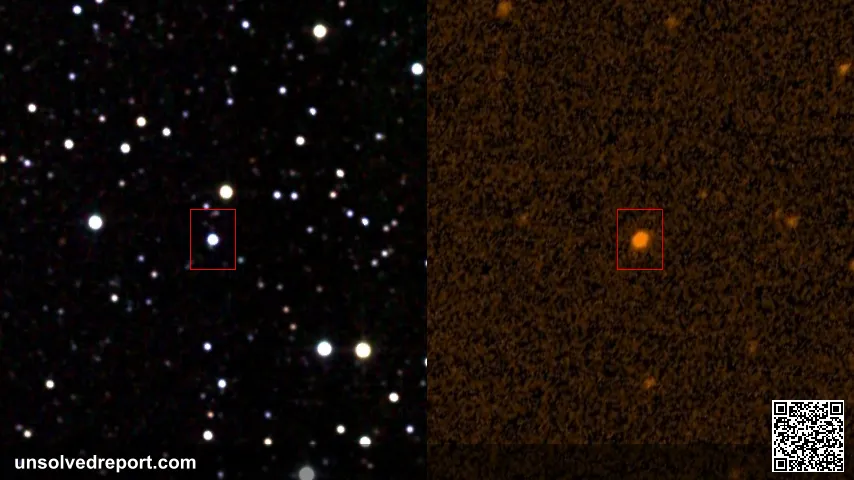
The star has a boring official name, KIC 8462852. Almost everybody calls it Tabby's Star, after the astronomer who led the team that announced it. So what is really going on out there, 1,470 light-years away? Here's what the data actually shows, what nobody can fully explain yet, and where that famous "megastructure" idea truly belongs.
What We Actually Know
Start with the star itself. Tabby's Star is an F-type main-sequence star — a little bigger and hotter than our Sun — sitting about 1,470 light-years away in Cygnus (Wikipedia; NASA/JPL). And here's the first surprise: it wasn't spotted by a lone professional hunched over a telescope. It was found by volunteers. The discovery came through the Planet Hunters project, where ordinary citizen scientists scanned Kepler light curves by eye, looking for the tiny dips in brightness that give away an orbiting planet (Wikipedia).
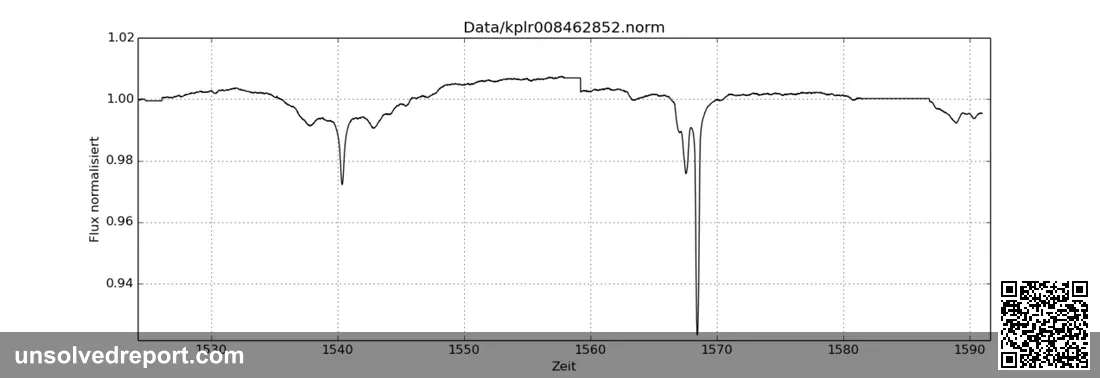
But what these volunteers stumbled onto was no neat, repeating planetary blink. It was a mess — a string of irregular dimming events with no rhythm and no consistent shape or depth, the same kind of pattern-defying behavior that would later put HD 139139 on astronomers' radar too. Two of them are jaw-dropping. In March 2011, the star's light plunged by roughly 15% (the dip nicknamed "D800"). Then in February 2013, it crashed by about 22% (the "D1500" event) (Wikipedia). Want some perspective? A Jupiter-sized planet sliding across a Sun-like star dims it by only about 1%. Something out there was swallowing up to a fifth of this star's light — and on no schedule anyone could find.
In September 2015, astronomer Tabetha S. Boyajian and her colleagues put out a paper laying the strangeness on the table, which is how the star picked up its nicknames "Boyajian's Star" and "Tabby's Star" (Wikipedia). Even the title was honest about the puzzle. They called it "Where's the Flux?" — because, frankly, nobody had a clean answer.
To get more data, Boyajian did something unusual: she asked the public for help. A 2016 Kickstarter campaign pulled in more than 1,700 backers and raised over $100,000 to buy dedicated monitoring time on the Las Cumbres Observatory's global telescope network (Penn State). The bet paid off. In May 2017, astronomers caught fresh dips unfolding in real time and gave them names with a little poetry to them: Elsie, Celeste, Skara Brae (after Scotland's ancient Neolithic village), and Angkor (after Cambodia's lost city) (Penn State).
Catching a dip live was the whole game. It let researchers measure the dimming in several colors of light at once — and that's where the case cracked open. The result, published in The Astrophysical Journal Letters in January 2018, settled one big question. As Boyajian put it, "different colors of light are being blocked at different intensities. Therefore, whatever is passing between us and the star is not opaque" (Penn State). Think about what that means. A solid object — a planet, or a giant manufactured panel — would block every color equally. This stuff didn't. It dimmed ultraviolet harder and infrared softer, the unmistakable fingerprint of fine dust (NASA/JPL).
An earlier 2017 study had already pointed the same way, using NASA's Spitzer and Swift telescopes and led by Huan Meng of the University of Arizona. The blocking particles looked to be no more than a few micrometers across — circumstellar dust. "This pretty much rules out the alien megastructure theory, as that could not explain the wavelength-dependent dimming," Meng said (NASA/JPL).
So... Case Closed? Not Quite
Here's the part that the triumphant "mystery solved" headlines tend to bury: ruling out a megastructure is not the same as explaining the star. Even in recent reviews, no single hypothesis accounts for every feature of Tabby's Star's behavior (Wikipedia).
Dust tells us why the light dims unevenly across colors. But it opens fresh questions. Where is all this dust coming from — and why this star in particular? Dust clouds don't just hang around; they tend to spiral inward and vanish. To keep dimming a star for years, you need a steady source feeding the cloud. And there's a second, much-argued thread: a possible slow fade over a century. In 2016, astronomer Bradley Schaefer dug through century-old photographic plates and claimed the star had quietly dimmed by roughly 14% between 1890 and 1989 (Wikipedia). Not so fast, said Michael Hippke and others — that apparent fade, they argued, is mostly a trick of how those ancient plates were calibrated, not a real change in the star (Wikipedia). That fight over the historical brightness still isn't settled.
So the honest scoreboard reads in layers. The sudden dips? Very likely passing dust. The megastructure? Effectively off the table. But the full origin story — and whether there's any slow, century-scale fade at all — is still an open problem in astrophysics.
The Theories, Laid Out Plainly
The frontrunner — circumstellar dust. The best-supported reading of the data is the simplest: clumpy dust orbiting the star drifts between us and it, blocking different wavelengths by different amounts (NASA/JPL; Penn State). It fits what we see. It just doesn't tell us where the dust ultimately comes from.
A tantalizing source — a dying exomoon. In 2019, Columbia University physicists Brian Metzger, Miguel Martinez, and Nicholas Stone offered an eerie possibility: a moon ripped from its planet, dragged toward the star, and now slowly boiling away — shedding ice, gas, and carbon-rich dust into an orbiting disk (Columbia University; phys.org). It's an elegant way to keep the dust supply topped up, like a slowly melting ice cube feeding the cloud. But it's still a model waiting for proof. Other versions of the dust-supply idea lean on swarms of exocomets instead.
The legend — an alien "megastructure." This is the idea that made the star famous, so it deserves the real story, not the clickbait version. Astronomer Jason T. Wright and colleagues pointed out that the dips were consistent with the silhouette of a hypothetical Dyson swarm — a fleet of energy-harvesting structures built by an advanced civilization — and said it was worth a serious look (Wikipedia). And here's the crucial bit: they offered it as a hypothesis to test and probably knock down, not as an answer. So the tests came. The SETI Institute aimed the Allen Telescope Array at the star in October 2015 and, after two weeks of listening, found "no evidence of technology-related radio signals." The Breakthrough Listen project watched it too (Wikipedia). Add the wavelength-dependent dimming on top of the silence, and the megastructure idea is now considered scientifically implausible — which is exactly what the scientific method is built to do.
The real lesson of Tabby's Star was never that aliens were likely. It's that a genuinely bizarre signal — spotted by volunteers, funded by strangers on the internet, and chased down by professionals — was followed wherever the evidence pointed, even when the evidence led somewhere disappointing. The flashiest explanation got named, tested, and set aside. And the quieter, dustier truth turned out to be strange enough on its own. The best part? Out there in Cygnus, the case still isn't closed.
Sources & Further Reading
- NASA/JPL: "Mysterious Dimming of Tabby's Star May Be Caused by Dust"
- Penn State University: "Alien megastructure not cause behind 'most mysterious star in the universe'"
- Columbia University: "Tabby's Star: Exomoon's Slow Annihilation Could Explain the Dimming"
- phys.org: "New observations help explain the dimming of Tabby's Star"
- Wikipedia (with primary-source citations): "Tabby's Star"
![Hereford Arizona Observatory photometry observations of KIC 8462852 between 2 May and 4 October 2017.[1] KIC8462852 Her…](/media/img/tabbys-star-mystery-dimming-alien-megastructure-0.webp)

Bob Lazar Area 51: 37 Years, One Story, Zero Proof — Why?
Bob Lazar named element 115 in 1989, before it existed. In 2025 Congress heard his story again. In 2026 a new documentary dropped. Still no proof. Why?

Majestic-12: The Secret Alien Files That the FBI Stamped 'BOGUS'
A mystery film roll, twelve secret names, an FBI file stamped BOGUS — and a 2026 claim it's all real. Cover-up or the greatest hoax in UFO history?

Travis Walton at 50: Five Missing Days, Two Opposite Lie Tests
50 years after the Travis Walton abduction, six loggers still stand by their story — five passed polygraphs, Walton failed one. What actually happened?