SETI at 65: One Unexplained Signal, Six Decades of Silence
65 years of SETI: Project Ozma, the Big Ear, a signal that got stronger on reanalysis, and why the silence itself is the strangest data point of all.
Not one signal from another civilization has ever been confirmed in 65 years of listening. Yet one signal still refuses to be dismissed — and in 2025, volunteers who dug through 75,000 pages of decades-old printouts found it was even stronger than anyone had recorded at the time. The Wow! signal's frequency and flux density have just been revised upward, reopening a mystery that has sat unsolved since 1977. Here is what SETI has actually documented, what the newest data changed, and what is still — honestly — unknown.
> ## The 60-Second Brief
> - 1960: Frank Drake's Project Ozma listens to two stars ~11 light-years away for ~150 hours near 1420 MHz — hears only a passing aircraft.
> - August 15, 1977: Ohio State's Big Ear telescope records the Wow! signal (6EQUJ5), about 30x background noise, lasting the full 72-second observation window.
> - 1984: The SETI Institute is founded on November 20, run by Thomas Pierson and Jill Tarter.
> - 2015: Breakthrough Listen launches — a 10-year, $100 million scan of a million nearby stars.
> - 2025: A reanalysis of 75,000+ pages of original Ohio SETI data revises the Wow! signal's flux density up to 250 Janskys (previous estimates: 54–212) and its frequency to 1420.726 MHz.
> - 65 years of searching, zero confirmed alien signals — the "Great Silence" remains unbroken.
The Documented Facts
The dawn experiment was called Project Ozma, and it really happened. In 1960, Frank Drake aimed the radio telescope at the National Radio Astronomy Observatory in Green Bank, West Virginia, at two sun-like stars about 11 light-years away — Tau Ceti and Epsilon Eridani. He listened near 1420 MHz, the natural frequency of hydrogen gas, betting that any smart civilization would know that number too and might use it like a cosmic phone line. Over roughly 150 hours, he heard nothing but a passing aircraft (HISTORY).
A year later, in November 1961, Drake gathered a tiny group of scientists — including a 27-year-old Carl Sagan — at Green Bank to ask a bigger question: how many alien civilizations could be out there? On the chalkboard he wrote what we now call the Drake Equation, a chain of seven factors (how many stars form, how many have planets, how many planets host life, and so on) that you multiply together to estimate the number of detectable civilizations in our galaxy (SETI Institute). It didn't give an answer. It gave the search a roadmap.
Then came the moment SETI fans still argue about. On August 15, 1977, Ohio State University's "Big Ear" radio telescope swept across the constellation Sagittarius. Days later, astronomer Jerry Ehman was flipping through the computer printout when one column of numbers stopped him cold: 6EQUJ5. The signal was narrow, powerful — about thirty times stronger than the background hum — and it sat right near that same magic hydrogen frequency. It lasted the full 72-second window the telescope could watch, then vanished. Ehman circled it in red pen and scrawled one word in the margin: "Wow!" (Wikipedia).
The Wow! signal has never been heard again, despite dozens of attempts to find it (Scientific American).
The search, meanwhile, grew up. The SETI Institute was founded on November 20, 1984, by Thomas Pierson and astronomer Jill Tarter (SETI Institute). When the U.S. Congress cut off NASA's SETI funding in 1993, the work didn't die — it went private, bankrolled by tech billionaires like Microsoft's Paul Allen, whose name is on the Allen Telescope Array in California (Electronic Design). In 2015, investors Yuri and Julia Milner launched Breakthrough Listen, a 10-year, $100 million program to scan a million nearby stars — the biggest alien hunt ever attempted (Universe Today).
The Genuine Open Question
So here is what we honestly know after 65 years of listening: nothing has been confirmed.
Not one signal has ever been verified as a message from another civilization. The sky, as far as our instruments can tell, is quiet. Scientists call this unsettling silence part of the "Great Silence" — the same puzzle behind the Fermi Paradox: if the galaxy is full of life, where is everybody?
And the Wow! signal sits right in the middle of that silence like a splinter. It had almost every quality SETI scientists said an alien beacon should have. It came from deep space, not a satellite. It was narrow and strong. But it never repeated. A real beacon, the thinking goes, should blink again. A one-time blast is exactly the kind of thing that's almost impossible to prove or rule out.
That's the genuine open question. Was the Wow! signal a fluke of nature, a piece of human technology bouncing back at us, or — just maybe — the only time we've ever caught someone calling? Because it never returned, we may never know for certain.
Theories and Interpretations
Here's where careful science separates from campfire stories. Everything below is interpretation, not settled fact.
The natural-event explanation (the current front-runner). In August 2024, a team led by Abel Méndez of the Planetary Habitability Laboratory at the University of Puerto Rico suggested the Wow! signal was made by nature, not aliens. The idea: a burst of energy from a magnetar — a wildly magnetic dead star — slammed into a cold cloud of hydrogen gas and made it suddenly blaze at radio wavelengths, like a cosmic light bulb flicking on. While digging through old Arecibo Observatory data, the team even found eight similar (weaker) signals near the same frequency (Scientific American). Important catch: this is a preprint, not yet peer-reviewed, and other experts pushed back — one called the timing "a bit contrived" (Space.com).
The comet idea (mostly discredited). Back in 2017, researcher Antonio Paris argued two passing comets spewed hydrogen that the telescope picked up. Most astronomers rejected it: the comets weren't in the right spot at the right time, and they don't glow brightly at that frequency anyway (Wikipedia).
Earthly interference. Some scientists think the simplest answer is the most boring one — a stray bit of human-made radio signal, reflected or scrambled, that fooled the telescope. Plausible, but no one has pinned down the exact source, and the newest reanalysis (below) makes a terrestrial origin look less likely, not more.
The alien hypothesis (unproven, and treated that way by scientists). This is the version that launched a thousand internet threads: a genuine "hello" from an extraterrestrial civilization. It's a thrilling thought, and it's not impossible — but it remains completely unproven. There is no evidence the Wow! signal was alien-made, and no serious researcher claims otherwise. Anyone telling you it was a confirmed alien message, a government cover-up, or proof of UFO contact is selling speculation as fact. The honest scientific position is: we don't know.
SETI Timeline: Six Milestones in the Listening
The modern search has a paper trail. Here are the dated turning points established above, each tied to the source that documents it.
| Date | Event | Source |
|---|---|---|
| 1960 | Frank Drake runs Project Ozma at Green Bank, WV — aiming an 85-foot dish at Tau Ceti and Epsilon Eridani (~11 light-years away) near 1420 MHz for ~150 hours; hears only a passing aircraft | HISTORY |
| November 1961 | Drake convenes a small Green Bank meeting (including a 27-year-old Carl Sagan) and writes the seven-factor Drake Equation | SETI Institute |
| August 15, 1977 | Ohio State's "Big Ear" telescope records the Wow! signal (6EQUJ5) from the direction of Sagittarius | Wikipedia |
| November 20, 1984 | SETI Institute founded by Thomas Pierson and Jill Tarter | SETI Institute |
| 1993 | U.S. Congress cuts NASA's SETI funding; the search continues privately (later, Paul Allen funds the Allen Telescope Array) | Electronic Design |
| 2015 | Yuri and Julia Milner launch Breakthrough Listen — a 10-year, $100 million scan of a million nearby stars | Universe Today |
Weighing the Wow!: What Each Explanation Can and Can't Account For
The Wow! signal's stubbornness is precisely that no single explanation closes every gap. Here is where each of the four interpretations discussed above actually stands — strictly on the evidence already laid out, not on new claims.
| Explanation | Evidentiary status | The unresolved weakness |
|---|---|---|
| Magnetar + cold hydrogen cloud (Méndez team, Aug 2024) | Current front-runner; team found eight similar weaker signals near the same frequency in old Arecibo data | Still a preprint, not peer-reviewed; a critic called the required timing "a bit contrived" |
| Comets 266P/335P (Paris, 2017) | Mostly discredited | Comets weren't in the right place at the right time and don't glow brightly at that frequency; dismissed by most astronomers |
| Earthly interference | Plausible by simplicity | No one has ever pinned down an actual terrestrial source; the 2025 reanalysis found the signal even stronger, cutting against a stray man-made origin |
| Extraterrestrial beacon | Completely unproven; not claimed by any serious researcher | Fits the "narrow, strong, near 1420 MHz, from deep space" profile — but a real beacon should repeat, and this one never returned in dozens of follow-ups |
The single fact that indicts every theory equally: the signal lasted the full 72-second window Big Ear could watch, then vanished and has not been heard since — leaving each explanation something it can neither fully prove nor fully rule out.
The 2025 Update: The Signal Was Stronger Than Anyone Recorded
Nearly five decades after Jerry Ehman circled 6EQUJ5 in red pen, the Wow! signal changed shape again — not because a new signal arrived, but because the old data got a second look. Volunteers working with Abel Méndez's Arecibo Wow! project, which launched in 2024 to digitize and safeguard the Ohio SETI Program's surviving records, ran optical character recognition across more than 75,000 pages of original Big Ear printouts. Their 2025 preprint, "Arecibo Wow! II: Revised Properties of the Wow! Signal from Archival Ohio SETI Data," recalculated the signal's peak flux density at 250 Janskys — notably higher than the 54–212 Jansky range estimated at the time — and revised its frequency to 1420.726 MHz, a shift from the originally logged 1420.4556 MHz (Phys.org).
None of this identifies a source. It does not turn the magnetar theory into proven fact, and it does not make the signal alien. What it does is confirm the Wow! signal was a more powerful, more precisely located event than the original 1977 printout suggested — which matters for any future attempt to explain, or rule out, what Big Ear actually caught that night. This development is directly about the Wow! signal itself, not merely thematically related to it.
Frequently Asked Questions
Was the Wow! signal ever detected again?
No. Despite dozens of follow-up observations using various telescopes over the decades, including targeted searches by Big Ear itself before it closed, the exact signal has never repeated (Scientific American).
What does "6EQUJ5" actually mean?
It's a shorthand printout of the signal's intensity over time, where the Big Ear telescope's computer used numbers 0–9 and then letters A onward for intensities above 9 (so "U" represents an intensity of 30). The sequence traces the signal rising and falling as Earth's rotation swept the telescope's fixed beam across the sky (Wikipedia).
Is the magnetar theory now considered proven?
No. As of the Méndez team's 2024 preprint, the hydrogen-cloud-maser explanation is the leading natural hypothesis, but it has not been peer-reviewed, and at least one outside researcher has publicly questioned whether the proposed timing is too convenient (Space.com).
Why did NASA stop funding SETI?
In 1993, the U.S. Congress eliminated NASA's SETI budget as part of a broader spending cut, ending federal funding for the search. Private funding — most notably from Microsoft co-founder Paul Allen — kept the work going, eventually building the Allen Telescope Array in California (Electronic Design).
What is Breakthrough Listen, and is it still running?
Breakthrough Listen is a privately funded search program launched in 2015 by investors Yuri and Julia Milner, committing $100 million over 10 years to scan a million nearby stars for technosignatures — the largest coordinated SETI effort ever mounted (Universe Today).
Does the Drake Equation prove aliens exist?
No. The Drake Equation, written by Frank Drake in November 1961, is a framework for estimating how many detectable civilizations might exist in the galaxy — it multiplies factors like star formation rate and the odds of life arising, several of which remain unknown. It's a way to organize the question, not an answer to it (SETI Institute).
Sixty-five years of listening, and the universe has handed us exactly one "Wow!" — a single shout in the dark that, even freshly re-measured as stronger than first recorded, still won't shout back. But the Wow! signal isn't the only message from the void that scientists still can't fully explain. Some of the strangest came not from the stars, but from a radio dish right here on Earth, picking up fast radio bursts that lasted a thousandth of a second and seemed to come from nowhere at all...
Sources & Further Reading
- HISTORY — Project Ozma launches
- SETI Institute — The Drake Equation
- Wikipedia — Wow! signal
- Scientific American — The Wow! Signal Mystery Might at Last Be Solved
- Space.com — Where the Wow! signal probably came from
- SETI Institute — Founded by Jill Tarter and Tom Pierson
- Universe Today — A Brief-ish History of SETI
- Phys.org — The 'Wow!' signal gets an update: It was even stronger than we thought (2025)

Varginha UFO Incident: The Red-Eyed Alien Nobody Can Explain
The Varginha UFO incident: a red-eyed alien, a dead soldier, zero physical evidence in 30 years. So what did three terrified girls actually see?

1952 Washington DC UFO Incident: 3 Radars, 1 Lost Tape, 74 Years
3 radars tracked it, jets chased it, and in 2026 a lawmaker says MIT has a tape of the Air Force briefing that followed. What the 1952 DC UFO case still can't explain.
Shag Harbour UFO 1967: The Object the Navy Never Found
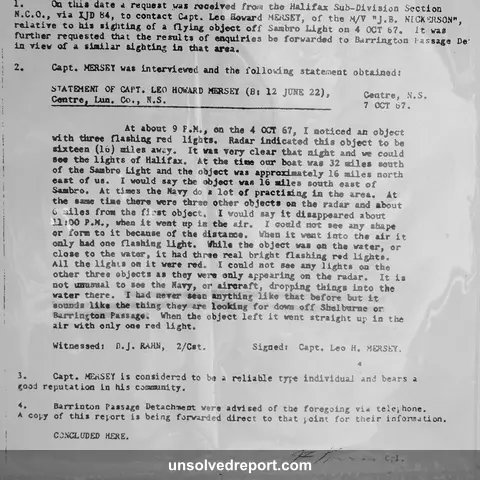
In 1967 at Shag Harbour, three police officers watched a UFO sink into the Atlantic. Navy divers searched for days. So where did it go?