Tartaria Tablets: Older Than the First Writing?
Tartaria tablets: three clay pieces from 1961 Romania may predate Sumerian writing entirely. So why, after 60+ years, can no one prove what the marks say?
Autumn, 1961. A quiet village in Transylvania. Out of the dirt come three lumps of clay, each barely bigger than a cookie—and they crack open one of the neatest stories we tell about ourselves: that writing was born in Sumer.
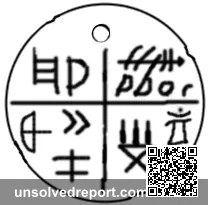
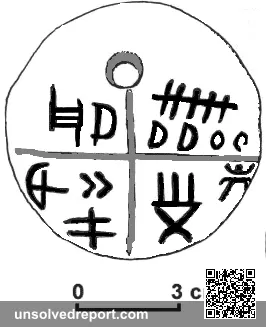
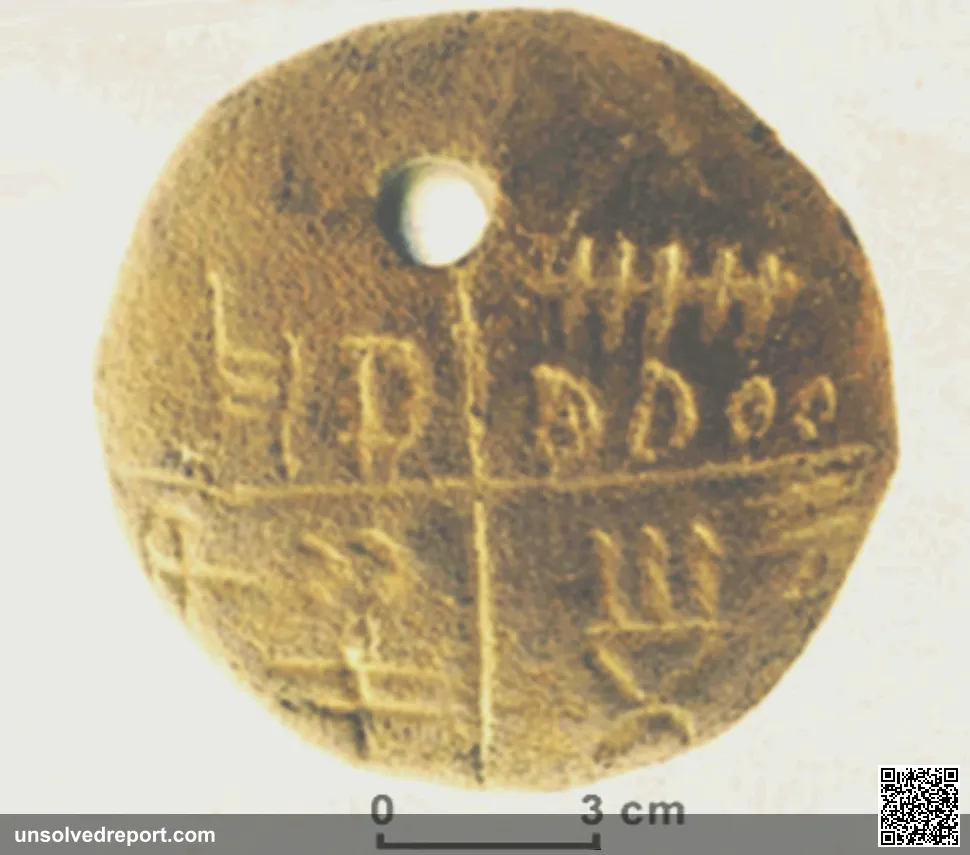
The tablets came from Tartaria, Romania. Two are rectangular. One is round. Several have little holes punched through them, as if someone once wore them on a string. And cut into their surfaces are marks. Strange marks. Marks that have kept people arguing for more than sixty years—because if they say what a handful of scholars suspect they might say, then the first scratch of human writing wasn't pressed into Mesopotamian mud at all. It was made here, in the valley of the Danube.
This is a real puzzle, and it deserves a careful telling. So let's pull it apart slowly: what we actually know, what nobody knows yet, and what is flat-out legend.
What We Actually Know
Start with the dig. The tablets came up at a Neolithic settlement near the village of Tartaria, in Salistea commune, about 30 km from Alba Iulia, during excavations tied to archaeologist Nicolae Vlassa of the National Museum of Transylvanian History in Cluj-Napoca (Wikipedia, "Tărtăria tablets"; Ancient Origins). The three unfired clay tablets didn't come up alone. In the same ground lay 26 clay and stone figurines, a shell bracelet, and the broken, burnt bones of an adult woman—a find that picked up the nickname "Milady Tartaria" (Wikipedia).
The marks are not a rumor. They're right there, cut into the clay. People have described a horned animal, a blurry figure, a leafy or branch-like shape, and a scatter of mostly abstract signs (Ancient Origins). And these signs aren't unique to three little tablets. They belong to a sprawling family called the Vinca symbols, named for the Vinca culture of southeastern Europe, first spotted back in the late 19th century when Zsófia Torma was digging at the nearby site of Turdas (Wikipedia). Hundreds of objects carrying these marks have turned up across what is now western Romania, Serbia, Bulgaria, and Hungary.
Now here's the catch—the one fact that hangs over everything else. You cannot carbon-date these tablets. Not directly. After they came out of the ground, conservation staff at the Cluj museum baked the soft clay to harden it so it wouldn't crumble. A reasonable thing to do to save a fragile object—except the baking burned away the very organic material that direct carbon dating needs (Ancient Origins; Science News Today). So any age we give them has to be guessed from the stuff buried beside them and the layer their pit was dug into—the same kind of indirect, hotly disputed dating fight that dogs sites like Gunung Padang. The clock was wiped clean.
The Question Nobody Can Close
Two questions are still wide open, and the honest scholars on both sides admit it.
First: how old are they really? If the tablets belong to the Vinca-culture layer their excavator assigned them to, then indirect radiocarbon evidence from the site has been read by some researchers as pointing to roughly 5300 BC—which would land them before the earliest Mesopotamian pictographic proto-writing (Wikipedia). That one inference is the whole foundation of the famous "older than Sumer" headline.
But it's a shaky foundation. Vlassa reportedly wasn't even standing there at the moment of discovery, and he never published a clear account of how or where the tablets came out of the ground (Ancient Origins; Wikipedia). Worse, some specialists argue the burial pit was intrusive—dug down from a later, higher layer—which would make the tablets a good deal younger than the Neolithic floor around them (Wikipedia). A detailed reassessment by Marco Merlini and Gheorghe Lazarovici lays out every weak point in a row: nobody's sure how the tablets were found, the radiocarbon claims are disputed, where the tablets sat inside the pit is unclear, and where the pit itself sat is unclear too (Merlini & Lazarovici, "Settling discovery circumstances, dating and utilization of the Tărtăria tablets"). Loose thread after loose thread.
Second, and this is the deeper one: are the marks even writing? Here's where the real mystery lives. The Vinca signs are undeciphered—much like the Indus Valley script—and after more than half a century, nobody has produced a decipherment anyone else can reproduce (Wikipedia). True writing, most linguists say, encodes language; it can hand a specific message to a reader with no one there to explain it out loud. Maybe the Tartaria marks do that. Or maybe they're something else entirely—ownership marks, religious or clan emblems, decoration, or a kind of symbolic "pre-writing" that never quite tipped over into full script.
Theories, From Careful to Wild
The "Old European Script" idea. (A minority view among scholars.) The late archaeologist Marija Gimbutas argued the Vinca marks add up to an "Old European Script," part of her bigger picture of a peaceful, goddess-centered "Old Europe." She floated them as either a writing system or, more cautiously, a kind of symbolic pre-writing (Wikipedia; Science News Today). Others picked up the thread: Shan M. M. Winn, who cataloged the sign system in Pre-writing in Southeastern Europe, and later Marco Merlini and Harald Haarmann working under the banner of the "Danube Script" (Wikipedia). Notice the word, though. Even the sympathetic scholars tend to say "pre-writing" more often than "writing."
The skeptics—who happen to be the mainstream. (The majority position.) Most archaeologists just aren't sold. Colin Renfrew said it bluntly: calling these Balkan signs "writing" would mean they could carry meaning to another person with no spoken contact at all, "and this I doubt" (Wikipedia). The skeptics point out that Neolithic Europe had no cities, no states, none of the administrative headaches that pushed Sumer into inventing cuneiform—and no independent sign of literacy anywhere in the region (Wikipedia). On their reading, the marks mean something. They're just not a language written down.
The forgery whisper. (An allegation, not a proven fact.) A separate strand of speculation questions whether the tablets are even genuine, noting that a few signs look a lot like Sumerian symbols printed in popular Romanian books floating around in 1961 (Wikipedia). That's a claim, not a demonstrated case—other scholars defend the find, and the argument echoes Romania's own Sinaia lead plates forgery mystery. So treat it as one hypothesis on the table, not a verdict.
The "lost civilization" leap. (Legend, not scholarship.) Plenty of websites stretch these tablets into proof of a forgotten, advanced civilization that "rewrites history." There's no evidence for that, and we only bring it up to push it firmly to one side.
So where does all this leave you? With something better than a tidy answer: a genuine, unsolved question. We know the tablets are real. We know where they were found and what they look like. We do not know exactly how old they are, and we do not know whether the person who made them was writing or just marking. Maybe the cradle of writing is still Sumer. Or maybe the first sentence in human history was pressed into Danube clay thousands of years ago—and sat there in the dark, waiting for a reader who never came, not unlike the Voynich manuscript, still waiting for someone who can crack it.
Sources & further reading
- Wikipedia, "Tărtăria tablets" — https://en.wikipedia.org/wiki/T%C4%83rt%C4%83ria_tablets
- Ancient Origins, "Do the Tartaria Tablets contain evidence of earliest known writing system?" — https://www.ancient-origins.net/ancient-places-europe/do-tartaria-tablets-contain-evidence-earliest-known-writing-system-002103
- Science News Today, "The Tărtăria Tablets of Romania" — https://www.sciencenewstoday.org/the-tartaria-tablets-of-romania
- Marco Merlini & Gheorghe Lazarovici, "Settling discovery circumstances, dating and utilization of the Tărtăria tablets" (academia.edu) — https://www.academia.edu/53490286/Settling_discovery_circumstances_dating_and_utilization_of_the_T%C4%83rt%C4%83ria_tablets
- Shan M. M. Winn, Pre-writing in Southeastern Europe: the sign system of the Vinča culture (referenced via Wikipedia)
Lake Michigan's Underwater Stonehenge: The Mastodon Stone Nobody Can Explain
A diver hunting shipwrecks in Lake Michigan found a mile of stones — and one boulder carved like a mastodon. Genuine monument or a trick of the ice? Nobody's proven it either way.
Carnac Stones: 3,000 Megaliths That Beat Stonehenge
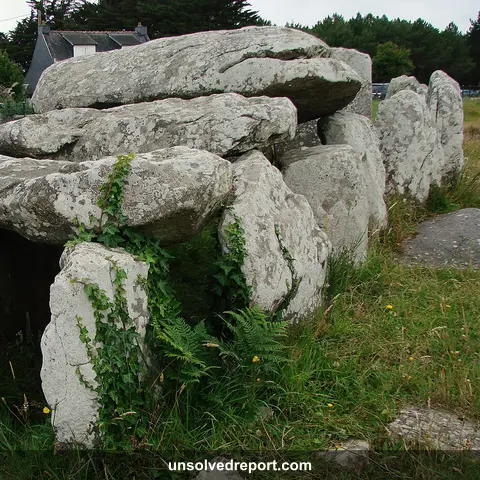
Over 3,000 megaliths line up across Brittany, older than Stonehenge by 1,000 years. A 2025 dig finally dated them - so why does no one know what they were for?
Roman Dodecahedron: 200 Years, Still No One Can Explain It
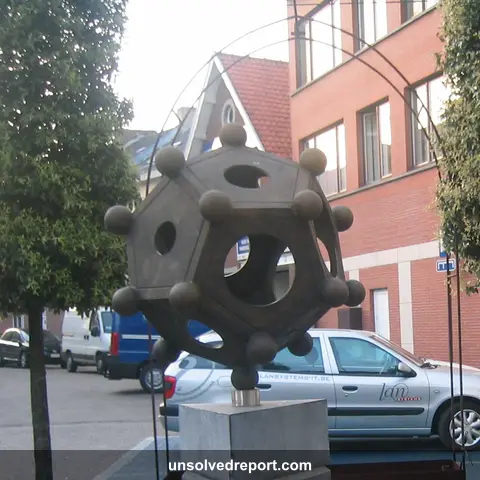
More than 130 Roman dodecahedra have been dug up across Europe. No Roman text ever mentions them. After 200 years, historians still can't agree why.