Gunung Padang Dating Controversy: The Pyramid Claim That Got Retracted
27,000 years old, or 2,000? A retracted paper, a buried hill in West Java, and a number that split archaeology in two. Here's what the evidence actually shows.
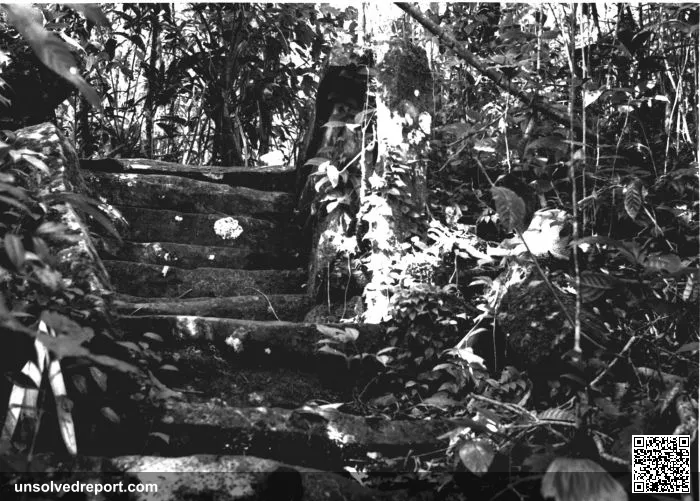
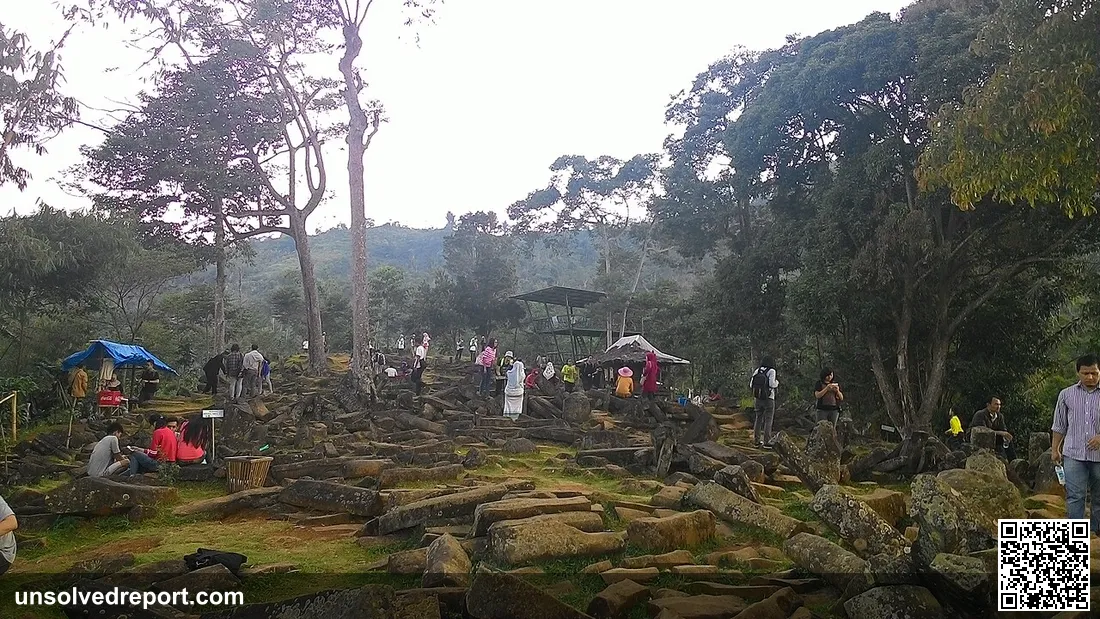
Climb a forested ridge in West Java and you arrive at a flight of worn stone steps. They lead up to a summit crowded with thousands of gray, pillar-shaped rocks, stacked and tumbled like a giant's discarded toys. The place is called Gunung Padang. Almost everyone who has stood there agrees on two things: it is old, and it is real. But ask a simple question — how old? — and the agreement falls apart. One peer-reviewed paper answered with a number that stopped the world: 27,000 years. If true, that would make this hill the oldest monument human hands have ever built. Then the paper was retracted. The terraces you can see and the layers you can't have become the stage for one of archaeology's loudest recent fights.
What We Actually Know
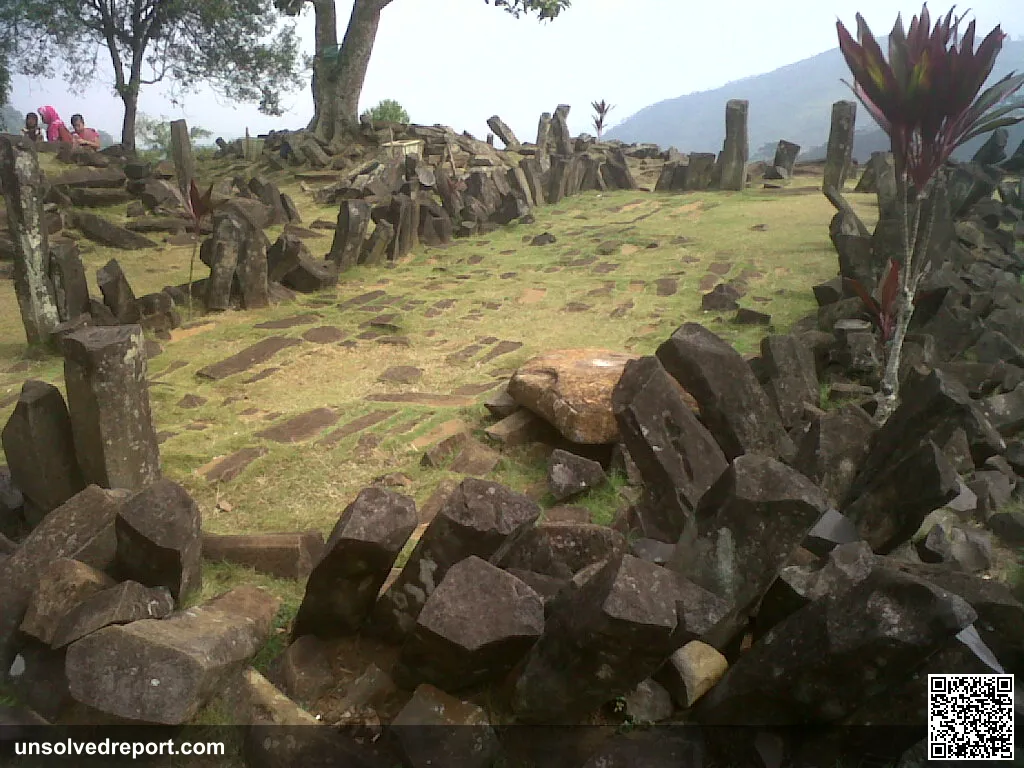
Start with the things nobody disputes. Gunung Padang sits in Karyamukti village, roughly 50 kilometers (31 miles) southwest of Cianjur, West Java, perched about 885 meters (2,904 feet) above sea level (Wikipedia; Archaeology Magazine). It crowns the top of an extinct volcano. Five artificial terraces step up the slope, each rimmed by stone retaining walls, all of it reached by a long, steep staircase of andesite (Archaeology Magazine).
Now look closely at the stones, because here's the strange and beautiful part. They are hundreds of prismatic, roughly hexagonal andesite columns, each one to three meters long. Nobody quarried them. Nobody carved them. They are columnar joints — igneous rock that splits itself into clean pillar shapes as lava cools, the same eerie process that built the Giant's Causeway in Northern Ireland (Archaeology Magazine). The builders of Gunung Padang didn't shape these columns. They found them, gathered them, and stacked them into terraces.
People have known about this place for a long time. It was recorded early in the colonial era, and the Dutch archaeologist N. J. Krom studied it back in 1914 (Wikipedia). In 2014 the Indonesian government drew a protective ring around it, designating a national site area of roughly 29 hectares (Wikipedia). Archaeologists give it a name: a punden berundak, a stepped, terraced platform of a kind the region built for honoring the dead and performing ritual, one entry among many in the region's list of megalithic sites nobody can fully explain (Archaeology Magazine). These structures, says archaeologist Harry Truman Simanjuntak, were raised to "commemorate and appease ancestral spirits" (Archaeology Magazine).
So how old are the terraces you can walk on? The answer is written in charcoal. Lutfi Yondri of the University of Padjadjaran has dug at Gunung Padang for roughly three decades, and beneath a retaining wall on Terrace 1 he pulled out charcoal dating to around 117 B.C. Samples under Terraces 2 and 4 cluster near 50 B.C. (Archaeology Magazine). "From these dates, we can assume that the terraces at Gunung Padang were not built by one generation," Yondri said — the monument grew slowly, over centuries, starting roughly 2,000 years ago (Archaeology Magazine). Other Indonesian researchers place phases of the surface work in the early centuries CE (Wikipedia). Two thousand years. Impressive. Ancient. But a long, long way from 27,000.
The Question Nobody Can Settle
Here's where it gets genuinely hard — and to be clear, this is a real puzzle, not a circus. Around 2011, a team led by geologist Danny Hilman Natawidjaja stopped looking at the surface and started looking underneath it. They used tools that can peer through solid ground without lifting a single stone: ground-penetrating radar, electrical resistivity tomography, seismic tomography. They drilled cores. They ran radiocarbon dates (phys.org; Wikipedia). And their instruments came back with something: layered structures buried deep below the terraces, which the team read as construction phase upon construction phase, stacked across tens of thousands of years. A hidden pyramid, in other words, with the natural hill buried at its heart.
So what are those buried layers? That is the whole fight in one sentence. Subsurface scanning really can reveal lost architecture, and nobody has fully dug out the inside of this hill. But the very same signals can be made by nature with no architect at all — weathered volcanic rock, layered soil, the inner plumbing of an old lava neck. It's the same natural-vs-manmade standoff that surrounds the Yonaguni Monument off Japan. Detecting a buried something is not the same as proving a human built it. And the deeper your drill bites, the harder it gets to link any scrap you pull up to a human hand. That gap — between "there's a layer down there" and "people made it" — is where the controversy actually lives. Not in a cover-up. In an honest, maddening interpretation problem.
Three Ways to Read the Same Hill
The "oldest pyramid on Earth" claim — and its undoing. In October 2023, the journal Archaeological Prospection published the bombshell: Natawidjaja and colleagues argued the site's deepest hidden phase could reach back roughly 25,000 to 27,000 years, which would crown it the oldest known pyramid anywhere on the planet — outdating even the scanning controversies around the Great Pyramid's hidden void (Times Higher Education; ScienceAlert). For a few months, the number traveled the globe. Then, on March 18–19, 2024, the publisher Wiley and the journal's editors pulled the paper. Their reason cut straight to the bone: the radiocarbon dating "was applied to soil samples that were not associated with any artifacts or features that could be reliably interpreted as anthropogenic or 'manmade'" (Times Higher Education; Southeast Asian Archaeology). Put plainly: the ancient dates were real — but they dated dirt, not anything humans were shown to have built. This is the disputed, retracted reading, and it belongs in the speculation column.
The mainstream view. Most archaeologists, in Indonesia and abroad, hold a calmer line: the part you can build a timeline on is the surface punden berundak, raised by the ancestors of today's Sundanese people starting about 2,000 years ago and used across many generations — a slow, multi-generational build-out not unlike how much of Southeast Asia's Bujang Valley still sits unexcavated (Archaeology Magazine). Cardiff University archaeologist Flint Dibble welcomed the retraction, pointing back to the roughly 2,100-year date drawn from charcoal in verified archaeological contexts (Times Higher Education). And there's a sharp counterpoint that's hard to wave away: there is little evidence that the hunter-gatherers living in the region 20,000-plus years ago were building large stone structures anywhere (Archaeology Magazine).
The "it's just a volcano" view. And then there's the reading that needs no builder at all. Volcanologist Sutikno Bronto concluded that Gunung Padang is essentially the neck of an ancient volcano, not an artificial pyramid (Wikipedia). On this view the mysterious buried layers aren't lost engineering. They're just geology being geology.
One more detail belongs on the record, because it tells you how charged this story became. The retracted paper's acknowledgments thanked author Graham Hancock "for kindly proofreading the manuscript," and credited his team's coverage of the site in the Netflix series Ancient Apocalypse (news.ssbcrack.com). Natawidjaja, meanwhile, did not back down. He called the retraction unjust, the product of "unfounded claims raised by third parties" (Times Higher Education).
So strip away the headlines, and what's left standing? A real, ancient, genuinely impressive megalithic monument — the largest stepped platform of its kind in Indonesia. Its surface terraces, fairly settled, go back about two thousand years. As for whether something truly human-made lies sleeping far beneath them — that part isn't decided in a journal. It's still down there in the dark, waiting on the spade.
Sources & further reading
- Wikipedia — Gunung Padang: https://en.wikipedia.org/wiki/Gunung_Padang
- Archaeology Magazine (July/August 2024) — Java's Megalithic Mountain: https://archaeology.org/issues/july-august-2024/features/javas-megalithic-mountain/
- Times Higher Education — Paper claiming 'world's oldest pyramid' retracted over 'error': https://www.timeshighereducation.com/news/paper-claiming-worlds-oldest-pyramid-retracted-over-error
- ScienceAlert — Retracted: Giant Pyramid Buried in Indonesia Could Be The Oldest in The World: https://www.sciencealert.com/giant-pyramid-buried-in-indonesia-could-be-the-oldest-in-the-world
- Southeast Asian Archaeology — Retracted: Controversial Gunung Padang cannot be 'reliably interpreted': https://www.southeastasianarchaeology.com/2024/03/19/retracted-controversial-gunung-padang-cannot-be-reliably-interpreted/
- Phys.org — New evidence strongly suggests Indonesia's Gunung Padang is oldest known pyramid (reporting original claim): https://phys.org/news/2023-11-evidence-strongly-indonesia-gunung-padang.html
- Wiley / Archaeological Prospection — Retraction notice (DOI 10.1002/arp.1932): https://onlinelibrary.wiley.com/doi/10.1002/arp.1932
Oualata, Mauritania: The Ksour Mystery No One Can Date
Oualata's painted walls are repainted by hand every year, erasing the evidence — so how old is this Mauritania ksour really? Even UNESCO won't say.
Hinterkaifeck: The Killer Who Stayed for Dinner
Six people slaughtered on a Bavarian farm in 1922 — then someone fed the cows, lit the stove, and stayed for days. Who, and why, still has no answer.
Easter Island Moai Walking Mystery: The Legend Science Mocked
Elders swore the moai walked to their platforms. Scientists dismissed it as myth — until 18 people, 3 ropes, and a 4-ton replica proved something startling.