Venus of Willendorf Mystery: The Journey Nobody Can Explain
Venus of Willendorf mystery: a CT scan found her stone traveled 730 km from Italy 30,000 years ago. No one can explain how she crossed the Alps.
She has no face. She fits in your hand. And for more than a hundred years she has stared out from a glass case in Vienna, a palm-sized woman carved from pale stone, while nearly everyone assumed the obvious thing about her: that she was a local. Local rock. Local people. Shaped somewhere near the Austrian village where workers dug her out of the ground.
Then scientists looked inside her — and the story cracked wide open. The stone wasn't Austrian at all. It came from a sunlit valley near a lake in northern Italy, on the far side of the Alps. Suddenly the Venus of Willendorf mystery wasn't only about what she means. It was about something far stranger: how on Earth did she get here?
What we know for certain
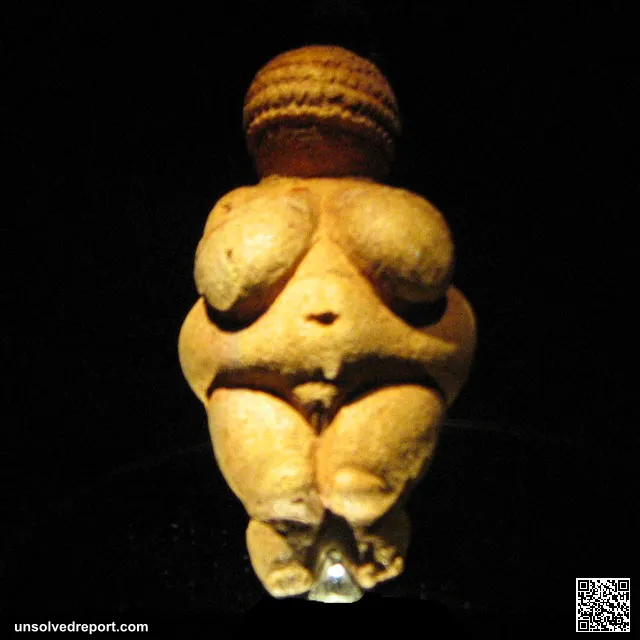
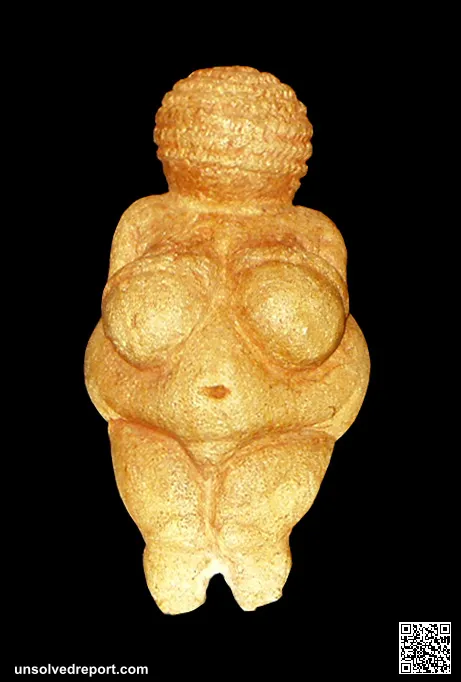
August 7, 1908. Workers cutting a railway line near the village of Willendorf, in Austria's Wachau region, hit something small and hard in the dirt. The dig was run by archaeologists Josef Szombathy, Hugo Obermaier, and Josef Bayer (Britannica; Natural History Museum Vienna via Google Arts & Culture). What they pulled from the earth was a figurine standing "exactly 110 mm in height" — about 4.3 inches — carved from oolitic limestone, a rock built from tiny round grains like fossilized fish eggs (Weber et al., Scientific Reports, 2022).
Now sit with how old she is. The layer of earth she rested in dates to roughly 30,000 years ago — the peer-reviewed study gives a calibrated range of about 29,000 years before present (Weber et al., 2022). That drops her squarely into the Gravettian, an Ice Age culture of Upper Paleolithic Europe. And here's a detail that's easy to miss: she was once painted. Red ochre, smeared across the stone. Traces of it still cling to her, even though much was scrubbed away during early cleaning (Wikipedia summary of Antl-Weiser; Weber et al., 2022).
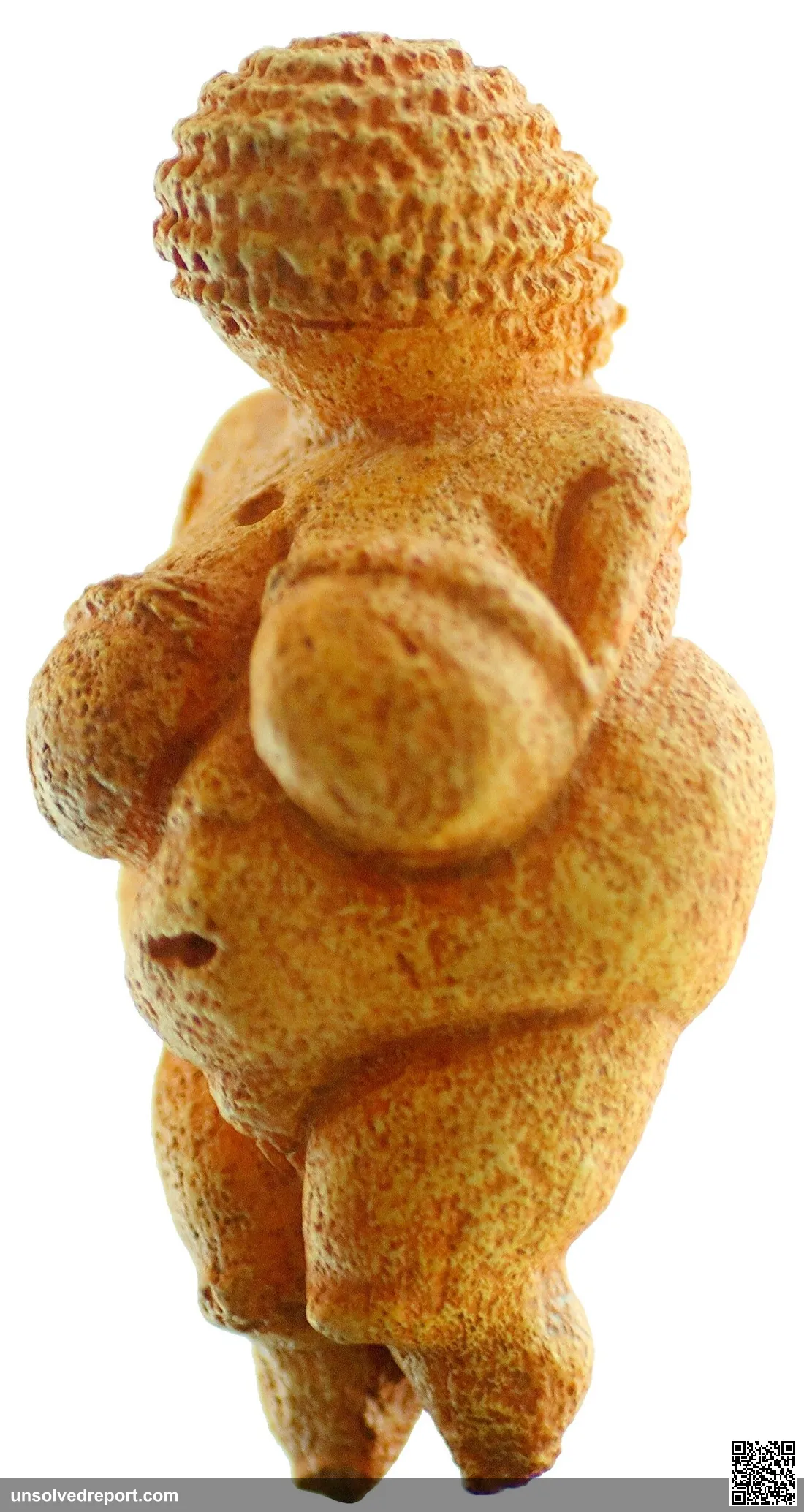
Look at her and you can't look away. The head has no face — just a ring of what might be a coiled, woven headdress or braided hair wrapped all the way around. Heavy breasts. A rounded belly. Broad hips. Thin arms resting on top of the breasts, and legs that taper down and simply vanish, with no feet at all (Britannica).
But the biggest fact of all isn't about her shape. It's hidden in her stone — the kind of clue that turns up again and again among unexplained ancient artifacts.
In 2022, a team led by University of Vienna anthropologist Gerhard Weber — working with geologists Alexander Lukeneder and Mathias Harzhauser and prehistorian Walpurga Antl-Weiser of the Natural History Museum Vienna — did something no one had done before. They fed her into a micro-CT scanner and X-rayed her insides at resolutions down to 11.5 micrometers, finer than a human hair (University of Vienna press release via ScienceDaily; Weber et al., 2022). What they saw glowing on the scan was a whole hidden world: six iron-oxide nuggets called limonite, averaging 2.77 mm across; little hemispherical pits where hard grains had popped out under the carver's tool; and — this is the eerie part — fragments of fossil shells. Ancient bivalves, probably from the Mesozoic, the age of dinosaurs. Those fossils were the smoking gun. They were far too old to belong to the young rock of the local Vienna Basin (Weber et al., 2022).
Here's why that matters. Oolitic limestone like hers simply does not exist anywhere in or near Willendorf (Archaeology Magazine). So the team went hunting. They compared the fingerprint of her internal grains against oolite from across a 2,500 km stretch of Europe — France to eastern Ukraine — sampling 18 sites in the field plus rock from 15 more (Weber et al., 2022). One match towered above the rest. It came from Sega di Ala, a quiet side valley near Lake Garda in the Southern Alps of northern Italy — the Early Jurassic Loppio Oolitic Limestone of the Trento Platform. The fit, the authors wrote, was "almost perfect" (Weber et al., 2022; Live Science).
The question no one can answer
So here it is, stripped to the bone: her stone was born on the Italian side of the Alps. The finished figurine ended up about 730 km away, in Austria.
How?
The researchers don't pretend the case is closed — hers is just one more entry on the long list of ancient mysteries archaeologists still can't explain. They say plainly they "cannot claim with absolute certainty that the raw material of the Venus originates from a particular locality" — and a site near Isjum in eastern Ukraine, more than 1,600 km away, gave the second-best match, though a clearly weaker one (Weber et al., 2022). Even her birthplace is a strong bet, not a sealed verdict.
And the source is only half the riddle. Did Ice Age people quarry the raw block near Lake Garda and lug the bare stone north over hundreds of kilometers? Did they carve her first and carry the finished goddess? Was she traded hand to hand, or handed down through families across a journey that may have eaten up decades? We have the destination. We have a very likely starting point. What we don't have is the road between them — and no way, yet, to know whether a single person, a whole community, or just the object itself made that long crossing.
The theories — and what we honestly don't know
How she traveled. Weber has sketched out a plausible journey, but he's careful to call it informed guesswork, not proof. "People in the Gravettian looked for favourable locations," he said. "When climate or prey changed, they moved on, preferably along rivers. Such journeys could span generations" (ScienceDaily). His team traced a possible path from Lake Garda to the Wachau, hugging the Etsch, Inn, and Danube rivers — staying mostly below 1,000 m, with only one short alpine stretch. That suggests people likely curved around the high mountains rather than dragging stone over glaciers (ScienceDaily). A reasonable map of how it could have happened. Not a diary of how it did.
What she meant. Here's the humbling truth: the Gravettian left no writing, so every reading of her is a guess dressed in confidence — much like the still-unsettled debate over why Laos' Plain of Jars were carved at all. The famous "fertility goddess" idea leans on her emphasized breasts and belly. A "survival and longevity" reading says she celebrated health and plenty in a brutal Ice Age world. Others see religion, shamanism — the same kind of ritual debate swirling around Tsodilo Hills' Python Cave — or a marker of status (Artsy; TheCollector). Then there's the strangest theory of all, floated in the 1990s by anthropologist Catherine McCoid and art historian LeRoy McDermott — that these figurines may be self-portraits. Picture a woman looking down at her own body without a mirror: the foreshortened, swollen proportions she'd see match the figurine almost eerily well. It's a haunting idea that, in plain terms, has "never held much sway with mainstream archaeologists," who point out it quietly ignores the figurines that don't fit (Artsy). And remember — even her romantic name is a modern invention. Nobody called her "Venus" until tens of thousands of years after her makers were dust. We genuinely have no idea whether they saw a deity, an ancestor, a real woman, or something we don't even have a word for.
So strip away the legends, and what's left is somehow even more astonishing. Around 30,000 years ago, someone chose one particular Italian stone, shaped it with patient hands, painted it red — and then it, or they, crossed the Alps. Maybe the missing face was always the point. She keeps her secret. And the long, silent road she traveled stays one of the Ice Age's quietest unsolved questions — the kind that makes you wonder what else is hiding inside the things we thought we already knew.
Sources & further reading
- Weber, G. W., et al. "The microstructure and the origin of the Venus from Willendorf." Scientific Reports (2022) — open access via PubMed Central: https://pmc.ncbi.nlm.nih.gov/articles/PMC8885675/
- University of Vienna press release, "Mystery solved about the origin of the 30,000-year-old Venus of Willendorf" (ScienceDaily, 2022): https://www.sciencedaily.com/releases/2022/02/220228095503.htm
- Encyclopaedia Britannica, "Venus of Willendorf": https://www.britannica.com/topic/Venus-of-Willendorf
- Archaeology Magazine, "Study Suggests Venus of Willendorf Originated in Italy" (2022): https://archaeology.org/news/2022/03/01/220301-limestone-venus-willendorf/
- Live Science, "Voluptuous 'Venus' of the Ice Age originated in Italy": https://www.livescience.com/venus-of-willendorf-origins-found
- Natural History Museum Vienna, via Google Arts & Culture: https://artsandculture.google.com/story/venus-of-willendorf-natural-history-museum-vienna/5AVh0EokEjjAKA?hl=en
- Artsy, "Why the Venus of Willendorf and Prehistoric Fertility Figures Still Mystify Experts": https://www.artsy.net/article/artsy-editorial-prehistoric-venus-figurines-mystify-experts

Tartaria Tablets: Older Than the First Writing?
Tartaria tablets: three clay pieces from 1961 Romania may predate Sumerian writing entirely. So why, after 60+ years, can no one prove what the marks say?
Lake Michigan's Underwater Stonehenge: The Mastodon Stone Nobody Can Explain
A diver hunting shipwrecks in Lake Michigan found a mile of stones — and one boulder carved like a mastodon. Genuine monument or a trick of the ice? Nobody's proven it either way.
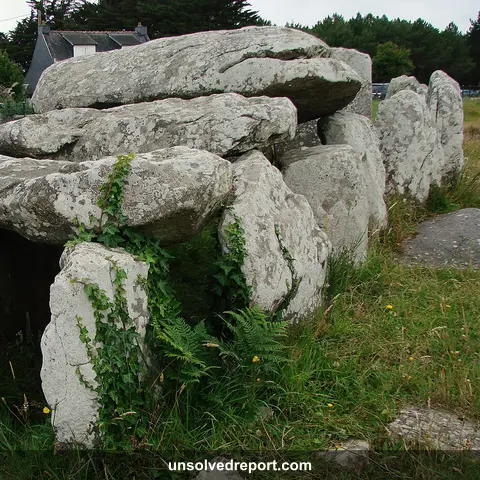
Carnac Stones: 3,000 Megaliths That Beat Stonehenge
Over 3,000 megaliths line up across Brittany, older than Stonehenge by 1,000 years. A 2025 dig finally dated them - so why does no one know what they were for?