Area 51's Real Secret: It Faked Half of America's UFO Sightings
Area 51 stayed "top secret" for 50 years — not because of aliens. The real reason fueled half of America's UFO sightings. What's still hidden there now?
Pilots saw the runway from the air. Spy satellites mapped it. Soviet intelligence knew exactly where it sat. Tourists drove out to a dusty Nevada hilltop just to squint at it through binoculars.
And for more than fifty years, the United States government swore it wasn't there.
Ask, and the answer never changed: there is no such place. One of the most-photographed military bases on Earth, and officially, on the record, it simply did not exist.
Then in 2013 the CIA said the name out loud — Area 51 — and the truth turned out stranger than the silence. The base really had been hiding something for decades. It just wasn't aliens. Here's what the declassified record actually shows, and what the current wave of federal UFO disclosure has — and hasn't — added to it.
> ### The 60-Second Brief
> - 1955: CIA officer Richard Bissell and Lockheed's Kelly Johnson pick Groom Lake, Nevada, as the secret U-2 spy plane test site; President Eisenhower signs off.
> - 1958: A 60-square-mile stretch of land is pulled from public use, with a no-fly zone starting at 60,000 feet.
> - The U-2 flew above 60,000 feet, more than double the altitude of most military jets of the era — which is why witnesses mistook it for something otherworldly.
> - The CIA's own declassified history says U-2 and OXCART flights "accounted for more than one-half of all UFO reports" from the late 1950s through most of the 1960s.
> - August 2013: The CIA publicly acknowledged Area 51 by name for the first time, in a roughly 400-page declassified history covering 1954–1974.
> - May 2026: The Trump administration began releasing more than 450 official government UFO reports in four tranches, posted to a Department of Defense website — the biggest UAP document release since 2013, though it does not name Area 51 directly.
A Plane That Touched the Edge of Space
Picture a small aircraft buzzing low over the Nevada desert in April 1955. Inside sit CIA officer Richard Bissell and Lockheed engineer Kelly Johnson, hunting for a place to hide. From the air they spot it: an old airstrip beside a dry, flat lakebed called Groom Lake. Empty. Remote. Ringed by mountains, like a bowl with the world locked out. Perfect for keeping a secret.
President Dwight Eisenhower signed off. By July 1955 the base was ready, and crews from the CIA, Air Force, and Lockheed started rolling in (National Security Archive).
What were they so desperate to hide? A spindly, glider-like spy plane called the U-2 — built to cruise at the edge of space and photograph Soviet military sites from miles overhead. To guard it, the government slammed the door on the whole area. In 1958 a 60-square-mile rectangle of land was pulled from public use, and the sky above was sealed shut: no aircraft allowed below 60,000 feet (Encyclopedia.com).
And that one number is where the flying saucers were born.
How a Spy Plane Became a UFO
Here's the catch. In the mid-1950s, ordinary airliners flew at 10,000 to 20,000 feet. Even military jets stayed below 40,000. The U-2 flew above 60,000 feet — more than twice as high as anything else in the sky.
So imagine you're an airline pilot at sunset. You glance up and catch a silver shape far overhead, glowing, lit up like it's on fire. Nothing in your training explains it. Nothing flies that high. Your brain reaches for the only word that fits: unidentified.
That wasn't a guess. The CIA's own history spelled it out — the U-2's silver wings would "catch and reflect the setting sun's light and, flying at 60,000 feet, appear as 'fiery' objects to airline pilots flying at 20,000 feet" (Defense One).
The reports flooded in. And the punchline buried in that declassified CIA study is staggering: U-2 and later OXCART flights "accounted for more than one-half of all UFO reports during the late 1950s and most of the 1960s" (Defense One).
Half. Half of America's flying saucers were America's own spy planes.
The investigators knew. They just couldn't say a word without blowing the whole program. So the sightings stayed "unexplained" — the same label the Air Force's own Project Blue Book investigators stamped on cases for 22 years — and the rumors fed on the silence, and a legend grew teeth out in the desert.
The mask finally slipped in August 2013. George Washington University's National Security Archive pried loose a roughly 400-page CIA history with a mouthful of a title: The Central Intelligence Agency and Overhead Reconnaissance: The U-2 and OXCART Programs, 1954–1974. It named Area 51. It described what happened there. And it drew the base on a map, right on the Groom Lake bed (CBS News). After half a century of "no comment," the government had finally blinked: yes, it's real, and here's what it was for.
So What's In There Now?
The famous secret is out. But it leaves a sharper question hanging in the dark.
If the U-2 explained the old UFO wave — what is Area 51 testing today, and what are we still not allowed to see?
Because the paper trail stops dead in 1974. Everything after that is still classified. The base is real, the airspace is still sealed, and for decades it has been exactly the kind of place where the world's most advanced aircraft fly in total secrecy long before the public ever hears a whisper. The B-2 stealth bomber and the F-117 stealth fighter were both reportedly tested out there, years before anyone was allowed to know they existed (Space.com).
That's the honest heart of the mystery. We now know Area 51 was built to hide real, human-made machines so far ahead of their time that witnesses swore they were looking at something from another world. What we don't know is what's parked in those hangars right now — and a government that sat on the U-2 for 50 years is in no hurry to hand over the keys.
The Stories People Tell
Past this point, we're in guess territory. Everything below is a possibility, not a proven answer. Hold each one loosely.
It's a test site, plain and simple. This is the boring, best-supported truth: Area 51 is, and always was, a place to build and fly classified aircraft and military gear away from spying eyes. The 2013 release backs it up cold. The secrecy isn't hiding the supernatural — it's hiding the next spy plane or drone (NBC News).
Crashed alien craft are stored there. Now the blockbuster version. The claim that the base holds wrecked UFOs and even alien bodies traces mostly to two sources. In 1989, a man named Bob Lazar told a Las Vegas TV station he'd worked at a site called S-4 near Groom Lake, taking apart alien spacecraft fueled by "Element 115." Gripping story. The trouble: journalists and scientists found no record of the MIT and Caltech degrees he claimed, and no record of the jobs he described. His account stays unverified and widely disputed (HowStuffWorks, Factually). Then there's journalist Annie Jacobsen's 2011 book, which floated something even weirder — that the famous Roswell wreckage was a Soviet hoax craft, later hauled to Area 51 — built entirely on a single unnamed informant, backed up by no one else (NPR). Treat both as speculation, not evidence.
It's where Roswell ended up. The 1947 Roswell crash is the emotional root of the whole alien-base legend. But the U.S. Air Force closed that loop in a 1994 report: the debris came from Project Mogul, a secret program flying high-altitude balloons to sniff out Soviet nuclear tests (HISTORY). No paper trail ties Roswell to Area 51. That link lives in the theories, not the records.
The legend got loud enough that in 2019 it broke out of the internet and into the desert. A man named Matty Roberts posted a joke Facebook event — "Storm Area 51, They Can't Stop All of Us" — daring people to rush the gates and "see them aliens." He even suggested that if everyone did a Naruto run, they could dodge the guards' bullets. Roughly 2 million people clicked RSVP. On the day? A few thousand showed up, and barely 150 drifted near the gate — where, by most accounts, the guards just grinned and posed for photos (Time, Wikipedia).
2026: A New Wave of Disclosure — But Not About Area 51 Specifically
In May 2026, the Trump administration began a serial release of more than 450 official U.S. government UFO/UAP reports spanning decades, publishing them in four tranches on a Department of Defense website (TIME). It's the most significant UAP document release since the CIA's 2013 U-2 disclosure, and it follows the 2022 creation of the Pentagon's All-domain Anomaly Resolution Office (AARO) and the December 2023 UAP Disclosure Act signed by President Biden.
Important caveat: none of the 2026 releases name Area 51 or add new detail about Groom Lake's Cold War programs. They concern separate, more recent UAP case files — Navy pilot encounters, sensor footage, and older records unrelated to the U-2/OXCART history. Area 51 shows up in the broader disclosure conversation mostly as a cultural reference point: Barack Obama has publicly stated there's no hidden alien facility there — "unless there's this enormous conspiracy and they hid it from the President" (TIME). So the base's real history — the one document dump that actually named it — is still the 2013 release. What's happening in 2026 is a parallel, government-wide push for transparency on UAP sightings generally, not a new Area 51 file.
Frequently Asked Questions
Is Area 51 still classified?
Yes. The CIA confirmed the base's existence and its Cold War purpose in 2013, but no U.S. government document has ever officially detailed what happens there after 1974. The airspace restriction over the site remains in effect today (National Security Archive).
Why is Area 51 called "Area 51"?
The name comes from a grid-square designation used on old Atomic Energy Commission maps of the Nevada Test Site, where Groom Lake was one numbered parcel of land. The CIA's declassified history places the base within that same federal reservation (National Security Archive).
Did the government ever admit to hiding aliens at Area 51?
No. The only official U.S. document naming Area 51 — the CIA's 2013 declassified history — describes it as the test site for the U-2 and OXCART (A-12) spy planes, not extraterrestrial technology. Claims of stored alien craft come from unverified individual accounts, not government records (CBS News).
Who is Bob Lazar and is his story credible?
Bob Lazar is the man behind the 1989 claim that he worked at a facility called S-4 near Groom Lake, reverse-engineering alien spacecraft. Journalists and researchers have found no record of the MIT or Caltech degrees, or the employment history, that he says qualified him for the job, leaving his account unverified and widely disputed (HowStuffWorks).
What actually happened during the 2019 "Storm Area 51" event?
A joke Facebook event posted by Matty Roberts drew roughly 2 million RSVPs, but only a few thousand people actually showed up in the Nevada desert, and barely 150 approached the base's gate — where security guards reportedly just posed for photos rather than confronting anyone (Time).
Does the 2026 UFO disclosure include new Area 51 documents?
No. The 2026 releases add hundreds of UAP case reports to the public record, but none of them concern Area 51's history or current activities specifically — the 2013 CIA history remains the only official document to name the base directly (TIME).
The U-2 story shows how easily a real secret can wear the mask of a flying saucer. But not every sighting has a spy plane hiding behind it. Sometimes the witnesses are dozens of schoolchildren, and the craft lands close enough to look back. That one is still waiting for an answer.
Sources & Further Reading
- National Security Archive — The Area 51 File: Secret Aircraft and Soviet MiGs
- National Security Archive — The Secret History of the U-2 and Area 51
- CBS News — Area 51's existence acknowledged by CIA
- Defense One — Area 51 Has Been Hiding U-2 Spy Planes, Not UFOs
- NBC News — Area 51 and its purpose declassified
- Space.com — Area 51 Declassified: Cold War Documents
- HISTORY — What Really Happened at Roswell?
- HowStuffWorks — Bob Lazar, UFO Hoaxster
- Time — Inside the Area 51 Raid
- TIME — America Is Finally Taking Extraterrestrials Seriously (Aug 2026)
Ghost Rockets of 1946: 2,000 Sightings Sweden Never Explained
A year before 'flying saucer' was even a word, Sweden tracked 200 ghost rockets on radar and one crashing into a lake. So what were they really?
Tabby's Star Mystery: The 22% Dimming Nobody Can Fully Explain
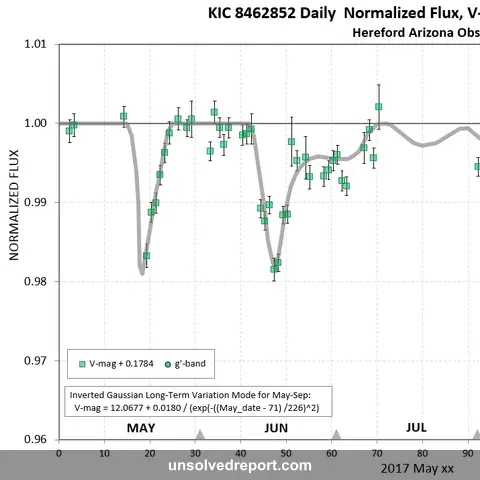
Tabby's Star dimmed by 22% with no warning, and top astronomers wondered if aliens were behind it. Here's what the data really shows — and what's still unexplained.
Bob Lazar Area 51: 37 Years, One Story, Zero Proof — Why?
Bob Lazar named element 115 in 1989, before it existed. In 2025 Congress heard his story again. In 2026 a new documentary dropped. Still no proof. Why?