Ghost Rockets of 1946: 2,000 Sightings Sweden Never Explained
A year before 'flying saucer' was even a word, Sweden tracked 200 ghost rockets on radar and one crashing into a lake. So what were they really?
It's the summer of 1946. A cigar-shaped object streaks low over a quiet Swedish lake, trailing fire, and then—splash—it slams into the water and vanishes. A farmer on the shore hears what he later calls a thunderclap. Soldiers race to the lake with diving gear. They search for three weeks.
They find nothing. No engine. No metal. No body. Just a scarred lake bottom and torn-up weeds where something heavy went in.
This happened a full year before the words "flying saucer" entered the dictionary. And it didn't happen once. It happened around two thousand times.
The Documented Facts
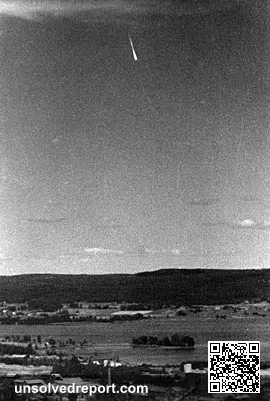
In 1946, the skies over Scandinavia filled with things nobody could name—not unlike the glowing foo fighters Allied pilots had reported chasing them through the air just a year earlier. People called them "ghost rockets"—long, missile-shaped objects, often gray, sometimes with stubby wings, usually moving fast and trailing smoke or sparks. The first report came on February 26, 1946. By the time the wave faded in December, Swedish authorities had logged roughly 2,000 sightings, and about 200 of those were tracked on radar—meaning machines, not just nervous eyes, registered something up there (Wikipedia: Ghost rockets).
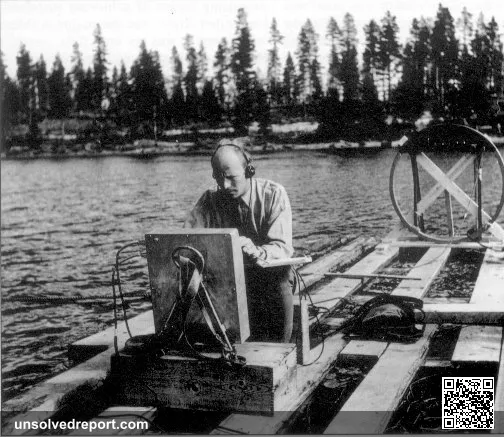
The most famous case is the crash into Lake Kölmjärv on July 19, 1946. Witnesses described a gray, winged, rocket-shaped object plunging into the water. The Swedish military sent in a search team led by Air Force officer Karl-Gösta Bartoll. After weeks of diving, Bartoll reported that the lake bottom "had been disturbed but nothing was recovered." His best guess for why nothing was left behind? The object was "probably manufactured in a lightweight material, possibly a kind of magnesium alloy that would disintegrate easily" (EDN: Ghost rocket UFOs first reported).
This was taken seriously at the highest levels—the kind of top-down urgency that would resurface decades later around Area 51 and its own web of official secrecy. On August 20, 1946, two American heavyweights quietly showed up in Stockholm: General Jimmy Doolittle, the famous aviator, and General David Sarnoff, the head of RCA. Officially they were there on business. Unofficially, they'd been sent to sniff out the ghost rockets. Two days later, on August 22, U.S. intelligence chief Lt. Gen. Hoyt Vandenberg wrote a top-secret memo to President Truman saying the "weight of evidence" pointed to the German rocket base at Peenemünde as the launch site (Military History Wiki: Ghost rockets).
Did Sweden ever recover hard evidence? Sort of. A committee memo dated December 3, 1946 noted that "nearly one hundred impacts have been reported and thirty pieces of debris have been received and examined" by Sweden's National Defence Research Institute (FOA). The catch: that debris was later identified as ordinary meteorite fragments—space rock, not enemy missile (Wikipedia: Ghost rockets).
Then the whole file went into a drawer. The Swedish government kept its ghost rocket records secret until 1984, when researchers finally opened them and found more than 1,500 reports that had been quietly collected all those years earlier (EDN: Ghost rocket UFOs first reported).
The Genuine Open Question
Here's the part that still doesn't add up.
Investigators tied the two biggest sighting spikes—August 9 and 11, 1946—to the Perseid meteor shower, which peaks every year around those exact dates, much like officials would later lean on mundane explanations for the Battle of Los Angeles, when an entire city's anti-aircraft guns opened fire on an intruder nobody could identify. Tidy. Convincing. Meteors are real, they're fast, they trail fire, and people misjudge them constantly.
But meteors don't explain everything. Many sightings happened on nights with no meteor activity. Witnesses reported objects that slowed down, changed direction, and flew level—things a falling rock simply cannot do. And the Soviet missile theory has its own hole: when Cold War archives were later opened, researchers found no record of any rocket launches at Peenemünde after early 1945. No launches means no missiles to track (Wikipedia: Ghost rockets).
So we're left with a genuine puzzle. Some ghost rockets were almost certainly meteors. Some were probably jittery imaginations in a tense post-war summer. But a stubborn slice of well-documented, radar-backed reports fits neither explanation—and to this day, nobody has cleanly accounted for them. Bartoll, the man who actually waded into that lake, never backed down. In a 1984 interview he insisted that "what people saw were real, physical objects."
Theories and Interpretations
So what were they? Here's the honest spread—what's grounded, and what is unproven speculation.
Meteors and natural fireballs (best-supported). This is the leading scientific explanation, and the Perseid timing and the meteorite debris back it up. It probably accounts for a large share of the sightings. It does not account for the maneuvering ones.
War nerves and mass hysteria (well-supported for part of the wave). German, British, and Scandinavian intelligence officials concluded much of the panic was a case of mass anxiety—understandable in a region that had just survived a world war and now sat on the edge of a new one. Real, but it can't explain radar contacts.
Secret Soviet missile tests (popular at the time, now weakly supported). In 1946 this felt obvious: captured German rockets, fired east over the Baltic to intimidate neutral Sweden. U.S. generals believed it. But with no recovered rocket parts and no launch records, the evidence dried up. Treat this as a once-leading theory now lacking proof.
Something genuinely unknown (speculative). A declassified 1948 U.S. Air Force document noted that Swedish air intelligence had described the phenomena as showing "a high technical skill which cannot be credited to any presently known culture on earth" (Military History Wiki: Ghost rockets). That's a striking line—but it's an opinion recorded in a memo, not a measurement. It is not evidence of alien spacecraft.
Extraterrestrial or UFO origin (unproven). Because the ghost rockets came before the 1947 "flying saucer" craze, many UFO and UAP enthusiasts point to them as the first modern wave of unidentified aerial phenomena—decades before Europe would see anything like it again in the radar-tracked triangles of the Belgian UFO wave. It's a fair historical observation. But to be clear: there is no physical proof of an extraterrestrial cause. No alien craft was recovered, no anomalous material was confirmed. The "aliens" angle is a hypothesis, not a finding—file it under fascinating but unverified.
The truth is probably layered: a real meteor shower, a frightened public, a Cold War shadow, and a handful of cases nobody can crack. That last handful is why the ghost rockets still haunt the record eighty years on.
A year after the last ghost rocket faded from Swedish radar, a pilot over Washington State would see nine shining objects skip across the sky "like saucers"—and hand the world a brand-new word. But was that sighting really the first of its kind, or just the one that got the name? Keep reading.
Sources & Further Reading
- Wikipedia — Ghost rockets
- EDN — Ghost rocket UFOs are 1st reported, February 26, 1946
- Military History Wiki — Ghost rockets
- Wikipedia — UFO sightings in Sweden
Tabby's Star Mystery: The 22% Dimming Nobody Can Fully Explain
Tabby's Star dimmed by 22% with no warning, and top astronomers wondered if aliens were behind it. Here's what the data really shows — and what's still unexplained.
Bob Lazar Area 51: 37 Years, One Story, Zero Proof — Why?
Bob Lazar named element 115 in 1989, before it existed. In 2025 Congress heard his story again. In 2026 a new documentary dropped. Still no proof. Why?
Majestic-12: The Secret Alien Files That the FBI Stamped 'BOGUS'
A mystery film roll, twelve secret names, an FBI file stamped BOGUS — and a 2026 claim it's all real. Cover-up or the greatest hoax in UFO history?