6478 Gault: The 'Dead' Asteroid That Grew Two Comet Tails
6478 Gault is a dry rock, not a comet — yet in 2019 it sprouted two glowing tails and nobody agrees on why it happens when it does. Here's the evidence.
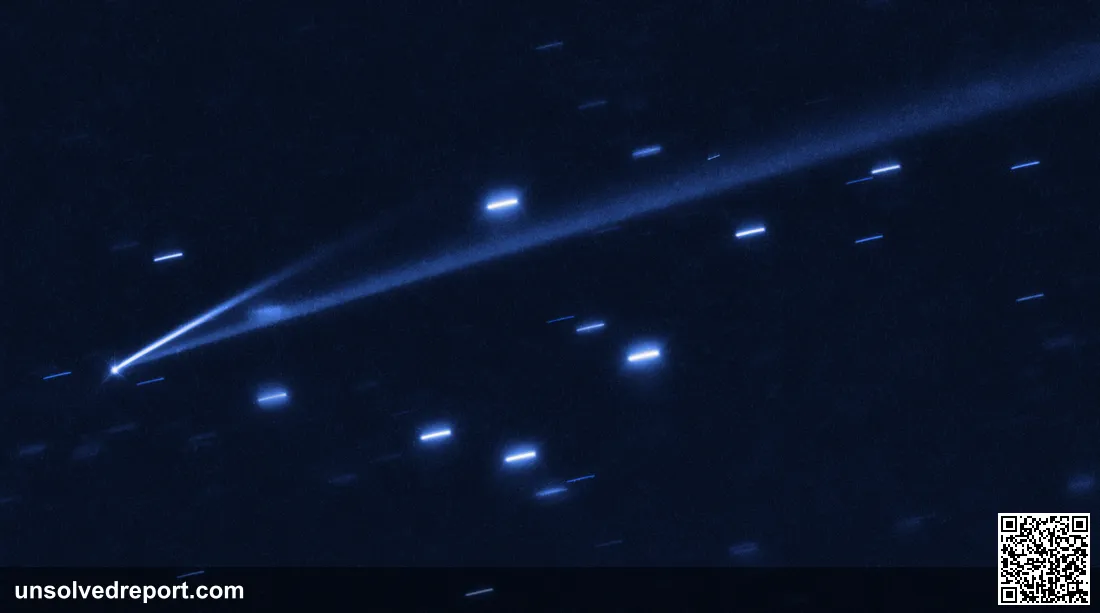
Two long, straight streamers of dust, fanning out across hundreds of thousands of miles of empty black. That's what telescopes saw in early 2019. The strange part isn't the tails. It's what was wearing them.
For more than a century, the rule felt rock-solid. Comets are icy wanderers, and when one swings near the Sun, it grows a glowing tail. Asteroids are the boring cousins: dry, dead rocks that circle quietly between Mars and Jupiter, doing nothing at all. Then a four-kilometer chunk of stone in the main asteroid belt broke the rule. It grew not one tail but two, streaming behind it like a comet that forgot it was supposed to be made of ice. Its name is 6478 Gault, and astronomers watched it appear to come apart in slow motion. Here's what the evidence actually shows — and the genuine puzzle nobody has cracked.
What we know for sure
Gault isn't some fresh face. It was spotted way back on May 12, 1988, by Carolyn and Eugene Shoemaker at Palomar Observatory in California, tagged with the clunky provisional name 1988 JC1, and later named for American planetary geologist Donald Gault, an expert in how impact craters form (Wikipedia, 6478 Gault). It belongs to the Phocaea family in the inner main belt, measures roughly 2.5 to 5.5 miles across (about 4 kilometers), and loops along between Mars and Jupiter (NASA Hubble; EarthSky). For thirty years it did absolutely nothing worth a second glance.
Then January 2019 happened. On January 5, the NASA-funded ATLAS survey telescope in Hawaii caught a tail of debris trailing the rock — and once they knew to look, the same feature turned up hiding in December 2018 archival images from ATLAS and Pan-STARRS (NASA Hubble). A second, shorter tail showed up in mid-January, caught by the Canada-France-Hawaii Telescope and the Isaac Newton Telescope. Then the Hubble Space Telescope swung around for a close-up. The numbers are hard to picture: the longer tail stretched more than 500,000 miles (about 800,000 kilometers) and ran roughly 3,000 miles wide. The shorter one was about a quarter of that length (NASA Hubble).
Here's the twist. These tails are not made of vaporizing ice, the way a real comet's are. Astronomers worked out that the two streamers came from two separate dust-release events, one around October 28 and one around December 30, 2018, each a short burst lasting anywhere from a few hours to a few days (NASA Hubble). And for all that drama, the total stuff thrown off would only make a clump about 500 feet (150 meters) across if you swept it back together — a trivial amount of debris next to the ice and rock still orbiting inside Saturn's rings. The dust was eerily tidy, too. Olivier Hainaut of the European Southern Observatory put it simply: the grains were so cleanly arranged that "we just had to look at the image of the streamers, and we can see all of the dust grains well-sorted by size."
So if it isn't ice, what is it? The leading answer is mechanical, and it comes down to one thing: this rock is spinning fast. Dangerously fast. Gault whips around with a rotation period close to two hours — right at the edge where a loosely bound "rubble-pile" asteroid starts to fling itself apart (NASA Hubble). Peer-reviewed photometry pinned the spin at about 2.49 hours, hovering near the roughly 2.2-hour barrier where rubble piles lose their grip (arXiv preprint, light curves of Gault). What's been winding it up? The prime suspect is the YORP effect (Yarkovsky-O'Keefe-Radzievskii-Paddack). It works like this: sunlight warms the asteroid, and the infrared heat radiating back off its surface carries away a whisper of momentum, applying a tiny torque that, over enormous stretches of time, spins the rock faster and faster. NASA's account reckons Gault has been spinning up for more than 100 million years. Jan Kleyna of the University of Hawaii called it "the best 'smoking gun' example of a fast rotator right at the two-hour limit."
Unusual, yes. Unique, no. Active asteroids — bodies on asteroid-like orbits that somehow act like comets anyway — are genuinely rare, part of the same broader pattern of solar system objects that refuse to behave, alongside oddities like ʻOumuamua. Out of roughly 800,000 known main-belt asteroids, an event like Gault's is thought to happen only about once a year, and Gault was just the second asteroid whose breakup has been strongly tied to the YORP effect (NASA Hubble).
The part that doesn't add up
Now the record turns into a real puzzle. The neat story — Gault suddenly cracked open in late 2018 — falls apart the moment you look closer. When researchers dug back through old sky-survey images, they found Gault had been quietly shedding material for years before 2019 ever arrived. One peer-reviewed study in The Astrophysical Journal Letters reported activity across several separate epochs going all the way back to 2013, with bouts in 2013, 2016, and 2017 (IOPscience, sustained activity in (6478) Gault).
Which lands us on the real question: why does Gault let go of dust when it does? If YORP simply spun the rock past its breaking point, you'd expect one of two things — a single catastrophic shattering, or a steady, continuous trickle of debris leaking out forever. Gault does neither. It fires off discrete bursts, with long quiet stretches in between, and — according to the archival study — no clean link between how close the asteroid is to the Sun and when it goes active. That detail matters more than it sounds. A comet's icy activity peaks near the Sun; no distance dependence is a strong argument that plain ice melting isn't pulling the trigger here. So the timing of these outbursts — what nudges a near-critical rubble pile over the edge in one particular month and not another — is genuinely unsettled.
Theories worth taking seriously
What follows are scientifically grounded reads of the evidence. But they are reads — the field hasn't closed the case, much like the debate over Planet Nine further out in the same solar system.
Rotational landslides (the leading idea). Picture Gault spinning so close to its structural limit that loose material near its equator simply can't hold on. Every so often, a patch lets go and slides off into space, kicking up dust — no ice required. This fits everything we see: the blistering spin, the dry composition, the stop-start bursts. It's the explanation NASA's analysis and the rotation measurements point to most directly (NASA Hubble; arXiv light curves).
A nudge from outside (a speculative trigger). Kleyna floated a tantalizing idea about the exact timing: maybe it's set by tiny outside knocks. "Even a tiny disturbance, like a small impact from a pebble, might have triggered the recent outbursts," he said. In this version, YORP loads the gun and a stray pebble pulls the trigger. Plausible — but, by its very nature, almost impossible to confirm for any single burst. Treat it as informed speculation, not a settled finding.
A "perpetually active" new class (a contested framing). The archival study pushed further, suggesting Gault might be a whole new kind of object — one that's essentially active all the time because it lives permanently right at the spin-breakup barrier (IOPscience). Is Gault truly "perpetually active," or just caught in an unusually busy stretch? That's still being argued out as the observations pile up.
What nobody disputes is the bigger lesson. Gault helped knock down the old wall between comets and asteroids, feeding the idea of an asteroid-comet continuum — a world where a "dry" rock can wear a comet's tail after all. As Hainaut said, now that modern survey telescopes are scanning the whole sky, "asteroids such as Gault cannot escape detection anymore." And the deeper mystery — exactly when, and exactly why, a spinning rubble pile finally decides to let go — is still wide open, no less than the clawed grooves on Phobos, waiting for the next strange rock to give itself away.
Sources & further reading
- NASA Science / Hubble: "Hubble Watches Spun-up Asteroid Coming Apart"
- EarthSky: "Hubble captures a rare active asteroid"
- The Astrophysical Journal Letters (IOPscience): "Six Years of Sustained Activity in (6478) Gault"
- IOPscience: "Episodically Active Asteroid 6478 Gault"
- arXiv (preprint): "Secular and Rotational Light Curves of 6478 Gault"
- Wikipedia (overview and discovery details): 6478 Gault
Eta Carinae: The Star That Faked Its Own Death
In 1843, Eta Carinae's Great Eruption nearly outshone a supernova — then the star refused to die. Astronomers still can't fully explain how it survived.
10 Cosmic Mysteries Even the Best Telescopes Can't Crack
Dark matter, the Hubble tension, signals from billions of light-years away. Ten real cosmic mysteries the world's best telescopes still cannot solve.
Planet Nine: The Massive World Nobody Can Find
Dozens of icy worlds past Neptune all lean the same eerie way, as if something massive and unseen is pulling the strings. Is Planet Nine actually real?