'Oumuamua: The Visitor That Shouldn't Exist
An interstellar object flew past the Sun in 2017, then sped up with no visible cause. What pushed 'Oumuamua? Scientists still can't agree.
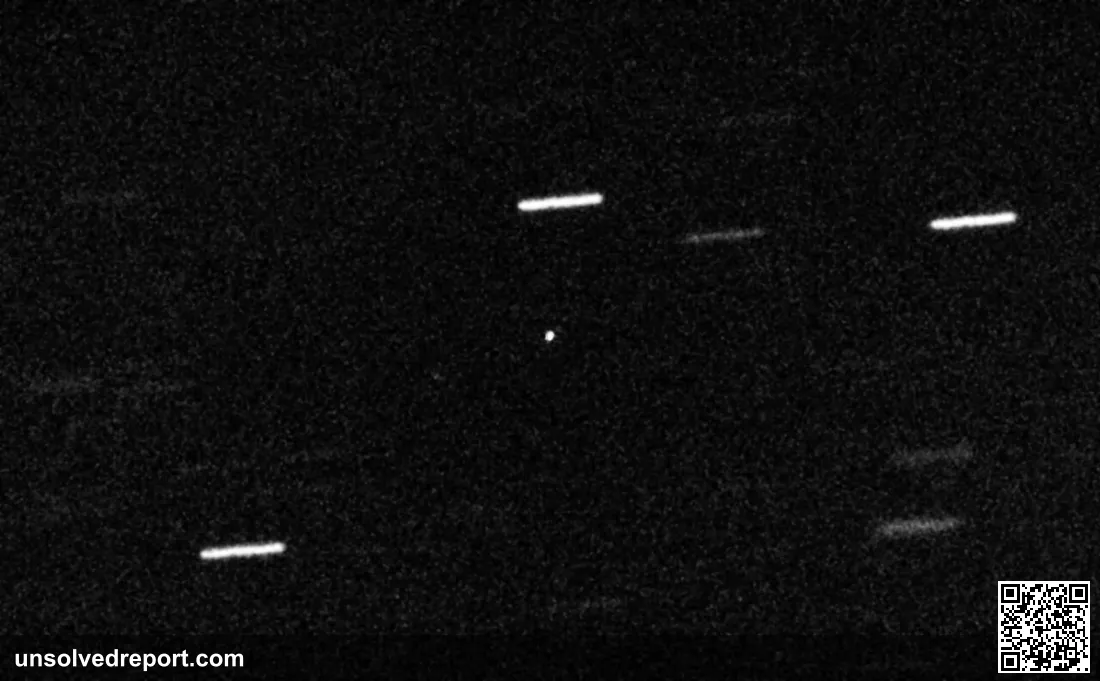
October 19, 2017. On a Hawaiian mountaintop, a telescope catches a faint smudge of light sliding across the sky — and it's moving the wrong way. Within days, the astronomers staring at it understand something that has never happened before in human history. This is not another comet. Not another asteroid born in our own backyard. This thing fell in from the dark between the stars, whipped around the Sun, and was already racing back out, never to return.
They gave it a name: 'Oumuamua.
And then they studied it. And the more they looked, the stranger it got.
This is the story of the first confirmed visitor from another star system — what we truly know, what nobody can explain, and the theories scientists have thrown at it trying to make the pieces fit.
What We Actually Know
We caught it leaving, not arriving. By the time the Pan-STARRS1 telescope at Haleakalā Observatory in Hawaii first spotted it on October 19, 2017 — funded by NASA's Near-Earth Object Observations Program — the visitor had already rounded the Sun (NASA Science). Its closest approach, perihelion, had come and gone on September 9. We were watching its taillights, not its arrival. Astronomers tagged it 1I/2017 U1, and that little "1I" carries a lot of weight: the first interstellar object ever catalogued. The name is Hawaiian, and it fits perfectly — "a messenger from afar arriving first" (NASA Science).
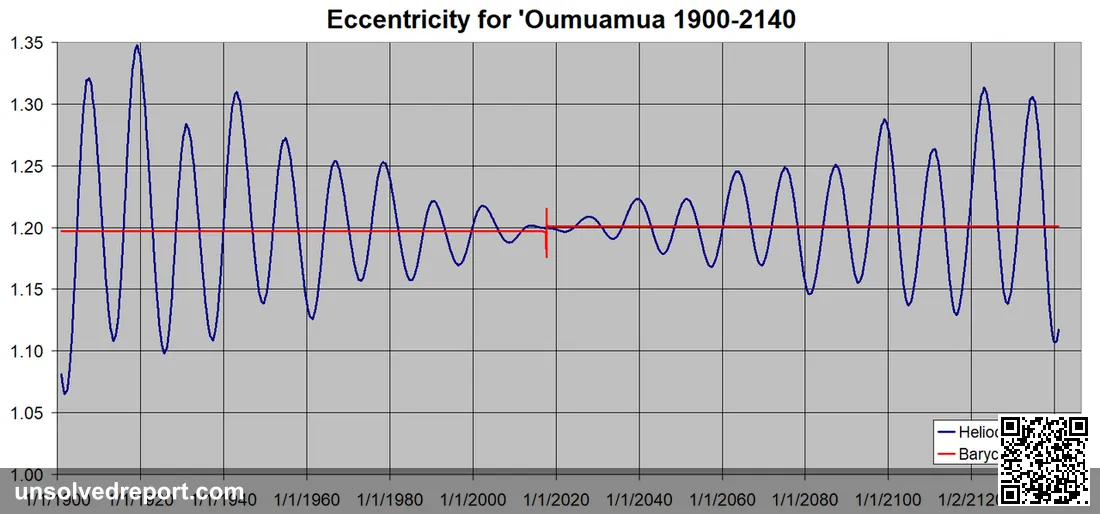
The math is what gave it away. Here's the clincher. Everything that orbits our Sun traces a closed loop — an eccentricity below 1.0. 'Oumuamua's eccentricity was about 1.20 (Wikipedia summary of orbital data). That single number means it was never trapped by the Sun at all. It was just passing through, on an open hyperbolic path, the way a stranger walks straight through a town without stopping. It came barreling in at an interstellar speed of roughly 26 km/s and cut its perihelion pass inside Mercury's orbit, around 0.255 AU (Wikipedia). At its fastest, NASA's Jet Propulsion Laboratory clocked it tearing past the Sun at about 87 km/s — roughly 196,000 mph (NASA JPL). It arrived from the direction of the constellation Lyra and is now headed out toward Pegasus.
It was small, red, and shaped all wrong. How big was it? That depends on how shiny you assume it was, but the best guess puts it at a few hundred meters along its longest side (NASA Science). And it flickered. As it tumbled through space, its brightness swung by a factor of about ten — far too violent a flicker for anything roughly ball-shaped. That flicker told the astronomers something eerie: this thing was wildly stretched out, maybe ten times longer than it was wide (NASA JPL). It didn't spin cleanly either. It tumbled, end over end, on a roughly 8-hour cycle in a chaotic non-principal-axis spin (Wikipedia). And it was reddish — the deep tan of something that has been baking in cosmic radiation for millions of years out in the dark.
It looked like a comet — but there was no tail. This is where the wheels come off. A comet that swings close to the Sun puts on a show: a glowing halo of gas, a streaming tail of dust. 'Oumuamua passed close to the Sun and gave us... nothing. No coma. No tail. When scientists looked hard for any gas or dust around it, they came up empty (Nature, 2018). To every eye and every instrument, it behaved like a dead, silent rock — the opposite problem of an object like asteroid 6478 Gault, which sprouted comet-like tails despite supposedly being an inert rock.
The Part Nobody Can Explain
And yet it didn't move like a dead, silent rock.
In June 2018, a team writing in Nature dropped the bombshell: 'Oumuamua's path simply could not be explained by gravity. They ran the numbers on every pull from the Sun and the planets — and there was still a push left over. A small but unmistakable extra shove, aimed away from the Sun, that sped the object up by about 17 meters per second near perihelion (Nature, 2018).
For a comet, you'd shrug. Comets get nudged all the time — jets of gas boiling off the surface act like tiny rocket thrusters. But that trick comes with a price: a visible cloud of gas and dust. 'Oumuamua had none. For the math to work as ordinary comet outgassing, the gas-to-dust ratio would have to be at least a hundred times higher than any comet we have ever measured (Nature, 2018).
So the riddle is brutally simple to ask and brutally hard to answer: What pushed 'Oumuamua, when it showed none of the outgassing that's supposed to do the pushing?
Here's the cruel part. We can't go back and check, the same dead end that still haunts the Wow! signal. The object is now too far to see and far too fast to chase — we will almost certainly never collect a single new data point on this particular wanderer (Astronomy.com). Whatever the answer is, it has to come from models on Earth — and from the next visitor we manage to catch.
The Theories — None of Them Settled
Everything below is interpretation. Smart people doing their best to make the facts above add up. Nobody has nailed it.
A secret, dust-free engine (the front-runner)
The most accepted idea keeps 'Oumuamua exactly where it sounds like it belongs — among the natural icy bodies — just a weird one. In a 2023 paper in Nature, Jennifer Bergner (then at the University of Chicago, now UC Berkeley) and Darryl Seligman (then at UChicago) suggested that during 'Oumuamua's endless trek through deep space, cosmic radiation slowly cooked some of its water ice into molecular hydrogen and locked the gas away inside the body (University of Chicago News; Nature, 2023).
Then the Sun warmed it up. The trapped hydrogen leaked out and gave the object a push — but because it was venting clean hydrogen instead of blasting out dusty ice, there was no tail to see. And the kicker: because 'Oumuamua was so small, even a gentle hydrogen sigh was enough to bend its course in a measurable way (University of Chicago News). It's an elegant fix — but not a closed case. Critics doubt the object could hold onto hydrogen at the temperatures involved, and even the authors admit it may not explain the similar "dark comets" we see closer to home. Treat it as a strong candidate, not a verdict.
Made of a stranger kind of ice
Other natural ideas say 'Oumuamua was a shard of something more exotic — say, a chip knocked off a nitrogen-ice surface, like the frozen plains of Pluto. A body made mostly of vaporizing nitrogen or hydrogen ice could, in theory, get its push without trailing an obvious dusty plume. Plausible? Yes. Proven? No — and it can't be, for the simple reason that we can never go back and take a sample.
What if it wasn't a cigar at all?
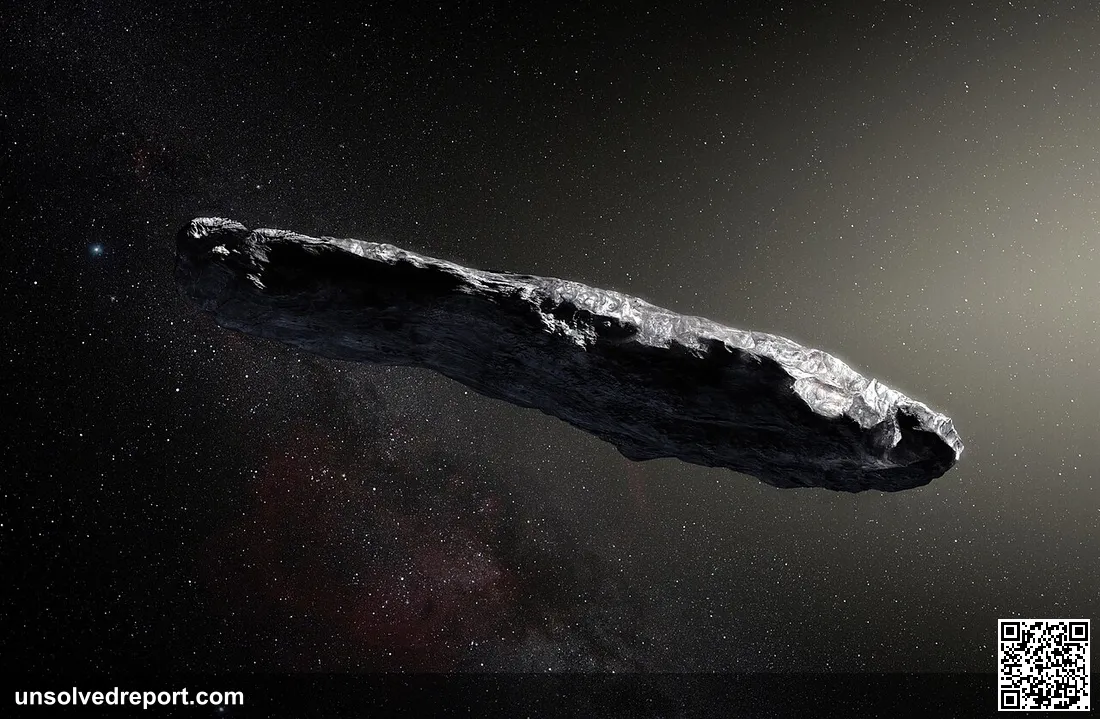
You've seen the artwork: a dark, cigar-shaped splinter of rock. But hold on. That flickering light curve fits another shape just as well — a flattened pancake, a thin disk (Sky & Telescope). We never saw 'Oumuamua as anything more than a single dot of light, so its real shape is its own little mystery. That it was stretched out — solid. Cigar versus pancake — genuinely up in the air.
The "it's a spaceship" idea — and why most scientists walked away from it
A thin object with strange proportions, plus a push nobody could explain. That combination led Harvard astrophysicist Avi Loeb to publish a striking hypothesis: maybe 'Oumuamua was artificial — a thin, light-sail-like structure being pushed along by sunlight (arXiv preprint; this is a preprint, not a peer-reviewed finding). It's an interpretation, not a discovery, and most of the astronomy world considers it unlikely. The closer analysts looked, the worse it fit: a tumbling light sail should have been shoved sideways in a way 'Oumuamua never was, and a sheet that thin would keep turning edge-on and briefly vanishing from view — which simply never happened (Big Think summary). By 2021 the mainstream consensus had landed firmly: 'Oumuamua's properties are consistent with a natural object (Wikipedia). We bring it up because it lit up the whole world's imagination — the same instinct Loeb later channeled into his Galileo Project search for alien technology — and because pulling it apart from the evidence is exactly the kind of careful thinking the Fermi paradox demands of anyone hunting for signs of intelligent life.
Why It Still Matters
'Oumuamua is gone for good. But it kicked a door wide open. In 2019, 2I/Borisov showed up — an unmistakable interstellar comet, tail and all (Wikipedia). Then in July 2025, astronomers confirmed a third arrival: 3I/ATLAS (NASA Science). And now the tools are catching up. The NSF–DOE Vera C. Rubin Observatory is sweeping the sky, and ESA's Comet Interceptor mission is built to lie in wait and chase down a future visitor (Scientific American). The age of hunting these wanderers is just getting started.
The first messenger from afar left us a riddle we ran out of time to finish reading. The next one might just let us read the whole sentence — and we're now watching, waiting, for it to arrive.
Sources and Further Reading
- NASA Science — 'Oumuamua overview
- NASA JPL — Solar System's First Interstellar Visitor Dazzles Scientists
- Nature (2018) — Non-gravitational acceleration in the trajectory of 1I/2017 U1
- Nature (2023) — Acceleration of 1I/'Oumuamua from radiolytically produced H2 in H2O ice
- University of Chicago News — A surprisingly simple explanation for 'Oumuamua's weird orbit
- Sky & Telescope — Is 'Oumuamua an Interstellar Pancake?
- NASA Science — Comet 3I/ATLAS Facts and FAQs
- Scientific American — European Comet Interceptor Could Visit an Interstellar Object
Roswell Incident 1947: Why the Official Story Changed 4 Times
Saucer, then balloon, then Mogul, then dummies -- the Army's Roswell story flipped four times. New 2026 Pentagon files add pages. Which version holds up?

Nimitz Tic Tac UFO: The 2004 Navy Sighting Nobody Can Explain
Navy pilots chased a wingless "Tic Tac" UFO off San Diego in 2004 — and it vanished in a blink. The Pentagon confirmed the video is real. What was it?

2021 Pentagon UAP Report: 143 UFOs Still Unexplained in 2026
143 of 144 military UFO sightings remain unexplained. Inside the 2021 Pentagon UAP report, the office it created, and the 319 new cases logged through 2026.