Planet Nine: The Massive World Nobody Can Find
Dozens of icy worlds past Neptune all lean the same eerie way, as if something massive and unseen is pulling the strings. Is Planet Nine actually real?
Out past Neptune, in the cold and the dark at the very edge of the solar system — the same frontier where Voyager's own instruments picked up a baffling anomaly — a planet several times heavier than Earth may be carving a slow, monstrous loop around the Sun. Here's the strange part: nobody has ever laid eyes on it. Not once. We don't even know it's there because we saw it. We suspect it's there because of the way a few faraway lumps of ice are moving — as if something big, something we can't see, is quietly tugging on them.
That's the case for Planet Nine. And it's one of the most gripping unanswered questions in all of astronomy.
Let's be straight with you from the start, though. Planet Nine isn't a confirmed discovery. It's a hypothesis — a guess, but a careful one. It comes from mainstream astronomers using plain old physics, and it makes predictions you can actually test. That's what makes it worth chasing, instead of either laughing it off or blowing it up into something it isn't.
The first clue: orbits that all lean the same way
Start way out in the Kuiper Belt and beyond, where the Sun is just a bright star and a single orbit can take thousands of years. Some of these bodies — the extreme trans-Neptunian objects, or ETNOs — never even drift close to Neptune. They stay out in the deep cold, going around and around in the dark.
In 2016, two Caltech astronomers, Konstantin Batygin and Michael Brown, spotted something that shouldn't be there. The stretched-out orbits of these distant objects seemed to be pointing the same way. Tilted the same way. Lined up — when, after billions of years of random bumping, they had every reason to be scattered in every direction.
Picture a handful of long, looping rings tossed into the air. They should land pointing all over the place, total chaos. Instead, several of the most distant ones looked like a bundle of arrows loosely aimed in one direction. Batygin and Brown ran the numbers and found the odds of that happening by pure luck were low. So they asked the obvious, eerie question: what's herding these orbits into line?
Their answer? An unseen planet. Far, far out. A planet whose gravity reaches across the void and gently nudges everything into the pattern we see.
What this hidden world would look like
From the way those orbits behave, Batygin, Brown, and others have sketched a rough portrait of the thing. The numbers have shifted over the years as better data rolled in, but the recent picture lands somewhere around here:
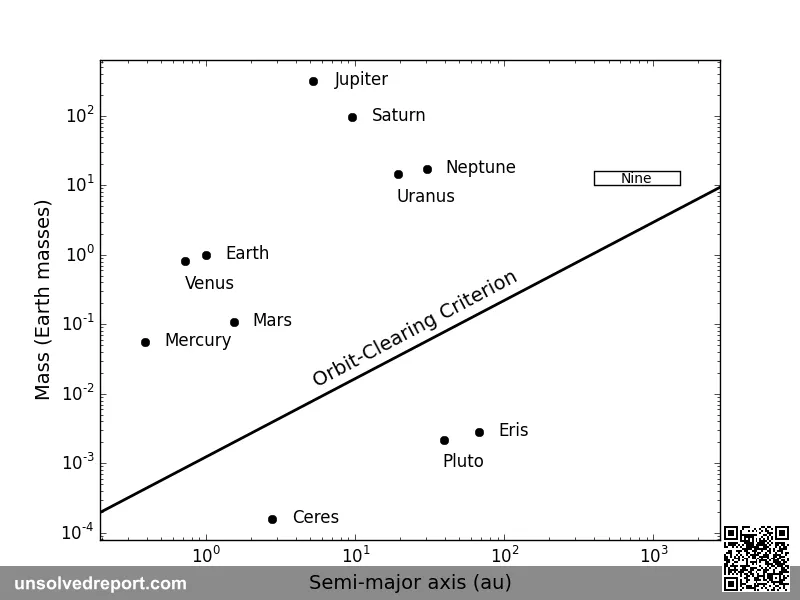
- Mass: roughly 5 to 10 times the mass of Earth — a "super-Earth" or "mini-Neptune." Newer work pushes it toward the lighter end, maybe 5 to 6 Earth masses.
- Distance: a semi-major axis of several hundred astronomical units (AU), usually quoted at 400 to 800 AU. One AU is the Earth-Sun distance. For a sense of scale: Neptune sits at just 30 AU. This thing would be more than ten times farther out.
- Orbit: long and lopsided and tilted, with a single trip around the Sun taking maybe 10,000 to 20,000 years.
A world that far away would be almost unthinkably dim, catching only a whisper of sunlight. And that, right there, is the main reason it could still be out there, undetected, after decades of us scanning the sky.
How do you lose a whole planet?
It sounds absurd, doesn't it? A planet several times bigger than Earth, somehow tucked away in our own solar system where nobody's noticed it. But once you understand how light works, it stops being absurd and starts being almost inevitable.
Here's the brutal math of brightness. The sunlight that reaches an object drops off with the square of its distance from the Sun. Then the light it bounces back to us drops off again with the square of its distance from Earth. Stack those together and a faraway object dims by roughly the fourth power of its distance. Double the distance, and it doesn't get four times fainter — it gets sixteen times fainter.
So look at Neptune: parked at 30 AU, you can spot it in a modest backyard telescope. Now shove an object out to 500 or 600 AU. Its glow collapses to thousands of times fainter, sinking right down to the edge of what even our biggest survey telescopes can catch. And it gets worse. A planet that distant crawls across the sky, barely budging, because faraway things orbit slowly — which makes it brutally hard to pick out from the fixed stars behind it. Worse still, depending on where it sits in that enormous looping orbit, it might right now be drifting across a thick band of the Milky Way, lost in a riot of background stars like a single face in a stadium crowd.
None of this is wishful thinking. It's just geometry and light, plain and simple. And it explains, cleanly, why a real planet could be hiding in plain sight.
Why a planet is such a tempting answer
Here's what makes the Planet Nine idea so seductive: one single object could untangle several separate puzzles all at once.
- The lined-up orbits: the clustering of those distant ETNOs.
- The steeply tilted objects: some bodies orbit at wild angles to the flat plane the planets share, and simulations with a big distant planet can churn out exactly those misfits.
- The Sun's lean: the Sun's own rotation axis is tipped about six degrees off the average plane of the planets — a small, nagging oddity, not unlike Uranus's own extreme sideways tilt, that's bugged astronomers for ages, and a distant heavyweight planet might explain it.
When one clean idea accounts for several unrelated mysteries, scientists sit up and pay attention. That's a big part of why Planet Nine has stuck around in serious conversation instead of quietly fading away.
Now, the part where we slow down
Here's where honesty matters most — because the evidence is genuinely fought over.
The biggest worry has a dull name and a sharp bite: observational bias. Those distant objects whose orbits seem to line up? They were found by telescopes that happen to scan certain patches of sky at certain times of year. And if you only ever look in a few directions, you might "discover" a cluster simply because those are the only objects you were ever going to find — not because the cluster is really out there. It's like concluding all fish are small because your net only has small holes. Several studies have argued that once you carefully account for where and when the surveys actually pointed, that tidy alignment gets shaky — or maybe disappears entirely, the same kind of doubt that shadows other suspicious cosmic alignments, like the Axis of Evil pattern seen in the cosmic microwave background.
The sharpest example is the Outer Solar System Origins Survey (OSSOS), built specifically so its team knew exactly where it had and hadn't looked. Their verdict? Once they modeled their own biases, the objects they found were perfectly consistent with no real clustering at all. Which raises a gut-punch of a question: what if the very thing Planet Nine was invented to explain isn't even real?
The hypothesis's defenders fire right back. Newer analyses, they say — ones that carefully pick which objects to trust and account for the bias — still turn up a clustering that's statistically real. And at its heart, this whole fight is a fight over statistics on a tiny sample. With only a couple dozen relevant objects in play, the answer swings hard depending on which objects you let in and how you model the surveys. It's a knife-edge.
And there are other ways to explain the pattern that need no planet at all:
- A self-gravitating disk: a huge swarm of small bodies way out there could, through their own combined gravity, pull each other into alignment — no single planet required.
- Plain dumb luck: with such a small sample, the clustering might just be a fluke that better data will quietly wipe away.
The hunt — and what's already been crossed off
If Planet Nine is real, it should be findable. And astronomers have hunted it hard. Wide-field surveys including Pan-STARRS, the Zwicky Transient Facility, and the Dark Energy Survey have swept across huge chunks of where the planet is predicted to be — and come up empty. Researchers have even dug back through old infrared data from the IRAS and AKARI space telescopes, betting that a cold distant planet would glow faintly in infrared. They've turned up candidate dots worth a second look. But nothing confirmed. Not yet.
Don't mistake those empty-handed searches for a verdict, though. They don't kill Planet Nine — they corner it. Every search shrinks the space where it could still be hiding. A planet that's fainter, or farther, or just sitting in an awkward spot can still slip through every net cast so far. But that hiding space is closing in. And the closer it closes, the higher the stakes for the next hunter.
The test that ends the argument is almost here
Here's the thrilling part: this mystery has an off-switch. We're going to know.
The Vera C. Rubin Observatory in Chile, armed with a colossal camera and a plan to photograph the entire southern sky over and over, is widely tipped to be the machine that settles it — either finding Planet Nine or slamming the door on most of the places it could still be lurking. Its Legacy Survey of Space and Time will peer deep enough to catch a faint, slow-crawling outer planet across much of the region where it's predicted to live.
Within a few years of full operation, astronomers expect a much clearer answer. Either a faint, slow-moving point of light flickers into view right about where the math says it should be — and we've added a planet to the solar system — or the survey closes off so much of the map that the whole idea becomes nearly impossible to defend.
What we know, and what we don't
What's solid:
- A family of distant trans-Neptunian objects really does exist, riding enormous, stretched-out orbits.
- In 2016, Batygin and Brown proposed that an unseen massive planet could explain the apparent clustering of those orbits.
- No such planet has ever been directly seen.
What's still up in the air:
- Whether the clustering is real, or just a mirage created by how surveys happened to sample the sky.
- Whether a planet, a giant disk of small bodies, or sheer chance best fits the data.
- And if a planet really is out there — where on Earth (or rather, where in the dark) it actually is.
That's the honest state of play. Planet Nine isn't confirmed. It isn't debunked. It's a sharp, well-aimed question, built on real observations, with a genuine shot at being answered this very decade. Hardly any mystery in astronomy sits this close to a clean yes-or-no — and that's exactly why you'll want to keep one eye on the dark out past Neptune. Something may be about to step into the light.
Sources & further reading
- Wikipedia - Planet Nine - https://en.wikipedia.org/wiki/Planet_Nine
- Batygin and Brown 2016, Evidence for a Distant Giant Planet in the Solar System, The Astronomical Journal - https://iopscience.iop.org/article/10.3847/0004-6256/151/2/22
- Caltech - The Search for Planet Nine - https://www.findplanetnine.com/
- NASA - Hypothetical Planet X overview - https://science.nasa.gov/solar-system/planets/hypothetical-planet-x/
- Shankman et al. (OSSOS) 2017 on observational bias - https://iopscience.iop.org/article/10.3847/1538-3881/aa83b1
- Vera C. Rubin Observatory - https://en.wikipedia.org/wiki/Vera_C._Rubin_Observatory

Methuselah Star: The Star Older Than the Universe It Lives In
The Methuselah star, HD 140283, was clocked at 14.5 billion years old — older than the 13.8-billion-year-old universe holding it. How can that be true?
Coronal Heating Problem: The Sun Breaks Its Own Rules of Heat
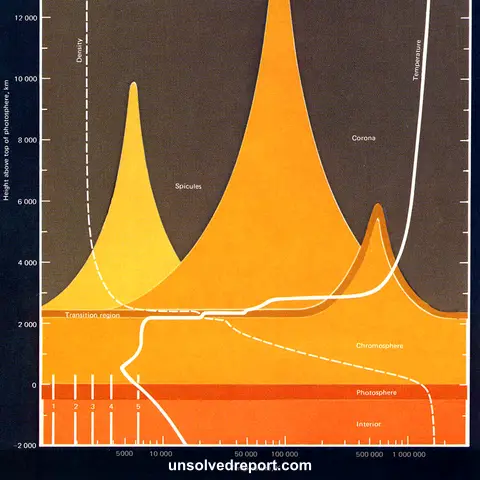
The Sun's surface is 10,000°F. Its corona hits 2 million. Walk away from a fire, get colder — unless it's the Sun. Scientists still can't fully explain why.
Galactic Center Gamma-Ray Excess: Dark Matter or 35,000 Dead Stars?
A real gamma-ray glow at the Milky Way's core has survived 15 years of scrutiny. Dark matter or dead stars? A 2026 AI analysis just reopened the case.